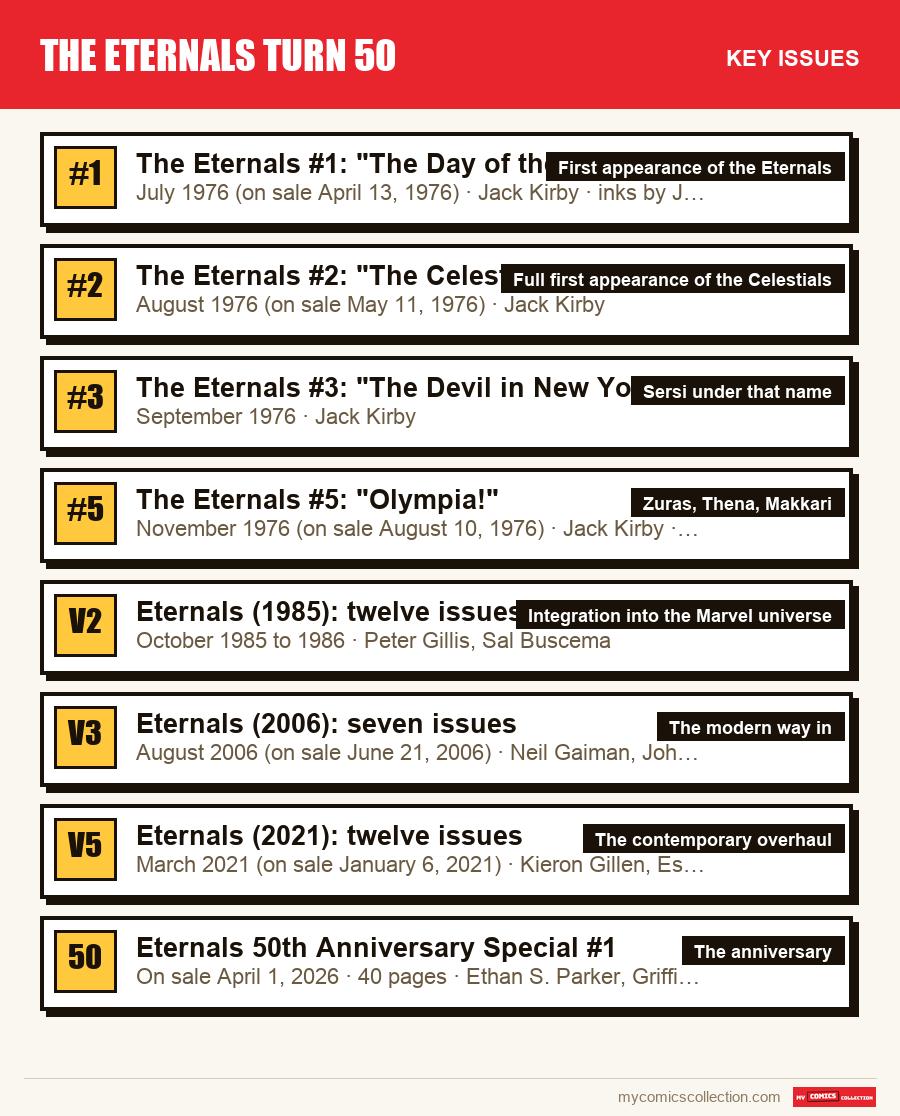
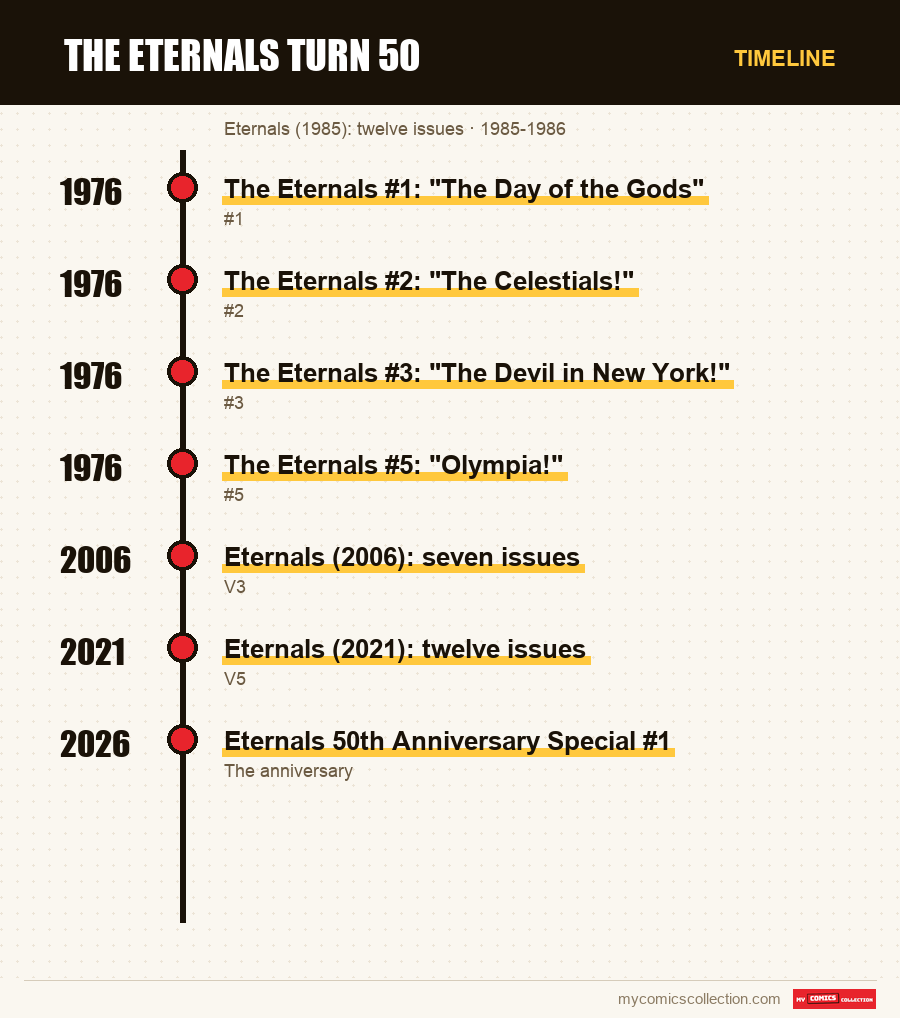
The Eternals were born in The Eternals #1, dated July 1976 and on sale April 13, 1976, written and drawn by Jack Kirby. The original series has 19 issues and one annual (1976-1978). The key issues are #1 (Eternals, Ikaris, Deviants), #2 (full first appearance of the Celestials, including Arishem, and of Ajak), #3 (Sersi under that name) and #5 (Zuras, Thena, Makkari, Olympia). Four relaunches follow: 1985 (Peter Gillis and Sal Buscema, Phastos in #1), 2006 (Neil Gaiman and John Romita Jr.), 2008, then 2021 (Kieron Gillen and Esad Ribić). For the 50th anniversary, Marvel published on 04/01/2026 a 40-page anniversary special centered on Ikaris and Captain America. In a collection, #1 and #2 from 1976 remain the two centerpieces.
Fifty years ago, Jack Kirby came back to Marvel with an idea he had carried for a long time: a race of immortal beings, created by cosmic giants, who would have inspired the gods and monsters of all human mythologies. The series that came out of it, The Eternals, lasts only nineteen issues. It nevertheless gave Marvel one of its most durable cosmologies, that of the Celestials, which today structures a good part of the publisher's universe.
This guide follows the issues that matter, from the first 1976 issue to the April 2026 anniversary special. It does not tell the story of one particular character, nor of the film adaptation: it maps the franchise's key issues, and indicates which deserve a place in a collection.
The 1976 context: Kirby returns with a whole world
Kirby had left Marvel in the early 1970s for DC, where he created the Fourth World, a saga of new gods cut short before its end. Back at Marvel in 1975, he got to launch series entirely his own. The Eternals is the most ambitious of them: Kirby writes, draws and handles the editorial direction of his title.
The concept rests on three peoples. The Celestials, armored giants from space, experimented on the first humans a million years ago. They created two lineages: the Eternals, immortal and beautiful, and the Deviants, unstable and monstrous. Ordinary humanity is the third branch. The Celestials are now returning to judge their experiment, and the Eternals and Deviants alike are preparing.
Kirby deliberately sets this story alongside the Marvel universe, not inside it. Superheroes almost do not appear in it. It is one of the reasons the series sold little at the time, and one of the reasons its ideas have aged so well: they were not attached to any continuity.
The key issues of Kirby's series (1976-1978)
The Eternals #1: "The Day of the Gods"
The founding issue. It introduces the Eternals as a concept, as well as Ikaris, the archaeologist Margo Damian, the Deviant Tode and the Celestials' ship. It is the issue the market associates with the whole franchise, and the first one every Eternals collector looks for.
The Eternals #2: "The Celestials!"
This is where the Celestials fully appear, with Arishem the Judge, the Celestial who presides over their judgment of Earth, and the Eternal Ajak, who communicates with them. The ship in #1 announced the Celestials; #2 shows them. In the long run, it is probably the most important issue of the series for the Marvel universe: the Celestials have become one of the publisher's great cosmic powers.
The Eternals #3: "The Devil in New York!"
Sersi appears for the first time under that name, spelled "Sersy" in the issue. Marvel later retroactively identified her with a Circe who appeared much earlier, which complicates her status as a "first appearance." The issue also introduces several Deviants.
The Eternals #5: "Olympia!"
The issue that populates the series. It introduces Zuras, leader of the Eternals, his daughter Thena, the speedster Makkari, as well as the city of Olympia, their refuge. It is the issue that turns an exploration story into a saga of a divine family.
Other issues round out the series. #4 introduces Gammenon the Gatherer, another Celestial. #7 (January 1977) presents the Celestial called One Above All, leader of the fourth celestial host. #8 introduces the Deviants Karkas and Ransak. Annual #1 (August 1977) adds a complete story. The series stops at #19, dated January 1978, without Kirby having been able to conclude all his threads.
| Issue | Cover date | What it brings |
|---|---|---|
| #1 | July 1976 | The Eternals, Ikaris, Margo Damian, Tode |
| #2 | August 1976 | The Celestials in full, Arishem, Ajak |
| #3 | September 1976 | Sersi under that name |
| #4 | October 1976 | Gammenon |
| #5 | November 1976 | Zuras, Thena, Makkari, Domo, Olympia |
| #7 | January 1977 | One Above All |
| #8 | February 1977 | Karkas, Ransak |
| Annual #1 | August 1977 | Complete story |
| #19 | January 1978 | Kirby's last issue |
The relaunches: four readings of the same idea
After Kirby, Marvel relaunched the series four times, each with a different approach. None of these relaunches has the historical value of 1976, but each added something to the franchise.
Eternals (1985): twelve issues
This miniseries frankly ties the Eternals to the rest of the Marvel universe. #1 introduces several characters, including Phastos, the inventor Eternal who has gained importance in recent stories and in film.
Eternals (2006): seven issues
Gaiman takes the concept up from scratch: the Eternals have forgotten who they are and live as ordinary humans. Ikaris must wake them one by one. It is the best read for discovering the franchise without having read Kirby, and a handsome object thanks to Romita Jr.'s art.
A nine-issue series follows in 2008, drawn by Daniel Acuña, which extends the status quo set up by Gaiman. It is less well known and easy to find.
Eternals (2021): twelve issues
Gillen sets a simple and cruel rule: each time an Eternal is resurrected, a human life is taken to pay for it. He puts Thanos, Eternal of Titan, back at the center of the stakes. The series is accompanied by several one-shots (Thanos Rises, Celestia, The Heretic) and leads into the 2022 event A.X.E.: Judgment Day.
The kinship between Kirby's Eternals and those of Titan, the lineage of Thanos, did not exist in 1976: Thanos had appeared three years earlier in another series, and it is later continuity that brought the two branches together. For the collector, this means Thanos issues are not Eternals issues, even though recent stories mix them.
The 50th anniversary special (April 1, 2026)
Eternals 50th Anniversary Special #1
Marvel marked the fiftieth anniversary of Kirby's concept with a 40-page one-shot. Its main story brings together Ikaris and Captain America, with flashbacks to Deviants and World War II Hydra. It is a one-off tribute, not the first issue of a regular series.
What to collect first
The 1976 #1 and #2
These are the two centerpieces. #1 for the birth of the Eternals and Ikaris, #2 for the Celestials. If you can only keep two, these are the ones.
#3 and #5
They complete the core of characters: Sersi, Zuras, Thena, Makkari. They generally remain more accessible than the first two, and give a coherent collection of the foundations.
Kirby's complete series
Nineteen issues and an annual is a short run. Completing it in uniform condition is a goal within reach of most collectors, and it is the fairest way to honor Kirby's work.
The relaunches for reading
The 2006 and 2021 series read well in collected form. Their first issues, and the 1985 #1 for Phastos, add reference points without much expense.
The 2021 film brought attention back to the franchise, with an uneven effect depending on the characters. Our article The Eternals, the film versus the comics details the gaps between the screen and the issues cited here.