Jack Kirby (born Jacob Kurtzberg in New York on August 28, 1917, died February 6, 1994) is the most prolific artist and co-creator in the history of superhero comics. With Joe Simon, he creates Captain America in 1941. With Stan Lee, starting from Fantastic Four #1 (1961), he co-creates the bulk of the modern Marvel universe: the Fantastic Four, Hulk, Thor, the X-Men, the Avengers, Silver Surfer, Galactus, Black Panther. Having left for DC in 1970, he invents the Fourth World and Darkseid there. Back at Marvel in the mid-1970s, he creates the Eternals (1976). In between, he also launched with Simon the romance comics genre, in 1947. His style, made of energy, forced perspective and cosmic machines, remains the basic grammar of the genre.
It is often said that Jack Kirby invented half of Marvel. It is a formula, and like all formulas it simplifies: Kirby worked with writers, inkers, editors, and the exact share of each in the 1960s creations has been the subject of decades of debate. But the formula is not false for all that. When you open a superhero comic published today, a considerable share of the characters, settings and ways of drawing a fight comes from him.
This article tells his career in order, from the studios of the 1930s to the last series of the 1980s, with for each period what it left to readers and collectors. It is not a list of market values: it is about understanding why so many key issues carry the same signature.
The beginnings: a child of the Lower East Side
Jacob Kurtzberg is born on August 28, 1917 in Manhattan's Lower East Side, to a family of Jewish immigrants from Austria. The neighborhood is poor, street fights are part of daily life, and Kirby would later say his fight scenes come from there: from the physical experience of the blow received and returned, not from observing a model.
He learns to draw almost on his own, copying newspaper comic strips, and enters in the late 1930s the world of the studios that supply pages on an assembly line to the young comic book publishers. He works there under several pseudonyms before adopting the one that will stay: Jack Kirby.
Simon and Kirby: Captain America and the Golden Age
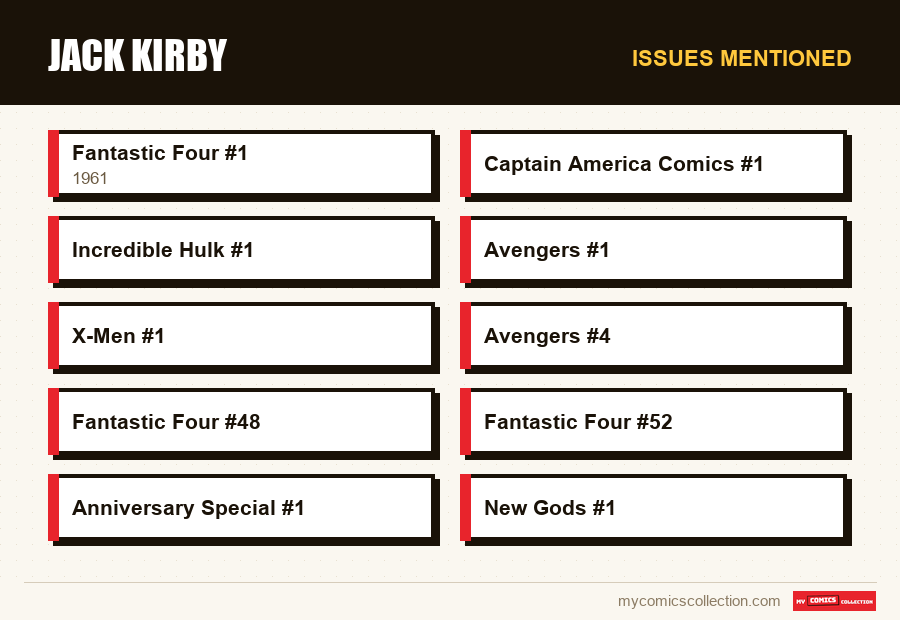
The decisive meeting is with Joe Simon, writer, artist and above all organizer. The two men form one of the first great duos in the medium's history, and their most famous creation arrives at the end of 1940: Captain America Comics #1, dated March 1941, for the publisher Timely, the ancestor of Marvel. The cover shows Captain America punching Hitler in the face, several months before the United States enters the war. It is a political gesture as much as an editorial stroke. The page for Captain America Comics #1 details this issue.
The duo leaves Timely after about ten issues, following a dispute over rights, and goes to National, the ancestor of DC. There they launch series of kid groups like the Boy Commandos and the Newsboy Legion, and take over the Sandman of the era. Then the war interrupts everything: Kirby is drafted and serves in Europe in 1944, in the infantry. This experience will later feed his war stories, notably Sgt. Fury.
The postwar years: inventing genres
It is often forgotten, but Kirby's contribution in the 1940s and 1950s is not limited to superheroes, whose fashion fades after the war. With Simon, he launches in 1947 Young Romance, generally considered the first romance comic book. The genre becomes one of the best sellers of the decade. The duo also touches crime, horror, western, and even founds its own publishing house in the mid-1950s.
This period ends badly. The campaign against comics and the adoption of the Comics Code in 1954 make sales fall across the whole sector, Simon and Kirby's company does not survive, and the two men part ways. Kirby then works freelance for several publishers, including National, for whom he creates the Challengers of the Unknown in 1957, a team of adventurers that in many ways foreshadows the Fantastic Four.
The return to Atlas: monsters and transition
In the late 1950s, Kirby returns to the publisher that will become Marvel, then called Atlas, at a moment when the house is at its lowest. There he draws giant monster stories for anthologies like Strange Tales or Tales to Astonish, scripted by Stan Lee. These stories, often mocked, are a laboratory: Kirby learns there to give scale, weight and menace to impossible creatures. Galactus and the great cosmic monsters of the 1960s come from there.
1961-1970: the Marvel universe
In 1961 comes out Fantastic Four #1, dated November. The story is written by Stan Lee and drawn by Kirby, following a working method that will become the "Marvel method": a discussed synopsis, pages drawn by the artist who builds the plot page by page, then dialogue added by the writer. This method is at the heart of all the discussions about each man's share. What is certain is that the decade that follows is of unheard-of productivity.
Fantastic Four #1
A family of heroes who quarrel, have no secret identity and live in New York rather than in an imaginary city. Kirby will draw the series without interruption until #102, in 1970, a longevity with no equivalent for an artist at this level. See the page for Fantastic Four #1 and our Fantastic Four reading guide.
The creations pile up. The Incredible Hulk #1 in 1962. Thor in Journey into Mystery the same year. The Avengers #1 and The X-Men #1 in 1963, the same year as Sgt. Fury. The return of Captain America in Avengers #4, in 1964. The Inhumans, then, in 1966, the Galactus trilogy in Fantastic Four #48 to #50, with the arrival of the Silver Surfer, whom Kirby added on his own initiative according to most accounts. The same year, Fantastic Four #52 introduces Black Panther, the first Black superhero of a major American publisher.
To place these issues in a collection, see the pages for Incredible Hulk #1, X-Men #1, Fantastic Four #48 and Fantastic Four #52. Kirby's role in creating Black Panther is developed in our article on the major Black Panther artists.
In those years, Kirby's style changes. His characters become more massive, his machines more abstract, his pages more exploded. He introduces photographic collages in some cosmic sequences. What is now called the "Kirby crackle," those fields of black dots that represent energy, becomes a signature recognizable above all others.
1970: the departure and the Fourth World
In the late 1960s, Kirby is frustrated: he feels he is not getting the credit or the pay that correspond to his contribution, and he wants to keep control of his new ideas. In 1970, he leaves Marvel for DC. His last regular issue of Fantastic Four is #102.
At DC, he launches a project with no equivalent: a cosmic saga spread across four series, which will be called the Fourth World. He begins by taking over Superman's Pal Jimmy Olsen, a series nobody wanted, from #133, dated October 1970. Darkseid makes a fleeting first appearance in the following issue. Then come The New Gods, The Forever People and Mister Miracle, in 1971.
The Fourth World tells the war between two divine planets, New Genesis and Apokolips, and its villain, Darkseid, will become one of the major figures of the DC universe. Our article on Darkseid's key issues takes stock of his first appearances. Commercially, the saga is not a sufficient success, and the series are stopped after about two years, before the planned conclusion. Kirby follows with other creations at DC: Kamandi, The Demon, OMAC.
1975-1978: the return to Marvel and the Eternals
In the mid-1970s, Kirby returns to Marvel, this time with greater creative freedom. He writes and draws Captain America, adapts 2001: A Space Odyssey, creates Machine Man and Devil Dinosaur, and takes over Black Panther. His major creation of the period is The Eternals, whose #1 is dated July 1976: a race of quasi-divine beings created by cosmic giants, the Celestials, which takes up certain ideas of the Fourth World in another setting.
This work had a second life well after its publication. It was adapted for film in 2021, which we compared to the comic in our article Eternals, the film versus the comics, and Marvel celebrated its fiftieth anniversary with Eternals 50th Anniversary Special #1, released on April 1st, 2026.
The last years: animation, independents and recognition
In the late 1970s, Kirby leaves major-publisher comics for animation, where he designs characters and sets for television series. He then returns to comic books at small independent publishers, in the early 1980s, with series like Captain Victory, whose rights he keeps, a novelty for him.
The mid-1980s are marked by a public conflict with Marvel over the return of his original pages, held by the publisher since the 1960s. The affair mobilizes many creators and readers in his favor, and part of his pages is finally returned to him. Kirby dies on February 6, 1994, in California. In 2014, his heirs and Marvel announce an agreement ending a long dispute over the rights to his creations, without its terms being made public.
What Kirby's style changed
Kirby's graphic contribution can be summed up in three ideas. The first is energy: his characters do not pose, they move, often toward the reader, with fists enlarged by perspective. The second is scale: he is the first to give cosmic threats a size that crushes the page, and Galactus is the perfect example, as our history of Galactus recalls. The third is the machine: his armors, ships and invented devices resemble no real technology, and this imaginary design has fed decades of science fiction in images.
Later generations built themselves with or against this style. Many artists of the 1970s began by imitating it, at the publishers' request. And even today, when a series wants to signal that it is reconnecting with grand cosmic spectacle, it cites Kirby.
Collecting Kirby: where to start
Choose a period
The Golden Age with Simon, the Marvel years from 1961 to 1970, the Fourth World, or the return of the 1970s. Each forms a coherent collection, with very different budget levels.
Start with the long series
The mid-run issues of Fantastic Four or Thor drawn by Kirby remain more accessible than the #1s, and offer the same reading pleasure.
Check the credits
Kirby often drew covers of issues whose interior he did not draw. A Kirby cover does not make a Kirby issue.
Read in parallel
Complete reprints let you read the great sagas without handling fragile single issues. Keep those for the collection.