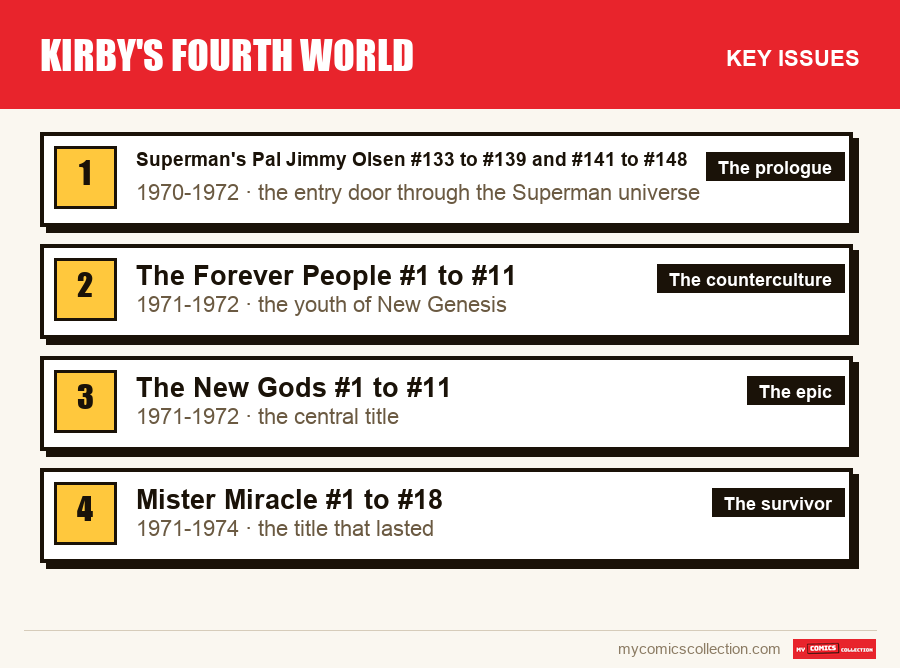
Jack Kirby's Fourth World is made up of four DC titles published from 1970 to 1973, that is 55 issues signed by Kirby: Superman's Pal Jimmy Olsen #133 to #139 and #141 to #148, The Forever People #1 to #11, The New Gods #1 to #11 and Mister Miracle #1 to #18. The recommended reading order is release order, interleaving the four series month by month, starting with Jimmy Olsen #133 (October 1970) then the number 1s of Forever People and New Gods, followed by Mister Miracle #1. Kirby adds two late conclusions: "Even Gods Must Die," an unpublished story run in New Gods #6 (1984), and the graphic novel The Hunger Dogs (1985). The four volumes of DC's omnibus follow exactly this release order.
The Fourth World is one of the most ambitious works in the history of superhero comics, and one of the most misread. Misread because it does not exist as a single title: Kirby spread it over four monthly or bimonthly series, one of which, Jimmy Olsen, was not even his at the start. A reader who reads the eleven issues of New Gods in one go, then moves on to Mister Miracle, misses part of the echoes Kirby had built from one title to another.
This guide does not redo the history of Darkseid, which the site covers in his key issues. It answers a practical question: in what order to read the whole saga, with which editions, and which issues to keep if you also want period single issues.
Kirby's project: a finite saga, designed for the book
In 1970, Jack Kirby leaves Marvel, where he co-created the Fantastic Four, Thor and a good part of the house universe, and joins DC. He arrives with an idea that cuts against the habits of the time: a long but finite saga, published as a serial then gathered in volumes. Kirby sensed that newsstand distribution was going to decline and that comics would have to find other sales circuits. He therefore imagined a story that could live in bookstores, like a novel.
The heart of the story is a war between two twin planets born from the death of the old gods: New Genesis, luminous, ruled by Highfather, and Apokolips, a factory-world run by Darkseid. Darkseid seeks the Anti-Life Equation, which would let him control every will. The two rulers have exchanged their sons to seal a truce: Orion, Darkseid's son, grew up on New Genesis; Scott Free, Highfather's son, grew up in the orphanages of Apokolips before escaping to Earth and becoming Mister Miracle, the escape artist. Everything else flows from this exchange.
The name "Fourth World" only appears in the series starting with the August and September 1971 issues of New Gods and Forever People. Kirby himself gave several explanations of it over the years, according to his assistant of the time, Mark Evanier: it is better taken as a label than as a key.
The four titles, and what each brings
Superman's Pal Jimmy Olsen #133 to #139 and #141 to #148
Kirby takes over an existing series, devoted to the young photographer friend of Superman, and turns it into a laboratory. He relaunches the Newsboy Legion there, introduces the Project Cadmus, and brings out the first signs of the threat from Apokolips, Darkseid included, who shows himself briefly as early as #134. These issues are lighter, more whimsical than the rest, but they establish the link between the saga and the established DC universe.
The Forever People #1 to #11
Five young people from New Genesis arrive on Earth aboard their Super-Cycle. The title is Kirby's answer, as a man in his fifties, to the youth of the late 1960s: idealistic, communal, curious. It is also in this title that Darkseid makes his first real appearance, and that part of the quest for the Anti-Life Equation plays out.
The New Gods #1 to #11
Orion, a warrior of New Genesis gnawed by his nature as a child of Apokolips, carries the most mythological story of the four. It is there that Kirby develops the truce, the exchange of sons, the Source, and the war that must set father against son. #1 is dated March 1971.
Mister Miracle #1 to #18
Scott Free, escaped from Apokolips, becomes an escape artist on Earth, accompanied by Big Barda and little Oberon. The title mixes spectacular escape issues and reminders of the childhood spent in Granny Goodness's orphanages. It is the only one of the four to survive the 1972 stop, and Kirby leads it up to #18 with the marriage of Scott and Barda, a personal conclusion in lieu of the overall one.
The recommended reading order: release order
Kirby wrote and drew the four titles in parallel, and had them answer each other. Reading them in release order, interleaving the series, is therefore the most faithful way to follow the saga. It is also the order adopted by the four omnibus volumes DC published in 2007 and 2008, which simplifies the reader's life a lot.
The prologue
Jimmy Olsen #133 (October 1970) to #139. Kirby sets the tone, the Newsboy Legion, and Darkseid's first agents. You can read these issues quickly, but do not skip them: several elements reappear later.
The three launches
Forever People #1 and New Gods #1, both dated early 1971, then Mister Miracle #1. Then alternate: one issue of each series, in cover date order, slipping in Jimmy Olsen #141 to #148 as they were released.
The 1972 stop
New Gods and Forever People stop at #11. Mister Miracle continues alone: read its remaining issues up to #18, which serves as a provisional endpoint.
The late conclusions
"Even Gods Must Die," an unpublished Kirby story published in 1984 in #6 of the New Gods reissue, then the graphic novel The Hunger Dogs, published in 1985 in the DC Graphic Novel line (#4). It is the ending Kirby was able to write, under editorial constraints.
Concretely, the omnibuses are divided as follows. The first contains Forever People #1 to #3, Mister Miracle #1 to #3, New Gods #1 to #3 and Jimmy Olsen #133 to #139. The second continues with issues 4 to 6 of each series and Jimmy Olsen #141 to #145. The third gathers Forever People #7 to #10, Mister Miracle #7 to #9, New Gods #7 to #10 and Jimmy Olsen #146 to #148. The fourth closes with Forever People #11, Mister Miracle #10 to #18, New Gods #11, "Even Gods Must Die" and The Hunger Dogs.
The other possible order: title by title
Some readers prefer to follow each series in one block. The advantage is consistency of tone: Forever People and Mister Miracle do not have the same register as New Gods, and reading them separately avoids breaks. The drawback is real: several events are announced in one title and shown in another, and the tension builds less well.
If you choose this route, the most logical order is Jimmy Olsen, then New Gods, then Forever People, then Mister Miracle, and finally the two conclusions. New Gods in second position gives the mythological keys straight away; Mister Miracle last lets you finish on the title that lasted longest.
What to know about the ending
The Fourth World never received the conclusion Kirby had imagined in 1970. DC stops New Gods and Forever People in 1972, for lack of sufficient sales. Several leads have been put forward to explain this failure, from distribution to editorial choices; they have never been the subject of a consensus, and this guide does not settle it.
In 1984, DC reissues the eleven issues of New Gods as a six-issue miniseries, two episodes per issue, and asks Kirby for an ending for the last one. The story he delivers, "Even Gods Must Die," is inserted in this #6. Kirby also draws from it The Hunger Dogs, published in 1985, which was supposed to serve as a conclusion while leaving the characters available to other writers: an editorial compromise you can feel in reading. At the same period, Kirby draws the two Super Powers miniseries, tied to a toy line, where he keeps Darkseid and his henchmen alive.
In the meantime, in 1976 and 1977, other writers had relaunched New Gods by resuming the numbering at #12. These issues are not by Kirby and are not part of the original saga: do not confuse them with the 1971 series.
The issues to keep if you collect
The market for period single issues concentrates on a few issues, for reasons of first appearances more than reading quality.
Jimmy Olsen #134 is sought after for Darkseid's first, brief appearance; Forever People #1 for his first full appearance. These two issues are covered in detail in our article on Darkseid's key issues. New Gods #1, first Orion, and Mister Miracle #1, first Scott Free, are the two other pillars, followed by Mister Miracle #4, first appearance of Big Barda, and Jimmy Olsen #133, Kirby's first issue at DC.
For the rest, the ordinary issues of these series remain accessible. The 1970 to 1974 single issues have often suffered: yellowed paper, marked spines, worn corners. Condition therefore makes most of the difference between two copies of the same issue. No price is given here; for a specific copy, the free estimate starts from its real condition.
Which edition to choose for reading
Three families of editions coexist. DC's omnibuses, in four hardcover volumes then in softcover, are the most complete solution, in color and in release order. The old softcover reissues of the early 2000s presented the series in black and white, except for the Jimmy Olsen issues: they are cheaper but less faithful to the original object. Finally, a large-format edition began in 2020 to take up the saga again, with a first volume running from the beginnings to #6 of each series.
For a first contact, the softcover omnibus remains the best ratio between completeness and comfort. For a collection of single issues, start from the key issues above, then complete series by series, beginning with the one you prefer to read.
Why read the Fourth World today
First because it is the source of a large part of DC's cosmic mythology: Darkseid, Apokolips, the Boom Tubes, the Source and the Anti-Life Equation have been taken up by dozens of writers, up to recent crossovers. Next because Kirby's art reaches there an excess he had not always been able to afford at Marvel: photographic collages, impossible machines, saturated double pages. Finally because the saga remains the work of a single creator, written and drawn by one man, with its clumsiness and its sincerity. You read it as you visit an unfinished monument: knowing the top floor is missing, and understanding why so many others wanted to build it. The Superman hub recalls in passing the role of his universe as the saga's entry door.