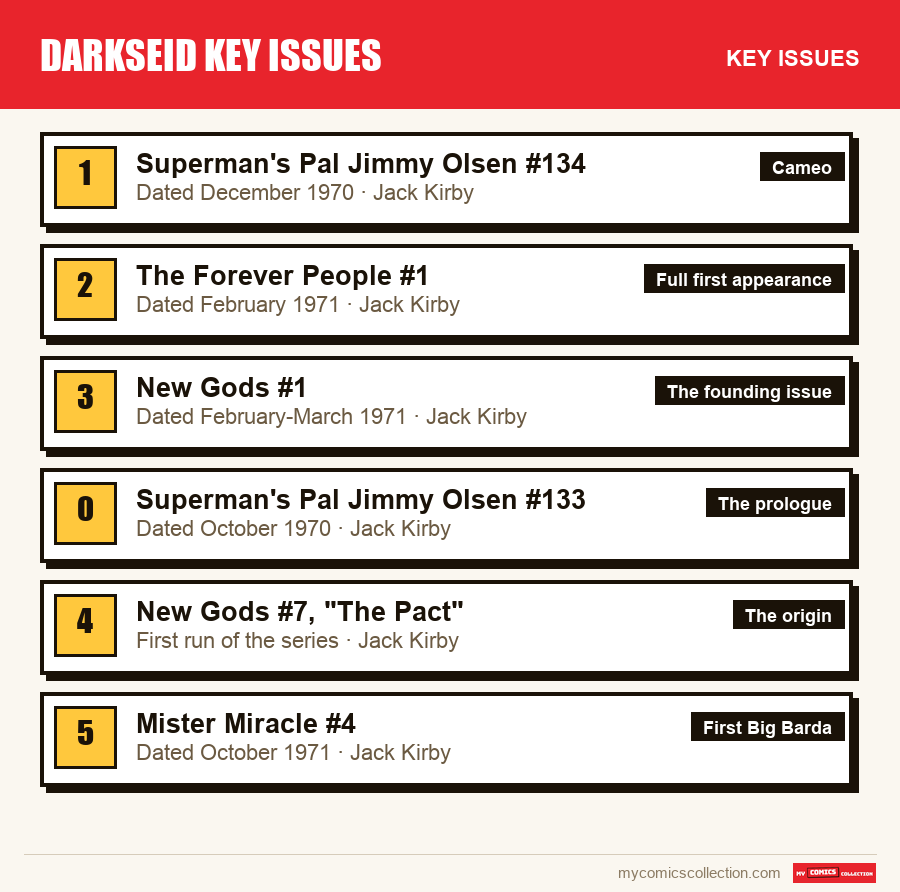
Darkseid is a creation of Jack Kirby, and his key issues come down first to a hierarchy that many buyers confuse. The character appears in a cameo in Superman's Pal Jimmy Olsen #134, dated December 1970, then is fully introduced in The Forever People #1, dated February 1971. New Gods #1, dated February-March 1971, is neither: it is the founding issue of the title that carries the mythology, with the debuts of Orion, Highfather and Metron. Three different issues, three different statuses, and a considerable scarcity gap between them. Next come New Gods #7, which gives the character's origin, then four major confrontations spread from 1982 to 2016. This article sets that hierarchy straight before you pay for the wrong issue.
There are characters whose key issues boil down to one line. Darkseid is not one of them, and it is not a matter of volume: it is a matter of editorial construction. Kirby did not launch him in a single title, he launched him in a four-title setup, seeding the character in a series that was not his own before installing him in the ones he had just created. The result, fifty-five years later, is a staircase of "first" appearances where every step sells, and where the steps are not worth the same.
This staircase explains why Darkseid produces more buying errors than most of his contemporaries. Anyone looking for "Darkseid's first appearance" lands on at least three issues presented as such, all dated winter 1970-1971, all genuinely tied to the character. No seller is necessarily lying: they are not talking about the same object.
The subject is back in the news, moreover: DC is publishing on October 28, 2026 a 48-page issue titled DC All In Saga: Darkseid vs. The World #1, written by Scott Snyder and Joshua Williamson, drawn by Sanford Greene. An event issue on an old character always wakes up demand for his back catalog. Better to know what you are touching before it arrives.
The three issues that will be presented to you as "the first appearance"
Let us start with the point that costs the most, and treat it in real chronological order.
Superman's Pal Jimmy Olsen #134
This is the issue that carries priority, and it is also the one that shows the least. Darkseid makes a cameo appearance in a series devoted to the Daily Planet photographer that Kirby had just taken over. The choice of vehicle is not incidental: Kirby had a title already in place, with its readership, and he used it as a launch pad for a mythology that did not yet have an issue of its own.
The Forever People #1
This is where Darkseid is fully introduced, and it is the issue most catalogs list as the full first appearance. It introduces at the same time the group that gives the series its title. Only two months separate it from the cameo, which explains why both circulate side by side under the same commercial label.
New Gods #1
This one is neither the cameo nor the full appearance, and yet it is often the most expensive of the three. Its importance comes from elsewhere: New Gods #1 founds the central title of the mythology and contains the debuts of Orion, Highfather and Metron. It is the issue you buy for the Fourth World, not for Darkseid. The two motivations blur on the shelf, because the character has become the emblem of the whole.
Superman's Pal Jimmy Olsen #133
It may be offered to you in the same conversation, and it deserves a place of its own. This is the issue by which Kirby takes over the series, two months before the cameo. Darkseid is not in it. What is in it is the change of regime: the Project Cadmus, the return of the Newsboy Legion and the Guardian, and a deliberate break in style. Kirby will stay on the title until issue 148, dated April 1972.
Why this hierarchy goes off the rails more than for other characters
The distinction between partial and full appearance is an ordinary cataloging tool, and we have detailed it elsewhere regarding a famous 1992 case in our article on the gap between cameo and full appearance. On Darkseid, four factors accumulate and turn a useful tool into slippery ground.
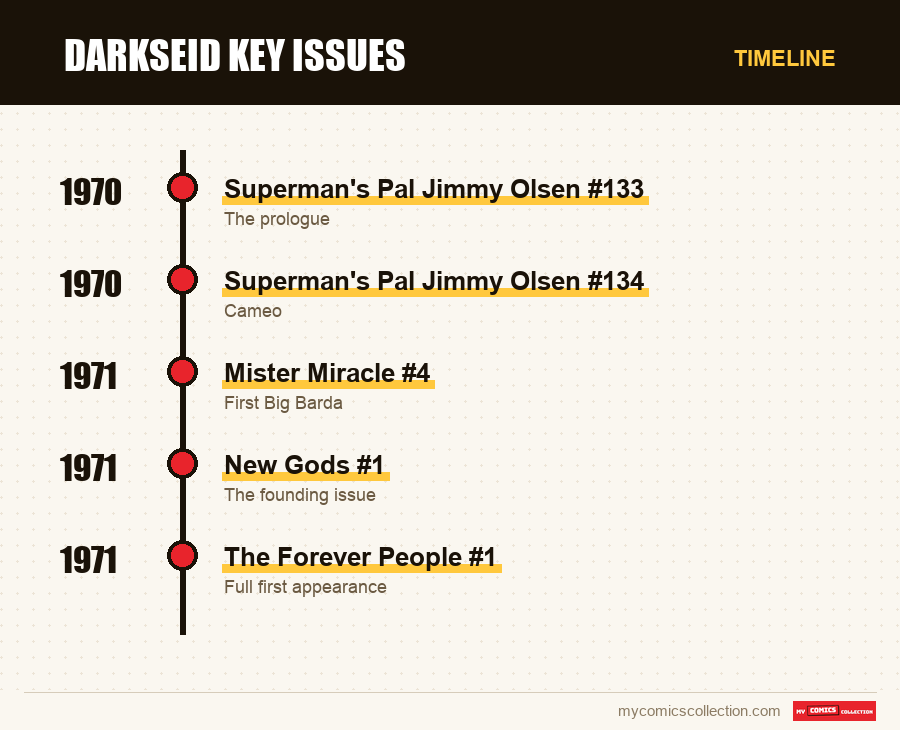
First factor: the three issues are almost simultaneous. December 1970, February 1971, February-March 1971. When two candidates are separated by two years, priority is visible to the naked eye. Here, the cover dates overlap to the point that the actual order of release is not obvious.
Second factor: the three issues are different titles. It is not a series that gradually introduces its antagonist, it is a creator building a universe in parallel across several vehicles. A buyer who applies the rule "the oldest issue of the series is the right one" is mechanically wrong, since there is no single series.
Third factor: the most desired issue is not the character's. Elsewhere, the sought-after issue and the appearance issue coincide. Here, New Gods #1 attracts attention for its founding value and for three other characters, which shifts the market's center of gravity away from the real first appearance.
Fourth factor: the character has a second editorial career. He was reintroduced in the 2011 continuity, where he is hinted at from Justice League (vol. 2) #1, dated November 2011, before appearing in issue 3 and fighting the team in issue 6. These modern issues sometimes circulate as "first appearances", with a qualifier in small print: the qualifier is accurate, the overall impression is misleading.
The practical consequence is simple: on this character, a listing's label is never enough. You have to read the title, the number and the cover date, and match them against the hierarchy above before comparing two offers. This is the kind of check that issue-by-issue tracking makes automatic, since it forces you to record the number and not the heading.
The Fourth World, mapped
To understand Darkseid's key issues, you need the map of the setup in which he was born. Kirby built four simultaneous fronts, and knowing which one stopped where matters: these stops explain why some collections look gapped when they are complete.
- Superman's Pal Jimmy Olsen, taken over at issue 133 dated October 1970, left at issue 148 dated April 1972. It is the entry point, not the heart.
- The Forever People, launched with issue 1 dated February 1971, stopped at issue 11. The title that carries Darkseid's full appearance.
- New Gods, launched with issue 1 dated February-March 1971, stopped at issue 11 dated October-November 1972. The central title.
- Mister Miracle, launched with issue 1 dated April 1971, which introduces Scott Free. It is the title that lasted longest, with 18 issues, where the other two stopped at eleven.
Two issues of this set deserve to be flagged separately, for reasons of content and not of scarcity.
New Gods #7, "The Pact"
This is the issue that lays out the genealogy of the New Gods and the pact from which the title takes its name. It has been read as a creation myth in comics, and as a statement on the moral cost of war, in a context where the Vietnam War was in the immediate background of all American fiction. For a collector, it is the character's origin issue, a category with its own demand, distinct from that of first appearances.
Mister Miracle #4
It is not a Darkseid issue, and yet it appears in every serious Fourth World collection: it is the first appearance of Big Barda. On a set this scattered, secondary first appearances make the difference between a collection of isolated pieces and a coherent collection.
The New Gods title then returned at regular intervals: a second series in July 1977, stopped at issue 19 dated July-August 1978; a third from February 1989 to August 1991, over 28 issues; a fourth from October 1995 to February 1997; a fifth since December 2024. A very concrete consequence on the shelf: there are several New Gods number 1s, and a distracted buyer can come home with the 1989 one believing they hold the 1971 one.
The major confrontations, and what they are worth for a collection
Darkseid is one of the few antagonists whose bibliography reads as a series of confrontations rather than a run. Four milestones structure this history, spread over more than thirty years.
The Great Darkness Saga, August to December 1982
Published in Legion of Super-Heroes (vol. 2) #290 to #294, written by Paul Levitz and drawn by Keith Giffen, inked by Larry Mahlstedt. The antagonist stays in the shadows for most of the story, designated as a "master" whose identity is the very revelation of the story, and he unveils himself by remaking an entire planet in his image. It is the story that established Darkseid as a universe-scale threat in the DC universe, outside Kirby's framework.
Cosmic Odyssey, December 1988 to March 1989
Four 48-page prestige-format issues, written by Jim Starlin and drawn by Mike Mignola. The plot revolves around the Anti-Life Equation, and the configuration is unusual: New Genesis and Apokolips ally, with Darkseid cooperating with Earth's heroes against a greater threat. It is also a Mignola milestone before Hellboy.
Final Crisis, May 2008 to January 2009
Seven oversized issues by Grant Morrison, drawn mainly by J. G. Jones, with help from Carlos Pacheco, Marco Rudy and Doug Mahnke because of delays. It is the story where the Anti-Life Equation spreads through communication networks and enslaves nearly the entire Earth population. Darkseid is treated there not as a conqueror but as an idea that propagates, which makes it the tipping point of the modern reading of the character. The editorial context of this period is detailed in our overview of the major DC crossovers.
The Darkseid War, in 2015 and 2016
Published in Justice League (vol. 2) #40 to #50, by Geoff Johns and Jason Fabok. Darkseid faces the Anti-Monitor there, that is, the antagonist of Crisis on Infinite Earths, and the outcome lastingly redistributes positions on Apokolips. It is the character's last big arc before the current period, and the most accessible of the four for a reader just starting out, because it is recent and complete in a single title.
A fifth title deserves mention, though it is not a confrontation: the 2017 Mister Miracle series, twelve issues by Tom King and Mitch Gerads, 2019 Eisner Award for best limited series. It takes up Kirby's material through an intimate angle, and it gave the whole Fourth World renewed visibility among a readership that had never opened a 1971 issue. On an old corpus, it is generally a modern work of this type that reactivates demand on the sources.
What October 28, 2026 changes, and what it does not
The issue announced for October 28, 2026, DC All In Saga: Darkseid vs. The World #1, is 48 pages long. It is written by Scott Snyder and Joshua Williamson and drawn by Sanford Greene. Three pieces of context deserve to be laid out before drawing any conclusion.
The date is loaded. October 28, 2026 is also the day of Justice League: Dark Realm Special #1, Absolute Wonder Woman #25 and Absolute Batman #25. A Wednesday that concentrates four notable releases from the same publisher is not neutral for an in-store buyer: budgets get split, and shops' orders arbitrate. Our DC 2026 calendar places this Wednesday in the full sequence.
The publisher's relative weight is real but poorly cited. On the register report for the week of September 22 to 28, 2026, covering more than 600 equipped specialty stores, DC accounts for 41.29 percent of recorded sales and Marvel 28.62 percent, with six DC titles in the top ten. It is a weekly report from a sample of points of sale, not a monthly or annual market share, which does not exist publicly for 2026: writing that DC holds 41 percent of the market would be false.
A modern event issue is not a key issue. It is the costliest confusion of the moment. A 48-page issue printed for a mass release, with star teams, is a good purchase for reading. It becomes key only if it introduces something that will last, and that cannot be known on release day. The mechanism is detailed in our explanation of print runs and what they say about future scarcity.
What is predictable, however, is the attention effect. When a publisher devotes an event issue to an old character, listings for his 1970 and 1971 issues multiply, and the quality of the titles degrades as occasional sellers enter the niche. This is where the hierarchy at the start of this article really serves, and where an estimate of what you already own is worth more than a decision made in a hurry.
How to build a coherent Darkseid collection
Three trajectories exist, and they do not mix well. Choosing first avoids spending twice.
The first-appearance trajectory. It targets the December 1970 cameo and the February 1971 full appearance, incidentally New Gods #1. It is the most demanding and the most condition-sensitive: these issues have the paper of their era, and the gap between a read copy and a preserved copy dominates everything else. The question of grading therefore arises from the purchase, as our guide on CGC grading explains.
The corpus trajectory. It gathers the Fourth World as a readable whole: the four fronts, their founding issues, New Gods #7, Mister Miracle #4. Cheaper per piece, longer to complete, it is the most interesting to read, and the one where tracking is most necessary: about thirty issues across four titles and two years.
The big-stories trajectory. It targets the four major confrontations, in original editions or collected editions. It is the most accessible and gives the best overall view, and it combines well with a broader path, such as that of our Justice League reading guide.
In all three cases, the verification rule fits in one sentence: record the title, the number and the cover date, never the seller's heading. Headings change from one listing to another, numbers do not. A collection tracked issue by issue tells you immediately whether the copy offered is the one you are missing or a neighbor from the same winter. On a character this poorly labeled, that is all you ask of a tool.