
The two key issues of Crisis on Infinite Earths are #7 (October 1985, the death of Supergirl) and #8 (November 1985, the death of Barry Allen), which form the leading pair of the mini-series. Issue #1 (April 1985) opens the story with the Monitor and the Anti-Monitor, and the other issues of this 12-issue saga by Marv Wolfman and George Pérez remain more accessible while being essential to a complete run.
⚠️ For informational purposes only: This information is provided for educational purposes only. My Comics Collection is not an investment advisor. Values vary with condition, scarcity and market trends. Always check recent eBay and GoCollect sales before any buying decision.
Crisis on Infinite Earths is the foundational crossover of DC Comics, the event that changed everything. Published from 1985 to 1986 across 12 monthly issues, this oversized miniseries by Marv Wolfman (script) and George Pérez (art) literally rewrote the DC Universe: end of the multiverse, death of iconic characters, total continuity reboot. Forty years after publication, Crisis remains the absolute benchmark for DC crossovers and one of the most important works in comic book history, period. This guide walks through all 12 issues, their key issues, the essential tie-ins and current market values in 2026.
Historical context: why Crisis was necessary in 1985
By 1985, DC Comics had a narrative coherence problem fifty years in the making. The DC Universe had grown in successive layers, accumulating contradictions, duplicates and a complexity that was actively scaring off new readers. There were multiple versions of Superman (Earth-1, Earth-2, Earth-S, Earth-X and more) and similar situations for other heroes: different publishing eras cohabiting an increasingly absurd multiverse.
Crisis on Infinite Earths is the editorial answer to that complexity. Marv Wolfman and Dick Giordano's idea was to write an event so massive it could eliminate the inconsistencies by destroying the multiverse itself and replacing it with a single coherent universe. Every parallel Earth would merge into one, and characters who didn't "fit" into the new canon would die or disappear.
The result is a 12-issue saga of extraordinary narrative and visual density, Pérez drawing pages with 30+ characters at once, and two deaths of major characters that still rank among the most shocking moments in DC history: Supergirl in #7, Barry Allen (Flash) in #8.
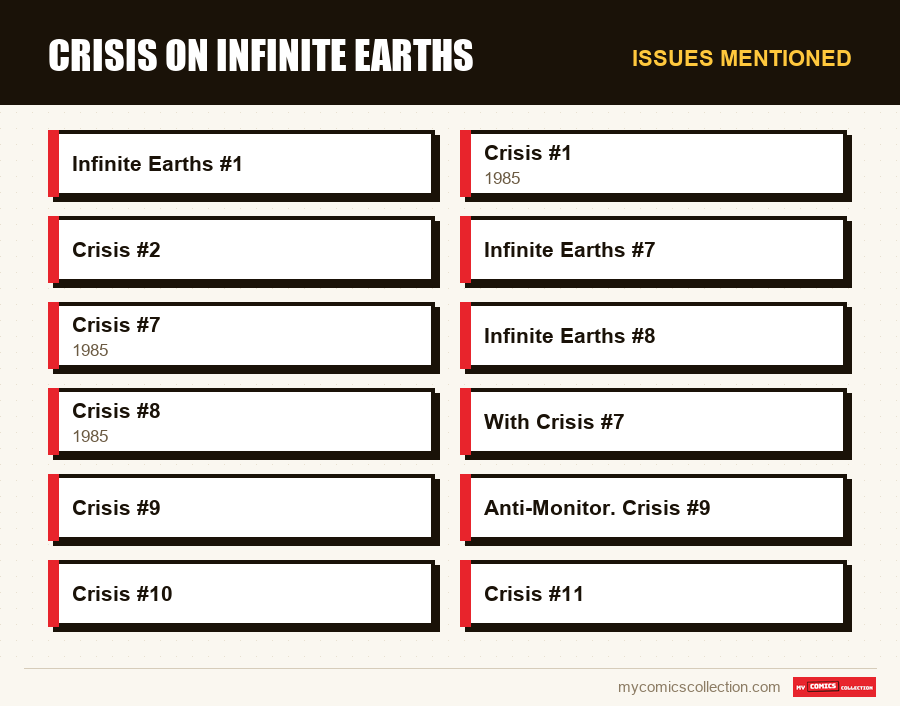
The 12 issues of Crisis: breakdown and 2026 values
Crisis on Infinite Earths #1, the beginning of the end
Crisis #1 (April 1985) opens with the appearance of the Monitor and the threat of the Anti-Monitor, who is destroying parallel universes one by one. It's a spectacular introduction that establishes the cosmic stakes and parades dozens of characters from different Earths.
In 2026, CGC values for Crisis #1:
- CGC 9.8: $250 to $400
- CGC 9.6: $120 to $200
- CGC 9.4: $60 to $100
- Raw NM: $20 to $40
Crisis #2-6, the rising stakes
These five issues escalate the Anti-Monitor threat, assemble alliances between heroes from different Earths and stage the first epic battles. Wolfman and Pérez sustain constant narrative tension while juggling a cast of roughly a hundred characters. They're narratively essential but lack standalone-key first appearances.
Each trades between $50 and $150 in CGC 9.8, and $10 to $25 raw in solid shape. Accessible and indispensable for a complete run.
Crisis on Infinite Earths #7, the death of Supergirl
Crisis #7 (October 1985) is the most famous issue in the series. It contains the death of Kara Zor-El / Supergirl, who sacrifices her life confronting the Anti-Monitor directly to save Superman. George Pérez's cover (Superman cradling Supergirl's body, his face broken by grief) is one of the most powerful images in comics history.
That death was intentional and permanent: Marv Wolfman wanted to prove Crisis was serious, that anyone could die, that this wasn't a fake-out event. Supergirl's death held for decades before DC eventually brought the character back in different forms.
In 2026, CGC values for Crisis #7:
- CGC 9.8: $500 to $800
- CGC 9.6: $250 to $400
- CGC 9.4: $120 to $200
- CGC 9.2: $80 to $130
- Raw VF: $40 to $80
This is the most valuable issue in the entire miniseries. Its value is anchored by the iconic status of its cover, reproduced and homaged countless times over 40 years, and by Supergirl's return in DC's television adaptations, which has sustained mainstream interest in the issue.
Key investment: If you're going to own only one issue of Crisis on Infinite Earths, it's #7. Its value rests on one of the most reproducible and recognizable images in DC history, with a very solid market floor.
Crisis on Infinite Earths #8, the death of Flash
Crisis #8 (November 1985) contains the death of Barry Allen / Flash, who sacrifices himself to destroy the Anti-Monitor's weapon and save the entire universe. The scene is staged with masterful tension: Barry runs so fast he travels through time itself before disintegrating while still accelerating beyond lightspeed to destroy the cosmic cannon.
Killing Barry Allen was one of DC's boldest editorial calls of the era: Flash was a Silver Age founding character, one of the company's most popular heroes. His death held until 2009, when Barry returned in Final Crisis. For 23 years, Wally West carried the Flash name, one of the most successful mantle passings in comics history.
In 2026, CGC values for Crisis #8:
- CGC 9.8: $300 to $500
- CGC 9.6: $150 to $260
- CGC 9.4: $80 to $150
- Raw VF: $25 to $50
With Crisis #7, this issue forms the top pair of the miniseries. Its value has been reinforced by the popularity of The Flash TV series and the character's multiple DCU adaptations.
Track values on your Crisis issues
Monitor every issue of your Crisis on Infinite Earths collection and follow its estimated value as eBay prices move.
Track my Crisis values7-day trial · Value tracking on every DC issue you own
Crisis #9-12, the conclusion and the new universe
Crisis #9 and #10, the counterattack
These issues see the surviving heroes organize their final offensive against the Anti-Monitor. Crisis #9 contains a remarkable scene where the DC Universe's supervillains temporarily join forces with the heroes against the Anti-Monitor: an improbable coalition made believable by the stakes. Crisis #10 intensifies the cosmic battle with Pérez at the peak of his graphic form.
In CGC 9.8, these two issues trade between $80 and $160 each. Solid run-builders without standalone key issue status.
Crisis #11 and #12, resolution and reset
Crisis #11 delivers the final confrontation between Superman and the Anti-Monitor in full epic mode. Crisis #12 closes the saga with the reforged DC Universe: one universe, rewritten origins, and the promise of Man of Steel and Batman: Year One as the platform for the company's two pillars.
These closing issues are among the most visually spectacular in the series. In CGC 9.8: $100 to $200 for #11, and $120 to $220 for #12 (slightly more in demand as the capstone).
Essential Crisis tie-ins
Crisis on Infinite Earths generated an impressive number of tie-ins across nearly every DC title of the era. Here are the most important ones to know:
Supergirl #21 and #22 (1985), the narrative transition
Published just before and during Crisis, these issues set up Kara's sacrifice. Sought-after by Supergirl collectors but still accessible ($30-80 in CGC 9.8).
The Flash #350 (1985), Barry's second-to-last adventure
This issue was published right before the Flash series ended to make way for Wally West. An important transition issue for Flash collectors. CGC 9.8: $40-80.
DC Comics Presents #87, Crisis prequel
This issue introduces the Monitor before Crisis begins and is considered a narrative preamble. Less sought-after but interesting for purists.
Who's Who in the DC Universe #1-26 (1985-1987)
Technically not a tie-in, this DC encyclopedia published alongside Crisis is an indispensable companion. It documents hundreds of pre-Crisis and post-Crisis characters and is a collectible in its own right for 1985-1986 enthusiasts.
Collecting this series?
Track what you own, what you are missing and what your collection is worth. 7 day trial.
Start my trial →Why Crisis remains foundational for any DC collection
Understanding Crisis on Infinite Earths is understanding how DC Comics has worked since 1986. All of modern DC continuity flows from this zero point. Man of Steel (John Byrne, 1986) rewrites Superman post-Crisis. Batman: Year One (Frank Miller, 1987) rewrites Batman post-Crisis. Wonder Woman by George Pérez (1987) rewrites Diana post-Crisis.
As a DC collector, Crisis is the absolute pivot. The issues you choose to own before or after Crisis define your relationship to the history of the medium. Owning Crisis #7 and #8 means owning two of the most important moments in 85 years of DC history. Owning the complete 12-issue run means having the founding document of everything that followed.
CGC price summary, Crisis on Infinite Earths 2026
- Crisis #7 CGC 9.8: $500-$800 (top priority)
- Crisis #8 CGC 9.8: $300-$500
- Crisis #1 CGC 9.8: $250-$400
- Crisis #12 CGC 9.8: $120-$220
- Crisis #11 CGC 9.8: $100-$200
- Crisis #2-6 CGC 9.8: $50-$150 each
- Crisis #9-10 CGC 9.8: $80-$160 each
The impact of DC adaptations on Crisis values
Unlike Marvel crossovers adapted directly for film (Civil War, Infinity Gauntlet), Crisis on Infinite Earths has not yet been adapted into a major film or series. But its effects are everywhere in DC productions:
- The Flash (TV series, 2014-2023): Borrowed heavily from Crisis concepts, notably in its season 6 finale titled "Crisis on Infinite Earths."
- The Flash (2023 film): Drew directly on the multiverse concept and iconic character deaths from Crisis.
- Supergirl (TV series): Sustained continuous interest in Kara, indirectly supporting Crisis #7 values.
The DC restructuring into the new DCU under James Gunn suggests a continuity reboot for DC films is in motion: exactly what Crisis did for the comics in 1985-1986. If a direct adaptation or a strong reference to Crisis issues emerges in Gunn's DCU, values could see a meaningful jump.
The sequels to Crisis: Infinite Crisis and Final Crisis
Infinite Crisis (2005-2006)
Twenty years after the original, DC published Infinite Crisis: a direct 7-issue sequel where survivors of the pre-Crisis universe (Superboy-Prime, Alexander Luthor Jr., Earth-2 Superman) try to restore the multiverse. A high-quality crossover that honored the original while staking its own arc. Infinite Crisis #1 in CGC 9.8: $60-120.
Final Crisis (2008-2009)
Grant Morrison reinterprets the Crisis concept with a far more abstract and metatextual vision. Final Crisis sees Darkseid conquer the DC Universe via the Anti-Life Equation before Batman, Superman and a newly resurrected Barry Allen turn the tide. Final Crisis #1 in CGC 9.8: $40-80.
Secret Crisis and other minor "Crises"
DC overused the "Crisis" branding after the original's success. Identity Crisis (2004), Zero Hour: Crisis in Time (1994), Convergence (2015) all borrowed the label without carrying the impact or market value of the original. None justifies a serious CGC investment.
How to approach a Crisis collection intelligently
The full run for reading ($150-300)
Buy the 12 issues raw in VF/NM. For $150 to $300 you get the entire original saga. Crisis is a fantastic read that more than justifies the entry cost.
The key issues in CGC ($800-1,500)
Invest first in Crisis #7 in CGC 9.4-9.6 ($200-400), then Crisis #8 in CGC 9.4. These two issues represent the bulk of the run's value. Add Crisis #1 if the budget allows.
The grail: Crisis #7 in CGC 9.8 ($500-800)
Crisis #7 in CGC 9.8 is the Holy Grail of the saga. Rare (few 1985 copies hit that grade), highly sought-after, with a solid market floor independent of DCU announcements.
Crisis and the DC Bronze Age collecting context
Crisis on Infinite Earths belongs to what we call the Bronze Age of comics (roughly 1970-1985), which ends precisely with this crossover. Collecting Crisis is often a gateway to the great DC runs that preceded it:
- New Teen Titans by Wolfman and Pérez (1980-1988): Same creative duo, with early issues that have become quite valuable.
- Legion of Super-Heroes (1958-1985): The Legion played an important role in Crisis and its Silver/Bronze Age issues are highly sought-after.
- Superman (Action Comics, Superman vol. 1): The last pre-Crisis issues (before Byrne's Man of Steel) close a 48-year era.
- Adventure Comics and the earliest Green Lantern: The DC Silver Age preceding Crisis is a goldmine of key issues.
This contextual richness is precisely what makes Crisis so compelling for serious DC collectors: it's both an ending and a beginning, the pivot of half a century of continuity.
Crisis on Infinite Earths FAQ
Build your DC collection methodically
Structure your DC collection by era, crossover or character. Checklists, wishlists with target prices and value tracking: My Comics Collection handles everything.
Start my 7-day free trial7-day trial · All major DC crossovers built in