The Eternals (2021), directed by Chloe Zhao, adapts the cosmic characters created by Jack Kirby In The Eternals #1 (1976). The film features these immortal beings (Sersi, Ikaris, Thena, etc.), their enemies Deviants , and their creators Celestials, these giant cosmic gods. It retains the Kirbyan mythology of the creation of humanity but reinvents the mission and loyalty of the Eternals. Detailed comparison, film versus comics.
The most cosmic and ambitious film in the saga upon its release, The Eternals delves into one of Jack Kirby's most outsized creations: a mythology of alien gods shaping humanity since the dawn of time. Under the direction of filmmaker Chloé Zhao, the film adapts this abundant material while reorganizing its issues. Source-by-source decryption.
As in each article in the series, only verified information (distribution, dates, numbers, creators) is stated; the comparative analysis is ours, without reproducing dialogue or protected images.
Title : The Eternals (2021)
Director: Chloe Zhao
Actors: Gemma Chan (Sersi), Richard Madden (Ikaris), Angelina Jolie (Thena), Salma Hayek (Ajak), Kumail Nanjiani (Kingo), Brian Tyree Henry (Phastos), Kit Harington (Dane Whitman)
Exit : November 5, 2021 (United States)
Studio: Marvel Studios
The Eternals #1 (1976): created by Jack Kirby
The Celestials: creative cosmic gods
The Deviants: rival race, enemies of the Eternals
Sersi, Ikaris, Thena…: the Kirby pantheon
- THE Eternals, immortal beings with cosmic powers (Sersi, Ikaris, Thena…).
- THE Celestials, giant cosmic gods creators of life.
- THE Deviants, a monstrous race rivaling the Eternals.
- The idea that the Eternals have inspired by myths and legends of humanity.
- La millennial fresco throughout human history.
- The mission of the Eternals is rewritten: here they are involuntary instruments of the Celestials.
- Their origin becomes artificial (created by the Celestials) rather than the fruit of evolution.
- Several characters are reinvented (gender, relationships, powers).
- The film adds a romantic and intimate dimension little present in Kirby.
- The big one moral dilemma (saving the Earth versus obeying the Celestials) is unique to the film.
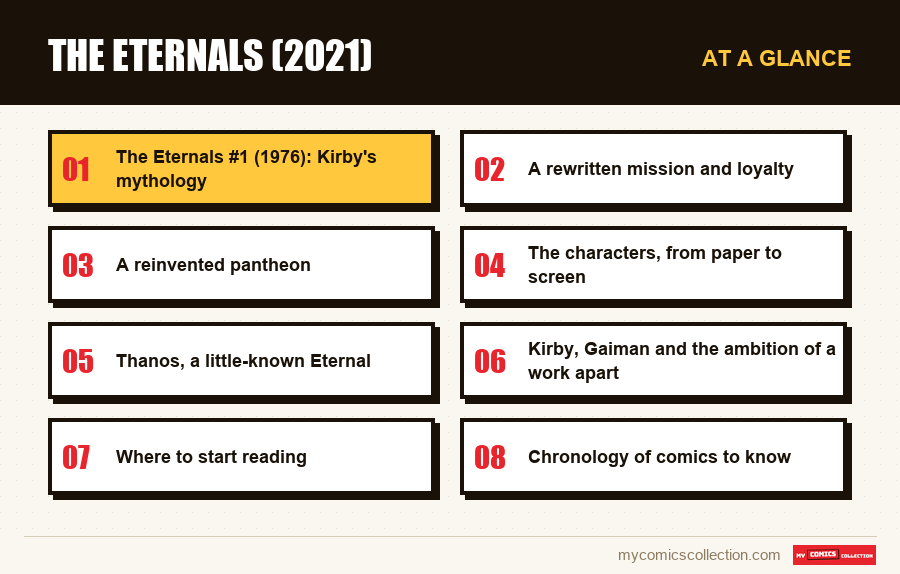
The Eternals #1 (1976): Kirby's mythology
The Eternals are one of Jack Kirby's most ambitious creations, who introduced them in The Eternals #1 (1976). The concept is dizzying: giant cosmic gods, the Celestials, visit Earth at the dawn of humanity and experiment on primates, creating three branches: ordinary humans, the unstable and warlike Deviants, and the Eternals, immortals with powers. These are said to have inspired the myths and pantheons of humanity, from ancient Greece to legends around the world. The film faithfully takes up this disproportionate architecture: the Eternals, the Deviants, the Celestials, and the idea that these beings have been hiding among us for millennia, having shaped our civilization in the shadows.
This fresco spanning the ages, one of the most striking features of Kirby's material, structures the film, which unfolds its narrative over thousands of years throughout human history. It is an adaptation of the epic scale specific to the Kirbyian imagination.
A rewritten mission and loyalty
The great freedom of the film concerns the nature and mission of the Eternals. In Kirby and his successors, the Eternals are generally protectors of humanity, fighting against Deviants. The film considerably complicates their role: here they are instruments created by the Celestials to prepare the Earth for a cosmic design which could mean the end of humanity. This revelation confronts the heroes with a heartbreaking dilemma: obey their creators or betray their mission to save the men they have grown to love. This moral conflict, unique to the film, transforms a mythology of cosmic superheroes into a reflection on free will, faith and disobedience. It's an ambitious rereading, which gives weight to characters otherwise difficult to humanize.
A reinvented pantheon
The film reinvents several Eternals compared to their Kirby versions. Some change their gender, appearance or powers; their relationships are deepened, notably the romance between Sersi and Ikaris, which is largely developed for the film. This approach, which favors intimacy and diversity, contrasts with the more mythological and distant register of Kirby's comics. The film thus adds an emotional and human layer to figures conceived as gods. Chloé Zhao, a filmmaker with a contemplative style, gives the film a naturalistic sensitivity unusual for the saga, with real settings and attention to faces. This divisive bias illustrates the desire to adapt Kirby's cosmic material to a contemporary sensitivity.
The characters, from paper to screen
- Sersi: Eternal capable of transmuting matter, at the emotional heart of the film.
- Ikaris: The most powerful of the Eternals, whose loyalty to the Celestials is reinvented.
- Thena: Warrior, whose film develops her mental fragility.
- The Celestials: Creative cosmic gods, faithful to their Kirbyian grandeur.
- The Deviants: Rival race, reinvented as a more organic and moving threat.
Collecting this series?
Track what you own, what you are missing and what your collection is worth. 7 day trial.
Start my trial →Thanos, a little-known Eternal
A discreet link connects The Eternals to the rest of the saga: in the comics, Thanos he himself is an Eternal, more precisely a Titan Eternal, born with a deviant appearance. This cosmic relationship, known to readers, anchors the big villain of the saga in the mythology that the film explores. Although the feature film does not develop this link, it reminds us that the Kirby universe of the Eternals and the Celestials deeply irrigates the entire Marvel cosmology. The Celestials, in particular, are recurring players in the great cosmic sagas, from the training of the Guardians to the issues of the Infinity Stones. By adapting this mythology, the film officially opens an essential part of its science fiction to the saga.
Kirby, Gaiman and the ambition of a work apart
The Eternals occupy a unique place in the work of Jack Kirby. Created in 1976, after his return to Marvel, they bear the mark of his most unbridled and metaphysical imagination: nothing less than a cosmic explanation of the origin of humanity, myths and gods. This excessive ambition, which blurred the boundaries between science fiction, mythology and theology, has long disconcerted readers, accustomed to more down-to-earth superheroes. This is perhaps why the original series, despite its richness, remained less famous than the 1960s creations of the same author. The film inherits this ambition and this risk: by adapting such conceptual material, it undertakes to confuse, even if it means dividing the audience.
The relaunch by Neil Gaiman and John Romita Jr. in 2006 had already attempted to update these characters, by anchoring them more in the present Marvel and questioning their nature. The film draws on this dual heritage, Kirby's original audacity and Gaiman's modern reinterpretation, to compose its own vision. This demanding lineage explains the contemplative tone and philosophical seriousness of the feature film, going against the usual entertainment of the saga. For the curious reader, discovering Kirby's series after the film means diving into one of the craziest and most visionary projects ever published by Marvel, signed by the hand of its greatest visual architect.
Where to start reading
The founding reading is Jack Kirby's original series, starting with The Eternals #1 (1976), a rich and visionary work, typical of its author's overflowing imagination. We can then explore the relaunch of Neil Gaiman and John Romita Jr. (2006), which modernized the characters, as well as the recent 2021 series. Those curious about the link with Thanos will find in the sagas of Jim Starlin the exploration of his ancestry as Eternal. From 1976 to today, this journey covers the source material for a film that adapts one of Marvel's most ambitious mythologies, and rewards the reader ready to be carried away by the cosmic and limitless imagination of Jack Kirby.
Chronology of comics to know
- 1976: The Eternals #1: creation by Jack Kirby of the Eternals, Deviants and Celestials.
- 2006: relaunch by Neil Gaiman and John Romita Jr.
- 2021: new series Eternals, contemporary with the film.
Collection side: what numbers to aim for after the film
The Eternals highlights an emblematic Bronze Age key. The Eternals #1 (1976) is the centerpiece, first issue of Kirby's series, interest in which soared with the announcement of the film; it's a must-have for any fan of Kirby's cosmic work. The following issues of the original series, introducing the different characters and the Celestials, are all targets. Kirby's collections and Gaiman's relaunch offer the best entry point into reading, at a controlled budget. As always, condition and gradation determine value; relying on real recent sales is strongly recommended. The Eternals #1 remains the priority target for a collector of this mythology, and one of the few major issues from Kirby's late period still accessible at a reasonable budget.
Its place in the saga and for the collector
The Eternals officially opens the saga to the mythology of the Celestials and the Eternals, a cosmic aspect destined to influence future stories. For the collector, the film has revived interest in The Eternals #1 and the late work of Jack Kirby, often less highly rated than his creations of the 1960s but just as visionary. This film once again illustrates the power of cinema to rediscover treasures: the mythology of the Eternals, long considered a curiosity at the end of Kirby's career, gains new recognition. Beyond speculation, it invites us to explore one of the most ambitious projects of Marvel's greatest designer, where science fiction, mythology and metaphysical questions mix. By adapting this demanding work, the film takes the challenge of cosmic grandeur, even if it means being confusing.
The Verdict: Kirby's Mythology, Humanized
- Loyalty: the Eternals, the Deviants, the Celestials and the millennial fresco come from Kirby's comics.
- Freedoms: the mission and loyalty of the Eternals rewritten, characters reinvented, an intimate dimension added.
- Collectible numbers: The Eternals #1 (1976) and the first issues of Kirby's series.
The Eternals adapts one of Jack Kirby's most outsized mythologies by adding unprecedented emotional depth and moral dilemma. By rewriting the mission of the Eternals, the film transforms a cosmic fresco into a reflection on free will and love for humanity. For both the reader and the collector, it is an invitation to discover the visionary and little-known work of the greatest architect of the Marvel universe. Divided but courageous, the film assumes a rare ambition: to bring to the screen a conceptual and philosophical mythology, rather than a simple superhero story. In this, it does justice to the spirit of Kirby, whose craziest creations were never afraid to aim bigger, and reminds us that, behind the blockbusters, hide the disproportionate ideas of a genius designer.
Frequently asked questions
From the series created by Jack Kirby, starting with The Eternals #1 (1976), which introduces the Eternals, the Deviants and the Celestials. The film takes up this mythology while rewriting the characters' mission.
Giant cosmic gods, created by Kirby, who visited Earth at the dawn of humanity and created the Eternals and Deviants by experimenting on primates. They are major players in the Marvel cosmology.
Yes, in the comics: Thanos is an Eternal of Titan, born with a deviant appearance. This cosmic relationship anchors the big bad of the saga in the mythology that the film explores.
The mission of the Eternals: for Kirby, they are generally protectors of humanity; the film makes them instruments created by the Celestials for a purpose that threatens the Earth, which creates a moral dilemma specific to the film.
The Eternals #1 (1976), the first issue of Jack Kirby's series, is the centerpiece. The following issues, introducing the characters and the Celestials, are other interesting targets.
Does the film make you want to collect? Estimate the value for free of your numbers (The Eternals #1…) with our tool based on current eBay listings.