
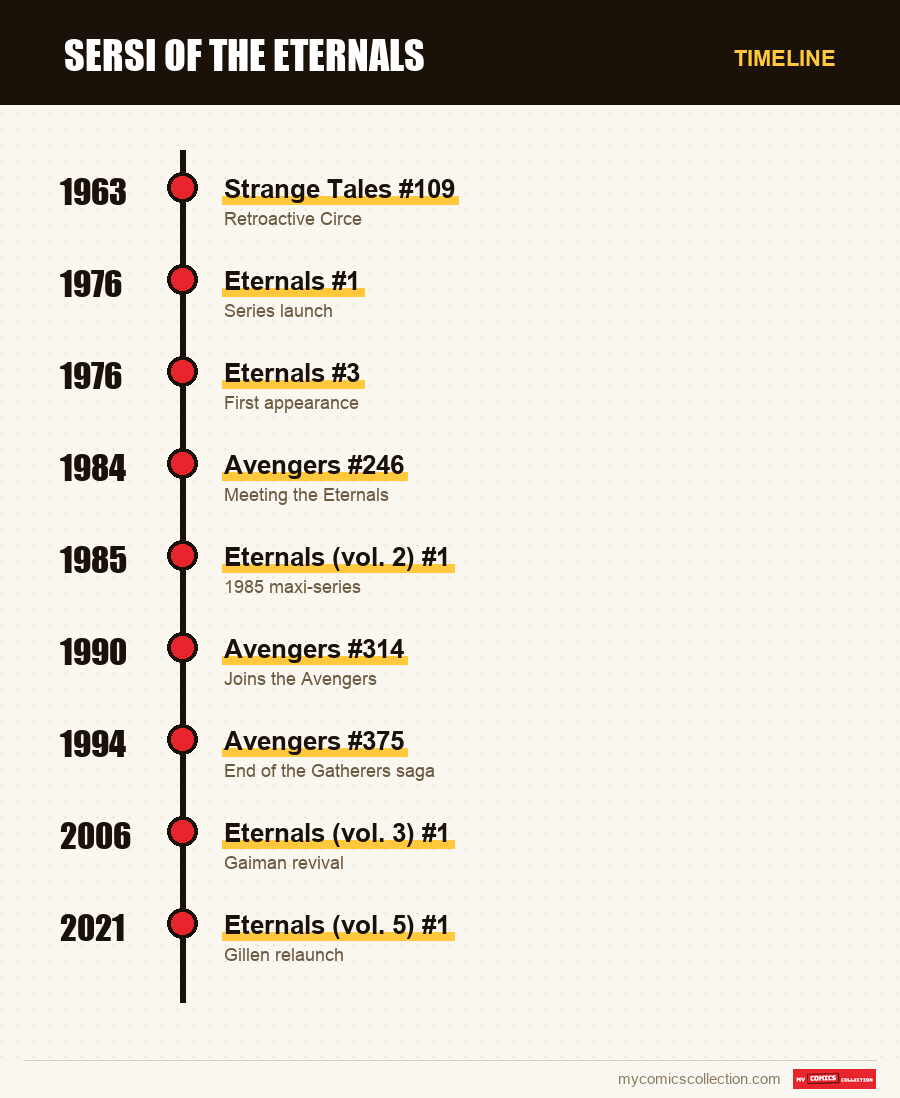
Sersi is an Eternal created by Jack Kirby and first published under that name in Eternals #3 (September 1976), at the heart of the Kirby cosmic mythos that reimagined humanity as a genetic experiment run by godlike beings from the stars. Officially over 7,000 years old in the Marvel timeline, she moves through antiquity, the Renaissance and the 20th century before joining the Avengers in Avengers #314 (February 1990) under John Byrne. The 2006 Eternals reboot by Neil Gaiman and John Romita Jr., in seven issues, redefined her modern status, ahead of Chloé Zhao's film adaptation in November 2021 starring Gemma Chan. The 1976 key issues remain undervalued in 2026: an Eternals #1 in CGC 9.8 trades between $400 and $700, five to ten times less than a comparable Bronze Age first issue at Marvel.
Among the characters of Marvel's cosmic mythos , Sersi holds a singular place: at once ancient goddess, the merry sorceress of the Odyssey, Manhattan party girl and full-fledged Avenger, she embodies the impossible synthesis of Kirby's contradictions. Born in 1976 in the last great series Jack Kirby created before leaving Marvel, she channels the King's late-career vision: a planetary mythology where the Greek gods, lost civilizations and cosmic upheavals converge into a single unified cosmogony. Her popularity long languished in the shadow of Marvel's major cosmic figures (Silver Surfer, Adam Warlock, Captain Marvel), until the 2021 film adaptation abruptly swung the spotlight back onto the entire Eternal pantheon.
This guide traces the 7,000 years of Sersi's editorial history, from her first appearance under that name in Eternals #3 to the 2006 Gaiman/Romita Jr. reboot and her MCU interpretation. We cover the 1976 Kirby creation , the Eternals/Deviants/Celestials cosmology, her integration into the Avengers in 1990, the 2006 reboot , Chloé Zhao's film adaptation , and the 2026 market value of the associated Bronze Age and Modern Age key issues. The goal: to equip collectors with a clear, verified and quantified timeline, so they can spot buying opportunities on a character still undervalued relative to its narrative and cinematic potential.
Created by Jack Kirby in Eternals #3 (September 1976)
Jack Kirby's return to Marvel in 1975, after five years at DC building his Fourth World, gave rise to several new series: Captain America , Black Panther , Devil Dinosaur and, above all, The Eternals, launched in July 1976. The series was written, drawn and conceived entirely by Kirby, who used it to develop a self-contained cosmogony drawing on Greek mythology, the theories of Erich von Däniken (Chariots of the Gods?, 1968) and the cosmic explorations of his time at DC. The central idea: millions of years ago, a race of space gods called the Celestials visited Earth and ran a genetic experiment on early hominids, creating three branches of humanity: ordinary humans, the monstrous and unstable Deviants , and the Eternals, perfect, immortal and endowed with near-divine powers.
Sersi makes her first appearance under that name in Eternals #3, cover-dated September 1976, actually published in June 1976 given the standard Direct Market lead times. The cover, by Kirby, depicts Ikaris, the series' main hero, facing a gigantic Deviant. Inside the issue, Sersi is introduced as an Eternal living among humans, in a Manhattan apartment: cheerful, worldly, free of the solemn gravity that defines her peers. Kirby drew her in a green dress, with wavy black hair and a sparkling tiara, a look lifted straight from the Circe of Homer's Odyssey: a reference the writer fully embraced: in the narrative continuity, Sersi is the real Circe who turned Odysseus's crew into swine on the island of Aeaea.
This mythological identification is Kirby's stroke of genius on The Eternals: every character in the series is presented as the real-world source of a human myth. Ikaris is Icarus, Thena is Athena, Sersi is Circe, Makkari is Mercury. The device echoes the ancient-aliens theory popular in the 1970s and offers a rationalist-cosmic rereading of mythology. In this logic, Sersi is an Eternal roughly 7,000 years old, a direct witness to the fall of Troy, the Persian invasions, the Italian Renaissance and 20th-century America. Her signature power (the transmutation of matter, the ability to turn one object into another) explains the legend of the Homeric transformations. An Eternals #3 CGC 9.8 copy trades in 2026 between $120 and $220, a trifling price for a Kirby-signed Bronze Age first appearance.
The cosmic mythos: Eternals, Deviants and Celestials
The ontological trilogy Kirby laid down in the first Eternals series (1976-1978, 19 issues + annual) structures the entire Marvel cosmic mythos for the next fifty years. The Celestials are colossal cosmic entities, 2,000 feet tall in their armor, that roam the galaxy to run genetic experiments on sentient species. Their first visit to Earth, about a million years ago, split the hominid line into three branches: baseline humans, destined to evolve naturally; the Deviants, marked by chaotic, unstable mutations, who withdrew into subterranean cities (notably Lemuria, explicitly named by Kirby as their capital); and the Eternals, genetically perfect, immortal, telepathic and able to manipulate matter, energy and gravity.
The Eternal pantheon numbers around a hundred members, of whom some twenty are major figures: Ikaris the warrior, Thena the warrior princess, Makkari the runner, Gilgamesh known as "the Forgotten One," Phastos the smith, Ajak the priest, Sprite the eternal child, Druig the mind manipulator, and of course Sersi. They all originally dwell in the city of Olympia, perched in the Greek Alps. Kirby establishes a political hierarchy: the Prime Eternal (Zuras, Thena's father) governs the community, and the Eternals occasionally merge into a Uni-Mind, a collective gestalt of their consciousnesses, to communicate with the Celestials during their cyclical visits.
Sersi stands apart in this pantheon through her radical rejection of Olympian solemnity. She prefers to live among the humans of Manhattan, throws society parties, seduces mortal lovers, and uses her transmutation powers for pranks as often as for heroic deeds. This hedonistic, almost Dionysian personality makes her the necessary counterpoint to the rigidity of Ikaris or Thena. Kirby also expands the cosmology by introducing the Fourth Host and the Fifth Host of the Celestials, series of cyclical cosmic expeditions tasked with judging humanity's evolution: a concept later picked up in the Celestial Madonna event and in the Hickman/Aaron arcs of the 2010s-2020s. The original 1976-1978 series remains a high point of late-career Kirby creativity, and a complete set (19 issues + annual) in CGC 9.0+ runs today between $1,200 and $2,500, an accessible and culturally essential Bronze Age investment.
Avengers #314 (February 1990): Sersi joins the team
After the Kirby series ended in 1978, Sersi remained a peripheral figure in the Marvel universe for a decade. She appeared sporadically in Avengers , Thor and What If?, never getting a sustained arc. The turning point came in July 1989 with Avengers #305 , the first issue of John Byrne's run on the flagship series after his acclaimed stints on Fantastic Four and West Coast Avengers. Byrne, a longtime fan of the Kirby mythology, brought Sersi onto the official Avengers roster in Avengers #314 (February 1990), giving her full-time member status alongside Captain America, Thor, Vision and She-Hulk.
Sersi's arrival on the team, in February 1990, comes shortly after the "Acts of Vengeance" crossover. Sersi is portrayed as a flamboyant socialite, a New York gala host and an improbable new recruit to the heroic roster. Byrne plays on the tension/comedy dynamic between Sersi's apparent frivolity and the military seriousness of the other Avengers, creating an unusually lively supporting character. It is during this period that her romantic arc with Black Knight (Dane Whitman) takes shape: an arc that would culminate in the early-1990s Gatherers saga and in the psychological breakdown known as Mahd Wy'ry, the cyclical madness peculiar to the Eternals.
The key issues of this Byrne/Harras era deserve collectors' attention. Avengers #305 in CGC 9.8 trades in 2026 between $40 and $80, a negligible price for a minor but documented key issue. The Gatherers saga (Avengers #355-375, 1992-1994), written by Bob Harras and drawn by Steve Epting, in which Sersi sinks into Mahd Wy'ry and ends up banished from the team into an alternate reality alongside the Black Knight, is her densest Avengers arc. Raw copies of these issues run $3 to $8 apiece, making it one of the most accessible Modern Age runs for building a coherent themed collection. Sersi's participation in Avengers vol. 3 under Kurt Busiek (1998-2002), notably in the Above the Law arc, rounds out her official superhero résumé without meaningfully moving the value of the back issues.
Eternals 2006: the Neil Gaiman and John Romita Jr. reboot
In 2006, Marvel handed an ambitious reboot of the franchise to Neil Gaiman, then crowned with the prestige of Sandman , 1602 and his novels ( American Gods , Stardust ). The Eternals vol. 3 miniseries, in seven issues (August 2006 - May 2007), drawn by John Romita Jr. at the height of his stylistic mastery, redefined the Eternals' standing in post-House of M Marvel continuity. The pitch: in the wake of the mutant decimation, the Eternals have forgotten their true identity. They live ordinary human lives (ER doctor, scientist, student) until Ike Harris (Ikaris) begins to wake them one by one.
Sersi is introduced as early as #1 as an extravagant New York party planner, running an events agency for millionaires. Gaiman faithfully revives the worldly character inherited from Kirby, but adds a layer of existential dread: what if all of this is merely an illusion implanted by a sleeping Celestial? The seven issues weave a tale of gradual awakening, punctuated by Romita Jr.'s iconic art, whose angular, cubist style suits the cosmic grandeur of the Celestials perfectly. The arc closes on the awakening of the Dreaming Celestial beneath San Francisco, an event that reorients the franchise's mythological future for the following decade.
The value of the Gaiman/Romita Jr. miniseries remains accessible in 2026. Eternals vol. 3 #1 (August 2006) in CGC 9.8 runs between $40 and $80 , and #2 through #7 raw between $4 and $10 apiece. The collected hardcover published by Marvel in 2007 (and reprinted several times since) is the reference format for reading, and trades secondhand between $20 and $35. This series directly informed the staging of Chloé Zhao's 2021 film, notably in the idea of Eternals living among humans with no memory of their divine nature. A second miniseries by Charles Knauf and Daniel Knauf, Eternals vol. 4 (2008-2009, 9 issues), extends the Dreaming Celestial arc without reaching the literary quality of the Gaiman run. For collectors looking to invest in the Eternal mythos for the long haul, this hardcover and Kirby's 1976 run are the two pillars to assemble first.
MCU 2021: Chloé Zhao and Gemma Chan
On November 5, 2021, Marvel Studios released Eternals, the twenty-sixth film in the Marvel Cinematic Universe, directed by Chloé Zhao (2021 Best Picture Oscar for Nomadland). The film belongs to MCU Phase 4, opens up the post-Endgame cosmic mythology, and adapts the 2006 Gaiman/Romita Jr. run directly while folding in elements of the original Kirby material. Gemma Chan , previously seen in Captain Marvel (2019) in a Kree role, plays Sersi and becomes the story's lead, functionally presented as the group's leader after Ajak's death.
The Zhao/Chan interpretation diverges noticeably from the Sersi of the comics. Where the Kirby character is worldly, hedonistic and frivolous, the screen version is introverted, melancholy and romantic, a history teacher in London in a relationship with a human played by Kit Harington (Game of Thrones, the future Black Knight). Her transmutation power is faithfully preserved, but her narrative role is broadened: she is the one who makes the final decision to halt the Emergence of the Celestial Tiamut, saving humanity at the cost of a rift with her fellow Eternals. The film drew mixed critical reception (Rotten Tomatoes 47% critics, 78% audience) and grossed $402 million at the worldwide box office, a performance seen as disappointing for Marvel Studios after the Endgame and Spider-Man successes.
The impact on the comics market was nonetheless notable, though more muted than the Iron Man #55 (Thanos) or Hulk #181 (Wolverine) explosions. Before the 2019 casting announcement, Eternals #1 in CGC 9.8 traded around $100-150; after the film's release in November 2021, the peak hit $500-700 in early 2022, before a correction to $400-550 in 2025-2026. Eternals #3 (first Sersi) followed the same curve with a smaller swing: from $40-60 CGC 9.8 before 2019 to $120-220 today. The film's critical underperformance likely capped its speculative ceiling, but the near-total absence of subsequent MCU appearances leaves room for appreciation should Marvel Studios announce a sequel or a tie-in to future phases. To anticipate value moves tied to production announcements, see our guide MCU Phase 6 comics: what should you anticipate?.
2026 market value: why Sersi remains undervalued
The Sersi case illustrates a recurring dynamic in the back-issue market: a cosmic character of high creative pedigree (Kirby) that stays undervalued because it has never benefited from a major narrative event capable of crystallizing speculative attention. By comparison, characters with similar origins but propelled by a hit film have seen their key issues multiply by 10 to 50: Iron Man #55 (Thanos) went from $5,000 to $80,000 in CGC 9.6, Hulk #181 (Wolverine) from $10,000 to $60,000, Tales of Suspense #39 (Iron Man) from $80,000 to $600,000. Eternals #1 and #3, despite their Kirby signature and first-appearance status, have never cleared the $1,000 threshold in CGC 9.8.
This undervaluation presents an analytical opportunity for collectors willing to bet on the long term. Three scenarios could trigger a re-rating: (1) a second Sersi appearance in the MCU, notably in Phases 6 or 7 slated between 2026 and 2030, which would refocus speculators on Eternals #3; (2) a new, ambitious comics run handed to a prestige author (of the Jonathan Hickman or Kieron Gillen caliber), capable of recasting Sersi as a central character; (3) a major cosmic crossover of the Secret Wars 2027 type that would reintegrate the Eternals into an Avengers-Galactic storyline. None of these scenarios is guaranteed, but their cumulative probability is not negligible.
To structure a reasoned Sersi collection in 2026, three priorities emerge. Entry level (budget $100-300) : target Eternals #1 and Eternals #3 raw NM or CGC 8.0-9.0, available at $50-150 apiece on eBay or at specialized conventions. Intermediate level ($300-1,000) : add an Eternals #1 CGC 9.6 ($250-400), an Eternals #3 CGC 9.6 ($60-120), and the 2006 Gaiman/Romita Jr. hardcover. Advanced level ($1,000-5,000) : target Eternals #1 CGC 9.8 ($400-700), Eternals #3 CGC 9.8 ($120-220), and the complete Eternals #1-19 run in CGC 9.0 minimum. Protecting copies through CGC grading is necessary for high grades: see our complete CGC grading guide before any investment above $200. To set this strategy within the broader context of undervalued Bronze Age cosmic comics, read our feature investing in comics: a strategic guide and the overview modern comics: investing 2020-2026.
→ See all "History" articles on the blog
Collecting this series?
Track what you own, what you are missing and what your collection is worth. 7 day trial.
Start my trial →Key issues to know
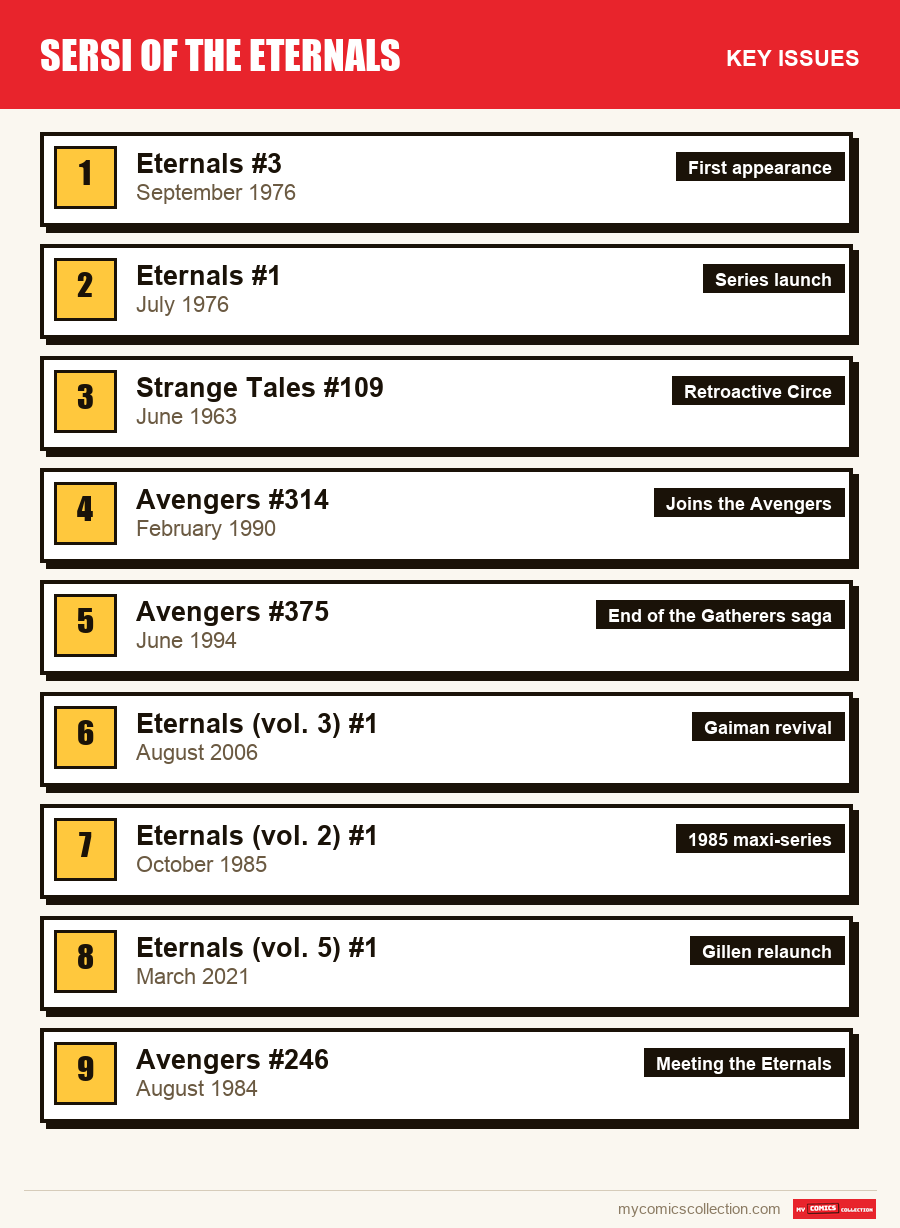
Eternals #3
Jack Kirby introduces Sersi, spelled Sersy in this issue: a socialite Eternal living in a Manhattan penthouse, with whom Ikaris leaves Margo Damian. She reveals that she was the Circe of Greek mythology.
Eternals #1
Jack Kirby, in full control, launches his cosmic saga: archaeologist Daniel Damian, his daughter Margo and his assistant Ike Harris, the future Ikaris, uncover traces of the Celestials. The nineteen-issue series sets up the Eternals, Deviants and Celestials mythos.
Strange Tales #109
In a Stan Lee and Jack Kirby story, the Human Torch and the Thing encounter a sorceress named Circe. Eternals #3 later reveals that she was Sersi, making this issue a retroactive appearance of the character.
Avengers #314
Written by John Byrne and pencilled by Paul Ryan, Sersi becomes an Avenger, in an issue where Spider-Man accompanies the team against Nebula. She remains a mainstay of the line-up until the mid-1990s.
Avengers #375
Bob Harras and Steve Epting conclude the Gatherers saga: against Proctor, the Black Knight's counterpart from another universe, the final battle is fought and Sersi leaves the Avengers at the end of her long arc with Dane Whitman.
Eternals (vol. 3) #1
Neil Gaiman and John Romita Jr. launch a seven-issue mini-series in which the Eternals have forgotten their nature and live ordinary human lives, until Ikaris tries to awaken them. Sersi appears as a New York party planner.
Eternals (vol. 2) #1
Peter Gillis and Sal Buscema relaunch the Eternals in a twelve-issue maxi-series. In the first episode, Sersi visits Sam Holden, one of the few humans who remember the events of Kirby's series.
Eternals (vol. 5) #1
Kieron Gillen and Esad Ribić relaunch the franchise the year of the film and revise the mythology: all the Eternals were created at the same time, a million years ago, and their successive generations are merely resets.
Avengers #246
Roger Stern and Al Milgrom stage a major meeting between the Avengers and the Eternals. Sersi forms her first ties with the team, which she would help several times before becoming a member.
FAQ: Sersi of the Eternals in comics
Sersi first appears under that name in Eternals #3, cover-dated September 1976, published by Marvel Comics. Marvel later retroactively identified her with the Circe of Venus #1 (1948) and Strange Tales #109 (1963). The issue is entirely written, drawn and conceived by Jack Kirby, during his return to Marvel after five years at DC building the Fourth World. Sersi is introduced there as a hedonistic Eternal living in Manhattan, cast as the real Circe of Homer's Odyssey in Kirby's cosmology. A CGC 9.8 copy trades in 2026 between $120 and $220, and a CGC 9.6 between $60 and $120. Eternals #3 remains one of the most accessible Bronze Age cosmic books signed by Kirby.
Sersi is officially around 7,000 years old in comics continuity, making her one of the youngest Eternals in the Olympian pantheon (Ikaris, Thena or Makkari are closer to 25,000 years depending on the version). Kirby presents her as early as Eternals #3 as a direct witness to the fall of Troy, the Italian Renaissance and the 20th century. The Gaiman/Romita Jr. reboot of 2006 retains that approximate figure without pinning it down rigorously. Chloé Zhao's MCU film (2021) explicitly places her as having arrived on Earth 7,000 years ago with the Eternal team sent by Arishem.
Sersi becomes an official member of the Avengers in Avengers #314, published in February 1990 by Marvel Comics. The issue is written by John Byrne, who takes the reins of the flagship series after his acclaimed work on Fantastic Four and West Coast Avengers. Her induction comes shortly after the Acts of Vengeance crossover. Sersi remains an active Avengers member during the Gatherers saga (Avengers #355-375, 1992-1994), where she develops her romantic arc with Black Knight (Dane Whitman) and sinks into Mahd Wy'ry, the cyclical madness peculiar to the Eternals. Avengers #305 in CGC 9.8 trades between $40 and $80 in 2026.
To discover Sersi, two runs stand out. First, the original Kirby series Eternals vol. 1 #1-19 + Annual #1 (1976-1978), entirely written and drawn by Jack Kirby, which lays down the Eternals/Deviants/Celestials mythos and presents Sersi in her role as the worldly New York Circe. Then the reboot Eternals vol. 3 #1-7 (2006-2007) by Neil Gaiman and John Romita Jr., which redefines the Eternal pantheon post-House of M with a gradual-awakening storyline. The Marvel hardcover collecting this miniseries can be found secondhand between $20 and $35. For Sersi's Avengers run, target the Gatherers saga (Avengers #355-375) by Bob Harras and Steve Epting.
Yes, market analysts broadly agree on this. Eternals #1 (July 1976) in CGC 9.8 trades between $400 and $700 in 2026, and Eternals #3 (first Sersi) between $120 and $220 in the same grade. By comparison, other Kirby Bronze Age first appearances propelled by the MCU have reached $5,000 to $50,000 in equivalent grades (Iron Man #55 for Thanos, Hulk #181 for Wolverine). Three scenarios could trigger a re-rating: a Sersi return in Phases 6 or 7 of the MCU (2026-2030), a new ambitious comics run handed to a prestige author, or a major cosmic crossover of the Secret Wars 2027 type. The current undervaluation is a documented window of opportunity for collectors prepared to practice a long buy-and-hold strategy.
Related articles
- Editorial history of Amazing Spider-Man
- Grading your comics with CGC: the complete procedure
- Investing in comics: a strategic guide
- Modern comics: investing 2020-2026
- MCU Phase 6 comics: what should you anticipate?