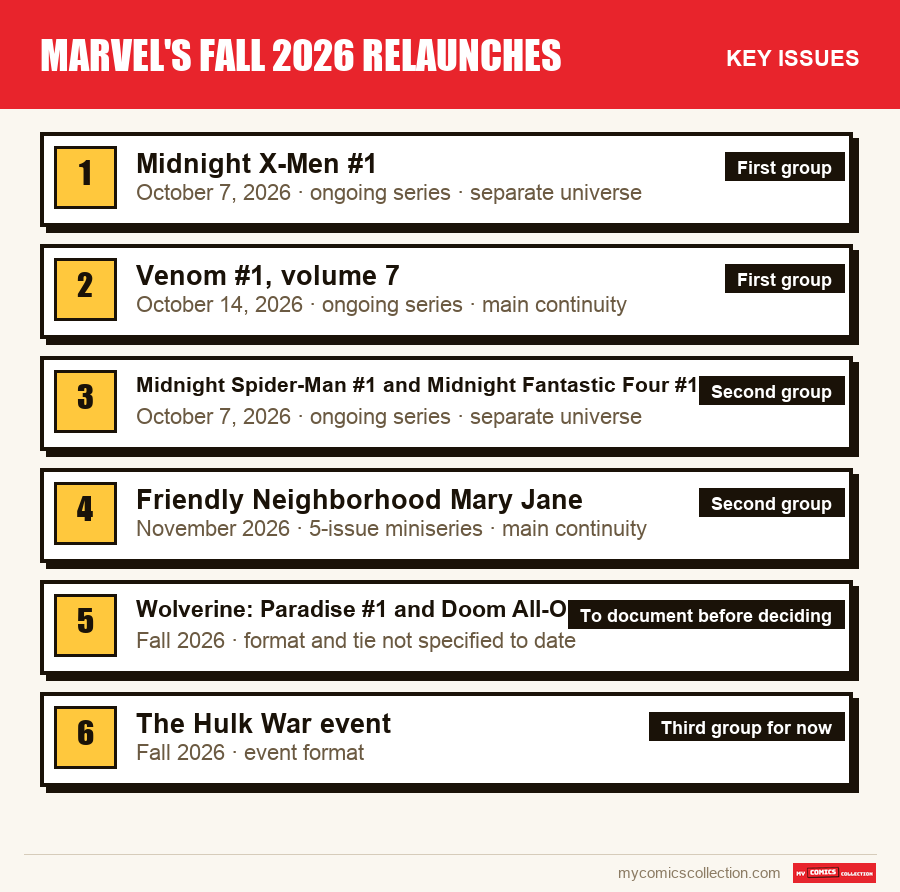
Marvel concentrates in October and November 2026 a volume of new releases few budgets can absorb: three Midnight launches on October 7, Venom volume 7 on October 14, Friendly Neighborhood Mary Jane in November, to which are added Wolverine: Paradise, Doom All-On-One and a Hulk War event. Choosing is done with a grid, not a mood. Five criteria make it up: the writer's trajectory, the title's announced durability, its tie to main continuity, its proximity to an adaptation, and the foreseeable abundance of its print run. The first four play in the same direction, the fifth plays against them: it is the tiebreaker. Applied to this fall season, the grid pushes Midnight X-Men and Venom #1 ahead of everything else, and sends miniseries and sequel-less rereadings to the end of the list.
A publisher that publishes a lot does not ask you to buy everything. It simply puts you in a situation where deciding nothing amounts to spending the maximum. That is the mechanism of this Marvel fall season: over nine weeks, the publisher opens at least six different entry doors, all presented as a beginning, all legitimate, and none that will tell you by itself it is less important than the others.
Each of these releases already has its own file here, and that is not what we redo. The question treated in this article is the other one: the one nobody asks, because it is uncomfortable. Faced with six simultaneous beginnings, which deserves your money first, and by what defensible reasoning? Not "which will be worth the most," since that question has no honest answer for several years, but "which is most likely to matter," which is a different question and one that can be treated.
What follows is therefore a grid, its instructions, then an owned ranking. A ranking can be argued: that is precisely its interest. A list of releases cannot.
This season's problem is not quality, it is simultaneity
Let's put the facts side by side, because seeing them lined up almost suffices to understand the difficulty.
- October 7, 2026: three issue #1s of the Marvel Midnight line, signed Jonathan Hickman, Phillip Kennedy Johnson and Benjamin Percy.
- October 14, 2026: Venom volume 7, by Charles Soule and Tommaso Bianchi, which follows the Queen in Black crossover completed on September 30.
- November 2026: Friendly Neighborhood Mary Jane, a five-issue miniseries by Ashley Allen and Phil Noto, the character's first solo series since her stint under the symbiote.
- November 18, 2026: the #2s of the three Midnight series, then the #3s on December 16.
- Also announced: Wolverine: Paradise #1, Doom All-On-One #1 and a Hulk War event.
None of these proposals is filler. They are identifiable creative teams, first-rank franchises, stories that each have a reason to exist. The problem is elsewhere: spending concentrates where attention concentrates, and attention is at its maximum at the exact moment information is at its minimum.
There is an asymmetry that must be named frankly. On October 7, a reader knows the writers' names and nothing else. By December 16, he will know which titles hold up, which have already changed artists, which have seen their orders collapse. Ten weeks later, information will be abundant and cheap, and three quarters of what came out in October will still be available, because that is what happens to comics printed in quantity. Part of the tradeoff work therefore consists simply in recognizing that most of these decisions can wait at no cost.
But only part. Some titles behave differently, and it is to spot them that a grid is of any use.
Five criteria, and why these
A criterion is useful only if it is observable before release and predictive afterward. This eliminates at once everything that is a matter of taste, rumor and cover. Five remain, here in the order in which they are consulted.
The writer's trajectory, not their reputation
The question is not "is this writer good." It is: did their previous stint on a franchise leave a structural trace the publisher then had to integrate? A writer who changed a franchise's grammar once is statistically the most likely to do so again, because they are entrusted with a line opener only for that reason. This criterion is the most predictive of the five, and it is also the one enthusiasm reads badly: loving a writer a lot is not the same as noting that they have already shifted a catalog.
The title's announced durability
An ongoing series with no announced end, a miniseries with a fixed number of issues and an event do not have the same future, and the difference is written into the announcement itself. The ongoing series can produce a character, a canonical version, a long run: it has open potential. The miniseries produces a closed object, pleasant to own, whose posterity depends almost solely on what continuity retains of it. The event is judged on its consequences and not on itself. This criterion is not a literary value judgment, it is a format datum.
The tie to main continuity
A title whose developments rise into shared continuity is a title the other series will have to cite. A title set in a separate universe obliges nobody, and its inventions have no life other than its own until a publisher decides to import them. This criterion is brutal but it explains most collecting disappointments on parallel lines: not the quality of the stories, but the absence of a mechanism that forces the rest of the catalog to remember them.
The proximity of an adaptation, and its exact meaning
This one reads the opposite of what you think. A nearby adaptation does not make a new comic more desirable: it makes more expensive what already existed, by pushing demand toward the old issues the production points to. For a new release, the effect is weak and often the reverse, since public attention turns to the original catalog. The criterion remains useful, but it serves to spot where not to buy now rather than where to buy.
Foreseeable abundance, which corrects all the others
The first four criteria measure probable importance; this one measures how easy it will be to obtain the object later. They almost always contradict each other, and that is logical: the more important a title, the more it is ordered, thus the more abundant it will be. A title rated very well on the first four criteria and very abundant is a title to read with no urgency, not an opportunity to seize. Conversely, a modest title with a small print run is not a good deal: scarcity without demand produces nothing.
How to weigh, and where the grid refuses to decide
A five-criteria grid that gave a single score would be an illusion of precision. What it usefully produces is a split into three groups, and the weighting fits in one sentence: criteria 1 and 2 open the file, criterion 3 confirms it, criterion 5 sets the urgency, criterion 4 serves only as a warning.
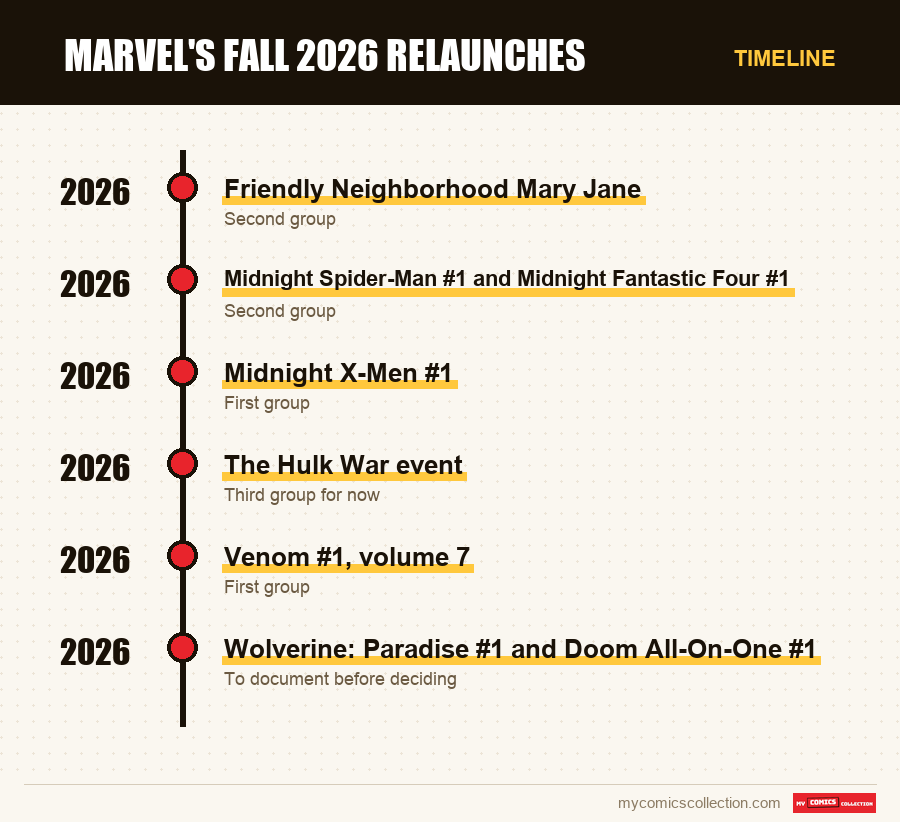
Concretely, a title that ticks 1, 2 and 3 belongs to the first group: it has good chances of mattering and deserves to be followed from the start, in reading at least. A title that ticks two of the first three criteria belongs to the second group: it is decided after three issues, which costs nothing since it will still be available. A title that ticks only one belongs to the third group, that of owned pleasure: you buy it because you feel like it, and you stop pretending it is an investment.
Three things this grid will not do, and it is more honest to announce them than to let you hope. It will not say whether a story is good, because no criterion observable before release measures that. It will not detect the happy accident, that is, the secondary character introduced on page 14 of an issue nobody expected and who becomes central three years later: by construction, this event is unpredictable, and any method claiming to capture it is selling dreams. And it produces no amount, because no copy of these titles has yet been sold anywhere.
The fall 2026 ranking
Here is the application, in order, with the reason for each position. Disagreements are legitimate: what is not is ranking without saying why.
Midnight X-Men #1
First despite a frankly unfavorable criterion 3, and that is the whole point of the exercise. The title is outside main continuity, which should penalize it heavily. It comes out ahead for a single but massive reason: criterion 1 is here at the maximum observable. Hickman's return to the X-Men is the only element of this season for which a documented precedent shows it produced a lasting change of grammar on an entire franchise. No other fall release has this characteristic.
Venom #1, volume 7
The only title of the season to tick the first three criteria without reservation. An ongoing series with no announced end, in shared continuity, and placed immediately after a crossover whose consequences it treats: what it establishes about Eddie Brock and the symbiote will have to be taken into account by the other series, which is true of no Midnight title. Charles Soule also has a track record on the symbiote franchise, which gives criterion 1 a solid score without being exceptional.
Midnight Spider-Man #1 and Midnight Fantastic Four #1
Ranked together because the grid does not separate them, and an honest ranking must not invent a distinction it does not measure. Both tick criterion 2 and fail criterion 3, exactly like Hickman's title; what puts them a notch lower is criterion 1 alone, where neither Phillip Kennedy Johnson nor Benjamin Percy has a comparable franchise-refounding precedent, which takes nothing away from their work.
Friendly Neighborhood Mary Jane
A position that illustrates well how criterion 2 weighs. The title ticks criterion 3 without difficulty and benefits from a strong narrative context, since it directly follows the end of the character's stint under the symbiote. But five announced issues is a closed object: its posterity will depend entirely on what continuity retains of it, and nothing in the announcement lets us know. The practical advantage is real, however: a five-issue collection is completable, which is true of no open series.
Wolverine: Paradise #1 and Doom All-On-One #1
These two titles are announced, and that is about all that can be said of them verifiably. Neither their length, nor their tie to continuity, nor their exact date is established clearly enough to feed criteria 2 and 3. Ranking them higher on the sole fame of Wolverine and Doctor Doom would be exactly the mistake the grid exists to avoid: confusing a character's popularity with a publication's reach.
The Hulk War event
Last, not out of contempt but out of method consistency: an event is, of all formats, the one whose value depends most on its epilogue and least on its opening. Its criterion 3 is a priori favorable, since an event serves precisely to modify continuity. But until the scope of its consequences is known, there is no way to tell an event that durably shifts the character's status from an event reset two years later.
Three budgets, three tradeoffs
A ranking is useful only converted into a decision, and the decision depends on the volume you can commit. Three scenarios cover most situations, and none assumes a particular amount: what changes is the number of titles followed simultaneously.
A single sustainable title. Take an ongoing series, not a miniseries or an event. The reason is mechanical: it is the only format where what you buy today places you in a story that continues, hence the only one where your October decision still has an effect in March. Between the two candidates of the first group, the choice rests on what you really want to read, because the grid separates them little and your reading cannot be delegated.
Two or three sustainable titles. It is the most comfortable case, and also the one where you go wrong most, by taking three titles from the same line. Taking the three Midnight series amounts to buying the same bet three times: same date, same universe, same probable commercial fate. Better one title from the first group, one title from main continuity, and one closed object you will finish. You cover three formats instead of one.
More than three sustainable titles. The limiting factor stops being money and becomes time, which changes the nature of the problem entirely. Beyond three or four series followed in parallel, the difficulty is no longer choosing but not dropping off: three Midnight series at an irregular pace, a regular monthly title and a miniseries amounts to a deadline almost every week until January. Annual planning then becomes the relevant tool, far more than selection.
What you must know to ignore
The most profitable part of a tradeoff is its list of exclusions. Here are five, in decreasing order of cost avoided.
The reflex of line completeness. Buying the three Midnight titles because they come out the same day and form a set is the easiest expense to avoid of the entire fall. The implicit reasoning is that an incomplete set would be worth less than a complete one. It is true for a numbered series, it is false for three distinct series that share a setting: each reads alone, and nothing guarantees the three will last equally long.
Alternate covers bought without knowing which one you hold. On six simultaneous launches, the number of covers in circulation becomes considerable, and confusion is guaranteed if you buy by instinct. The subject deserves to be treated for itself, which the ratio covers guide does, and it has no place in a selection decision: you choose a title first, a copy afterward.
The old catalog at the moment an adaptation points to it. It is the direct application of criterion 4. VisionQuest arrives on October 14, Avengers: Doomsday on December 18: the period is precisely the worst for buying the old issues these productions put in the light, since demand is at its maximum there and supply unchanged. If these stories interest you, read them, and let the wave pass before buying the original issues.
Rankings of releases published before release. A ranking whose criteria are not stated is not a tradeoff, it is a disguised preference. The one you have just read is arguable, but it is arguable on its criteria, which is the only useful form of disagreement. Apply the same test to everything you read on this season: if the reasons are not given, the order means nothing.
The idea that fall 2026 is an exceptional opportunity. A busy season is not a window that closes, it is a period when the same objects will be produced in greater quantity than usual. Abundant launches remain available; what disappears are the mid-series issues, a year later, when nobody is looking any more. Nothing in this season's density creates urgency, and that is rather good news.
Holding the tradeoff until January
A tradeoff made in October is worth something only if it survives November, and that is where it most often breaks. Not through a reasoned change of mind: through drift. You had retained two titles, you buy a third because it was next to it on the shelf, then a fourth because the first three formed a set. Six weeks later, the selection has vanished and the spending has doubled.
Two gestures suffice to avoid it, and neither requires continuous effort. The first is to write down the retained list before the first release, with for each title the reason in one line: "ongoing series, main continuity" or "miniseries, I will finish it." A written reason resists a shelf temptation; an unwritten intention does not. The second is to set a review date, a single one, after the #3s of December 16, because it is the first moment when new information will justify reopening the file. Reviewing earlier is reacting to noise; never reviewing is turning a decision into a habit.
In the app, this list materializes simply: create the retained series from the first issue owned, and leave the others aside, including those you hesitated to take. It is what makes the tradeoff visible. In March, you will see at a glance which ones you really followed and which stopped at the second issue, and this information is worth more for next season than any ranking established in advance. The preservation method specific to a launch takes over once the selection is made; it is the logical next step, and it is another subject.
One obvious point remains that deserves saying to finish. This whole grid serves to protect a budget, not to replace a desire. If only one of these six titles makes you want to go to the store on Wednesday, take it, even if it is last in the ranking. A comic read with pleasure has served its purpose the same day. The other five will wait without deteriorating, and that is precisely what this season's density makes possible.