Midnight Spider-Man #1 comes out on October 7, 2026, written by Phillip Kennedy Johnson and drawn by ScieTronc. For the collector, the decisive fact is not the creative team but the arithmetic: Spider-Man is the most printed character in Marvel's history, and 1990's Spider-Man #1 still holds the absolute record with about 2.5 million copies. A Spider-Man issue #1 therefore almost never becomes scarce by itself. On the other hand, alternative takes on the character are the ones that have held up best over time: Ultimate Spider-Man #1 (2000) was only preordered at 54,407 copies, a modest number, and it is precisely that initial caution that created its scarcity. Horror, finally, is not a new costume for Spider-Man: it has been documented in the series since 1971.
There is a nearly universal reflex among Marvel collectors: when a Spider-Man issue #1 is announced, you take it. The reasoning is implicit and seems solid. Spider-Man is the character that sells the most, so the one the most people will look for, so the one whose future demand will be strongest. The first half of the reasoning is accurate. The second is false, and for a mechanical reason: demand alone does not set the price of a printed object. Supply does too, and on Spider-Man supply is colossal.
That is the whole paradox posed by Midnight Spider-Man #1. The title is almost certainly the one of the three October 7 launches that will be ordered most widely by retailers, because the character is the most recognizable in the catalog and because he speaks to an audience that reads nothing else. That makes it the easiest of the three to find, today and in ten years. And it says nothing about its reading value, which is another question.
This article does not repeat the presentation of the line: it is covered in detail in our complete guide to Marvel Midnight. It asks a single question, and follows it through: what does it change, for a collection, that Spider-Man goes horror? The answer takes three obligatory detours, all verifiable: the character's print volume, the real history of horror in his continuity, and the precedent of the only alternative take on Spider-Man that truly marked the market.
The number that commands everything: Spider-Man is Marvel's most printed character
Let us start with the hardest fact of the file. In August 1990, Marvel launches a series simply titled Spider-Man, written and drawn by Todd McFarlane. The first issue sells about 2.5 million copies. It is, to date, one of the biggest paid print runs in the history of the medium, and a record that largely contributed to setting off the 1990s speculative bubble.
This number is not an anecdote. It describes a market structure that has never disappeared. Since 1990, every Spider-Man relaunch starts from a very high base of orders, because retailers know the character sells to people who buy nothing else: parents, casual readers, the curious who came through the movies. A Spider-Man title is the least risky product in the catalog for a retailer. They therefore order a lot of it.
The practical consequences, for anyone who collects, are four, and all are unpleasant to hear:
Availability never dries up. On a high-print-run Spider-Man title, there is no scarcity window. Six months after release, ten years after release, copies circulate permanently on the secondhand market. Nothing obliges you, then, to buy on day one for collecting reasons. The urgency of the first Wednesday is a reader's urgency, not a buyer's.
High grade ceases to be a distinction. When several hundred thousand copies leave the factory the same week and a significant share is bought by people who handle them carefully, near-perfect copies number in the thousands. A very high grade on an abundant modern comic describes the normal state of a new object, not an exceptional survival. Getting such an issue certified amounts to paying a fixed price for information the market already has.
The scarcity premium moves to details. This is the most important and least intuitive point. On a heavily printed title, value does not lie in the issue but in the marginal versions of that issue: a second printing, a limited-distribution edition, a signed copy, a manufacturing anomaly. These are not objects to buy at random, they are objects you must know how to identify, and identifying them requires keeping a precise record of what you own.
The payback time lengthens. On a scarce piece, the market forms in a few months. On an abundant piece, it takes years for the preserved stock to degrade, scatter, get lost. That is why Spider-Man issues #1 from the 1990s took more than thirty years to become merely interesting, and only in the highest grades.
There is a detail in this observation that is a kind of editorial irony and that directly illuminates Midnight. The most printed comic in Spider-Man's history, that famous 1990 issue #1, opened a story arc titled Torment in which the hero faced the Lizard manipulated by a voodoo priestess, in a setting of ritual and swamp. The character's absolute print record is attached to a horror story. Marvel is therefore discovering nothing in October 2026.
Horror in Spider-Man: a documented history, not a novelty
When a publisher announces a horror rereading of a mainstream hero, the common reaction is to talk about a turn, a gamble, a break in tone. In Spider-Man's case, that vocabulary is inaccurate. The macabre register has run through the series for more than fifty years, and has produced some of its most respected stories there. Here are the precedents that matter, and what each teaches the collector.
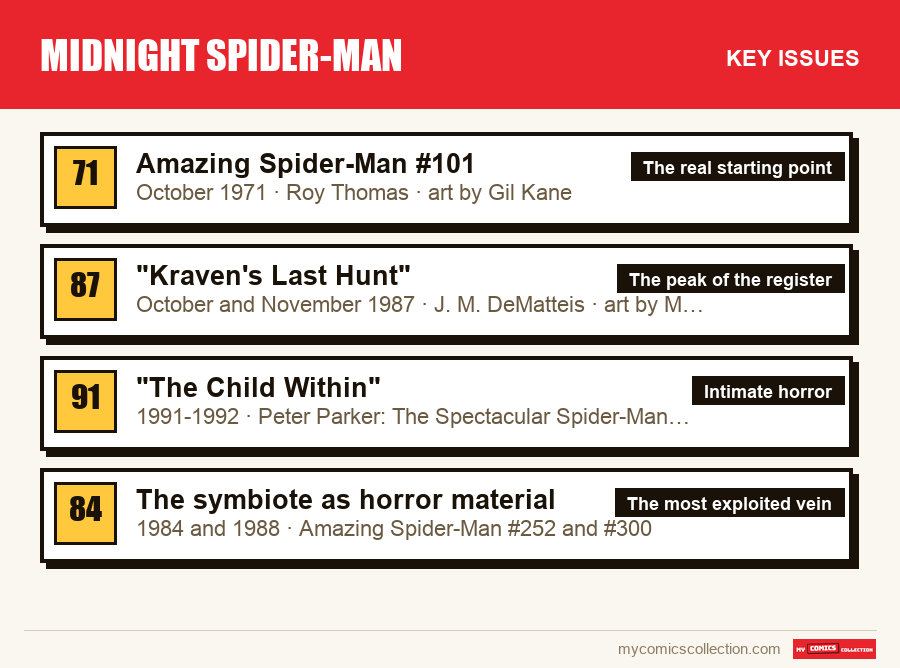
Amazing Spider-Man #101
In February 1971, the profession's self-censorship body, the Comics Code Authority, lifts its ban on vampires and several supernatural figures. Marvel reacts fast, and it is in Amazing Spider-Man #101 that Morbius, the first vampire of the new era, appears. Roy Thomas and Gil Kane build him as a scientific accident rather than a folkloric creature, and Kane is instructed to avoid gothic imagery in favor of the primary colors of a supervillain. It is also the first issue of the main series not written by Stan Lee since the character's creation in 1962.
"Kraven's Last Hunt"
Six parts spread across three simultaneous series: Web of Spider-Man #31 and #32, Amazing Spider-Man #293 and #294, Peter Parker, the Spectacular Spider-Man #131 and #132. Kraven buries Spider-Man alive and takes his place to prove his superiority. The story is built on madness, obsession and burial, and is regularly cited as one of the character's greatest stories. It is psychological horror embraced, published at the heart of the 1980s, in the main continuity.
"The Child Within"
The same writer returns four years later in an even darker register, crossing Harry Osborn's dementia with the figure of Vermin, whose story openly explores the aftermath of abuse. The arc is long, slow, grueling, and nothing like a superhero adventure. It demonstrates something useful for understanding Midnight: Spider-Man handles horror very well when it is internal, not when it is decorative.
The symbiote as horror material
We do not retell the symbiote's history here, covered elsewhere on the site, but a point of method deserves to be made. What made this vein's fortune is not the black costume of Amazing Spider-Man #252 nor even the creature of Amazing Spider-Man #300: it is the narrative principle of an organism that inhabits a body and alters it. It is a horror-movie mechanism introduced into an adventure series, and it produced the most profitable spinoff character in the catalog.
Put end to end, these four references say the same thing. At Spider-Man, horror is neither an accident nor a transgression: it is a mode of operation available since 1971, which has produced lasting first appearances and major stories. Midnight Spider-Man is therefore not attempting a coup. It formalizes a tradition. Which is reassuring editorially, and rather unfavorable speculatively: a register already explored has less chance of producing a market surprise.
Why Spider-Man rereadings hold up better than others
There remains one fact that works in the title's favor. Marvel has tried parallel versions of many of its franchises. Only one produced a lasting collectible, and it is a version of Spider-Man.
In 2000, the publisher launches the Ultimate line on an idea of Bill Jemas: forty years of continuity had made the Marvel universe inaccessible to new readers, they had to start from zero, and they had to start with Spider-Man. Ultimate Spider-Man #1, written by Brian Michael Bendis and drawn by Mark Bagley, stretches into seven issues and about one hundred eighty pages an origin that originally fit in eleven pages.
Here is the number almost nobody cites, and the most instructive of this whole article. In September 2000, Ultimate Spider-Man #1 ranks fifteenth in the market's preorders, with 54,407 copies ordered. Fifty-four thousand. For a launch that was going to become the character's reference version for more than twenty years and feed film and animation. The series' total paid circulation for the year 2000 then reaches about 354,115 copies per issue, but that rise comes from reprints, not from the initial print run.
In other words: the scarcity of Ultimate Spider-Man #1 in first printing was not manufactured by enthusiasm, it was manufactured by caution. The market did not believe in it, the market ordered little, and it is that little that became precious once the series was established. The series eventually even overtook Amazing Spider-Man in sales, which was not at all the starting hypothesis.
Two lessons come out of it, and they do not point in the same direction.
The favorable lesson: the public accepts an alternative version of Spider-Man more readily than that of any other Marvel character. The costume, the silhouette and the principle of the character survive very violent rewrites. A horror rereading therefore has a real chance of finding a readership of its own, and not just a two-month curiosity.
The unfavorable lesson: what gave the 2000 issue #1 its value was a low initial print run. Midnight Spider-Man #1 starts in the exact opposite configuration. It arrives with a communication campaign, a clear release slot, three coordinated series and the attention of the whole market. Orders will be high. The condition that made Ultimate Spider-Man #1 a sought-after piece is absent.
This is not bad news for the reader, it is information for the buyer. The two issues #1 are not the same economic object, despite the resemblance of their editorial promise.
What to watch during the first twelve months
Since issue #1 will not be scarce, the useful question becomes: where, on this series, does scarcity have a chance of forming? Here are the six checkpoints to keep an eye on, in the chronological order in which they will show up.
Issue #2, on November 18, 2026
It is the only real test, and also the least ordered issue of a starting series. The drop from an issue #1 to an issue #2 is the sharpest of a title's whole life cycle, because retailers adjust their orders downward before knowing real sales. On a series that ends up settling in, issue #2 is structurally harder to find than issue #1. It is counterintuitive and it is regular.
A possible second printing of issue #1
If the first printing sells out, Marvel reprints. A second printing almost always circulates in far fewer copies than the first, because it is ordered once demand is known and to fill it, not to anticipate it. It is not the reference piece and must not be presented as such, but it is often the hardest object to find from a launch. You still have to be able to tell the two apart on the copy you hold, which is written in the legal notice on the inside page.
The first appearance of a creation specific to the line
This is the most important point of the list. The last fifty years of the market say the same thing with monotonous regularity: what gains value is a first appearance that lasts. Morbius in 1971 shows it, the symbiote in 1984 and 1988 shows it. If Midnight Spider-Man introduces a creature, an antagonistic version or an entity that Marvel then picks up elsewhere, the issue concerned will become the series' piece. It will come out six, eight or fifteen months after launch, at a far lower print run, and almost nobody will have set it aside.
The first crossover with main continuity
A parallel line lives in its corner until the day it touches the main universe. On that day, it stops being a curiosity and becomes a piece of the canon, and the readers who had ignored it have to catch up. It is the mechanism that gave several alternative universes a second commercial life. Nothing is announced in that direction today, and that is precisely why you need to watch for the moment it happens.
The release of the first collected edition
The move to collected form is a health marker and a market marker. It signals that the publisher believes in duration, and it transfers reading demand from the single issue to the bound volume. From that moment, single issues are only bought by collectors, which cleans up demand but reduces it. It is generally the quietest period to find the first issues at a reasonable price.
The twelfth issue
A series that reaches its twelfth issue with no announcement of an end has passed the milestone. The announced pace for the first three episodes is not monthly, so that milestone will be reached well after October 2027. It is the reasonable horizon to judge the line, and only then does the question of getting a copy certified begin to arise seriously.
The only defensible strategy before October 7
It comes down to three decisions, all made before entering a shop.
Decide whether you are buying to read. If horror interests you and you like the character, it is simple: take the main cover, read it, and you will have obtained everything this comic can give you with certainty. If you are only buying in hope of a gain, the previous pages explain why it is the worst candidate of the three launches of the day.
Take one copy, not a collection of covers. The question of variants and ratios is a subject in itself, which requires knowing how to read an order catalog. For a first contact with a line whose performance nobody knows yet, one copy in main cover of the first printing is enough. It is the version the market will identify unambiguously in ten years.
Record the purchase the same day. It is the part everyone neglects and which costs the most in the long run. In the app, create the series as soon as you buy the first issue, then note the cover, the printing and the date of acquisition. In three years, when you need to prove that your copy is a first printing from release week, that recorded line will carry more weight than any memory. And enable release tracking: with an issue #2 six weeks later, forgetting is the first cause of a gappy collection.
The rest is a matter of patience. Spider-Man survived a record of 2.5 million copies, a speculative bubble, a complete rewrite in 2000 and several announced deaths of superhero comics. He will survive horror. The question is not whether the character will come out of the exercise bigger, but what this version will have produced that is reusable. And that answer cannot be bought on October 7: it is observed, issue by issue, over a year.