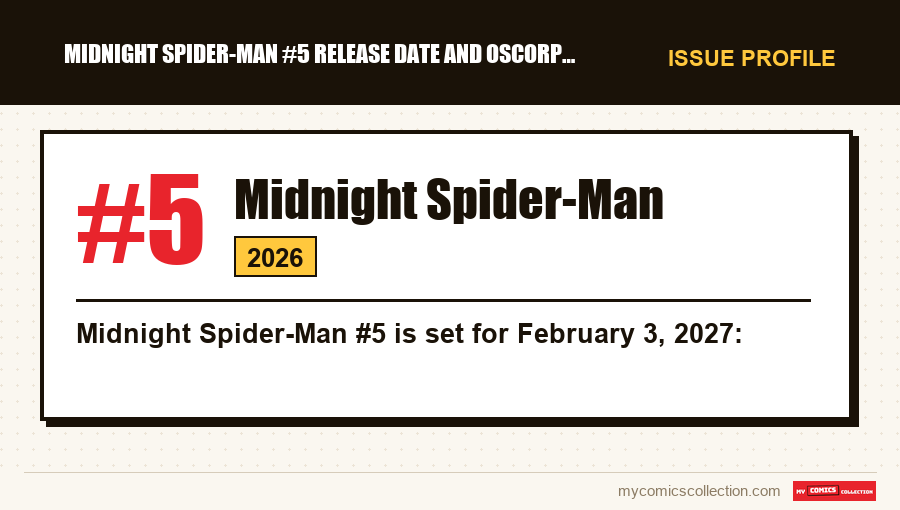
The Midnight Spider-Man #5 release date is February 3, 2027: written by Phillip Kennedy Johnson, drawn by ScieTronc, with a veiled cover A by Steve Beach. According to Marvel, Oscorp's new monster, a second-generation creature, is unleashed and makes Spider-Man its first target, while the mutation behind Spider-Man finds a new host, with striking consequences. It is the last issue of the series scheduled to date.
A solicitation that opens with "the monster is unleashed" promises a confrontation issue. What the page does not say is where this monster comes from, and that is precisely why its announcement deserves a closer look.
As always in this guide, only verified information (creators, issue numbers, dates) is stated as fact; the analysis is ours, with no reproduction of protected pages or dialogue.
Issue #5 spec sheet: release, creators, cover
Marvel places Midnight Spider-Man #5 on Wednesday, February 3, 2027. The series reaches its fifth and last appointment of the known schedule. The line's other two series follow: Midnight Fantastic Four #5 on February 10, then Midnight X-Men #5 on February 17. In other words, February 2027 is a month spread over three Wednesdays, and Spider-Man kicks it off.
The script is by Phillip Kennedy Johnson and the art by ScieTronc, as since the October 7, 2026 launch. Cover A is by Steve Beach, veiled per the line's convention. The page count, the rating, the colorists and the letterer do not appear in the announcements we have; we therefore fill in only what is known, and we advise you to do the same in your inventory until you have the single issue in hand.
This page does not redo the presentation of the line, which you will find in our complete guide to Marvel Midnight. It focuses on what issue #5 puts at stake: a corporation, a monster and a mutation, three elements that each have a long history in the classic series.
What the solicitation announces: a monster and a new host
The solicitation comes down to two announcements. The first is head-on: the monster of Oscorp's second generation is loose, and its first target is Spider-Man. The second is more oblique: the mutation that created Spider-Man finds a new host, and the consequences are described as striking. Marvel's text says no more, and we respect that limit: no identity is given to the creature, no detail about the person who receives the mutation, no hint about the outcome.
What is legible, however, is the construction. The vocabulary of a "second generation" assumes a first generation exists: that of Peter Parker, whose transformation at Oscorp issue #1 tells. The vocabulary of a "new host" assumes, for its part, that the mutation is something that passes on. The two announcements therefore look in the same direction: the series moves from the story of an individual to that of a process, from a case to a lineage. This reading is ours, and it remains a reading: the issue will come out in several weeks.
For those following the series from the start, the chronology of the announcements sketches a steady build-up. Peter disappears, residents worry, an urban legend takes hold, an investigator gets involved, then Oscorp's creature is unleashed. With issue #5, the solicitation puts Oscorp's creature in the foreground. If your interest is that of a reader, it is the promise of a showdown; if it is that of a collector, it is a pivot issue to shelve in its place in the run.
Oscorp in the classic series: the company behind the Green Goblin
Oscorp is not a neutral backdrop. In the classic series, the company is tied to Norman Osborn, created by Stan Lee and Steve Ditko. It is in The Amazing Spider-Man #37 that Osborn finally gets a name; he had been glimpsed in a few panels earlier, without being identified. The Green Goblin, for his part, is introduced in The Amazing Spider-Man #14, and it is later that the series reveals Osborn and the Goblin are the same man. That issue has its own dossier (The Amazing Spider-Man #14), and the character has his reference page: the Green Goblin.
This reminder serves to place what the Midnight version does with this legacy. In the classic series, the company is the setting in which a powerful industrialist becomes an adversary; science, profit and madness rub shoulders there, and the threat has a face. In the issue #5 solicitation, Oscorp is the producer of a monster: the creature is described as a product of the company, of a "second generation." The same institution, seen from the lab side rather than the boardroom side. The setting is recognizable; the function has changed.
That is, incidentally, one of the line's attractions for a reader who knows the original series: spotting what was kept (the names, the places, the institutions) and what was moved (the order of causes, the genre framing the whole). This reading exercise requires no collector's expertise, and it is the best way not to confuse a reinvention with a sequel.
A threat born from the same source as the hero
The issue #5 solicitation points to a device the classic series has used several times: the adversary who comes from the same origin as the hero. Spider-Man's origin, presented in Amazing Fantasy #15 by Stan Lee and Steve Ditko, rests on a radioactive spider bite during a science demonstration. The event happens only once in the narrative, which gives anything resembling a repetition of this origin a particular charge. We return to this issue on our page about Spider-Man's debut.
The best-documented case of this logic is Carnage. The killer Cletus Kasady shows up as early as The Amazing Spider-Man #344; his Carnage form fully takes hold in issue #361, a creation of David Michelinie and Mark Bagley. Carnage descends from the Venom symbiote: he is presented as its offspring, and the series sets him against Spider-Man as a threat born of the same universe as Venom. The principle is that of a generation extending the previous one. You will find the details on our pages about The Amazing Spider-Man #361 and on the Carnage character.
We are not saying that Oscorp's creature repeats this pattern: the solicitation does not say so, and nothing allows us to assert it. We are saying that the classic series contains a tradition of second-generation threats, and that it is in this tradition that the seasoned reader will spontaneously place Marvel's announcement. This tradition has its own codes: the adversary more fearsome than his elder, the fear of spread, the impossibility of going back. The Midnight line, which claims horror, draws on it in its own way.
Do you collect this series?
Track what you own, what you are missing and what your collection is worth. 7-day trial.
Start my trial →
The new host: a mutation that moves
The issue's second announcement, the mutation that finds a new host, touches on what makes Spider-Man singular in his origin: one hero, one event, one bite. The whole classic series rests on this rarity. Stories that multiply power-bearers, like those that multiply copies, question this condition, and they are rarely harmless: they force the series to redefine what makes Peter Parker Peter Parker.
In the Midnight framework, the announcement takes on a different meaning. The mutation is not a stroke of luck that lands on a teenager; it is, according to the issue #1 solicitation, the result of a quest for immortality led by a corporation. That another bearer receives it thus looks more like a consequence than a plot twist, and the solicitation stresses the effects rather than the person. We will go no further: the solicitation does not say who receives the mutation, and any hypothesis on this point would be invention.
For your collection, the practical message is simple. A series that announces a change of bearer or a change in the nature of a central element is a series whose later issues are read in light of the fifth. If the Midnight line continues for Spider-Man, this issue will be a reference point for finding where things shifted; you should therefore have it on hand, rather than hunting for it later among the unsold.
Cover and copies: what we can know today
Steve Beach signs cover A, veiled like those of issues #2 to #4: the illustration only appears in full inside the single issue. The second printing of issue #1, announced for October 28, 2026, incidentally carries Steve Beach's cover fully unveiled: for this series, the veiled cover therefore designates the current state of issues in the course of publication.
For the other issue #5 covers, we stick to what the announcements let us write, that is, cover A. To understand the line's variant families and how to read a ratio without confusing it with a print run, see the page on ratio variants. We refrain from adding artists or ratios we have not seen.
What the last announced issue changes for a shop subscription
A fifth issue is also a decision point for the buyer. The five announced issues make a set that reads in one sitting, and the issue #5 solicitation has the shape of a confrontation episode. If Marvel announces an issue #6 or a new series in the Midnight universe, the decision will be made on facts; until then, no continuation is established, and it is better not to assume one.
The most useful thing, in the meantime, is to check that your collection is complete: if an issue is missing between #1 and #4, now is the time to look for it, while copies are still easy to find in shops. Our page on missing comics explains how to draw up that list. Rereading the page on the series' key issues also helps set a buying rule, rather than buying by reflex.
If the idea of getting a copy certified crosses your mind, remember that grading is justified by condition and by established scarcity, not by the novelty of a release. The grading landmarks are on our CGC grading page, to be consulted before deciding anything.
Single issue or collected edition: what to plan for the end of the series
No collected edition is announced in the documents we have consulted. This silence says nothing about the future: we can neither announce an edition nor rule one out. The choice is therefore made on personal criteria. The single issue suits those who like covers and monthly reading; a collected edition, if one comes, would suit those who prefer continuous reading and more compact storage.
In both cases, the inventory record should be precise: series title in the original English, issue number, release date, cover letter, and condition. This discipline seems tedious for a five-issue series, but it becomes indispensable when the same line has three parallel series, each with its variants. To set it up without spending hours, start from the general method for managing a collection and adapt it.
Frequently asked questions
Marvel announces the release of Midnight Spider-Man #5 for Wednesday, February 3, 2027. The #5 issues of the line's other two series follow: Fantastic Four on February 10 and X-Men on February 17. The Spider-Man series therefore opens this February.
Phillip Kennedy Johnson on script; ScieTronc on art. Cover A is by Steve Beach, veiled. The colorists, the letterer and the page count do not appear in the current announcements: leave those fields empty in your inventory.
Marvel announces that Oscorp's second-generation monster is unleashed and that Spider-Man is its first target. The solicitation adds that the mutation that created Spider-Man finds a new host, with striking consequences. No identity is given: the detail will only be known on reading.
No appearance is announced for this issue. The second-generation creature is not named in the solicitation. For a collector, the prudent approach is to shelve this issue in its place in the run, without giving it a value that nothing supports before release.
It is the last issue scheduled to date: Marvel's announcements cover issues #1 to #5, from October 2026 to February 2027. They remain silent on a possible extension. That decision belongs to the publisher, and we do not guess it.
Before completing your Spider-Man collection, have the issues you already own appraised, old and recent alike.
Estimate my comic