A ratio cover is not a limited print run: the "1:25" figure describes a purchase condition imposed on the retailer, who must order twenty-five copies of the main cover to earn the right to order a single copy of the alternate cover. That figure therefore says nothing about the number of copies in existence, since that depends on the volume ordered by all stores combined. On a hotly demanded launch like Marvel's Midnight line of October 7, 2026, where the publisher releases nothing else that day, orders concentrate, the main cover climbs, and "rare" variants multiply in proportion. The rational decision is to buy a variant for what it is (an image you want to own), not for a scarcity announced before release that nobody can yet verify.
Ten different covers. That is the number of versions announced for each of the three #1s of the Midnight line, labeled A to J. In a well-stocked shop, the reader who walks in on October 7, 2026 to buy Midnight X-Men #1 will not find one comic: they will find a display of images to choose from, with price gaps that have nothing to do with the face price printed on the back.
This situation is neither an accident nor a one-off excess. It is the normal functioning of the North American market for some twenty years, and it rests on a mechanism that almost everyone quotes wrongly: the ratio. The misunderstanding is always the same. "1:100" is read as one would read "limited edition of one hundred copies," whereas the two statements do not at all have the same meaning, nor the same relationship to scarcity.
This article takes the mechanism apart, then applies it to a concrete and dated case. It is written on October 1st, 2026, that is, after retailer orders have closed and before the on-sale date. In other words, at the only moment when print runs are already fixed but still unknown to the public. It is exactly the window in which bad decisions are made, and it deserves a close look.
What a ratio figure really designates
Let us start with the plumbing, because everything flows from there. At North American publishers, a comic is not printed and then offered to shops: it is ordered by shops, then printed. Retailers place their orders in advance with the publisher's distributor, and these orders are locked at a cutoff date a few weeks before the on-sale date. After that date, quantities no longer move and printing is launched on the basis of what was ordered.
A ratio cover slots into this circuit as a conditional reward. The order form indicates, for a given alternate cover, a proportion: for example one to fifty. This means a shop earns the right to buy one copy of this cover for each block of fifty copies of the main cover it commits to take. Does it want three copies of the alternate cover? It will have to order a hundred fifty of the main one, pay for them, and sell them through.
The purpose of the mechanism is transparent and has never been hidden: to inflate orders of the standard version. The publisher gets a more comfortable base print run, the guest artist gets distribution, and the retailer an object they can resell above face price to offset the stock they had to absorb. Each of the three actors has a reason to take part. None of the three aims to create a durably scarce object.
Hence the consequence almost nobody takes in: the ratio figure is a divisor, not a ceiling. It does not set the number of copies produced, it sets the entry price in standard copies. The number actually produced depends entirely on shops' appetite for the main cover. Two covers showing the same ratio on two different series may exist at a few dozen copies for one and several thousand for the other. The figure is identical. The scarcity is nothing alike.
Put another way: a high ratio on a very low-selling series produces an objectively scarce object that nobody is looking for. A modest ratio on an event launch produces an abundant object that everyone thinks is scarce. It is precisely the second situation that awaits us on October 7.
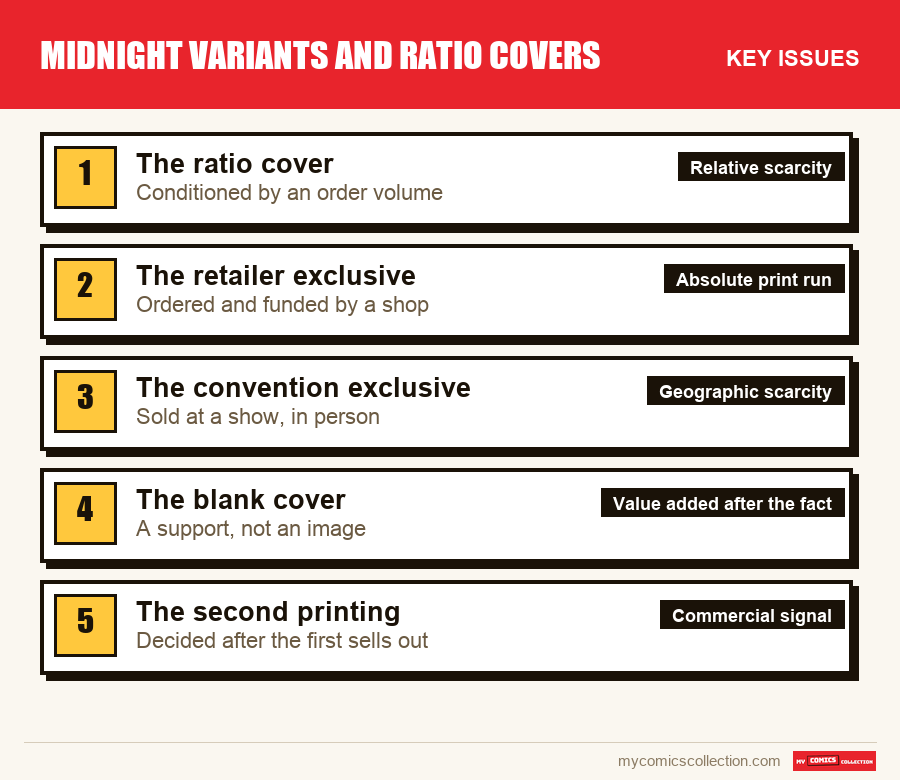
Five different objects called "variant"
The word "variant" covers realities whose scarcity regimes have nothing in common. Confusing them is being wrong about what you are buying. Here are the five you actually run into in shops.
The ratio cover
The case detailed above. Its quantity is the product of two unknowns: the orders of the main cover, and the proportion of retailers who actually exercise their right. Many give it up, because triggering the right costs a cash advance on standard copies that will have to be sold. The higher the required proportion, the more people let it pass.
The retailer exclusive
The inverse logic of the previous one. Here, a shop or group of shops directly commissions a cover from an illustrator, funds the printing and sets the quantity. There is no proportion to reach: there is a number, often announced, sometimes printed on the object. Some even carry the commissioner's name. It is the only family where the word "limited" has a verifiable arithmetic meaning from the start.
The convention exclusive
Same principle of a closed print run, but with an additional constraint: the object can only be acquired in one place and for a few days. The quantity produced is small, and demand is cut by all those who did not make the trip. This double restriction creates very marked availability gaps depending on the continent.
The blank cover
This one is not a variant in the usual sense: it is a comic whose cover is deliberately left blank, apart from the title, the number and the barcode. It exists to be drawn on, generally by an illustrator met at a show. The raw object has almost no collecting value; what has value is the drawing added to it, and therefore the identity of whoever drew it.
The second printing
It is not an alternate cover but a reprint, decided because the first printing has been absorbed. It arrives several weeks after release, most often with a different image and a printing notice in the legal indicia. Its quantity is calibrated on the restocks requested, therefore generally well below the first printing.
To these five families are added variations that do not change the scarcity regime but change the object: the version with no logo or text, the black-and-white version, the metallic-finish version, and the so-called connected cover, which only makes sense assembled with those of the other titles in the same set. The same image can thus exist in four states, two of them ratio and two open order. That is where most cataloging errors are born.
Why scarcity announced before release is worth nothing
Suppose a publisher announces a one-in-one-hundred cover on a #1. Three things separate this announcement from real scarcity, and they all play in the same direction.
First, the right is not the use. Having the right to order one copy obliges no one to do so. Triggering a high proportion means tying up the price of a hundred standard copies, which will have to be sold or discounted. High-volume shops do it without thinking; the others abstain. The number of copies actually ordered is therefore always below, often far below, the theoretical maximum obtained by dividing the print run by the ratio. And this gap widens as the required proportion increases.
Second, printed is not available. Some copies are damaged in handling, others stay in a display case for years, others still go into collections that will never be unwound. At any given moment, the number of copies actually offered for sale is a fraction of the population produced. It is this float, not the print run, that determines what you must concede to get one.
Third, scarcity without demand is not scarcity, it is obscurity. Two hundred copies of an image nobody is looking for sell at face price, or do not sell. Scarcity acts on a price only when multiplied by demand, and demand is the unstable term of the equation. It depends on what the story will produce, on the artist, and on outside events that no September announcement can anticipate.
What determines real scarcity is therefore measured after the fact, through three cross readings: the order of magnitude of the print run, reconstructed from order data published later; the population recorded by grading services, which gives a partial but usable picture of what exists in very fine condition; and the history of transactions actually concluded, which is the only judge of demand. None of these three readings is available on release day. All three will be in a year.
The Midnight case: ten covers and an empty day
Let us apply all this to the October 7, 2026 launch. The Marvel Midnight line starts with three #1s the same Wednesday: Midnight X-Men #1 by Jonathan Hickman, Midnight Spider-Man #1 by Phillip Kennedy Johnson and Midnight Fantastic Four #1 by Benjamin Percy. The #2s follow on November 18, the #3s on December 16. For the presentation of the line itself, its premise and its teams, see the complete guide to the Midnight line; what concerns us here is solely the cover offering.
Marvel structured this offering in an unusual way, and one quality must be granted it: it is legible. Five categories come back identically across the three titles and on every issue, labeled A to E.
- Cover A: the series' regular cover, in a so-called veiled presentation, where the image is partly masked by shadow. Dike Ruan on Midnight X-Men, Steve Beach on Midnight Spider-Man, Kev Walker on Midnight Fantastic Four.
- Cover B, Midnight Bloodbath: the bloody variation, handled by Ryan Stegman on all three titles.
- Cover C, Midnight Special: the rereading of a Marvel character in the horror register. Skan on the X-Men, Peach Momoko on Spider-Man, Ben Harvey on the Fantastic Four.
- Cover D, Midnight Horror Homage: the tribute to the imagery of horror cinema and pulp magazines. Björn Barends, Skan and E. M. Gist depending on the title.
- Cover E, Midnight Gallery: the painted version, entrusted to Jeehyung Lee on all three series.
The stated intent is to make cover collecting intelligible: the reader knows in advance which family they follow, and the retailer anticipates demand better. It is a real improvement over the usual practice, where cover letters change meaning from one issue to the next.
But the A to E program does not replace the other covers: it adds to them. Beyond letter E, the published lists show for each #1 a three-part connected cover signed Clayton Crain, which only forms a complete image once the three titles are brought together, a version with no logo or text of cover C, then two additional covers by other illustrators, one of them also offered without text. That makes ten announced versions per issue, thirty for the day of October 7.
The important point, and it is honest to say it clearly: the order proportions associated with these covers are not published. They appear on trade order forms, not in announcements aimed at the public. We know how many images exist; we do not know which are open order and which are conditioned, nor at what level. Anyone who states it to you precisely today is extrapolating.
The effect of a day with no other release
Marvel scheduled no other title on October 7. It is a distribution decision, and it has a mechanical consequence on ratios that is worth unrolling.
A retailer has an order budget and a shelf of new releases. In an ordinary week, this budget is spread over about twenty of the publisher's titles. That week, there are only three slots. The budget does not disappear: it concentrates. Orders of main covers on these three issues will therefore be clearly higher than they would have been in a busy week, especially as the publisher authorized shops to hold midnight openings, without pushing them to.
Now, the quantities of conditioned covers are proportional to these orders. The more the main cover is ordered, the more ratio covers exist. The paradox is complete: the day that makes these issues most visible is also the one that makes their variants least scarce. A proportion that would produce a few hundred copies on an established series can produce several thousand here, without the label changing by a digit.
Let us add that the order cutoff date passed at the end of September. The print runs are fixed. They will neither be announced on release day, nor deducible from the mood in the shop, and the first usable order data will only arrive with a lag of several weeks. Any scarcity estimate formulated between today and year's end is therefore an opinion, not a measurement.
Deciding: when a variant is justified, when it is not
Here is a six-question method, in this order. It does not aim to maximize a hypothetical gain, but to make sure you do not regret your purchase in three years.
Do you want this image, or this number?
The test is simple and it eliminates most dubious purchases. If the same illustration were available in open order, with no mention of a proportion, would you pay above face price for it? If the answer is yes, buy it: you are buying an image, which is a solid motive. If the answer is no, you are paying for a label you have just read measures nothing.
Does the issue have a stake of its own?
A conditioned cover inherits the demand of the issue carrying it, it does not create it. A launch first issue is an object of attention, not necessarily an object of stakes: by definition it contains no first appearance whose significance is already known. On a line that is starting, the stakes reveal themselves later, which is why waiting costs less than it seems.
Is the base print run high or low?
It is the question the ratio does not ask and which decides everything. A massively ordered launch dilutes its own variants. A discreet series concentrates them. In the case of October 7, all signals point to a high base print run, therefore to variant quantities above what the labels suggest.
What are you giving up to get it?
A variant is paid several times the price of the main cover. Put the expense in terms of other comics you will not read. Three alternate covers on the three #1s represent a substantial reading budget, devoted to three objects identical in content to three much less costly objects.
Does the connected series interest you in full?
The three-part cover is the most elegant trap of the lot: it only makes sense assembled, so it imposes all three titles. If you only want to read one of the three series, buying a third of an image is a pointless expense, and completing it later on the secondary market will cost more than the three bought on the same day.
By default, take the main cover
It is not a fallback, it is a choice. The first printing's regular cover is the version the market identifies as the reference of an issue, the one that appears everywhere and whose condition is easiest to compare. On an issue whose importance nobody yet knows, it offers the best ratio between what you spend and what you will know you bought.
There remains the case where a variant is fully justified, and it exists. You follow a particular illustrator and their work interests you for itself. You are building a thematic collection, for example horror cinema tributes, in which case cover D of each issue has a coherence the main one does not. Or you have the chance to buy a version with no logo or text of an image you love, and you prefer the bare image. In these three cases, the purchase rests on a stable criterion, which depends on no forecast. It is the only defensible basis.
Recording a variant without getting it wrong later
The practical problem arrives six months after purchase, when you have to answer the question: "which of the ten, exactly?" On a set of three series whose covers come back in families issue after issue, memory fails very quickly, and the object itself is often silent. Many conditioned covers carry no mention of their status.
Six pieces of information are enough, provided you enter them the same day, while the comic is in your hands and the receipt is still in your pocket.
- The cover letter and the family name. "Cover D, Midnight Horror Homage" is a complete identification. "Variant" is not.
- The cover illustrator, who is almost never the interior artist. On these three issues, ten covers point to eight different illustrators for a single page artist. It is the cover illustrator who identifies the object.
- The variation. With logo and text, or without; in color or in black and white; connected or standalone. Two objects carrying the same letter and the same illustrator name can be two distinct objects.
- The announced proportion, if it was indicated to you, noting that it is reported information and not a printed notice. Specifying it will keep you from later taking it for certain data.
- The printing. First, second, or later. It is read in the legal indicia, inside. It is the easiest information to check today and the hardest to reconstruct in ten years.
- The price paid and the date. Not to speculate, but because it is the only data no one but you will ever be able to retrieve.
In the app, these six fields are filled in when the issue is added, and it is the same gesture that then lets you filter the collection by variation or by illustrator. If you follow a cover family across several issues, the list of missing issues will tell you what remains to be found on that precise family rather than on the series in general. And to know whether grading makes sense on a modern copy, reading up on grading is a prerequisite: on a heavily printed comic, a high grade is the normal condition of a copy bought new, not a distinction.
What to look at after release
Three deadlines will say, far better than any announcement, what the October 7 covers were really worth.
The following weeks, for second printings. If one of the three issues goes back to press, it is the most reliable commercial signal we will have: the first printing, however massive it was, was not enough. It will be known quickly, and it will say more about demand than the crowds on release day.
November 18, for the #2s. That is when orders recalibrate on real sales instead of calibrating on anticipation. If base quantities fall sharply, the conditioned covers of #2 will become genuinely fewer than those of #1. It thus regularly happens that a variant of a second or third issue is much harder to find than that of the first, for the sole reason that nobody ordered it.
The course of 2027, for the data. Order magnitudes, certified populations and a sufficiently long transaction history will then appear. Only at that point will the words "scarce" and "common" have verifiable content for these thirty covers, and an estimate backed by completed sales will make sense on any one of them.
In the meantime, the most comfortable position is also the simplest. Buy what you want to read and what you want to look at, in main cover if no other particularly attracts you. Note precisely what you bought. And leave to those who gamble the job of discovering, in a year, what their bet was worth.