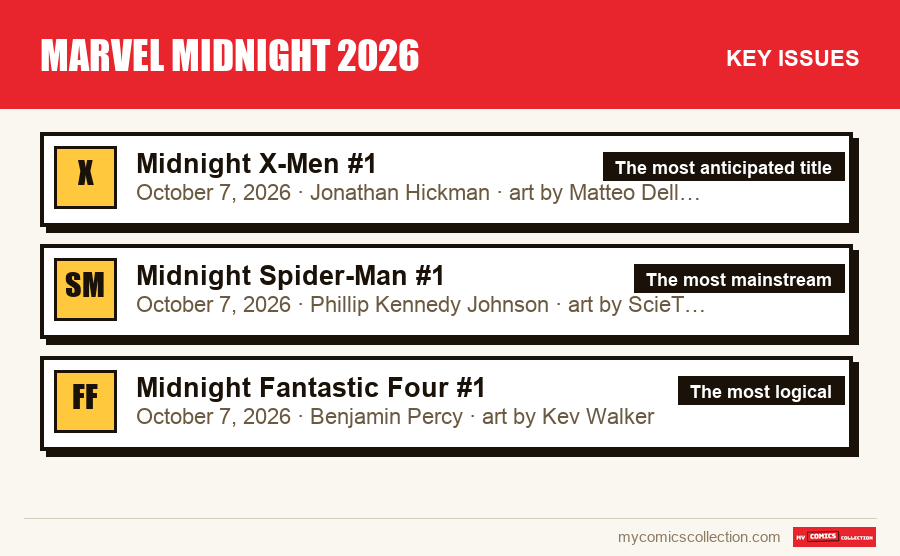
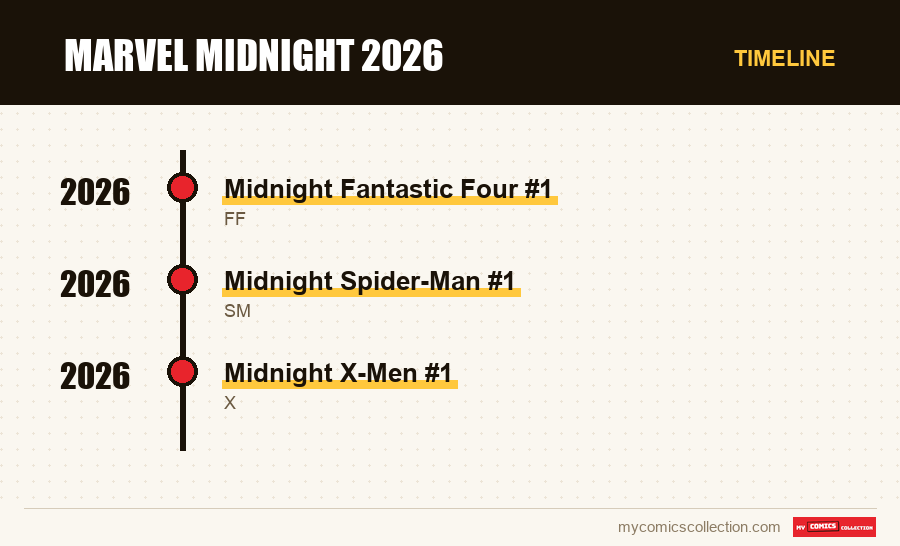
Marvel Midnight is a shared-universe line launched on October 7, 2026, which rewrites three house franchises through the lens of horror. Three number 1s come out the same day: Midnight X-Men #1 (Jonathan Hickman, art by Matteo Della Fonte), Midnight Spider-Man #1 (Phillip Kennedy Johnson, art by ScieTronc) and Midnight Fantastic Four #1 (Benjamin Percy, art by Kev Walker). Marvel has scheduled no other release that Wednesday, which has not been seen in a long time. What follows is already dated: the three number 2s on November 18, 2026, the number 3s on December 16, 2026. It is not a one-off event but a universe meant to last, with its own continuity. This article explains what the line really is, what it is not, and how to approach these three number 1s as a collector rather than a speculator.
There are two ways of welcoming the launch of a parallel line at Marvel. The first is to buy the three number 1s on release day, hoping that one of the three becomes the piece everyone will be looking for in five years. The second is to first ask what this line is about, who is making it, and how many copies will really circulate. The first approach has cost a lot of people a lot of money since the 1990s. The second takes half an hour of reading.
This article is written before the release, on October 1st, 2026. No copy is yet in circulation, no price guide value exists, and anyone who told you today the future value of Midnight X-Men #1 would be making it up. What does exist, on the other hand, are programming facts, named creative teams, a published calendar, and forty years of editorial history that say quite precisely how this kind of launch behaves.
What Marvel Midnight is, and what it is not
The word Marvel uses is "universe," not "event." The nuance is anything but cosmetic for a collector. An event has a beginning, an end and a final issue: it is collected as a closed object, and its value depends largely on what it changes in the main continuity. A universe has no announced end: it is collected like a subscription, and its value depends on its ability to last and to produce characters you will find elsewhere.
Midnight belongs to the second category. The three series share a setting, answer each other, and Marvel speaks of an interconnected mythology rather than a one-off crossover. Concretely, that means a reader who took only one of the three series will read a complete story, but will miss part of the echoes between the titles.
The creative principle is also explicit: each writer is given wide latitude to turn known heroes into something darker. It is therefore neither a sequel, nor a prequel, nor a one-off "what if." It is a rereading, in the sense that you reread a text through another grid. Spider-Man remains Spider-Man, but the genre framing him is no longer the New York adventure serial: it is horror.
One last point deserves attention, because it is rare: Marvel has scheduled no other release on October 7, 2026. The publisher's entire release day is devoted to these three issues. It is a distribution decision, not an artistic one, and it has very concrete consequences for what will happen in stores that day. We come back to it below.
The three number 1s of October 7, 2026
Here is what is confirmed, and only what is confirmed.
Midnight X-Men #1
It is the title that draws attention, for a simple reason: Hickman returns to the X-Men, seven years after refounding the franchise with House of X and Powers of X in 2019. That precedent is the only useful comparison, and it cuts both ways. In 2019, Hickman had not written a good X-Men series: he had changed the franchise's grammar for five years, by imposing a mutant nation and an entirely new reading structure. Here, the announced frame is horror, not political science fiction. The author is the same, the method probably close, the object very different.
Midnight Spider-Man #1
Spider-Man is the publisher's best-selling character, and also the one whose alternative rereadings have historically worked best. Phillip Kennedy Johnson arrives with a reputation built on dark-register stories, notably on Hulk. The bet is readable: take the most familiar character in the catalog and make him uncomfortable. It is exactly what the Ultimate line had achieved in 2000, by other means.
Midnight Fantastic Four #1
By far the most coherent pairing of the three. Benjamin Percy is a horror novelist before being a comics writer, and he spent several years at Marvel on Wolverine and X-Force, that is, on the violent side of the mutant catalog. The Fantastic Four are also the family easiest to tip into horror: their origin is already an irradiation accident that transforms four bodies, and Fantastic Four #1 (1961) was as much a monster story as a superhero story.
The calendar to keep, and why it matters
Marvel has published the dates of the next two issues, which is more useful information than it seems:
- October 7, 2026: the three number 1s, the only Marvel release of the day.
- November 18, 2026: the three number 2s.
- December 16, 2026: the three number 3s.
Six weeks between number 1 and number 2, four between 2 and 3. It is not a monthly rhythm, and that is where many collections break: you buy three number 1s with enthusiasm, you forget to go to the shop in mid-November because nothing reminded you of the deadline, and you end up in January with three series full of holes. On a new line, there is no reading habit to make up for the oversight.
Second consequence of the calendar: number 2 is the real commercial test. Historically, it is between the first and second issue of a new series that the drop in orders is the steepest. If the three titles hold on November 18, the line will live. If one of them drops markedly, it will become a short-lived curiosity, which changes everything for anyone who wanted to collect it.
What the history of parallel lines teaches us
Marvel is not at its first alternate universe, and the past gives serious reference points.
Marvel 2099, launched in 1992. A cyberpunk future, several simultaneous titles, an enormous initial print run carried by the speculative bubble of the time. The number 1s of this line were printed in considerable quantities and bought by people who kept them sealed. The result thirty years later: they are comics easy to find and inexpensive, with the exception of a few copies in very high grade. The lesson is not "2099 was bad," because the line gave good stories and characters still in use. The lesson is that the abundance of copies neutralizes demand.
Marvel Knights, launched in 1998. Not an alternate universe but a separate editorial line, with widened latitude of tone. It produced runs that still matter and durably relaunched supporting characters. Its number 1s are not worth fortunes, but the line had a real effect on the catalog.
The Ultimate line, launched in 2000. The textbook case. Ultimate Spider-Man #1 became a sought-after issue, but not for the reason people think: it is not the fact of being a number 1 of an alternate line that gives it its value, it is having carried a version of the character that lasted more than twenty years and fed film and animation. The other number 1s of the same line, launched under the same conditions, did not have the same trajectory.
The new Ultimate universe, relaunched in 2024 after Ultimate Invasion (2023), written by Hickman. The closest precedent in time, and the most directly comparable, since it is the same author who was opening the project.
From these four examples emerges a simple rule, worth more than any price guide prediction: what gains value in a parallel line is not the launch, it is what survives it. A new character who takes hold, a version that becomes the reference, a costume taken up elsewhere. None of that is visible on release day.
Buy or wait: the decision, point by point
Separate reading from collecting
These are two budgets and two decisions. If the three series interest you as a reader, take them in the standard cover and read them: it is the only use whose return is guaranteed. The question of which copy to keep is distinct, and it can wait for number 3.
Favor the main cover of the first printing
On a new line's number 1, the main cover of the first printing is the reference the market will retain, because it is the one everyone identifies. Low-ratio alternate covers trade more, but they require knowing exactly what you are buying. For a first contact with a line, the main cover is the sober choice.
Do not grade anything before seeing the fallout
Having a modern number 1 graded the week of its release costs a fixed price for an unknown value. On a recent, abundantly printed comic, a 9.8 is nothing exceptional: it is the expected condition of a well-handled copy. Wait to know whether the line settles in. If it does, well-preserved copies will still be there.
Buy for yourself, not against others
On October 7, there will be only these three comics on sale from Marvel. All the day's attention will concentrate on them, and the mood will push you to buy more than planned. It is precisely the time to stick to a decision made before walking in.
Record your copies at purchase
Three series starting at the same time, with an irregular rhythm, is exactly the case where memory fails at six months. Record the printing, the cover and the price paid the same day.
The traps of the first month
Four mistakes come back with every line launch, and they all cost money.
Confusing announced scarcity and real scarcity. A cover presented as limited is only so relative to the main print run. On a heavily ordered launch, a so-called rare variant can exist at several thousand copies. The scarcity that counts is measured after the fact, by the number of copies actually kept in good condition, not by the figure advertised before release.
Buying all three series "so as not to miss one." It is an understandable reflex and a bad method: it triples the spending for zero information. If the budget is constrained, the Hickman title is the one whose effect on the rest of the catalog is most probable, because of the 2019 precedent.
Believing a second printing is worth nothing. It is false in general and particularly false on a series that starts strong: a second printing signals that the first was exhausted, and it often circulates at far fewer copies than the first. It is not the reference piece, but it is not junk.
Forgetting that horror ages particularly well. Horror comics have a market specificity: they benefit from a background demand, independent of adaptations, carried by fans of the genre and not only by superhero readers. A successful horror line can therefore find an audience beyond Marvel's usual readership, which is rarely the case for a classic alternate universe.
Tracking a new line in your collection
A new line poses a practical problem that established series do not: there is no history to hang on to. No legacy numbering, no already-filled catalog, no reference point to know what is missing.
In the app, three reflexes are enough. Create the three series as soon as you buy number 1, even with only one issue owned: that is what then triggers the tracking. Turn on release tracking for the three titles, so that the November 18 and December 16 deadlines come up effortlessly. Finally, record the cover and the printing of each copy at the time of purchase, while the information is fresh and verifiable on the object you are holding.
For anyone who keeps a built collection, the interest of a new line is also being able to date your entry precisely. In ten years, knowing that you bought Midnight X-Men #1 in the main cover, first printing, on its release day, will be worth more than any estimate made today.
Is it worth going?
Yes, if horror interests you as a genre, because it is a real editorial proposal and not a dressing. Yes, if you liked Hickman's work on the X-Men, because his return to the franchise, in a frame freed from continuity, is the creator event of this year-end.
No, if your only reason to buy is the hope of a short-term gain. The three issues will be available, printed in quantity, and nobody will run out of copies in six months. The value, if there is any, will come from what the line produces next: a character who stands out, a version that becomes canonical elsewhere, a series that lasts. None of that is decided on October 7.
The good news is that these two answers lead to the same gesture: buy what you want to read, keep it properly, and record it correctly. The rest will be seen at issue 12.