The Midnight Spider-Man #2 release date is November 18, 2026, and Doc Ock is the headline: Marvel announces the debut of Otto Octavius in the Midnight universe. Phillip Kennedy Johnson stays on script and ScieTronc on art. The solicitation describes a missing Peter Parker, missing New Yorkers and Oscorp subcontractors combing through surveillance footage. Steve Beach is the announced cover A artist.
In a five-issue series, #2 is the one where we learn who else lives in the world that #1 set up. Marvel announces the arrival of Doctor Octopus here, and it is that choice, more than the release date, that structures this article: who is Otto Octavius in Spider-Man's history, and what could his entry into a world of horror mean?
As always in this guide, only verified information (creators, issue numbers, dates) is stated as fact; the analysis is ours, with no reproduction of protected pages or dialogue. The issue has not been released: we rely only on what Marvel announces about it.
November 2026: the #2 spec sheet
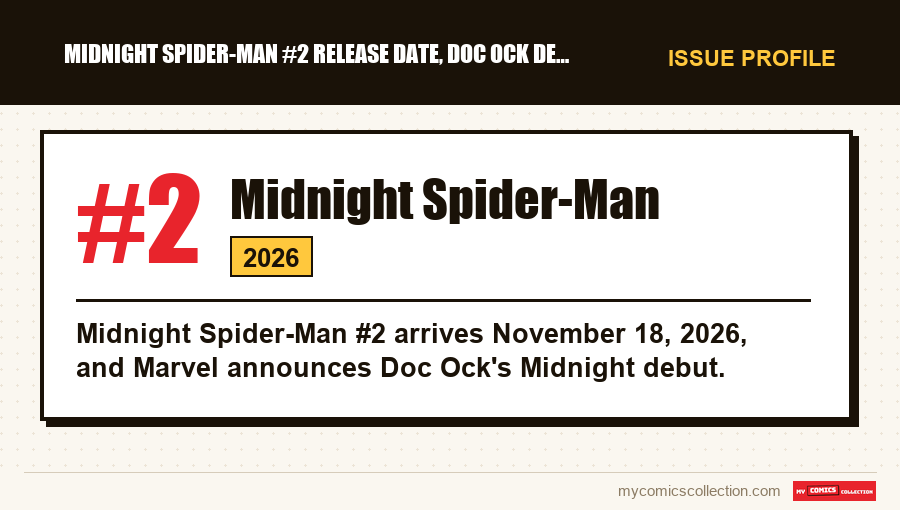
The on-sale date is set for November 18, 2026, six weeks after the line launched. The format is smaller than #1: 32 pages instead of 40, with the Parental Advisory label kept. The creative pair does not change, but the announcements specify neither the colorist nor the letterer: those two credits will be read on the single issue itself.
For cover A, Marvel names Steve Beach. This cover A is said to be veiled: the announced artist's name is known, but not the whole image, which is only discovered by opening the issue. In your record, simply note Steve Beach as the announced artist.
The series then continues at a roughly monthly pace, through #5 announced for February 2027. Issue #2 therefore holds second place in a short run, between the origin laid down by #1 and the follow-up issues already solicited.
An absent hero, a city that searches
Marvel's text for this issue comes down to three elements. Peter Parker has disappeared. Several New Yorkers are missing. And Oscorp subcontractors are combing through surveillance footage in search of a spider.
These three elements sketch a frame. The monster of #1 is no longer at the center of the screen: we now watch the city looking for him, or for what resembles him. The register shifts from the horror of the body to the horror of disappearance, the kind where someone's absence is measured by what is done to find them. The image of the subcontractors is precise: Oscorp does not run the operation itself, it delegates it, and intermediaries are the ones watching the recordings. It is how a large company searches without showing itself.
The solicitation says nothing more, and we will add nothing. We do not know what role Octavius will play in these scenes, nor whether he steps in on Oscorp's side, against it or alongside it. What is announced is his entry, presented at the Midnight panel at New York Comic Con as the character's debut in the Midnight universe. As for the rest, reading the issue will settle it.
Otto Octavius: who steps onstage
To measure what this arrival represents, we need to recall who the character is in classic continuity. The character was born in The Amazing Spider-Man #3, cover-dated July 1963, from an idea by Stan Lee and Steve Ditko. Otto Octavius is a nuclear physicist there who designed mechanical arms controlled by thought for atomic research. A radiation accident fuses the harness to his body, and he turns to crime. From the start, then, the character has a structural link to laboratories: he is the product of an experiment gone wrong.
That is what makes his entry into Midnight Spider-Man so telling. The series rests on one idea: labs manufacture monsters. For sixty years, Otto Octavius has been the canonical example of the scientist transformed by his own instrument. In other words, the series stages a lab metamorphosis and welcomes the character whose founding act is a lab metamorphosis. This kinship is a fact of the character's history; how the issue will use it, if it does, is a matter of reading.
The character's psychological profile matters as much as his origin. Biographies describe a shy, bullied child, raised by a mother who pushed him toward intellect and away from manual labor, nearsighted and sensitive to light. These traits make up an adversary who compensates: he is not a conqueror by taste, he is a man whose mind has been his refuge and whose mechanical arms extend a wounded pride. In a horror series, this profile is valuable, because it gives the threat a human face, with a history and reasons.
From scientist to conductor: what the character has been
Over the decades, Otto Octavius has held several jobs in the series. He returns as early as issues #11 and #12 of the regular series, comes back in the saga running from #31 to #33, and establishes himself as one of Spider-Man's three great adversaries, alongside the Green Goblin and Venom. He is also the one who brings together the Sinister Six, the team of supervillains formed to take on Spider-Man. That matters: Doctor Octopus is not only a fighter, he is an organizer.
The relationship with Aunt May belongs to this repertoire. Octavius becomes her tenant, tries to marry her to get his hands on an island housing an atomic plant, and comes close to the altar. This almost domestic side of the character is one of the most discussed by readers of the series. The seven reads we rank in our guide to the best Doctor Octopus comics detail its stages; we do not redo them here.
What matters to us for Midnight is the diversity of registers. The same character has been the lab scientist, the neighborhood enemy, the strategist, the ridiculous suitor, and later a hero of a particular kind. A series that summons him can pick any of these faces, or invent a new one. Marvel has not specified which, and it would be unwise to guess.
Do you collect this series?
Track what you own, what you are missing and what your collection is worth. 7-day trial.
Start my trial →
The "Superior" precedent: Otto in Peter's place
One episode holds a place apart in Otto Octavius's history, and it concerns precisely the relationship between the two men. In The Amazing Spider-Man #698, cover-dated November 2012, at the end of the Dying Wish arc, Octavius swaps bodies with Peter Parker, following the latter's death. He then becomes Superior Spider-Man, an alias introduced in Avenging Spider-Man #15.1, in December 2012. The regular series The Superior Spider-Man runs 33 issues from 2013 to 2014. Other series bearing that name followed, one in 2018 written by Christos Gage and drawn by Mike Hawthorne, another in 2023 written by Dan Slott.
This precedent sheds light on our subject in a particular way. It shows that Otto Octavius is, of all the hero's adversaries, the one with the most intimate relationship to him: he has carried his life, his memories and his costume. The character's biographies note that he becomes aware of his fundamental inferiority there and overcompensates where Peter Parker held back. Our reading: the question of the body, of what we inhabit and who we are when the body changes, is a terrain this character knows better than any other adversary, and that is what stays with us when he arrives in a story where the hero has lost his appearance.
Be careful not to conclude more than is said. The Midnight universe is distinct from the main continuity, and nothing in the announcements suggests a return of that body swap. We mention this precedent as a tradition of the series, that of an adversary who gets close enough to the hero to almost merge with him, and not as an indication of the plot.
Dan Slott, who writes the 2023 Superior Spider-Man series, has his own reference page: every article on the site about Dan Slott.
A meeting of two traditions in the series
Placing Doctor Octopus in a horror story means bringing two traditions together. The first, that of Lee and Ditko, presents a duel of scientists: a teenager whose science is a radioactive spider, an adult whose science is a harness of tentacles. The character was born from the collaboration of Stan Lee and Steve Ditko: he is less a monster than a man deformed by his tool. For the artist's work, the Steve Ditko page gathers our articles; the Stan Lee page does the same for the writer.
The second tradition is the more recent one, that of the reinvention. In Midnight Spider-Man, it is the hero's form that is monstrous, and the lab is the place of horror. Octavius is the character who links these two traditions. The reason Marvel announces him at this point in the story is not explained in the solicitations, and we do not guess it.
The five covers announced for November
The variants announced for #2 are as follows:
- A: Steve Beach, veiled cover;
- B: Lucas Werneck, in the Midnight Bloodbath series;
- C: Peach Momoko, Midnight Special version;
- E: Simone Bianchi, Midnight Gallery family, 1:25 ratio;
- F: Peach Momoko, Special Virgin version, at the 1:50 ratio.
The list also includes a variant D from the Horror Homage family; its artist will be read on the single issue. Ratios are explained on the Midnight variants and ratios page; above all, keep in mind that they set an ordering rule, not a number of copies.
Peach Momoko signs two of these covers, including a Virgin version. If you follow this artist, her page gathers our articles about her.
Preparing your purchase before November 18, and placing the issue
An upcoming issue calls for preparation. Here are the useful decisions to make before November 18:
- choose a cover and stick with it: A, which is the base cover, or a variant, knowing that cover A is veiled until the issue is opened;
- decide whether you collect the complete series or only the issues announcing a character: Otto Octavius's debut in the Midnight universe is announced by Marvel for this issue, but that does not make it a first appearance in the catalog sense, since the character has existed since 1963;
- plan the record: on-sale date, cover, printing, condition on opening;
- keep in mind that #2 runs 32 pages, eight fewer than #1.
The announcement of a known character in a parallel universe is not a first-appearance event. It is an entry, and entries count for content, rarely for scarcity. We offer no price prediction: how an issue fares depends on its long-term demand, which nobody can establish in advance.
Issue #2 is the one that prepares what follows. The series' follow-up issues are solicited, but they have their own profiles. For #2, keep the setup in mind: an absent hero, a city that searches, a scientist who enters.
Reading this issue does not require knowing the line's other series. For the whole range, see the complete guide to Marvel Midnight; the page on this series' key issues covers tracking over time.
Frequently asked questions
Issue #2 is scheduled for November 18, 2026. It is a 32-page issue with the Parental Advisory label, written by Phillip Kennedy Johnson and drawn by ScieTronc; Steve Beach is the announced artist of cover A.
The solicitation describes a missing Peter Parker, several missing New Yorkers and Oscorp subcontractors combing through surveillance footage in search of a spider. Nothing more is announced, and we do not fill in the rest: the issue has not been released.
At its New York Comic Con panel, Marvel presented Otto Octavius's debut in the Midnight universe in connection with #2. The character's exact role is not detailed in the solicitation. The character has existed in the classic series since The Amazing Spider-Man #3, in 1963.
Not in the catalog sense: Otto Octavius's first appearance dates to July 1963, in The Amazing Spider-Man #3. Midnight Spider-Man #2 is announced as his debut in the Midnight universe, which is an entry into a parallel version, not the creation of the character.
The solicitations list covers by Lucas Werneck (Bloodbath), Peach Momoko (Special), Simone Bianchi (Gallery, 1:25 ratio) and Peach Momoko in Special Virgin version (1:50 ratio), plus a Horror Homage variant. Steve Beach's cover A is veiled until the issue is opened.
Already shelving #1 and getting ready for #2? Have the Spider-Man comics you already own appraised.
Estimate my comic