
The best Doctor Octopus comics start with the Master Planner saga in The Amazing Spider-Man #31-33 (1965-1966), then his first appearance in #3 (1963), Annual #1 and the Sinister Six, and #88-90 (1970). For a modern read, follow with Ends of the Earth (#682-687, 2012), then Dying Wish and The Superior Spider-Man (2012-2014), where Otto Octavius takes Peter Parker's place.
There is no single Doctor Octopus in the comics, but several: the lab-bound foe of the Ditko years, the suitor of Aunt May, the strategist who gathers six enemies, the dying man who steals a life. Choosing an entry point means choosing which Otto Octavius you want to meet first. This guide ranks seven stories and suggests a reading path based on whether you are a reader or a collector.
As always in this guide, only verified facts (creators, issue numbers, dates) are stated as fact; the analysis is our own, with no reproduction of protected art or dialogue.
His first appearance
The series' first mechanical tentacle appears in The Amazing Spider-Man #3, the July 1963 issue written by Stan Lee and drawn by Steve Ditko. Otto Octavius is a nuclear physicist whose reactor accident fuses him to a harness of mechanical arms. The idea is simple and has lasted: a man whose science produced the weapon, facing a teenager whose science (a radioactive spider) produced the power.
For a collector, #3 is a major first appearance, but its appeal goes beyond scarcity: it set the grammar of the character for sixty years, with the scientist, the tentacles and the superiority complex. For a 1963 book, restoration and grade are the two things to check before any purchase. If you are entering the series from the beginning, our guide to Amazing Spider-Man #1 sets the stage for the earliest issues.
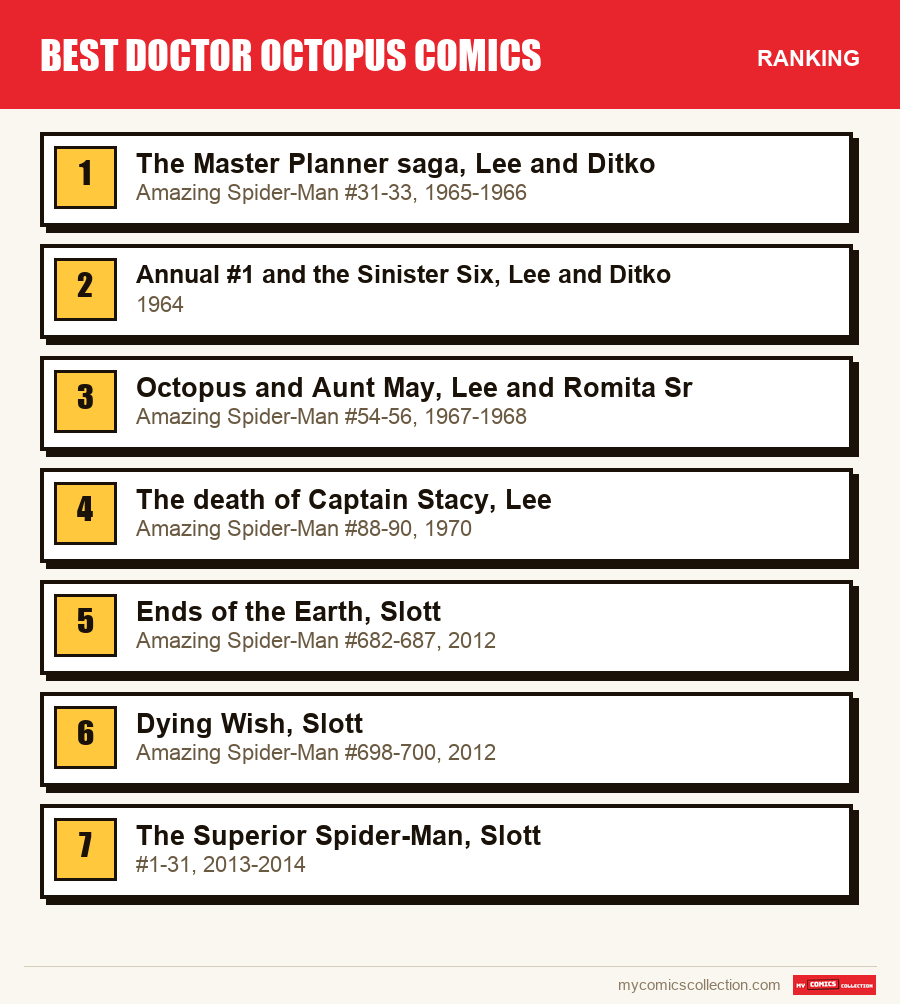
1: The Master Planner saga, Lee and Ditko (Amazing Spider-Man #31-33, 1965-1966)
This is the peak of the Ditko era and the story to read first if you only read one. A crime boss runs an operation from the shadows that deprives Peter Parker of a medicine vital to Aunt May; an exhausted Spider-Man must recover the ingredients of a serum in time. The Master Planner is Octavius, and #33 turns the final confrontation into a famous scene: the hero, buried under tons of machinery, rises through sheer willpower.
What the story does for the character: it makes Otto an adversary on the hero's level, not just a laboratory threat. It suits any reader, even with no prior knowledge, because the three issues stand on their own. How to read it: as single issues if you are after #31-33 for their historical value; as a collected edition in the volumes that reprint the Ditko era.
2: Annual #1 and the Sinister Six, Lee and Ditko (1964)
The first Amazing Spider-Man Annual is where Octavius brings the Sinister Six together for the first time: Electro, Kraven the Hunter, Mysterio, Sandman and the Vulture, alongside Otto himself. The idea of a team of supervillains united against a single hero, a staple ever since, finds its template here.
What the story does: it reveals a side of the character that #3 did not show, that of the conductor. Octopus is a strategist before he is a fighter. It suits readers who want to understand the origin of the villain teams seen throughout the series' history, and collectors who follow the annuals; our guide to Spider-Man annuals covers this family of issues in detail.
3: Octopus and Aunt May, Lee and Romita Sr (Amazing Spider-Man #54-56, 1967-1968)
After Ditko's departure, John Romita Sr gives the series a more soap-opera tone, and Doctor Octopus is a good example. In this short sequence, Otto enters Aunt May's life, to the point that readers learn to fear a wedding. The register is melodrama: Peter worries, May grows attached, and the villain plays both sides.
What the story does: it widens Octavius beyond the laboratory and gives him an almost comic and touching dimension, unexpected in a repertoire of menace. It will please anyone who likes the neighborhood Parker, where the threat comes through Aunt May's kitchen. How to read it: collected edition, or consecutive single issues, since the run is short.
4: The death of Captain Stacy, Lee (Amazing Spider-Man #88-90, 1970)
This three-issue sequence, written by Stan Lee, puts Octopus at the center of a lasting tragedy. The fight takes place in the city, under the eyes of the police, and Captain George Stacy, Gwen's father, dies protecting a child. Peter carries a guilt from it that runs through the series for years, up to the death of Gwen Stacy, which we cover in our guide to Amazing Spider-Man #121.
What the story does for Octavius: he becomes, indirectly, responsible for a tragedy, which complicates his image as a colorful enemy. It suits readers who want to follow the dramatic thread of the Bronze Age, darker than the Silver Age. How to read it: single issues or collected edition, your choice, with the advantage that the trilogy reads in one sitting.
5: Ends of the Earth, Slott (Amazing Spider-Man #682-687, 2012)
Dan Slott takes Doctor Octopus out of the city and turns him into a global threat. Octavius, struck by an illness that dooms him, builds a plan that endangers the entire world and mobilizes the Sinister Six in an international operation. The register is the disaster thriller, with Spider-Man pulled far beyond his usual streets.
What the story does: it gives Otto a personal urgency, that of a man who knows he will die, and sets up what follows. It suits readers who already know the modern series. Reading these issues before the next ones is almost mandatory: without them, the reversal of the following story loses much of its force.
Do you collect this series?
Track what you own, what you are missing and what your collection is worth. 7-day trial.
Start my trial →
6: Dying Wish, Slott (Amazing Spider-Man #698-700, 2012)
Issue #700, dated December 2012, is the last of that volume of the series and one of the most debated in modern Spider-Man history. Octavius, dying, manages to swap minds with Peter Parker. Slott delivers a twist that challenges the hero's identity and whose consequences extend into the following series.
What the story does: it turns the villain into the protagonist, something no writer had dared at this scale. It suits readers willing to accept that a flagship series can change its central character. How to read it: as a collected edition, with Ends of the Earth read beforehand, or as single issues if you are after #700, now a modern key issue.
7: The Superior Spider-Man, Slott (#1-31, 2013-2014)
After #700, the series continues under the title The Superior Spider-Man, with Octavius in Peter Parker's body. Otto wants to prove he makes a better hero than his predecessor. He has more method, fewer scruples, and an obsession with success that often backfires on him. The series runs thirty-one issues, and its conclusion, which brings Peter back, is all the more effective because the reader has watched Otto evolve.
What the story does: it deepens Octavius more than any earlier story, by subjecting him to Peter's life, friends and responsibilities. It suits those who want to see the character as a protagonist, not an adversary. How to read it: collected editions, preferably, because the continuity with the tie-in titles is complicated in single issues. Slott's run has its place in our ranking of the best Spider-Man runs.
What this ranking prioritizes
The ranking above follows two axes at once: the story's place in the evolution of Otto Octavius, and how readable it is for someone who has not followed sixty years of the series. That is why the Master Planner saga comes before Annual #1: it is easier to read on its own. It is also why the three Slott-era entries follow one another instead of being scattered, because they reinforce each other.
We left out stories whose content or exact issue numbers are not established with certainty. The list therefore stays deliberately short, and you can supplement it with Octavius's secondary appearances in the parallel monthlies. To go deeper into the period of Steve Ditko, who defined the look of the tentacles, see Steve Ditko: where to start.
Where to start based on your profile
If you are discovering the character and want to understand what makes him a major adversary, read the Master Planner (#31-33), then Annual #1. The pair gives you the scientist and the strategist in a single evening.
If you come from the movies, notably Spider-Man 2 (2004), start with #3 and then jump straight to the Slott era, which explores the character's tragic side.
If you are a collector, focus on a core of issues with an established status: #3, Annual #1, #33, #700. Add #88-90 if you follow the Gwen Stacy storyline.
If you mostly read trade paperbacks, follow the chronological order of the seven entries above: it tracks the character's evolution, from scientist to protagonist.
The key issues to know
The list of landmarks fits in a handful of books. Amazing Spider-Man #3 (1963): first appearance of Otto Octavius. Amazing Spider-Man Annual #1 (1964): first gathering of the Sinister Six. Amazing Spider-Man #33 (1966): conclusion of the Master Planner saga. Amazing Spider-Man #90 (1970): death of Captain Stacy. Amazing Spider-Man #700 (2012): the body swap. The Superior Spider-Man #1 (2013): first issue of the series that follows.
The buying method rests on three checks. First, confirm the identity of the issue: the 1963 #3 is not to be confused with reprints or facsimile editions. Second, compare the real condition with the stated grade, especially on dark covers. Finally, separate #33, which people hunt for its story, from #3, which people hunt for Octavius's birth: their buyers are not the same. We give the detail of these landmarks in the key issues of Amazing Spider-Man.
Frequently asked questions
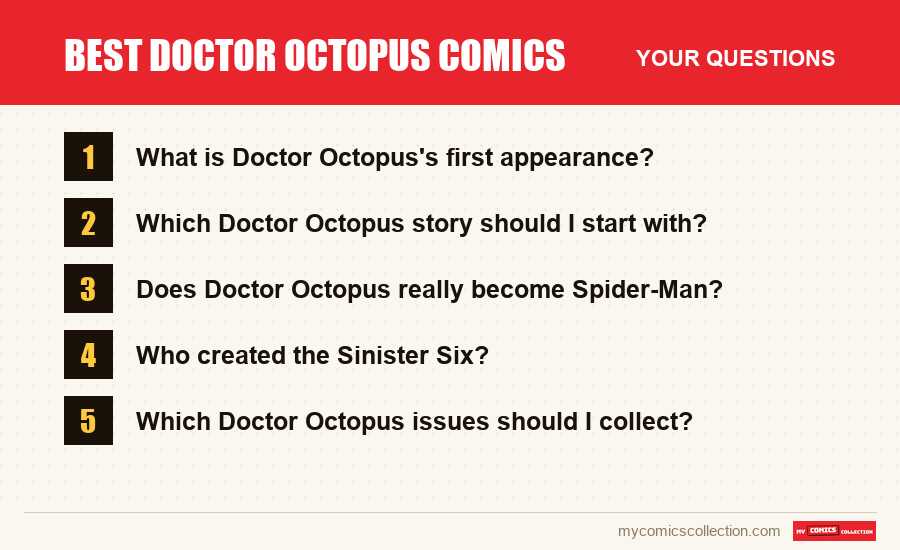
Otto Octavius makes his debut in The Amazing Spider-Man #3 (July 1963), written by Stan Lee and drawn by Steve Ditko. A nuclear physicist fused to his mechanical arms by an accident, he remains the collectors' benchmark for this character.
Start with the Master Planner saga in Amazing Spider-Man #31-33 (1965-1966), by Stan Lee and Steve Ditko. It is self-contained, short, and puts the character on Spider-Man's level. Modern readers can follow with The Superior Spider-Man.
Yes, for two years. In Amazing Spider-Man #700 (2012), Octavius swaps minds with Peter Parker. The series The Superior Spider-Man (#1-31, 2013-2014), by Dan Slott, follows him in that role until Peter's return.
The Sinister Six were born in The Amazing Spider-Man Annual #1 (1964), by Stan Lee and Steve Ditko, under the leadership of Doctor Octopus. The group brings together Electro, Kraven, Mysterio, Sandman and the Vulture, and became the template for the villain teams that followed.
Aim for #3 (1963), Annual #1 (1964), #33 (1966), #88-90 (1970), #700 (2012) and The Superior Spider-Man #1 (2013). Check the real condition of each copy and what kind of issue it is before buying: first appearance, arc conclusion or modern turning point.
Do you have an Amazing Spider-Man #3, #33 or #700 in your collection? Get it appraised.
Appraise my comic