Spider-Man 2 (2004) Sam Raimi , with Tobey Maguire , opposes the hero to Doctor Octopus (Otto Octavius), appeared in Amazing Spider-Man #3 (1963) by Stan Lee and Steve Ditko. The film also takes up the theme of renunciation, a direct echo of “Spider-Man No More!” » (Amazing Spider-Man #50, 1967). Hailed as one of the best superhero films, it is very faithful to the spirit of the comics. Here is the detailed comparison, film versus comics.
Often cited as a pinnacle of the genre, Spider-Man 2 delves deeper into the dilemma of the hero torn between his life and his duty. It draws on two major stories from the saga: the birth of Doc Ock and the famous renunciation of Peter. Source-by-source decryption.
As in each article in this series, only verified information (creators, distribution, dates, comic numbers) is stated; the comparative analysis is ours, without reproducing dialogue or protected images.
Title : Spider-Man 2 (2004)
Director: Sam Raimi
Actors: Tobey Maguire (Peter Parker), Kirsten Dunst (Mary Jane), Alfred Molina (Otto Octavius), James Franco (Harry)
Exit : June-July 2004
Studio: Columbia Pictures (Sony)
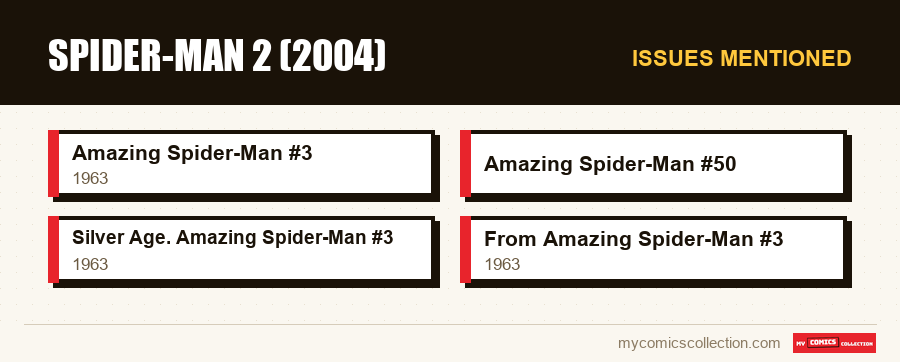
Amazing Spider-Man #3 (1963): 1st appearance of Doctor Octopus
Amazing Spider-Man #50 (1967): “Spider-Man No More!” »
The hero's dilemma: private life versus duty
The Peter/MJ/Harry triangle: continued and deepened
- Otto Octavius, scientist who became Doctor Octopus.
- His four mechanical arms, emblem of the character.
- Le renunciation of Peter, echo of “Spider-Man No More!” ".
- Le burden of double life and his sacrifices.
- La Harry's growing resentment towards Spider-Man.
- THE AI arms which influence Octavius, absent from the original comics.
- La final redemption of Octavius, specific to the film.
- La loss of powers psychosomatics of Peter, invention of the film.
- Mary Jane discover the identity of Peter, earlier than in the comics.
- A condensed origin by Doc Ock for the film format.
Amazing Spider-Man #3 (1963): the birth of Doctor Octopus
Doctor Octopus appears in Amazing Spider-Man #3 (1963), imagined by Stan Lee and Steve Ditko. Otto Octavius is a brilliant nuclear physicist who, during a laboratory accident, sees his four mechanical arms merge with his body and mind. Having become Doctor Octopus, he is among the very first great enemies of Spider-Man, and one of the most formidable: in the comics, he inflicts on the hero one of his first crushing defeats. His combination of superior intelligence and raw power makes him an adversary equal to Peter Parker, also a scientist.
Raimi's film respects the essence of the character: the brilliant scientist, the accident, the mechanical arms that have become extensions of his will. Alfred Molina delivers a lauded, human and tragic interpretation. The main freedom lies in the addition of artificial intelligence in the arms, which influence Octavius and push him to evil by neutralizing the inhibitor which protected his brain. This idea, absent from the original comics, gives the character a dimension of victim as much as executioner, and prepares his final redemption: an addition specific to the film which was very appealing.
“Spider-Man No More!” »: Peter's renunciation
The emotional core of the film draws from one of the most famous stories in the saga: Amazing Spider-Man #50 (1967), “Spider-Man No More! ". In this issue, exhausted by the sacrifices imposed on him by his double life, Peter decides to abandon his costume and throw Spider-Man away. The iconic image of the costume abandoned in a trash can, while Peter walks away, is one of the most repeated in comics history. Raimi's film brings this crisis to the forefront: Peter, crushed by renunciations (love, studies, friendship) also gives up being Spider-Man.
This thematic fidelity is one of the film's great successes. Where Spider-Man 2 innovates is in the translation of this uneasiness: Peter's loss of powers is psychosomatic, his webs failing as his faith wavers. This idea, invented for the film, visually illustrates the link between the hero's identity and his will. Peter's return to his vocation, when duty calls him again, faithfully reproduces the arc of the comic: one does not give up on being Spider-Man, because the responsibility, once understood, never quite sets aside.
A dilemma at the heart of the myth
What makes Spider-Man 2 so true to the comics is its deep understanding of the character. Spider-Man is not a triumphant hero but a hero of sacrifice: each victory costs him something in his private life. Peter Parker constantly pays the price of his responsibility: in thwarted loves, in weakened friendships, in a compromised future. The film puts this dilemma at the center of its story, with rare accuracy. It is this human dimension, this vulnerability, which has always distinguished Spider-Man from other superheroes, and which Raimi captures with obvious affection.
This dilemma permeates the entire editorial history of the character since Lee and Ditko. Spider-Man is the everyday hero, the one whose concerns resemble those of the reader: paying the rent, passing his exams, winning over his loved one. By amplifying this tension to the point of renunciation, Spider-Man 2 touches the very essence of the myth. The film does not just adapt plots: it adapts a philosophy, that of a hero defined by what he sacrifices as much as by what he accomplishes. This is what makes it, in the eyes of many, one of the best adaptations ever made.
Collecting this series?
Track what you own, what you are missing and what your collection is worth. 7 day trial.
Start my trial →The characters, from paper to screen
- Peter Parker / Spider-Man: Hero of sacrifice, tempted by renunciation, faithful to the spirit of Amazing Spider-Man #50.
- Otto Octavius / Doctor Octopus: Brilliant scientist with mechanical arms, more tragic and redeemed in the film.
- Mary Jane Watson: Thwarted love which discovers the identity of Peter, the emotional heart of the film.
- Harry Osborn: Friend consumed by hatred of Spider-Man, on the path of revenge.
- J. Jonah Jameson: The boss of the Daily Bugle, still hostile to Spider-Man.
Doc Ock, a humanized enemy
One of the strengths of the film is its way of humanizing its antagonist. In the comics, Doctor Octopus is a devious and arrogant villain, one of the pillars of Spider-Man's gallery of enemies, without much tragic dimension in his early days. The film enriches this portrait: Octavius is first and foremost an idealistic scientist, a loving husband, whose scientific dream turns into a nightmare. The destruction of his experience, the death of his wife and the influence of intelligent arms plunge him into madness. This trajectory, more nuanced than in the original comics, makes him a figure of pity as well as terror.
This humanization culminates in the final redemption, where Octavius regains control of his arms to repair the harm he has caused. This outcome, specific to the film, deviates from the comics but respects its humanist spirit: at Marvel, the villains are rarely pure monsters, and the possibility of redemption is never completely excluded. By giving Doc Ock a worthy conclusion, the film deepens a character that readers will then rediscover in all his complexity, up to recent stories where Octavius will experience spectacular developments.
A film that marked the genre
Beyond its fidelity, Spider-Man 2 has had a lasting influence on superhero cinema. By proving that a sequel could delve deeper into its hero rather than simply outdoing the spectacle, it set a standard that many subsequent productions sought to achieve. Its balance between action, emotion and moral dilemma is regularly cited as a model of the genre. The train scene, where a crowd of anonymous people protects an unmasked and exhausted Spider-Man, crystallizes this success: it places the humanity of the hero, and the link that unites him to the city he protects, above the simple demonstration of force.
This approach is deeply faithful to the spirit of Lee and Ditko's comics, where Spider-Man was never an invulnerable demigod but a fallible young man, loved and rejected in turn. By showing a hero that the city supports in his vulnerability, the film touches on a truth of the character: Spider-Man is the protector of everyday life, the one with whom we can identify. This dimension, rarely so well rendered on screen, explains why Spider-Man 2 continues to be a reference years later, and why it made so many spectators want to delve into the hero's origin stories.
Where to start reading
To extend the film, Amazing Spider-Man #3 (1963) features the first appearance of Doctor Octopus and one of the hero's first major defeats. Amazing Spider-Man #50 (1967), “Spider-Man No More!” ”, is a summit of renunciation and essential reading. The great classic Spider-Man runs of the 1960s, signed Lee, Ditko then Romita, develop the hero's dilemma. This journey covers the sources of a film with rare fidelity to the spirit of the comics.
Chronology of comics to know
- 1963: Amazing Spider-Man #3: The first appearance of Doctor Octopus.
- 1967: Amazing Spider-Man #50: “Spider-Man No More!” », Peter's renunciation.
- 1960s: Lee, Ditko and Romita's runs deepen the hero's dilemma.
Collection side: what numbers to aim for after the film
Spider-Man 2 points to major keys to the Silver Age. Amazing Spider-Man #3 (1963, first appearance of Doctor Octopus) is a highly sought-after issue, important for the hero's gallery of enemies. Amazing Spider-Man #50 (1967, first appearance of the Kingpin and story “Spider-Man No More!”) is a doubly valuable key, both for its cult plot and for its first appearances. These targets cover high budgets but remain pillars of any collection. As always, condition and gradation determine value; relying on real recent sales is strongly recommended.
Its place in the saga and for the collector
Spider-Man 2 is often considered the pinnacle of Raimi's trilogy, for its faithfulness to the spirit of the comics and its understanding of the hero's dilemma. For the collector, it revived interest in Amazing Spider-Man #3 and #50, keys to the Silver Age. It illustrates the effect of major adaptations on the market. Beyond speculation, the film invites us to discover the founding stories of the character, in particular “Spider-Man No More!” », one of the emotional peaks of the saga. By capturing the sacrificial essence of Spider-Man, he gave the genre one of its most accomplished films.
The verdict: a peak of loyalty
- Loyalty: Doctor Octopus, his mechanical arms, Peter's renunciation (echo of Amazing Spider-Man #50) and the hero's dilemma come from the comics.
- Freedoms: the arms equipped with an AI, the final redemption of Octavius, the psychosomatic loss of powers, Mary Jane who discovers Peter's identity.
- Collectible numbers: Amazing Spider-Man #3 (Doctor Octopus), Amazing Spider-Man #50 (“Spider-Man No More!”).
Spider-Man 2 delves into the hero's sacrificial dilemma with a fidelity that makes it, for many, the pinnacle of the genre. True to Doctor Octopus and the spirit of “Spider-Man No More!” », the film humanizes its antagonist and captures the essence of the myth. For both the reader and the collector, it is an invitation to discover Amazing Spider-Man #3 and #50, two keys to the Silver Age.
Frequently asked questions
From Amazing Spider-Man #3 (1963), created by Stan Lee and Steve Ditko. Otto Octavius, nuclear physicist, sees his four mechanical arms merge with him during an accident. The film respects the essentials, while making it more tragic.
Yes: it is inspired by Amazing Spider-Man #50 (1967), “Spider-Man No More!” », where Peter, exhausted, abandons his costume. The film takes up this theme, adding a psychosomatic loss of powers of its own.
His redemption at the end of the film is a neat addition to the adaptation. In the original comics, he is a twisted villain without much tragic dimension, even if recent stories will give him spectacular developments.
For his deep understanding of the character: Spider-Man is a hero of sacrifice, whose every victory costs something of his private life. The film puts this dilemma at the center, with an accuracy faithful to the spirit of the comics.
Amazing Spider-Man #3 (1963, first of Doctor Octopus) and Amazing Spider-Man #50 (1967, “Spider-Man No More!” and first of Kingpin) are two major keys to the Silver Age to aim for.
Does the film make you want to collect? Estimate the value for free of your issues (Amazing Spider-Man #3, #50…) with our tool based on current eBay listings.