Spider-Man: Far From Home (2019), directed by Jon Watts with Tom Holland , stages Mysterio (Quentin Beck), one of the weaver's oldest enemies, born in Amazing Spider-Man #13 (1964) by Stan Lee and Steve Ditko. A former special effects specialist turned master of illusion, he is faithfully adapted to his essence: a manipulator who fabricates false threats. The film maintains this sham while modernizing its technology and tying it to Iron Man's legacy. Detailed comparison, film versus comics.
Sequel to Homecoming and epilogue to the great Avengers saga, Far From Home follows a grieving Peter Parker on a school trip to Europe. Under the direction of Jon Watts, the film draws from the weaver's rich gallery of villains to offer one of the most faithful adaptations of a classic enemy: Mysterio. Source-by-source decryption.
As in each article in the series, only verified information (distribution, dates, numbers, creators) is stated; the comparative analysis is ours, without reproducing dialogue or protected images.
Title : Spider-Man: Far From Home (2019)
Director: Jon Watts
Actors: Tom Holland (Peter Parker), Jake Gyllenhaal (Quentin Beck / Mysterio), Zendaya (MJ), Samuel L. Jackson (Nick Fury), Marisa Tomei (May), Jacob Batalon (Ned)
Exit : July 2, 2019 (United States)
Studio: Marvel Studios/Sony Pictures
Amazing Spider-Man #13 (1964): Mysterio's first appearance (Lee & Ditko)
Amazing Fantasy #15 (1962): Spider-Man's first appearance
The Elementals: elemental threats from the Marvel bestiary
The Spider-Man in mourning and without reference: recurring theme of comics
- Mysterio, master of illusion and staging.
- The past of special effects specialist by Quentin Beck.
- The imposture: making false threats to pose as a hero.
- Le dome, cape and helm character characteristics.
- A Spider-Man young, fallible and overwhelmed, faithful to the spirit of the hero.
- Quentin Beck becomes an embittered former Stark Industries employee, an unprecedented connection.
- The illusions move from practical effects to high holographic technology (drones).
- The Elementals are presented as false multiversal threats.
- Le mentoring from Iron Man and his legacy weigh on the plot.
- La identity revelation finale has no equivalent in classic comics.
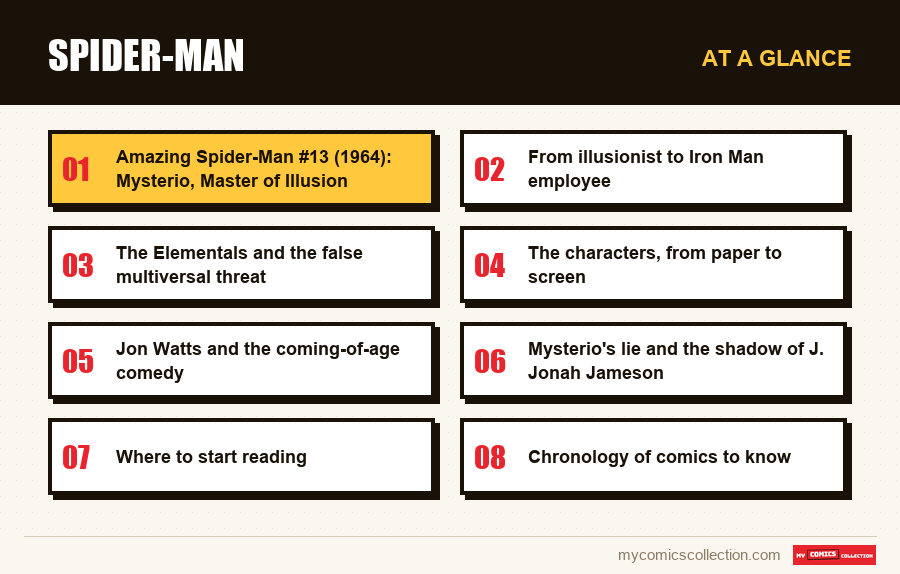
Amazing Spider-Man #13 (1964): Mysterio, Master of Illusion
Mysterio is one of the Weaver's oldest enemies: Quentin Beck appears in Amazing Spider-Man #13 (June 1964), created by Stan Lee and Steve Ditko. His concept is brilliant in its simplicity: a former special effects specialist in Hollywood, frustrated at not having made it big, he puts his talent as an illusionist at the service of crime. His signature (the opaque dome helmet, the cape, the mist) hides a manipulator who orchestrates scenarios to deceive his adversaries. The film adapts this essence with remarkable fidelity: on screen, Beck remains a master of illusion and staging, whose entire plan relies on the fabrication of false threats to pose as a savior. This is one of the cases where the adaptation perfectly captures the founding idea of a villain.
This fundamental fidelity is all the more notable as the film completely modernizes the means. Where the Beck of the 1960s used practical tricks, projections and rudimentary holograms, the film gives him an army of drones capable of generating holographic illusions of total realism. The form changes, the spirit remains.
From illusionist to Iron Man employee
The great freedom of the film concerns Beck's motivations. In the comics, he is a failed artist who takes revenge on the world of entertainment and confronts Spider-Man out of criminal ambition. The film reinvents him as a former employee of Stark Industries, a brilliant technician humiliated and pushed aside by Tony Stark, whose resentment fuels the entire plan. This rereading anchors the character in the mythology of the saga: Beck exploits the void left by the death of Iron Man, presenting himself as the new hero that the world needs. It thus embodies a criticism of media manipulation and false truths, a very contemporary theme. This link with Stark's heritage, absent from the comics, gives the film a particular resonance in cinematic continuity.
The Elementals and the false multiversal threat
The film features the Elementals, elemental creatures (water, fire, earth, air) inspired by various threats from the Marvel bestiary. Beck presents them as monsters from another universe, posing as an interdimensional hero. This deception is perfectly in line with the character's logic: in the comics, Mysterio's plans almost always begin with a false threat intended to trap his target. The film pushes the process to its climax by playing on the idea of the multiverse, a concept that the saga will develop later. The threat is only a decoration: the real danger is the manipulation itself.
The characters, from paper to screen
- Peter Parker: Young, fallible and grieving, true to the spirit of the ordinary hero overwhelmed by his responsibilities.
- Mysterio (Quentin Beck): True to his essence as an illusionist, reinvented as an ex-employee of Stark.
- Nick Fury: Manipulative and demanding, he pushes Peter to take on a role he doesn't feel ready to take on.
- MJ: Modernized, complicit and lucid, far from the classic version.
- Iron Man's Shadow: The missing mentor weighs on the entire story, a link specific to the film.
Collecting this series?
Track what you own, what you are missing and what your collection is worth. 7 day trial.
Start my trial →Jon Watts and the coming-of-age comedy
Faithful to Homecoming, Jon Watts maintains the register of the teen movie while adding the weight of mourning and responsibility. The school trip to Europe offers a light framework, but the deeper issue is that of maturity: Peter must decide if he wants, or can, become Iron Man's successor. This tension between adolescent carefreeness and heroic burden is faithful to the DNA of the character, whose best stories have always mixed daily life and duty. By confronting Peter with a manipulator who precisely exploits his need for guidance, the film deepens its portrait of a hero under construction, still uncertain of his place.
Mysterio's lie and the shadow of J. Jonah Jameson
The great strength of the film lies in the way in which Mysterio embodies, from 2019, a very current anxiety: that of the manipulation of reality through images. Beck fabricates false threats, portrays himself as a hero, and fashions an alternative truth that the public swallows without hesitation. This theme, strikingly modern, was already in the making in the character of 1964, whose plans were based on illusion and staging. The film pushes the idea to its conclusion in a post-credits scene that remains famous: Mysterio, from beyond, broadcasts a doctored video accusing Spider-Man and revealing his identity to the whole world, orchestrated by a media figure taken from the comics, J. Jonah Jameson, the eternal slayer of the weaver. This cliffhanger takes up a classic comic book plot, the press against Spider-Man, by mixing it with the era of disinformation.
This outcome illustrates the richness of Mysterio's character: beyond the special effects villain, he is the prophet of a world where we can no longer believe what we see. By adapting it in this way, the film demonstrates the astonishing foresight of Lee and Ditko, who had imagined, since the 1960s, an enemy whose ultimate weapon is visual lies. For the reader, it is an invitation to rediscover a villain who is often underestimated, but whose relevance has only increased over time.
Where to start reading
To discover Mysterio, the ideal reading is Amazing Spider-Man #13 (1964), his first appearance, then the first confrontations of Lee and Ditko, where the character displays his illusions. We can then explore the major modern arcs where Mysterio returns, often in psychologically twisted roles. For the beginner and developing Spider-Man, the very first issues of the series remain the best entry point, as does the “Ultimate Spider-Man” rereading by Brian Michael Bendis. From 1962 to today, this journey covers both the hero and one of his most devious enemies, and allows us to measure the extent to which the Spider-Man universe, from its beginnings, was overflowing with ideas that would irrigate cinema decades later.
Chronology of comics to know
- 1962: Amazing Fantasy #15: First appearance of Spider-Man.
- 1964: Amazing Spider-Man #13: First appearance of Mysterio.
- Subsequent decades: Mysterio returns regularly, often within the Sinister Six.
Collection side: what numbers to aim for after the film
Far From Home highlights a beautiful key to the Silver Age. Amazing Spider-Man #13 (first appearance of Mysterio) is a sought-after number, whose interest has increased with the significant presence of the character on screen, worn by Jake Gyllenhaal. More broadly, the first issues of Amazing Spider-Man, which are full of first appearances of villains, are popular targets for all budgets. Amazing Fantasy #15 (first appearance of Spider-Man) remains the absolute holy grail, reserved for the most fortunate collections. As always, condition and gradation determine value; relying on real recent sales is strongly recommended. Amazing Spider-Man #13 is an ideal target for a collector wishing to own a major first appearance without aiming for the inaccessible, especially as the character's on-screen popularity continues to support its demand.
Its place in the saga and for the collector
Far From Home closes a great era of the saga while beginning the future of Spider-Man. For the collector, it had a direct effect on Amazing Spider-Man #13, whose rating benefited from Mysterio's excellent adaptation: proof that the quality of a villain on screen can revive interest in his first appearance. This film reminds us that Spider-Man's wealth lies as much in his enemies as in the hero himself: each iconic villain is a door to a number to hunt. Beyond speculation, it underlines the intelligence of the concept of Mysterio, imagined by Lee and Ditko in 1964: a villain whose weapon is lies and illusion, strikingly modern in the era of false information. By adapting it so faithfully, the film honors the inventiveness of the original creators.
The Verdict: A Classic Villain Perfectly Captured
- Loyalty: the essence of Mysterio (illusionist, ex-special effects technician, false threats) is faithfully adapted.
- Freedoms: Beck reinvented as an ex-Stark employee, illusions modernized into holograms, link to the legacy of Iron Man.
- Collectible numbers: Amazing Spider-Man #13 (Mysterio), Amazing Fantasy #15 (Spider-Man).
Far From Home offers one of the most faithful adaptations of a classic Spider-Man villain: Mysterio remains, at heart, the manipulator imagined in 1964, whose weapon is illusion. By anchoring him in Iron Man's legacy and modernizing his technology, the film extends the spirit of the character while making him terribly contemporary. For the reader as well as the collector, it is an invitation to rediscover the richest gallery of villains in comics. By proving that a second-rate antagonist like Mysterio could carry an entire film and become its revelation, Far From Home reminds us that the depth of Spider-Man lies in this ecosystem of memorable enemies, each offering a door to a founding number and a part of the character's history.
Frequently asked questions
Quentin Beck/Mysterio appears in Amazing Spider-Man #13 (1964), created by Stan Lee and Steve Ditko. He is a former special effects specialist who became a master of illusion and crime.
Very faithful in essence: the illusionist, the ex-special effects technician, the fabrication of false threats. The film modernizes his means (holograms, drones) and reinvents him as an embittered former Stark employee.
The Marvel bestiary has elemental creatures, but in the film, the Elementals are false threats fabricated by Mysterio: perfectly in line with the character, whose plans begin with an illusion.
The film reinvents him as a former employee of Stark Industries, a brilliant technician humiliated and dismissed by Tony Stark. His resentment fuels his plan, which exploits the void left by Iron Man's death.
Amazing Spider-Man #13 (Mysterio's first appearance) is the ideal target, a key to the Silver Age more accessible than Amazing Fantasy #15, the absolute holy grail of the character.
Does the film make you want to collect Spider-Man? Estimate the value for free of your issues (Amazing Spider-Man #13…) with our tool based on current eBay listings.