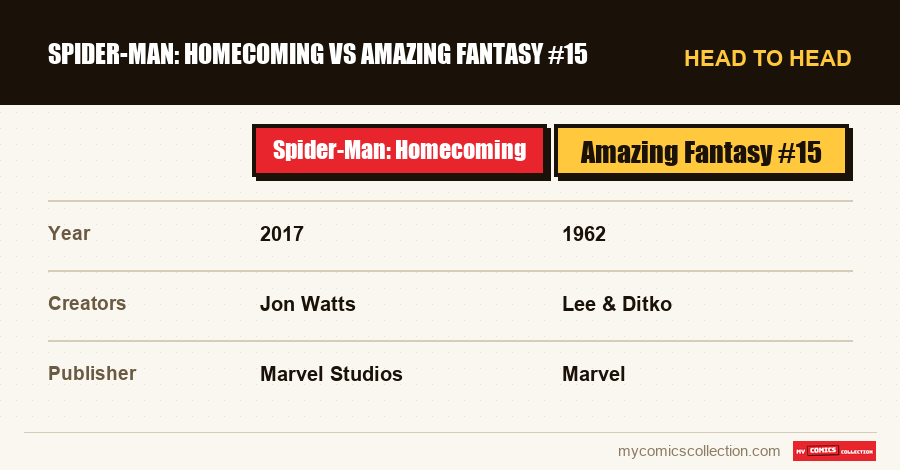
Spider-Man: Homecoming (2017), directed by Jon Watts with Tom Holland, relies on the weaver born in Amazing Fantasy #15 (1962) by Stan Lee and Steve Ditko, and features the Vulture (Adrian Toomes), appeared in Amazing Spider-Man #2 (1963). The film chooses a high school Peter Parker, without redoing his origin, and completely modernizes the Vulture into a working-class father. It retains the adolescent spirit of the character but deviates from several classic codes. Detailed comparison, film versus comics.
First solo film for Spider-Man from the Marvel universe after his introduction in a previous part, Homecoming makes a smart bet: not to tell (yet) the origin of the character, but to plant a teenage Peter Parker in the middle of high school. Under the direction of Jon Watts, the film borrows from teen movies as much as comics. Let's see what he keeps from his roots and what he reinvents.
As in each article in the series, only verified information (distribution, dates, numbers, creators) is stated; the comparative analysis is ours, without reproducing dialogue or protected images.
Title : Spider-Man: Homecoming (2017)
Director: Jon Watts
Actors: Tom Holland (Peter Parker), Michael Keaton (Adrian Toomes / the Vulture), Marisa Tomei (May Parker), Robert Downey Jr. (Tony Stark), Zendaya, Jacob Batalon (Ned)
Exit : July 7, 2017 (United States)
Studio: Marvel Studios/Sony Pictures
Amazing Fantasy #15 (1962): Spider-Man's first appearance (Lee & Ditko)
Amazing Spider-Man #2 (1963): 1st appearance of the Vulture (Adrian Toomes)
Amazing Spider-Man #46 (1967): Shocker's first appearance
The high school Spider-Man: the spirit of the first comics
- Un Peter Parker high school student, juggling homework, social life and a double life: the character's DNA.
- Le Vulture (Adrian Toomes), one of Spider-Man's oldest enemies.
- The theme of the responsibility, the moral heart of the hero since 1962.
- Aunt May and the New York entourage.
- The appearance of Shock, another classic villain from the weaver.
- No origin story: neither the spider's bite nor Uncle Ben's death are shown.
- The Vulture is rejuvenated and humanized into a working-class father, far from the bitter old man of the comics.
- Tony Stark becomes an omnipresent mentor, a link never before seen in classic comics.
- Le high-tech suit provided by Stark is a departure from the original homemade costume.
- Aunt May is clearly rejuvenated compared to the elderly figure in the comics.
Amazing Fantasy #15 (1962): the origin that the film chooses to keep quiet
Spider-Man is born in Amazing Fantasy #15 (1962), created by Stan Lee and Steve Ditko: a shy high school student, Peter Parker, bitten by a radioactive spider, who learns the hard way that “with great powers comes great responsibilities” after the death of his uncle Ben. This origin is one of the most famous in all of popular culture. The challenge of Homecoming is precisely not to tell it: the public knows it by heart, and two series of films had already staged it. The film therefore skips the bite and death of Uncle Ben, to focus on a Peter already active, young and eager to prove himself.
This daring choice allows the film to reconnect with a too often neglected aspect of the character: his youth. The Spider-Man of the very first comics was a high school student overwhelmed with very ordinary worries, and Homecoming puts this dimension back at the center, fully assuming the register of the teen movie.
Amazing Spider-Man #2 (1963): the Vulture, humanized
The film's antagonist, the Vulture, is one of the Weaver's oldest enemies: Adrian Toomes appears as early as Amazing Spider-Man #2 (1963), created by Stan Lee and Steve Ditko. In the comics, he is an embittered old man, a cheated engineer, who uses a harness allowing him to fly. The film retains the harness and the name, but profoundly reinvents the character: Toomes becomes a working-class father, an entrepreneur ruined by large institutions, who falls into crime out of necessity as much as out of resentment. This humanization, carried by Michael Keaton, makes the Vulture one of the most nuanced villains of the saga: a man whose motivations we understand, if not approve of them.
The Shock and the second-line villains
The film enriches its gallery with Shocker, another classic Spider-Man enemy, whose identity as Herman Schultz appears in Amazing Spider-Man #46 (1967). As is often the case, the film draws from the weaver's rich pool of villains to populate its plot, without making them major threats. This abundance of adversaries is a wealth specific to Spider-Man, whose gallery of villains is one of the most extensive in comics. The film uses it sparingly, keeping the Vulture at the center.
The characters, from paper to screen
- Peter Parker: Faithful to the spirit of the first comics: a high school student overwhelmed with ordinary worries, here without remaking the origin.
- The Vulture (Adrian Toomes): Rejuvenated and humanized into a working-class father, far from the old man in the comics.
- Tony Stark: Omnipresent mentor, a unique bond that does not exist in classic comics.
- Aunt May: Significantly rejuvenated compared to the traditional aged figure.
- Ned and his high school friends: Modernized adolescent entourage, anchoring the film in the teen movie.
Collecting this series?
Track what you own, what you are missing and what your collection is worth. 7 day trial.
Start my trial →Jon Watts and the Spirit teen movie
The great success of Homecoming lies in its genre: the film takes on the heritage of American high school comedies, with their issues of integration, first love and self-affirmation. This layer is not directly taken from a specific comic, but it is deeply faithful to the spirit of the character: Spider-Man has always been the everyday superhero, the one whose real problems are often exams and bills rather than cosmic threats. By choosing this register, Jon Watts reconnects with what made the character universal in 1962: a teenager with whom we can identify, under the mask. The film proves that an adaptation can be faithful to the soul of a hero while freeing itself from its usual visual codes.
Where to start reading
To discover the high school Spider-Man, nothing beats the very first comics by Lee and Ditko, starting with Amazing Fantasy #15 (1962) and the first issues of Amazing Spider-Man: there we find the Vulture (#2), the Shock (#46) and most of the gallery of villains. Those curious about a more modern version of the teenage character will appreciate the “Ultimate Spider-Man” series by Brian Michael Bendis, which updated the origin for the 2000s and fueled recent adaptations. Finally, to deepen the Vulture, the major arcs featuring Adrian Toomes shed light on this villain who is too often underestimated. From 1962 to today, this journey covers the film's sources.
Spider-Man's gallery of villains
If the film focuses on the Vulture, it draws on one of the character's most precious assets: his gallery of villains, undoubtedly the most extensive and most memorable in all of comics. From the Green Goblin to Doctor Octopus, from the Sandman to the Chameleon, Spider-Man has faced a menagerie of enemies since 1962, many of whom have grouped together in the Sinister Six team: of which the Vulture is a founding member. The film follows in this tradition by bringing together several second-line villains (the Shock, the Handyman) around Toomes, and by sowing clues about future threats. This abundance of adversaries is a considerable narrative asset: it guarantees the character an almost infinite renewal, each enemy embodying a different facet of his anxieties.
For the collector, this gallery represents so many first appearances to hunt for, from the most prestigious to the most affordable. The film, by highlighting the Vulture and the Shock, reminds us that the value of Spider-Man comics lies not only in the hero, but also in the wealth of its antagonists: a pool from which cinema will continue to draw for years.
Chronology of comics to know
- 1962: Amazing Fantasy #15: First appearance of Spider-Man.
- 1963: Amazing Spider-Man #2: first appearance of the Vulture (Adrian Toomes).
- 1967: Amazing Spider-Man #46: first appearance of Shock (Herman Schultz).
Collection side: what numbers to aim for after the film
Spider-Man brings together some of the most prestigious comics in all of comics. Amazing Fantasy #15 (first appearance of Spider-Man) is an absolute grail, the best copies of which reach dizzying amounts reserved for the most fortunate collectors. More attainable but highly sought after, Amazing Spider-Man #2 (first appearance of the Vulture) and Amazing Spider-Man #46 (first Shock) offer keys to the Silver Age linked directly to the film. For a measured budget, the collections of the first issues of Lee and Ditko are the best entry point. As always, condition and gradation determine value; relying on recent real sales is strongly recommended before any purchase. Please note: Amazing Fantasy #15 is regularly cited among the most expensive comics ever sold at auction, which makes it more of a dream item than a common purchase. To build a coherent and accessible Spider-Man collection, it is better to target the first appearances of villains (the Vulture, the Shock, later Doctor Octopus or the Green Goblin), often more affordable while regularly gaining value over the course of the adaptations.
Its place in the saga and for the collector
Homecoming successfully integrates Spider-Man into the great collective narrative, after his debut in Civil War. By linking Peter to Tony Stark, the film creates an unprecedented mentorship that colors his entire trajectory on screen. For the collector, it recalls the importance of the weaver's very first issues, among the most coveted on the market. Amazing Fantasy #15 remains an unattainable peak for most, but the film also highlights more accessible keys like Amazing Spider-Man #2. Beyond speculation, Homecoming above all reaffirms what makes Spider-Man's timeless strength: an ordinary, fallible and endearing hero, whose adventures speak to every generation. It is this closeness, born under the pen of Lee and the pencil of Ditko, that the film aptly revives, and which explains why the character remains one of the most collected in the world.
The verdict: the character's soul, without the origin
- Loyalty: the adolescent spirit, responsibility and the Vulture as enemy are respected.
- Freedoms: no origin story, a humanized Vulture, mentorship with Stark and a rejuvenated May.
- Collectible numbers: Amazing Fantasy #15 (the grail), Amazing Spider-Man #2 (the Vulture), #46 (the Shock).
By ignoring a well-known origin, Homecoming frees itself to tell what really matters: the youth and the gropings of Peter Parker. The film brilliantly humanizes its antagonist and reconnects with the spirit of the character as Lee and Ditko had conceived him: a teenager overwhelmed by life. For both the reader and the collector, it brings attention back to the first founding issues of the weaver, among the most valuable ever published. By focusing on youth rather than spectacle, Homecoming reminds us of a simple truth: if Spider-Man is the most popular superhero in the world, it is first and foremost because he is the most human, and everyone can recognize themselves in the awkward teenager who hides behind the mask.
Frequently asked questions
Because the origin (the spider bite, the death of Uncle Ben) is well-known and had already been brought to the screen. The film chooses to show an already active Peter Parker, a young high school student, to focus on his youth.
Part: Adrian Toomes and his flying harness are from Amazing Spider-Man #2 (1963). But the film rejuvenates him and humanizes him as a working-class father, far from the bitter old man of the comics.
In Amazing Fantasy #15 (1962), created by Stan Lee and Steve Ditko. It is one of the most famous and expensive comics on the market.
Not in classic comics. The mentorship between Peter Parker and Tony Stark is a specificity of the cinematic universe, which colors the entire trajectory of the character on screen.
Amazing Fantasy #15 (Spider-Man's first appearance) is the absolute holy grail. Amazing Spider-Man #2 (Vulture's first appearance) is a more attainable key and directly linked to the film.
Does the film make you want to collect Spider-Man? Estimate the value for free of your issues (Amazing Fantasy #15, Amazing Spider-Man #2…) with our tool based on current eBay listings.