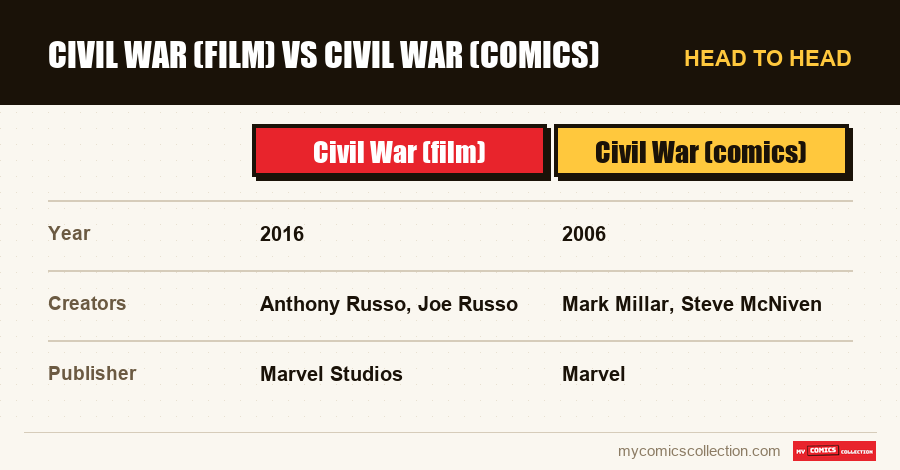
Captain America: Civil War (2016), directed by Anthony and Joe Russo, freely adapts the event comics “Civil War”(2006-2007) by Mark Millar and Steve McNiven, where a superhero registration law pits Captain America against Iron Man. The film introduces two major figures: Black Panther , born in Fantastic Four #52 (1966), and Spider-Man Tom Holland version. It retains the heart of the conflict, freedom versus control, but scales it down and completely reinvents Zemo. Detailed comparison, film versus comics.
Captain America's third solo film but a true gathering of Avengers, Civil War adapts one of the biggest crossovers in Marvel history. The Russo brothers transform a societal debate on a global scale into an intimate divide between allies. Let's see what the film takes from the 2006 event and what it changes.
As in each article in the series, only verified data (distribution, dates, numbers, creators) are stated; the comparative analysis is ours, without reproducing dialogue or protected images.
Title : Captain America: Civil War (2016)
Directors: Anthony and Joe Russo
Actors: Chris Evans (Steve Rogers), Robert Downey Jr. (Tony Stark), Sebastian Stan (Bucky), Chadwick Boseman (T'Challa / Black Panther), Tom Holland (Spider-Man), Daniel Brühl (Zemo)
Exit : May 6, 2016 (United States)
Studio: Marvel Studios
“Civil War”(2006-2007): event in 7 issues, Mark Millar & Steve McNiven
Fantastic Four #52 (1966): 1st appearance of Black Panther (Lee & Kirby)
Amazing Fantasy #15 (1962): Spider-Man's first appearance
Superhero Registration Act: driving force of the conflict
- Le heart of the conflict: Government regulation of superheroes divides the team.
- Le Captain America/Iron Man duel, two irreconcilable moral visions.
- The idea of heroes pitted against each other, without a real villain in the classic sense.
- The entry on stage of Spider-Man and of Black Panther in the grand collective narrative.
- The weight of collateral damage as a trigger for the debate.
- The issue of secret identity, central in the comic, disappears: the heroes of the film are already known.
- Zemo is completely reinvented: a manipulative grieving Sokovian, far from the comics baron.
- The scale goes from a universe-wide war to a tight confrontation between a handful of heroes.
- The emotional engine becomes Bucky and the past of the Winter Soldier, absent from the comic.
- No tragic outcome comparable to that of the original event.
“Civil War” (2006): the war that divided Marvel
The event “Civil War”, published in 2006-2007 with a script by Mark Millar and drawings by Steve McNiven, is one of Marvel's most notable crossovers. Its starting point: after a disaster caused by reckless heroes, the government imposes a registration law forcing any individual with superpowers to reveal their identity and place themselves under official control. The community then splits into two camps, one led by Iron Man (favorable to the register), the other by Captain America (defender of freedoms). The film faithfully takes up this moral fault line and the emblematic duel between the two men, as well as the deeply disturbing idea of a confrontation without a villain: it is the heroes themselves who tear each other apart.
The big difference lies in the issue of secret identity, absolutely central in the comic. In the cinematographic universe, the heroes already operate openly: the film therefore eliminates this influence and shifts the debate towards the question of international supervision, embodied by the “Sokovia Accords”.
Fantastic Four #52 (1966): Black Panther's entrance
Civil War marks the on-screen debut of Black Panther. The character, T'Challa, king of the African nation of Wakanda, was born in Fantastic Four #52 (July 1966), created by Stan Lee and Jack Kirby: one of the first black superheroes in mainstream American comics. The film respects the essentials: royalty, Wakanda, the dimension of a warrior linked to a lineage. His inclusion in the conflict, motivated by the death of his father, cleverly serves to introduce a major character while fueling the drama. This is an example of how the film uses a large gathering to launch new figures.
Amazing Fantasy #15 (1962): Spider-Man joins the party
Another big first: the arrival of Spider-Man, played by Tom Holland. The weaver, born in Amazing Fantasy #15 (1962) under the pen of Stan Lee and the pencil of Steve Ditko, here makes its entry into the shared universe after years of rights exploited separately. In the comic "Civil War", Spider-Man plays a crucial role: he publicly reveals his identity, a gesture with serious consequences. The film cannot take up this spring, but it exploits the opportunity to present a teenage Peter Parker, recruited by Stark, whose enthusiasm brings a welcome breath of fresh air in the middle of the drama.
Zemo, a total reinvention
The film's greatest freedom concerns its antagonist. The Zemo of the comics is Baron Helmut Zemo, heir to a line of villains, often at the head of the Masters of Evil, wearing a characteristic hood. The film makes him something completely different: an anonymous former Sokovian officer, bereaved by the deaths of his family during previous events, who does not seek power but revenge. His plan is not to defeat the Avengers by force, but to turn them against each other from the inside. This rereading, more intimate and psychological, illustrates the film's desire to favor human drama over spectacular confrontation.
Collecting this series?
Track what you own, what you are missing and what your collection is worth. 7 day trial.
Start my trial →The characters, from paper to screen
- Captain America: Defender of freedoms, faithful to his role in the event, but moved here by loyalty to Bucky.
- Iron Man: Supporter of control, consumed by guilt, like in the comic.
- Black Panther: True-to-its-roots introduction to Fantastic Four #52, motivated by grief.
- Spider-Man: Young enthusiastic recruit, far from the tragic role he plays in the comic.
- Zemo: Total reinvention: a grieving manipulator, unrelated to the comics baron.
The Russo brothers and the choral blockbuster
After The Winter Soldier, the Russo brothers confirm their mastery of the overall narrative by orchestrating a film that juggles a dozen heroes without getting lost. Their master choice: anchor an abstract political debate in an intimate story, that of the friendship between Steve and Bucky. By making the Winter Soldier's past the real detonator of the conflict, the film transforms a clash of ideas into a personal tragedy. This ability to give an emotional heart to a crossover has redefined expectations of the genre, and prepared for the great gatherings to come. This is also what distinguishes the film from the event: where the comic weighed each camp politically, the film relies on the spectator's attachment to the characters.
Where to start reading
To extend the film, the event “Civil War” (2006-2007) by Millar and McNiven is the obvious reading, provided you accept a larger and more political narrative than the film. Those curious about Black Panther should go back to Fantastic Four #52 (1966) and then explore the major runs devoted to the king of Wakanda. For Spider-Man, Amazing Fantasy #15 (1962) remains the cornerstone. Finally, those who want to understand the Cap / Bucky relationship, so central to the film, will find the basis of the Winter Soldier in Ed Brubaker's run. From 1962 to 2006, this route covers all the major sources of feature films.
The other heroes caught in the turmoil
If the Cap / Iron Man duel occupies the center, Civil War also owes its density to the way in which it involves the entire gallery of characters from the saga. Vision and the Scarlet Witch, whose closeness the film deepens, find themselves on opposing sides; Ant-Man, just introduced, offers a moment of spectacular bravery; War Machine pays a heavy price for the conflict. This dispersion of heroes on both sides takes up a fundamental principle of the 2006 event, where each figure in the Marvel universe had to choose their side, breaking friendships and alliances. The film condenses this collective divide into a handful of characters, but preserves its essentials: the idea that the real drama is not played out against an external enemy, but between yesterday's allies.
This logic of camps, where the spectator struggles to designate a “good” side, is what made the event so striking in the comics, and what the film recreates with finesse. By refusing Manichaeism, Civil War extends a rare ambition for a blockbuster: to make people think as well as entertain.
Chronology of comics to know
- 1962: Amazing Fantasy #15: First appearance of Spider-Man.
- 1966: Fantastic Four #52: First appearance of Black Panther.
- 2006-2007: “Civil War”: the event that inspires the film, with the registration law.
Collection side: what numbers to aim for after the film
Civil War points to several major keys. Fantastic Four #52 (first appearance of Black Panther) is a historic issue of the Silver Age, whose popularity exploded with the popularity of the character on screen. Amazing Fantasy #15 (first appearance of Spider-Man) is one of the absolute holy grails of all comics, reserved for the most fortunate collections. On the modern side, the issues of the “Civil War” event (2006) remain very accessible and easy to find, perfect for a first thematic purchase. These three targets cover the entire spectrum, from the historical grail to the recent affordable comic. As always, condition and gradation determine value; relying on real recent sales is strongly recommended.
Its place in the saga and for the collector
Civil War is a pivotal point in the saga: it permanently fractures the Avengers, introduces two major characters and prepares for the major clashes to come. For the collector, its interest is twofold. On the one hand, it thrust Fantastic Four #52 into the spotlight, transforming a previously secondary key into one of the most sought-after of the Silver Age: a textbook case of cinema's effect on the marketplace. On the other hand, he recalled the existence of the 2006 event, the collections of which constitute essential reading. Few films point so clearly to so many collectible numbers, from the most prestigious to the most affordable. In this, Civil War perfectly illustrates the way in which an adaptation can redraw the map of treasures to be hunted, by shining its light on characters and stories that the general public was barely discovering.
The verdict: the spirit of conflict, the reduced scale
- Loyalty: the heart of the debate (control versus freedom) and the Cap / Iron Man duel are respected.
- Freedoms: the secret identity evacuated, a reinvented Zemo, a scale tightened and an engine centered on Bucky.
- Collectible numbers: Fantastic Four #52 (Black Panther), Amazing Fantasy #15 (Spider-Man), the “Civil War” event (2006).
By adapting “Civil War”, the Russo brothers were able to extract the essence of a sprawling event, heroes tearing each other apart over a question of principle, and pour it into an intimate and controlled drama. The film sacrifices the political scope of the comic, but gains emotion by making the friendship between Steve and Bucky its real issue. For both reader and collector, it opens a door to some of Marvel's most coveted issues.
Frequently asked questions
From the event “Civil War” (2006-2007) by Mark Millar and Steve McNiven, where a superhero registration law pits Captain America against Iron Man. The film also introduces Black Panther (Fantastic Four #52) and Spider-Man.
The issue of secret identity, central in the comic (Spider-Man reveals his), disappears because the heroes of the film are already operating openly. The film also shifts the emotional engine to the friendship between Cap and Bucky.
No, he is completely reinvented: a grieving former Sokovian officer who manipulates the Avengers, far from the Baron Helmut Zemo of the comics, masked leader of the Masters of Evil.
Yes for the saga: Black Panther (born in Fantastic Four #52, 1966) and Tom Holland version of Spider-Man (from Amazing Fantasy #15, 1962) both make their debut there.
Fantastic Four #52 (Black Panther's first appearance) is the key to the Silver Age most tied to the film. Amazing Fantasy #15 (Spider-Man) is a holy grail, and the “Civil War” event collections (2006) are the accessible modern entry.
Does the film make you want to collect? Estimate the value for free of your issues (Fantastic Four #52, Civil War…) with our tool based on current eBay listings.