Black Panther (2018), directed by Ryan Coogler with Chadwick Boseman, adapts the king of Wakanda born in Fantastic Four #52 (1966) by Stan Lee and Jack Kirby. His great enemy, Killmonger , appears in Jungle Action #6 (1973) by Don McGregor, in the "Panther's Rage" arc; Klaw born in Fantastic Four #53 (1966) and Shuri in 2005. The film respects the essentials of Wakandan mythology but deepens the theme of the diaspora. Detailed comparison, film versus comics.
The first major superhero film to place an African king and his kingdom at the center of the story, Black Panther is a milestone in the saga. Under the direction of Ryan Coogler, the film draws on more than fifty years of comics to build Wakanda and its characters, while adding new thematic depth. Source-by-source decryption.
As in each article in the series, only verified information (distribution, dates, numbers, creators) is stated; the comparative analysis is ours, without reproducing dialogue or protected images.
Title : Black Panther (2018)
Director: Ryan Coogler
Actors: Chadwick Boseman (T'Challa), Michael B. Jordan (Killmonger), Lupita Nyong'o (Nakia), Danai Gurira (Okoye), Letitia Wright (Shuri), Andy Serkis (Klaue)
Exit : February 16, 2018 (United States)
Studio: Marvel Studios
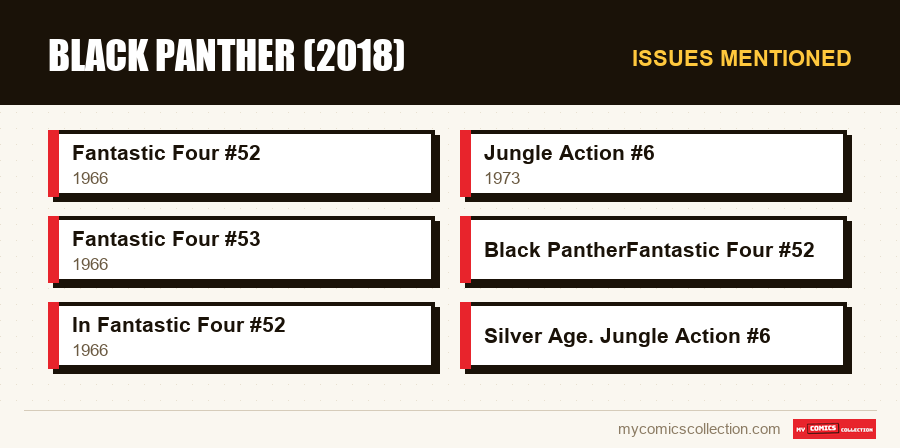
Fantastic Four #52 (1966): 1st appearance of Black Panther (Lee & Kirby)
Jungle Action #6 (1973): 1st appearance of Killmonger (Don McGregor)
Fantastic Four #53 (1966): Klaw's first appearance
Black Panther vol. 4 #2 (2005): Shuri's first appearance
- Le Wakanda, secret African nation and technologically advanced thanks to vibranium.
- T'Challa, king and protector, whose power is linked to a lineage and a ritual herb.
- Killmonger, a rival with Wakandan blood, taken from “Panther's Rage”.
- Klaw, the enemy with the sonic arm, murderer of T'Challa's father.
- Shuri, the genius sister, and the Dora Milaje, elite goalkeepers.
- Killmonger is profoundly rewritten: the film makes him a cousin of T'Challa, carrying a discourse on the diaspora.
- The political theme: Wakanda's duty to the world: is amplified compared to the original comics.
- Shuri becomes a genius inventor, a role much more developed than when she started in 2005.
- Klaw sees its appearance modernized (sound cannon rather than hand weapon).
- The story condenses and rearranges decades of Wakandan continuity.
Fantastic Four #52 (1966): the first mainstream black superhero
Black Panther is born in Fantastic Four #52 (July 1966), creation by Stan Lee and Jack Kirby. T'Challa, king of the fictional African nation of Wakanda, is presented as one of the first black superheroes in mainstream American comics: a historic milestone. The film scrupulously respects the foundations laid in this issue: Wakanda, an isolated and secret nation whose technological advance is based on vibranium; hereditary royalty; the connection between the title Black Panther and a ritual herb granting superhuman strength and agility. This fidelity to the basics of 1966 anchors the film in a rich mythology, developed by generations of authors.
Vibranium, a miraculous metal introduced in these same pages, is the base of the entire edifice: it is this which makes Wakanda a hidden power, and the film makes it the central issue of its intrigue, between foreign lust and national responsibility.
Jungle Action #6 (1973): Killmonger and “Panther's Rage”
The film's main antagonist, Killmonger, appears in Jungle Action #6 (1973), at the heart of Don McGregor's "Panther's Rage" arc: one of the first long stories constructed as a coherent graphic novel. In the comics, N'Jadaka, known as Erik Killmonger, is an exiled Wakandan who returns to challenge T'Challa for the throne. The film retains this fratricidal rivalry for power, but gives it a new meaning: on screen, Killmonger becomes the cousin of T'Challa, an American marked by injustice, whose revolt carries a powerful message about the African diaspora and the responsibility of Wakanda towards the oppressed of the world. This rewrite makes him one of the most nuanced and striking antagonists in the entire saga: an enemy whose cause is not without justice.
Klaw, Shuri and Wakandan mythology
The film completes its gallery with figures from various eras. Klaw (Ulysses Klaue), the enemy with sonic power, was born in Fantastic Four #53 (1966), the issue following T'Challa's, and remains in the comics the murderer of the Panther's father: a link that the film maintains. Shuri, T'Challa's younger sister, is a much more recent addition: she appears in Black Panther vol. 4 #2 (2005), from the pen of Reginald Hudlin. The film transforms her into a genius inventor, the technological brain of Wakanda, a role that left a lasting mark on the character. The Dora Milaje, elite guardians, complete this faithfully recreated mythology.
The characters, from paper to screen
- T'Challa: True to his roots from Fantastic Four #52: king, warrior and protector linked to a sacred bloodline.
- Killmonger: Rewritten as a cousin carrying a discourse on the diaspora, much deeper than in the comics.
- Klaw: Modernized sound enemy, murderer of T'Challa's father, faithful to this link from the comics.
- Shuri: Transformed into a genius inventor, from a character introduced in 2005.
- Nakia, Okoye and the Dora Milaje: Wakandan entourage faithful to the mythology developed over the course of the runs.
Collecting this series?
Track what you own, what you are missing and what your collection is worth. 7 day trial.
Start my trial →Ryan Coogler and cultural reach
The film's great success lies in Ryan Coogler's vision, which transforms a superhero story into a meditation on identity, colonial heritage and responsibility. This thematic depth, if it extends ideas present in authors like Christopher Priest or Ta-Nehisi Coates, is taken to a new level for a blockbuster. Wakanda becomes a utopia full of meaning: an Africa never colonized, sovereign and prosperous. By giving Killmonger a coherent and painful speech, the film refuses Manichaeism and questions the role of the powerful against the oppressed. This ambition explains the exceptional cultural reach of the film, well beyond the comic book audience alone.
Priest and Coates: the runs that shaped modern Wakanda
If the foundations go back to 1966, the Black Panther that the film wears owes a lot to two modern runs. That of Christopher Priest (late 1990s) is often considered definitive: it deepens the political dimension of the character, makes T'Challa a formidable strategist and introduces the Dora Milaje, these elite guardians that the film features. More recently, Ta-Nehisi Coates' run (from 2016) explored the internal tensions of Wakanda, the legitimacy of royal power, and the moral responsibilities of the king. The film draws from these two sources the material for its reflection on power and heritage, well beyond the superhero adventure.
This connection explains the thematic richness of the film: Wakanda is not a simple exotic setting, but a nation with its history, its conflicts and its dilemmas, shaped by decades of writing. Drawing on Priest and Coates as much as Lee and Kirby, the film offers a remarkable synthesis of more than half a century of character development. For the reader, discovering these runs after the film is to measure the extent to which the cinema was nourished by what the comics had the most ambitious to offer on this character.
Where to start reading
To discover Black Panther, the “Panther's Rage” arc by Don McGregor (Jungle Action, from 1973) is a foundational read, where Killmonger appears and where Wakandan mythology unfolds. We can then explore the run of Christopher Priest (late 1990s), considered definitive, then that of Ta-Nehisi Coates (2016), the closest to the political sensitivity of the film. Those curious about the origins will go back to Fantastic Four #52 (1966). From 1966 to today, this journey covers the major sources of a character whose thematic richness has continued to grow. Few heroes can boast such continuity of excellence, from Kirby to Coates, which makes Black Panther one of the most rewarding characters to read for those who love ambitious stories.
Chronology of comics to know
- 1966: Fantastic Four #52: First appearance of Black Panther.
- 1966: Fantastic Four #53: First appearance of Klaw.
- 1973: Jungle Action #6: First appearance of Killmonger (“Panther's Rage”).
- 2005: Black Panther vol. 4 #2: First appearance of Shuri.
Collection side: what numbers to aim for after the film
Black Panther lines up some highly sought-after keys. Fantastic Four #52 (first appearance of T'Challa) is a historic number from the Silver Age, whose popularity exploded with the success of the film; it's one of the most coveted debut appearances of the decade. Jungle Action #6 (first appearance of Killmonger) is a more accessible Bronze Age key, but whose importance has been rediscovered thanks to the film. Black Panther vol. 4 #2 (first Shuri) is an affordable and promising modern number. These targets cover a wide range of budgets. As always, condition and gradation determine value; relying on real recent sales is strongly recommended. Fantastic Four #52 remains the holy grail for any Wakanda collector.
Its place in the saga and for the collector
Black Panther occupies a special place in the saga: a cultural phenomenon as much as a commercial success, it proved that a superhero film could make a major political and identity statement. For the collector, its impact on the market was spectacular: Fantastic Four #52 saw its value rise dramatically, bringing in its wake Jungle Action #6 and the first Wakandan stories. This film wonderfully illustrates the power of cinema to rediscover treasures: “Panther's Rage”, long considered a pioneering but confidential story, is now recognized as a major milestone in comics. Beyond speculation, the film invites us to explore a mythology of rare richness, where adventure is coupled with a reflection on power and heritage. It is this depth, born from the pens of Lee, Kirby, McGregor then Coates, that the film brings magnificently to the screen.
The verdict: the mythology respected, the words amplified
- Loyalty: Wakanda, T'Challa, Klaw and Killmonger are faithfully taken from the comics.
- Freedoms: Killmonger rewritten as a cousin carrying a discourse on the diaspora, Shuri promoted to genius, amplified political statement.
- Collectible numbers: Fantastic Four #52 (T'Challa), Jungle Action #6 (Killmonger), Black Panther vol. 4 #2 (Shuri).
Black Panther achieves the feat of being both faithful to Wakandan mythology and carrying a message of unprecedented magnitude. By giving Killmonger a legitimate and painful cause, the film transcends the superhero narrative to question power, legacy and justice. For reader and collector alike, it opens a door to one of Marvel's richest universes, and to some of its most coveted keys. Rare are the superhero films to have had such a cultural impact, and even rarer those which have increased the popularity of their original comics so much. Black Panther will remain as the quintessential example of an adaptation that honors its material while giving it new resonance, transforming a paper king into a universal symbol.
Frequently asked questions
Foundations laid in Fantastic Four #52 (1966) and Don McGregor's "Panther's Rage" arc (Jungle Action, from 1973), which introduced Killmonger. He also draws on the modern runs of Priest and Coates.
Partly: N'Jadaka appears in Jungle Action #6 (1973) as T'Challa's rival for the throne. The film rewrites him as T'Challa's cousin, carrying a powerful discourse on the African diaspora.
In Fantastic Four #52 (1966), created by Stan Lee and Jack Kirby. T'Challa is one of the first black superheroes in mainstream American comics.
No, it is relatively recent: it appears in Black Panther vol. 4 #2 (2005). The film transformed her into a genius inventor, a role that had a lasting impact on the character.
Fantastic Four #52 (first appearance of Black Panther) is the holy grail of the Silver Age. Jungle Action #6 (first appearance of Killmonger) is a more accessible Bronze Age key and rediscovered thanks to the film.
Does the film make you want to collect Black Panther? Estimate the value for free of your issues (Fantastic Four #52, Jungle Action #6…) with our tool based on current eBay listings.