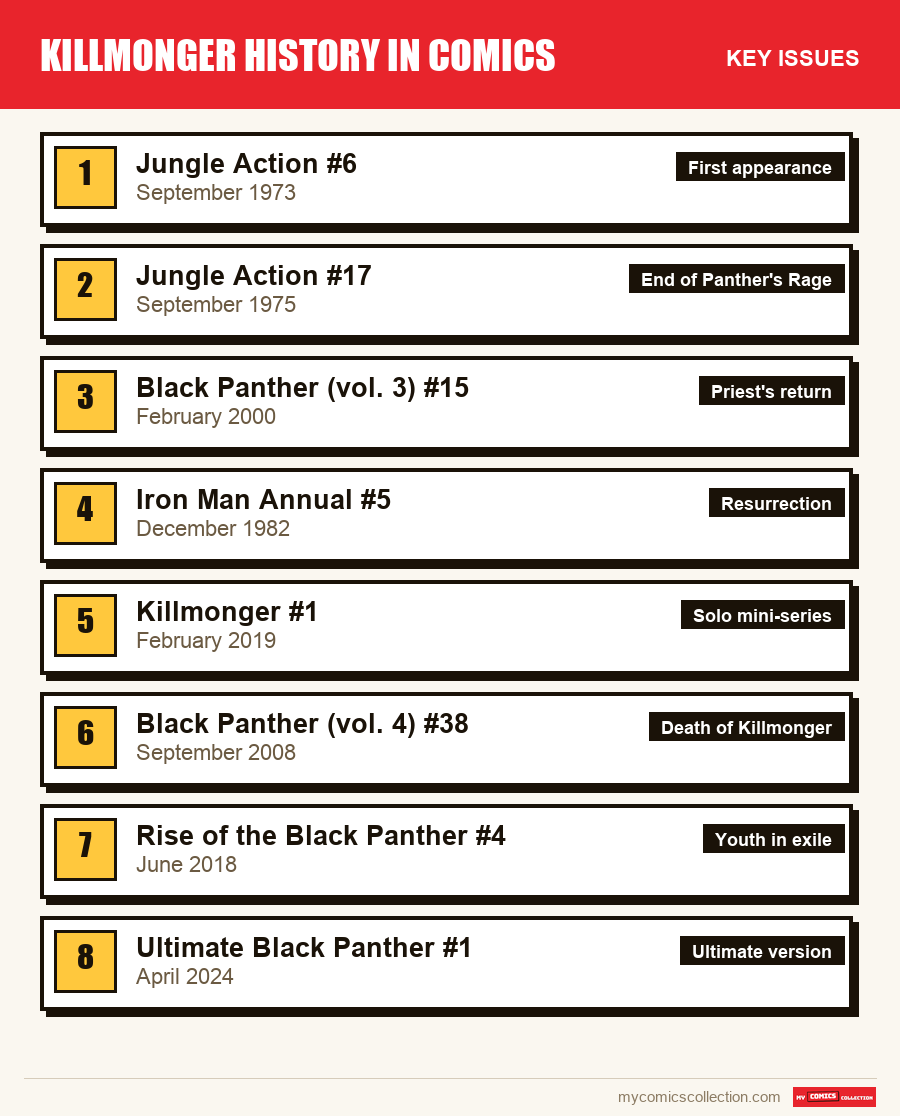
Erik Killmonger (born N'Jadaka) is created by writer Don McGregor and artist Rich Buckler, inked by Klaus Janson, and first appears in Jungle Action #6 (September 1973), first chapter of the cult arc “Panther's Rage”. The character dies in Jungle Action #17 (1975), resurrected via The Mandarin in Iron Man Annual #5 (1982), then returns to the fore under the pen of Christopher Priest in Black Panther vol. 3 #15-18 (2000). His popularity exploded after the film Black Panther of 2018 with Michael B. Jordan, which pushed Marvel to dedicate a solo mini-series to him by Bryan Edward Hill and Juan Ferreyra at the end of 2018, and increased the rating of Jungle Action #6 on the second-hand market.
There are few Marvel villains whose editorial trajectory has been as tortuous as Killmonger's. Discreetly introduced in 1973 in an anthology magazine doomed to disappear a few years later, the character crossed nearly five decades of comics in relative confidentiality before a 2018 film propelled him to the rank of the most discussed antagonist of the Marvel Cinematic Universe. This shift is not insignificant for collectors: it transforms an anthology issue long shunned by the market into a real keystone of any Black Panther collection.
This article traces the complete history of Killmonger in comics, from his creation by Don McGregor to his most recent reincarnations, based on verifiable editorial facts: numbers, creators, publication dates and available market data. The goal is to give collectors a reliable roadmap to understanding what numbers really matter, why, and how to value what they own or want.
Birth of a Character: Don McGregor and “Panther's Rage”
To understand Killmonger, you must first understand the very particular context in which he was born. Black Panther, created in 1966 by Stan Lee and Jack Kirby in the pages of Fantastic Four, never had a solo series worthy of the name during its first seven years of existence. He wanders between Fantastic Four , Avengers and a brief foray into Daredevil, always in a supporting role. It was only in 1973 that Marvel offered him a real narrative space, by entrusting the character to screenwriter Don McGregor in the pages of Jungle Action, a magazine previously devoted to reissues of jungle adventure stories from the 1950s. McGregor, supported by artist Rich Buckler and inker Klaus Janson, launches with Jungle Action #6 (cover dated September 1973, on sale July 10, 1973) the first long-format story entirely devoted to Black Panther: the “Panther's Rage” arc, which will unfold over thirteen issues. It is in this very first chapter that Erik Killmonger appears, literally from the first pages, in the guise of a rival determined to overthrow T'Challa and take control of Wakanda. The character's founding scene (the confrontation at Warrior Falls, where Killmonger throws T'Challa into the void after defeating him in combat) will be repeated almost identically forty-five years later in the 2018 film, proof of the lasting imprint left by this first story.
Killmonger's original identity, N'Jadaka, and his past as a Wakandan exiled to the United States after the death of his parents, are established from these first issues. McGregor constructs a political antagonist more than a simple supervillain: Killmonger does not seek to destroy Wakanda but to take power to modernize it in his own way, relying on external support and anti-colonial rhetoric turned against the Wakandan monarchy itself. It is this complexity, rare for the time in a mainstream action comic, which allowed the character to survive the disappearance of his original series and to resurface regularly in Marvel continuity for more than fifty years. The "Panther's Rage" arc also includes a map of Wakanda drawn by McGregor himself, which has served as a geographic reference to the fictional kingdom in almost all subsequent stories, both comics and films.
From Death to Warrior Falls to the Return of Christopher Priest
The "Panther's Rage" arc concludes in spectacular fashion: Killmonger dies in Jungle Action #17 (September 1975), thrown off a cliff by a young boy who simultaneously saves T'Challa's life. The series Jungle Action itself stops shortly after, replaced by a new series Black Panther launched in 1977 under the direction of Jack Kirby, who started on very different bases and did not immediately exploit McGregor's legacy.
The character doesn't stay dead for very long on the scale of Marvel continuity. His body is recovered by The Mandarin, and Killmonger reappears in Iron Man Annual #5 (1982), a transitional episode that keeps him alive in the shared universe without offering him a major new plotline. We had to wait until the year 2000 and the arrival of Christopher Priest at the helm of Black Panther vol. 3 for Killmonger to regain a central role. In issues #15 to #18 of this series, Priest orchestrates the return of the character in an almost Christ-like form: Killmonger methodically destabilizes the economy of Wakanda, eventually defeats T'Challa in ritual combat and temporarily becomes Black Panther himself, before being neutralized by the poison of the heart-shaped herb during the ascension ceremony, which allows T'Challa to regain his place. This rereading of Priest is today considered by a large part of the fandom as one of the pinnacles of the character's writing, on par with McGregor's founding story.
Killmonger will return again later, notably in the Reginald Hudlin era of Black Panther vol. 4 from 2005, then in an attempt to take control of the fictional country of Niganda recounted in Black Panther vol. 4 #35 to #38 (2008), where he is killed by Monica Rambeau in #38. As is often the case with major Marvel antagonists, death is never completely final, and the character has since been declined in several alternate continuities, including a particular version explored by Ta-Nehisi Coates in Black Panther vol. 7 #20 (2020) and an Ultimate iteration signed Bryan Edward Hill in 2024 in Ultimate Black Panther, rooted in the alternate reality Earth-6160.
The impact of the 2018 film on the Killmonger comics rating
The most defining commercial turning point for Killmonger as a collectible character occurred in February 2018, with the theatrical release of Black Panther directed by Ryan Coogler. The film was released on February 16, 2018 and became an immediate cultural and financial phenomenon: opening to $218 million over the four-day Presidents' Day weekend, for a worldwide total of around $1.35 billion at the box office. Michael B. Jordan plays N'Jadaka / Erik "Killmonger" Stevens, presented as a former US Navy SEAL turned clandestine operator, and his performance is immediately hailed as one of the best villain incarnations in the Marvel Cinematic Universe. This critical recognition had a wildfire effect on the second-hand comic book market. Jungle Action #6, long considered a minor anthology issue reserved for Black Panther purists, has found itself propelled to the status of a key sought after by a much wider audience. Market tracking data shows that a 6.0 graded copy was trading on average for less than $80 in the year before interest peaked, before sales regularly exceeded $120, with a 90-day rolling average above $100. This movement illustrates a classic phenomenon of the comic market: it is not the release of a film alone that increases the rating of a key issue, but the critical reception and the anchoring of the character in the collective memory of the public, two criteria that Black Panther largely filled.
Marvel Comics supported this editorial craze by ordering a solo mini-series directly inspired by the film: Killmonger, published from December 2018 in five issues, written by Bryan Edward Hill and drawn by Juan Ferreyra. Presented by its author as a form of origin story, the series follows N'Jadaka from his exit from MIT to his exile in the United States, explicitly relying on the film's waterfall fight scene as an entry point into the psychology of the character. Hill explores the choices and failures, both Wakandan and outside, that shaped a man devoted to revenge: material that directly continues the moral ambiguity already present in McGregor's original 1973 story. This mini-series remains sought after today by collectors who wish to own the character's entire bibliography, without reaching the value of the very first issue from 1973.
The character also continued to exist on screen after 2018: Michael B. Jordan takes on a spectral form of Killmonger in a cameo in Black Panther: Wakanda Forever (2022), and lends his voice to alternate variations of the character in several episodes of the animated series What If...? (2021). These appearances, although secondary, maintain the notoriety of the character and, in turn, the interest in his founding comic appearances.
Collecting this series?
Track what you own, what you are missing and what your collection is worth. 7 day trial.
Start my trial →Identify and evaluate Killmonger key issues
For a collector who wishes to build a coherent collection around Killmonger, the hierarchy of numbers to know is relatively simple to establish, even if the difficulty of accessing each title varies greatly.
- Systematically check that it is indeed Jungle Action #6 and not from another issue of the series: issues #7 and #8 continue the “Panther's Rage” arc but do not have first appearance value; only #6 contains Killmonger's very first debut.
- Check the title page and the collection number in cents copy for ungraded copies: Jungle Action #6 was published at a cover price of $0.20, a useful benchmark for distinguishing a vintage copy from a reprint or facsimile.
- Favor graded CGC or CBCS copies for significant investments: high grades remain rare on this anthology issue more than fifty years old, and the difference in value between a VG (4.0) and a VF (8.0) can be considerable.
- Don't neglect Black Panther vol. 3 #15-18 by Christopher Priest: This is not a first appearance but the most critically acclaimed return arc, often sought after as a companion to the 1973 issue.
- Think about the miniseries Killmonger (2018) by Bryan Edward Hill and Juan Ferreyra in full five issues if you want to cover the entire post-film bibliography, its availability remains good because its print run is recent.
- Always compare several recent sales before buying or selling, the rating of an anthology issue like Jungle Action #6 can fluctuate significantly depending on the character's cinematic news.
- Examine the condition of the staples and spine: Marvel anthology magazines from the early 1970s often have weaker paper than the main titles of the same era, which strongly affects high-grade conservation.
Beyond these practical benchmarks, we must keep in mind that Killmonger remains, unlike figures like the Joker or Duke Bane, a character whose editorial career is relatively short and concentrated on a few key arcs. This simplifies the collector's task: there are not dozens of secondary first appearances to track down, but a limited number of well-identified milestones, from the founding story of 1973 to the retelling of Priest in 2000, including the solo mini-series of 2018. This relative scarcity of major milestones, combined with a general public notoriety now established thanks to cinema, explains why Jungle Action #6 continues to occupy a special place in discussions about comic book investments related to the Black Panther universe.
If you have a copy of Jungle Action #6 or one of Killmonger's return arcs and you want to follow the evolution of its price on the market, remember to catalog your collection precisely: title, number, year, publisher and state of conservation are the four pieces of information which determine most of the value of an old comic. OUR comic collection management application allows you to centralize this information and follow the evolution of your library number by issue, which is particularly useful for long runs like that of Black Panther, spread over several series and several decades.
Key issues to know
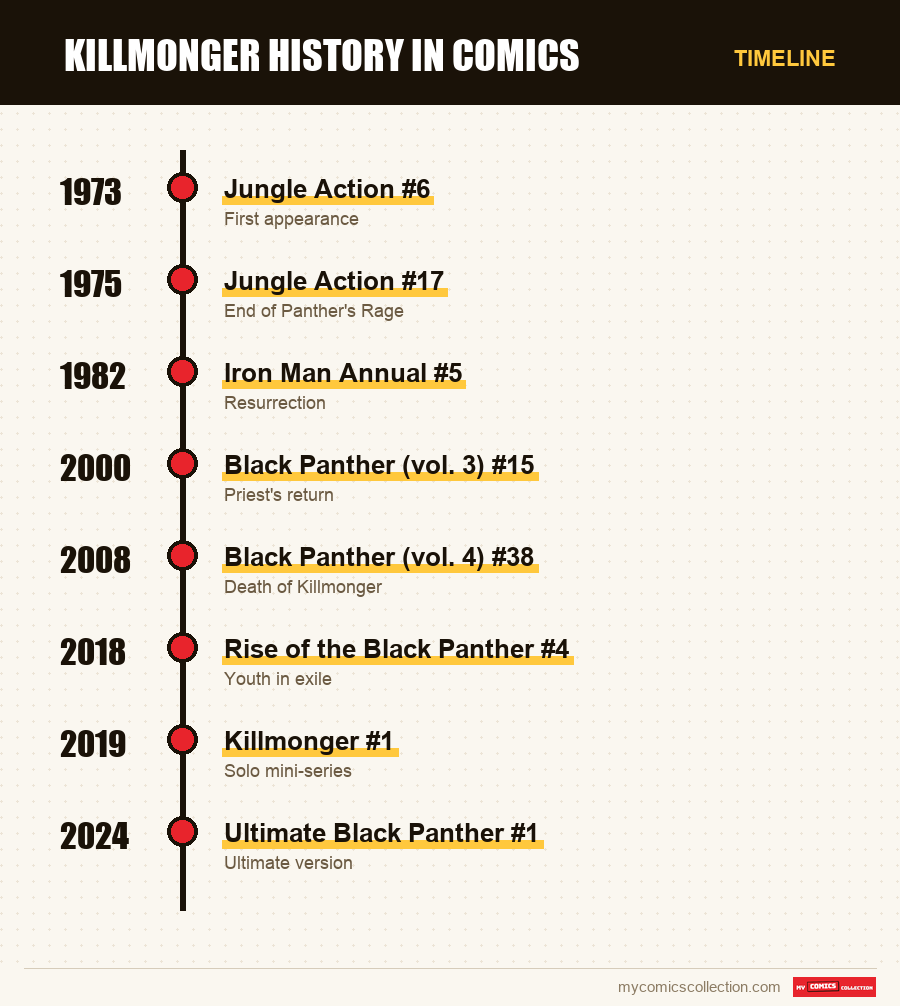
Jungle Action #6
Don McGregor, Rich Buckler and Klaus Janson open Panther's Rage, the first long-form Black Panther story. Erik Killmonger appears in the very first chapter, leading a rebellion against T'Challa, and the first clash takes place at Warrior Falls.
Jungle Action #17
Final chapter of the saga, drawn by Billy Graham: the last clash between T'Challa and Killmonger, with young Kantu present, ends in the rebel's apparent death and the scattering of his forces.
Black Panther (vol. 3) #15
Christopher Priest brings Killmonger back to the fore. In this arc he defeats T'Challa in the ritual combat for the throne and takes over Wakanda. It is regarded as one of the best takes on the character.
Iron Man Annual #5
Peter Gillis and Jerry Bingham stage Killmonger's return, brought back to life by the Mandarin's rings. Defeated by Black Panther, he reverts to a lifeless skeleton when the Mandarin recalls his ring. This return was later reinterpreted as a mere simulacrum.
Killmonger #1
Released in December 2018 in the wake of the film, this five-issue mini-series by Bryan Edward Hill and Juan Ferreyra tells N'Jadaka's American youth, his MIT degree and his recruitment by Kingpin's operatives. An origin built around revenge.
Black Panther (vol. 4) #38
Conclusion of Reginald Hudlin's Back to Africa arc: back in Wakanda for revenge, Killmonger fights Black Panther and Monica Rambeau. About to deliver the final blow to T'Challa, he is killed by Monica Rambeau.
Rise of the Black Panther #4
In this mini-series by Evan Narcisse and Javier Pina, released the year of the film, the story looks back at N'Jadaka's exile from Wakanda and his arrival in Harlem, where he takes the name Erik Killmonger.
Ultimate Black Panther #1
Bryan Edward Hill, who wrote the Killmonger mini-series, and Stefano Caselli reinvent Wakanda in the new Ultimate universe. Killmonger makes his first appearance there as a warrior protecting a village from the forces of Khonshu and Ra.