The series Jungle Action (Marvel, 1972-1976) is not a minor Bronze Age title: it is there, and nowhere else, that Don McGregor and Rich Buckler created Erik Killmonger in issue 6 (September 1973), the starting point for "Panther's Rage", the first long-format story ever devoted to a black hero at Marvel. Number 6 remains the absolute key to the series; the 17th (death of Killmonger) and the 19th (opening of “Panther vs the Klan”) complete a trio of masterpieces sought after by collectors of Bronze Age comics and by fans of the MCU since Michael B. Jordan's cartoon in Black Panther (2018) then his surprise return in Wakanda Forever (2022).
Jungle Action is a textbook case in the history of Marvel: a title initially doomed to editorial destruction, resurrected to recycle old anthological pages, which without warning becomes one of the most acclaimed runs of the entire 1970s. Few series display such a spectacular gap between their starting point (reprints of jungle-comics from the 1950s judged, in hindsight, frankly embarrassing) and their point of arrival: a political, tragic saga and ambitious film centered on the Black Panther, which author Dwayne McDuffie would later call "the best-written multi-part superhero epic ever".
For today's collector, the series poses a problem characteristic of Bronze Age comics: a confidential print run, chaotic newsstand distribution and cultural recognition that arrived almost fifty years after publication, thanks to the cinema. As a result, the best issues circulate in small quantities in high grade, and demand has been multiplied since 2018 by the success of the films Black Panther. This guide details, number by issue, the real value of this series and why certain 20 or 25 cent titles have become four or even five figure coins in near mint condition.
From Atlas' forgotten anthology to Don McGregor's masterpiece
There are actually two series called Jungle Action. The first, published by Atlas Comics (the ancestor of Marvel) from October 1954 to August 1955, is a six-issue anthology featuring characters modeled on Tarzan such as Lo-Zar, Jungle Boy or Leopard Girl: stories that modern critics bluntly describe as dated and problematic in their treatment of Africa. This first version has absolutely no creative link with what follows, and its value remains anecdotal compared to the series that interests us here.
In October 1972, Marvel relaunched the title for the second time, with the initial intention of simply republishing these old Atlas stories in order to fill an editorial schedule. The first five issues (#1 to #5, October 1972 to July 1973) effectively follow this logic: pure reprints, without original narrative contribution, with a collector's value today limited to their status as the first issue of the relaunch. It was screenwriter Don McGregor who changed the situation: judging it absurd to publish stories of white heroes in the middle of the African jungle at a time when Marvel was precisely looking to develop its first leading black hero, he managed to rebuild the series around the Black Panther. Number 5 initiates the shift by republishing Avengers #62 (“The Monarch and the Man-Ape”), first appearance of the character in the title, before issue 6 definitively switches to 100% new content.
What follows, issues 6 through 18, form the "Panther's Rage" arc: thirteen consecutive chapters, approximately 200 pages published over two years, considered in retrospect to be the very first "graphic novel" in Marvel history: long before the term became a marketing argument. McGregor invents the very principle of the story-flow in several parts in a superheroic universe, a format that the house will then take up as a routine. The drawing is successively signed by Rich Buckler then Gil Kane, with striking reliefs of Klaus Janson and Billy Graham inking: Graham himself becoming the main artist of the title from issue 8, a rare occurrence for an African-American artist on a Marvel series of the time.
Jungle Action #6
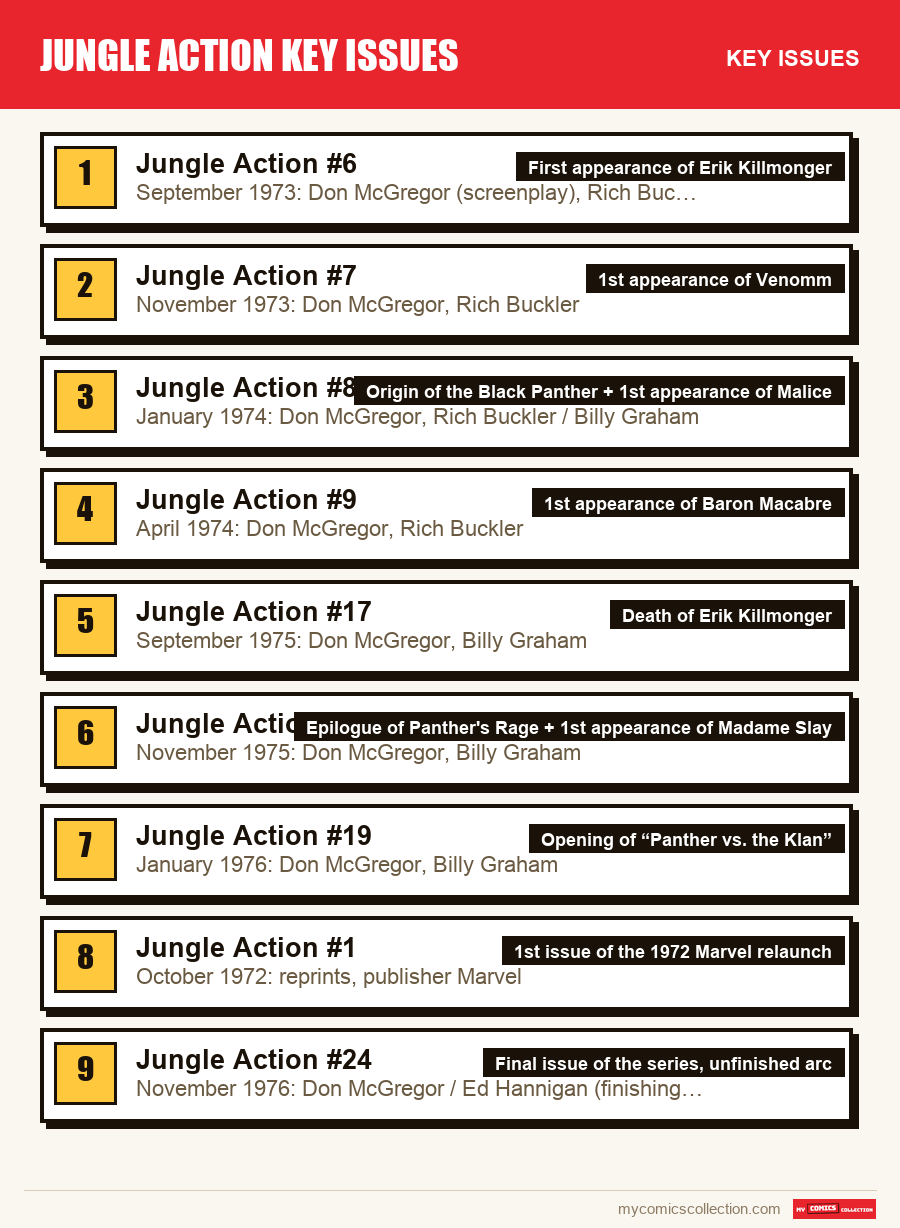
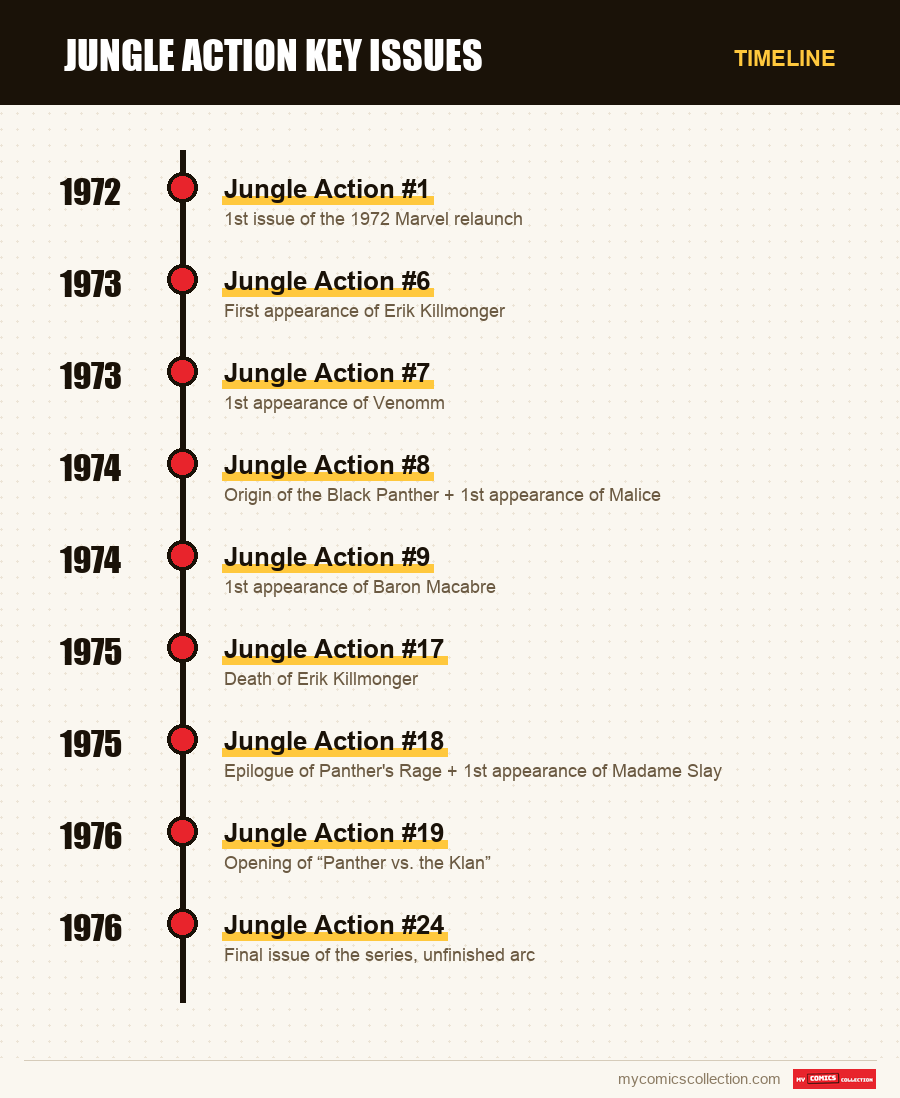
The absolute key to the entire series, and one of the most popular Marvel Bronze Age issues since 2018. “The Man Called Kill-Monger!” » opens "Panther's Rage": T'Challa returns to Wakanda to discover that his throne is threatened by a rival born there but exiled in the United States, N'Jadaka: now Erik Killmonger. It's also the first solo story ever dedicated to the Black Panther in its own pages, after years of simple supporting appearances in Avengers or Fantastic Four. The character of Killmonger will become the antagonist of the film in 2018 Black Panther, performed by Michael B. Jordan: a critically acclaimed performance that skyrocketed demand for this specific issue, which until then had been relatively ignored by classic Bronze Age collectors.
Jungle Action #7
"Death Regiments Beneath Wakanda" directly continues "Panther's Rage" and introduces Venomm, one of Killmonger's lieutenants with snake control-a character who will return several times in later runs of Black Panther. This issue mechanically benefits from the notoriety of #6 since it continues with the same plot and the same cast of villains, but remains significantly more accessible on the market because it is less identified as "key" by the general public of occasional collectors.
Jungle Action #8
This issue combines two collector's assets: it returns to the origin of T'Challa (useful for any reader discovering the character without having gone through Fantastic Four #52-53) and introduces Malice, a former Dora Milaje who joined Killmonger. It was also the last issue published at the price of 20 cents before the increase to 25 cents from the following issue: a production detail that interested newsstand circulation specialists of the time, the price increase often having a slight impact on the distribution of subsequent issues.
Jungle Action #9
Fourth chapter of “Panther's Rage”, this issue introduces Baron Macabre, a necromancer capable of raising the dead to fight the Panther, a character who will then face King Cadaver in the following episodes. It was also the first issue sold for 25 cents on newsstands, Marvel having adjusted its prices across its entire editorial line in the spring of 1974.
Jungle Action #17
The climax of “Panther's Rage”: after thirteen issues of tracking, T'Challa confronts Killmonger at Warrior's Falls. Exhausted, the Panther is about to be thrown into the void when Kantu, a young Wakandan whose father was killed by Killmonger, pushes him into the fall: accidentally saving T'Challa's life. Killmonger's body is then recovered by Madame Slay, before being later resurrected by the Mandarin to use against Iron Man in another series. A pivotal number in the run, it attracts strong demand from collectors focused specifically on the character of Killmonger since his cinematic breakthrough.
Jungle Action #18
Thirteenth and final chapter of the arc, this episode serves as an epilogue after the death of Killmonger: the Black Panther, captured and tortured by Madame Slay (Killmonger's companion, capable of commanding leopards), must escape with the help of W'Kabi. This is the first appearance as such of the character of Madame Slay, whose role was introduced in the previous issue. Editorially, this issue neatly closes the most ambitious story in the series before the more controversial turn that follows.
Jungle Action #19
“Blood and Sacrifices” launches the second major arc of the series: the Black Panther directly confronts the Ku Klux Klan on American soil. It is one of the most daring stories ever published by Marvel in the 1970s: the story, conceived at the beginning of the decade, would have according to several sources provoked threats against the Marvel offices before its publication, as the subject was sensitive for the time. Cover by Gil Kane, very identifiable with its imagery of white hoods, making it an issue that is both historically important and visually immediately recognizable on the shelf.
Jungle Action #1
This issue contains no Black Panther content, only reprints of jungle stories from the 1950s, but remains in demand among run-complete collectors and issue #1 specialists, regardless of editorial content. This is the chronological starting point of the series which, five issues later, will become the vector for the creation of Killmonger.
Jungle Action #24
The abrupt end of a series that was nevertheless praised by critics: due to lack of sufficient sales and problems with completion (number 23 is even a simple reprint of Daredevil #69, with an appearance by the Black Panther, to fill the schedule), Marvel stops Jungle Action with this 24th issue, leaving “Panther vs the Klan” unfinished. The story will only be picked up and concluded three years later, in Black Panther #14-15 then Marvel Premiere #51-53 (1979-1980), signed by another screenwriter (Ed Hannigan) due to lack of McGregor's return to the project. Marvel relaunched the Black Panther in an eponymous series in January 1977, written and drawn by Jack Kirby, who had recently returned to the publisher.
Collecting this series?
Track what you own, what you are missing and what your collection is worth. 7 day trial.
Start my trial →The impact of the MCU on the series' rating
Before 2018, Jungle Action remained a cult series, recognized by comic book critics but largely ignored by the speculative market: few characters emerged from it to permanently integrate the Marvel universe beyond the pages of the series itself, with the notable exception of Killmonger. The movie Black Panther by Ryan Coogler changes everything in 2018: Michael B. Jordan plays an Erik Killmonger largely rewritten compared to his original comics version, but faithful enough in his essence (exiled Wakandan rival, claimant to the throne, dark mirror of T'Challa) for readers to naturally go back to his very first paper appearance. Number 6 therefore became the most requested piece of the entire series, a status it has never lost since.
The surprise return of the character in Black Panther: Wakanda Forever (2022): an unannounced appearance by Michael B. Jordan in the Ancestral Plane, opposite Shuri, kept secret until the film's release: relaunched a second wave of collecting interest, this time driven both by long-time fans and by new buyers discovering the existence of Killmonger in comics on this occasion. This dynamic explains why number 17, which seals the death of the character in the Marvel pages, displays such a marked rating in very high grade despite an originally anonymous newsstand print run: the objective rarity (barely nine copies known in CGC 9.8) meets a very real and lasting cultural demand.
The second arc, "Panther vs the Klan", has, however, never been adapted for the screen, its subject undoubtedly remains too frontal for a general public filming, which maintains its rating on more historical and editorial bases than cinematographic: issues 19 to 24 primarily appeal to collectors interested in the social history of American comics rather than in speculation linked to the films.
Buying Guide for Jungle Action Collectors
- Target number 6 first if the budget is limited to a single part: it is the most identified key of the run, the most requested since 2018, and the one which will retain the most liquidity upon resale.
- Systematically check the cover price to distinguish the 20 cent issues (up to #8) from the 25 cent issues (from #9): an error in mentioning the price in an advertisement can betray a recycled cover scan from another issue.
- Beware of undeclared restorations on numbers 6 and 17: their high rating in high grade mechanically increased the risk of unreported retouching, in particular on the often fragile cover of these cheap newsstand prints.
- Consider numbers 7 to 16 as an affordable entry point into “Panther's Rage” before investing in the major keys: they tell the same saga, with the same creative team, for a significantly lower budget.
- Do not confuse the 1972-1976 Marvel series with the 1954-1955 Atlas anthology bearing the same title: the two have no creative or editorial link, only the second is of interest to Black Panther collectors.
- Compare several recent sales before buying: the low census population of certain issues (notably #17 and #19) generates high price volatility from one sale to another: an isolated copy at a high price does not make a market.
- Use the app application-collection-comics/ to follow the evolution of the odds of each number owned over time rather than relying on a fixed number.
- Learn about grade differences before purchasing CGC 9.6 or 9.8 on this series: the difference in value between 9.2 and 9.8 can be considerable on newsstand prints from the 1970s, see our comparison CGC grade 9 vs 9.8 to understand what justifies these differences.