
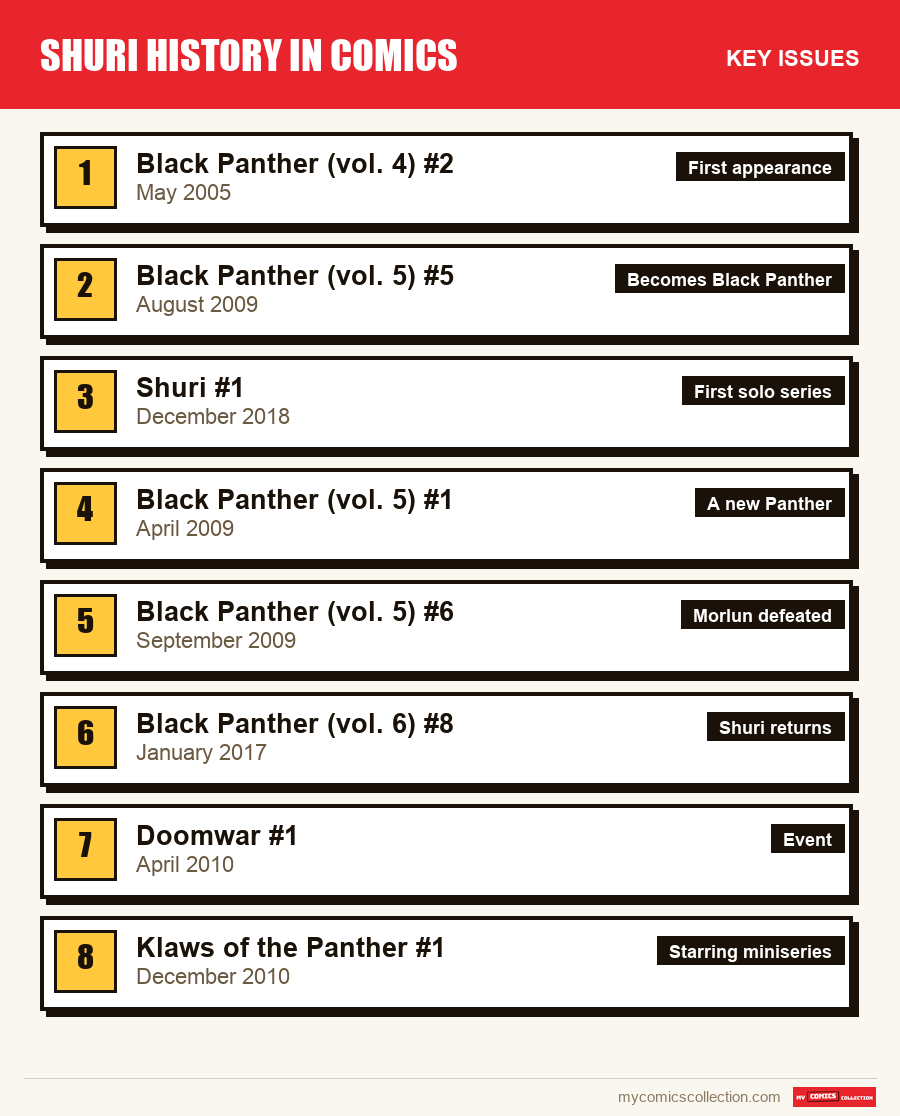
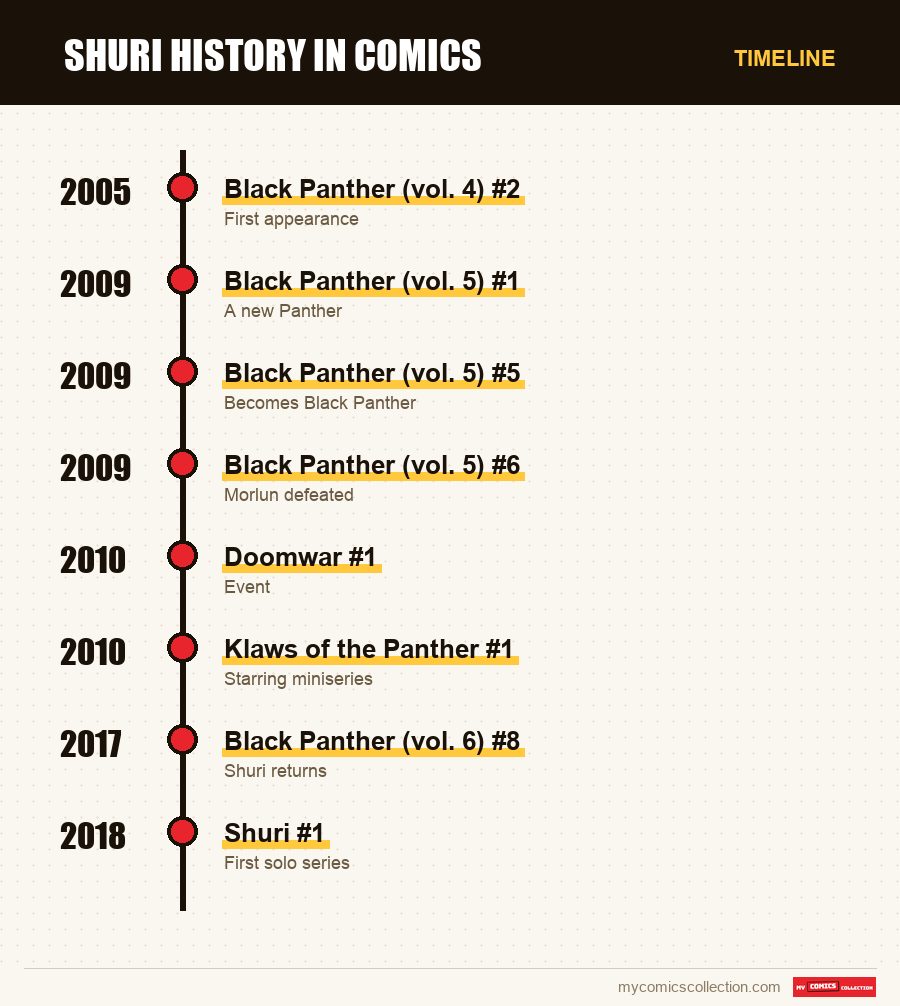
Shuri makes her first appearance in Black Panther vol. 4 #2 (May 2005), created by screenwriter Reginald Hudlin and artist John Romita Jr. She officially becomes Black Panther for the first time in Black Panther vol. 5 #1-6 (2009), after a coma which hits his brother T'Challa. She got her own solo series in 2018 under the pen of Afrofuturist author Nnedi Okorafor, before becoming world famous thanks to Letitia Wright in the MCU, notably in Black Panther: Wakanda Forever (2022).
Long relegated to the background behind her brother T'Challa, Shuri has established herself in around twenty years as one of the most endearing figures in the Marvel universe: gifted princess, warrior, interim queen, Black Panther in her own right then morello cherry endowed with spiritual powers. Her editorial career is atypical because it does not follow a straight line: she dies, comes back to life, changes codename, disappears from the shelves for years then comes back into the spotlight when Hollywood needs her the most.
For a collector, retracing the story of Shuri in comics means understanding three very distinct layers: the Hudlin era which invented her as a secondary character, the Maberry-Hickman-Coates era which shaped her into a heroine in her own right and sometimes sacrificed her, then the post-2018 era where she became a franchise in her own right, propelled by cinema. This article details, issue by issue, how this character born from a Halloween party anecdote became one of the most sought-after princesses on the comic book market.
From Wakandan origins to the editorial genesis of Shuri
Shuri was born in May 2005 in Black Panther vol. 4 #2, second chapter of a six-part arc where a team of super-powered mercenaries prepares the assault on Wakanda while a tournament determines who will succeed to the throne. Screenwriter Reginald Hudlin, then at the head of the relaunch of the title after the highly respected era of Christopher Priest, and artist John Romita Jr. introduce in a single delivery two characters who will mark Wakandan mythology: Shuri herself and S'yan, T'Challa's uncle who had occupied the throne after the assassination of T'Chaka.
The creation anecdote remained famous among comic book readers: Hudlin explained that he imagined Shuri so that his son and daughter could both dress up as Black Panther on Halloween night, without one of the two children finding themselves confined to a secondary role. This detail, almost anecdotal, says a lot about the initial intention: Shuri is thought of from the start as a legitimate heir to the costume, not as a simple stooge for her brother.
In these early issues (vol. 4 #2 to #6, May-September 2005), Shuri appears as a brash and brawling princess, capable of killing Radioactive Man using the Ebony Blade, the cursed sword usually associated with the Black Knight, before T'Challa personally takes charge of her combat training. The character then remains a recurring supporting role: she is captured by Erik Killmonger's forces in issues #26-27 (May-June 2007), then, under the pen of Jason Aaron who takes over the title at the end of the run, she leads the Wakandan forces against a Skrull invasion in issues #39-41 (September-November 2008), in a direct tie-in with the Marvel event Secret Invasion. These 2007-2008 episodes are now minor milestones for purists, but they lay the foundations for the military commander character that Shuri will later play.
2009: the coronation: Shuri officially becomes Black Panther
The decisive turning point came in 2009. In Black Panther vol. 5 #1-2 (April-May), still written by Hudlin, T'Challa is seriously injured and placed in critical condition. We must designate a new Black Panther. Storm, then queen of Wakanda through her marriage to T'Challa, cannot claim the title since she was not born of royal blood, but Shuri can. The plot twist is interesting: during the first pass in front of Bast, the panther goddess, Shuri fails. Her arrogant attitude and taste for personal glory make her unfit, in divine judgment, to bear the mantle.
It is in issues #3 to #6 (June-September 2009) that Shuri returns to the charge, confronts and defeats Morlun, the totemic predator already known to Spider-Man readers, and ends up earning the costume through sacrifice and humility rather than through brute force. She ingests the heart-shaped herb, the sacred plant that gives the Black Panther their superhuman abilities, and thus becomes the first woman to officially don the costume in the main Marvel continuity (Earth-616). There followed a period where Shuri governed Wakanda while T'Challa remained diminished (vol. 5 #7-12, October 2009-March 2010), during which Hudlin co-wrote issue #7 with Jonathan Maberry, who then took over writing the title alone.
Maberry develops the character in two notable mini-series. Doomwar #1-6 (April-October 2010), written by Maberry on a plot co-imagined with Hudlin, sees Shuri and a T'Challa gradually regaining his powers confront Doctor Doom, who has taken control of the Wakandan vibranium reserves with the help of the Fantastic Four and the X-Men. Then Klaws of the Panther #1-4 (December 2010-February 2011) places Shuri alone in the spotlight: she tracks down vibranium stocks scattered across the world and once again faces Klaw, as well as a mutant creature called M.U.S.I.E. These two series constitute, along with the Maberry run in general, the period where Shuri is most clearly treated as a solo heroine in her own right even before her eponymous 2018 series.
War, sacrifice and spiritual resurrection (2012-2016)
After a relative eclipse of the character in the early 2010s, Shuri reappears in New Avengers vol. 3, written by Jonathan Hickman. In issue #7, she declares war on Atlantis following Namor's attack during the event. Avengers vs. X-Men, then, in issue #12 (November 2013), she banishes T'Challa from the Wakandan capital following a major political disagreement. The same year, in Infinity: The Hunt #1, she directs the Wakandan School for Alternative Studies, confirming her role as both a military and intellectual leader.
The dramatic peak of this period comes in Hickman's "Time Runs Out" arc. While the Cabal invaded and devastated Wakanda, Shuri sacrificed herself by holding off Proxima Midnight, lieutenant of Thanos' Black Order, alone to allow T'Challa to escape (New Avengers vol. 3 #24). His death is confirmed in issue #29, where his spirit appears briefly among the lineage of former Black Panthers. It was only in Black Panther vol. 6 #8 (January 2017), from the pen of Ta-Nehisi Coates, that T'Challa manages to bring her back from Djalia, the ancestral Wakandan spiritual plane. Shuri returns transformed: in addition to her original physical abilities, she acquires the powers of a morello cherry: transformation of the body into a material close to flexible stone, ability to metamorphose (and to metamorphose others) into black birds, temporary superhuman speed and a power costly in energy to momentarily reanimate the dead.
2018: Shuri finally gets her solo series
It was not until December 2018 (cover date, on sale from October) that Shuri had, for the first time, the title of a series in her name alone. Shuri #1 is written by Nnedi Okorafor, already recognized Afrofuturist science fiction author (Hugo, Nebula, World Fantasy Award for her novels), drawn by Leonardo Romero, with a cover by Sam Spratt. The premise is simple and effective: Black Panther has disappeared, lost during a mission in space, and all attention turns to the next one in the order of succession. But Shuri would rather stay in her laboratory, surrounded by the gadgets she invents, than climb into a ring or a throne, except that a nation without a leader becomes vulnerable, and she will have to choose between her personal well-being and that of Wakanda.
On a commercial level, the series is off to a strong start for a title centered on a hitherto secondary character: according to Diamond distribution figures, Shuri #1 ranks 65th best-selling comic for the month of October 2018, and issue #2 ranks 96th again in November. The first issue also had a second printing ("2nd print"), a fairly classic sign of an initial demand having exceeded the publisher's circulation forecasts: an indicator that modern comic book collectors know how to read as a signal of real popularity at the time of release, independently of any subsequent speculation. The series concludes with issue #10 in 2019, after a complete arc centered on Shuri's training as a future leader, between scientific exploration, quest for identity and crisis management.
Since then, Shuri has remained a regular presence in the Marvel editorial universe without finding a monthly series in her name: we find her for example in Black Panther: Blood Hunt #1 (2024), then in 2025 in Black Panther: Intergalactic #1, in Imperial #3-4 and in Strange Tales #3, often in a technological or diplomatic support role alongside T'Challa rather than as a solo protagonist.
The impact of adaptations on the rating
Shuri's exposure to the general public owes a huge debt to the Marvel Cinematic Universe. The character, played by Letitia Wright, first appears in Black Panther (2018), then in Avengers: Infinity War (2018) and Avengers: Endgame (2019), before becoming the center of gravity of Black Panther: Wakanda Forever (2022), where she in turn takes on the mantle of Black Panther after the death of T'Challa: a script choice made necessary by the real death of actor Chadwick Boseman in 2020, which the studio chose to honor rather than recast the role. The film grossed approximately $860 million at the worldwide box office, ranking as the sixth highest grosser of 2022 and the second highest grossing worldwide for a female-led superhero film.
This cinematic exposure has a direct effect, widely documented in the comics collecting ecosystem, on the interest in key appearances of the character on the secondary market: each Black Panther film release has historically generated a surge in searches and purchases around Black Panther vol. 4 #2 (first appearance) and Black Panther vol. 5 #5 (first time Black Panther), the two milestones most naturally associated with the character. Unlike circulation or census data which can be verified with precision, the price levels observed on the secondary market constantly evolve according to the offer available at the time of the sale: rather than relying on a fixed figure, it is better to consult an updated estimate based on actual eBay sales at the time you wish to buy or sell.
It should be noted that Shuri has, to date, never been entitled to his own series linked directly to a film release (unlike certain Marvel characters benefiting from accompanying mini-series timed to the cinema calendar): most of his editorial footprint remains concentrated on the Hudlin/Maberry runs from 2005-2011, the Hickman/Coates diptych from 2013-2016, and the Okorafor solo series from 2018-2019. It is this relative scarcity of titles truly centered on it which explains why collectors concentrate their attention on a handful of well-identified issues rather than dispersing their research over a broad bibliography.
Collecting this series?
Track what you own, what you are missing and what your collection is worth. 7 day trial.
Start my trial →Buying Guide: How to Collect Shuri Key Appearances
Building a coherent collection around Shuri requires knowing precisely the hierarchy of issues that count, and avoiding some classic pitfalls of the modern comics market. Here are the points to be aware of before purchasing:
- Prioritize Black Panther vol. 4 #2 (May 2005): this is the historic first appearance of Shuri (and S'yan), the cornerstone of any collection dedicated to the character; always check the volume citation (vol. 4, 2005 release) to avoid confusion with earlier Priest runs or later relaunches with the same generic title.
- Black Panther vol. 5 #5 (August 2009) remains the reference number for when Shuri first becomes Black Panther; some collectors prefer to include the entire arc #1-6 to have the complete plot of the coronation.
- For Shuri #1 (2018), clearly distinguish the first print from the second print (“2nd printing”): the notice generally appears at the bottom of the cover or in the indicia (legal notices page inside the issue); the first edition, rarer since printed in a smaller initial quantity, is generally the most sought after by purists.
- Systematically require a photo of the indicia (the page which mentions the publisher, copyright and printing number) before any purchase of an issue advertised as “key issue”, in particular for online sales without certification by a third party.
- Check the general condition of the back and corners: comics from the years 2000-2010 (thinner paper than the Bronze Age period) easily mark reading folds, which can significantly lower a grade during a CGC or CBCS certification.
- Do not neglect the numbers of death and resurrection (New Avengers vol. 3 #24 and #29, Black Panther vol. 6 #8): they are less sought after financially than the first two appearances, but remain essential narrative milestones for a complete collection of the character.
- Compare several estimates before setting your budget: use an estimator based on real and recent eBay sales rather than a fixed list price, as the market for MCU-related comics can fluctuate strongly around film or series releases.
- Consider cataloging your collection digitally to precisely track which numbers you already have, their condition and where they came from, rather than relying on your memory alone as you make purchases.
In terms of state of conservation, keep in mind that the issues published between 2005 and 2011 are still relatively young on the scale of comics collecting: it is not uncommon to find copies in excellent condition (9.6 to 9.8 on the CGC scale) as long as the original print run was sufficiently large, which was the case for the majority of Black Panther titles from the Hudlin era, then driven by the notoriety of the screenwriter, also recognized TV showrunner. Conversely, the 2018 solo series benefited from a tighter distribution, typical of series centered on a secondary character at the time of its launch, which explains the need for a second printing for issue #1 and justifies increased vigilance on the authenticity of the copies offered as the first printing.
Why Shuri remains a strategic character for collectors
What makes Shuri's editorial journey particularly interesting to follow is the way in which it faithfully embraces the broader evolution of representation in American superhero comics since the mid-2000s. Introduced as a supporting character in a run that already sought to modernize Black Panther for a post-Civil War audience, she gradually became the preferred vehicle for stories centered on science, innovation and female leadership within the Marvel universe, before cinema comes to consecrate this trajectory in a spectacular way with Wakanda Forever.
For the collector, this continuity between the page and the screen is a rare asset: unlike purely cinematographic characters with no real basis in the comics, each stage of Shuri's career on the big screen refers directly to an identifiable and documented issue of the comics: which gives the collection a complete narrative sense, from the first appearance drawn by John Romita Jr. to the most recent runs. This also explains why the key issues of Shuri, although they do not benefit from the same mythological aura as the very first appearances of characters born in the 1960s, occupy a special place in the discussions of the modern comics collector community.
Whether you start from an existing collection centered on the Black Panther universe or discover the character through the MCU, the main thing remains to check each issue with the same rigor: edition, print run, condition, and provenance. A collection management tool makes it possible to keep precise track of each acquisition, from its purchase price to its declared condition, which is particularly useful when following a character whose bibliography spans more than twenty years and around ten different titles.
Key issues to know
Black Panther (vol. 4) #2
The second chapter of "Who is the Black Panther?", written by Reginald Hudlin and drawn by John Romita Jr. Shuri, T'Challa's younger sister, appears for the first time. It is the cornerstone of any collection devoted to the character.
Black Panther (vol. 5) #5
Hudlin and Ken Lashley show Shuri as Black Panther for the first time, as Morlun, the devourer of totems, descends on Wakanda to go after T'Challa's body. The new Panther takes on the predator and finally defeats him in the next issue. This is the issue of her rise to the role.
Shuri #1
Nnedi Okorafor (script) and Leonardo Romero (art) give Shuri her first series under her own name. With Black Panther lost on a space mission, all eyes turn to her, though she would rather stay in her lab. The series runs ten issues.
Black Panther (vol. 5) #1
Reginald Hudlin and Ken Lashley open "The Deadliest of the Species": with T'Challa gravely wounded, Wakanda must for the first time find another Black Panther. This six-issue arc leads to Shuri taking up the mantle. The opening issue of this pivotal period.
Black Panther (vol. 5) #6
The conclusion of "The Deadliest of the Species": Shuri leads Morlun on a chase to the sorcerer Zawavari, whose magic finishes off the predator. Meanwhile, Storm and T'Challa argue over which of them should sacrifice themselves in the realm of the dead. The new Black Panther's first major victory.
Black Panther (vol. 6) #8
Ta-Nehisi Coates (script) and Chris Sprouse (art): with Manifold's help, T'Challa goes looking for his sister's soul in the Djalia, Wakanda's collective memory. Shuri comes back transformed, carrying new powers born of that training. The issue of her resurrection.
Doomwar #1
Jonathan Maberry (script) and Scot Eaton (art): a coup has toppled Wakanda's government, Storm is put on trial and Doctor Doom goes after the vibranium reserves. Shuri, the reigning Black Panther, seeks the X-Men's help. The miniseries cements her status as the kingdom's protector.
Klaws of the Panther #1
Written by Jonathan Maberry and drawn by Gianluca Gugliotta, this miniseries puts Shuri alone in the spotlight. She travels to the Savage Land to negotiate for vibranium with Ka-Zar and uncovers A.I.M.'s schemes, while Klaw plots his return. A milestone of her time as Black Panther.