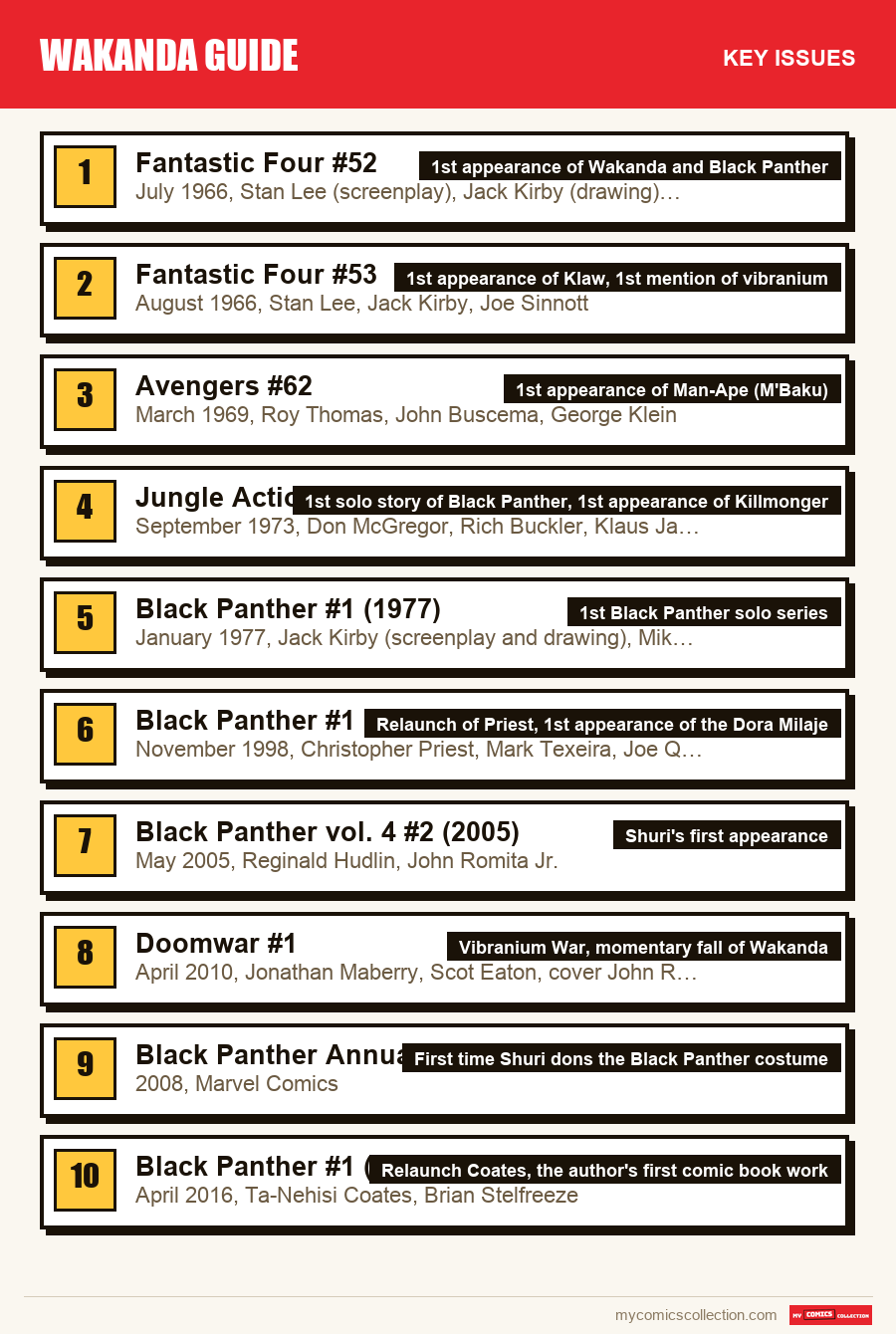
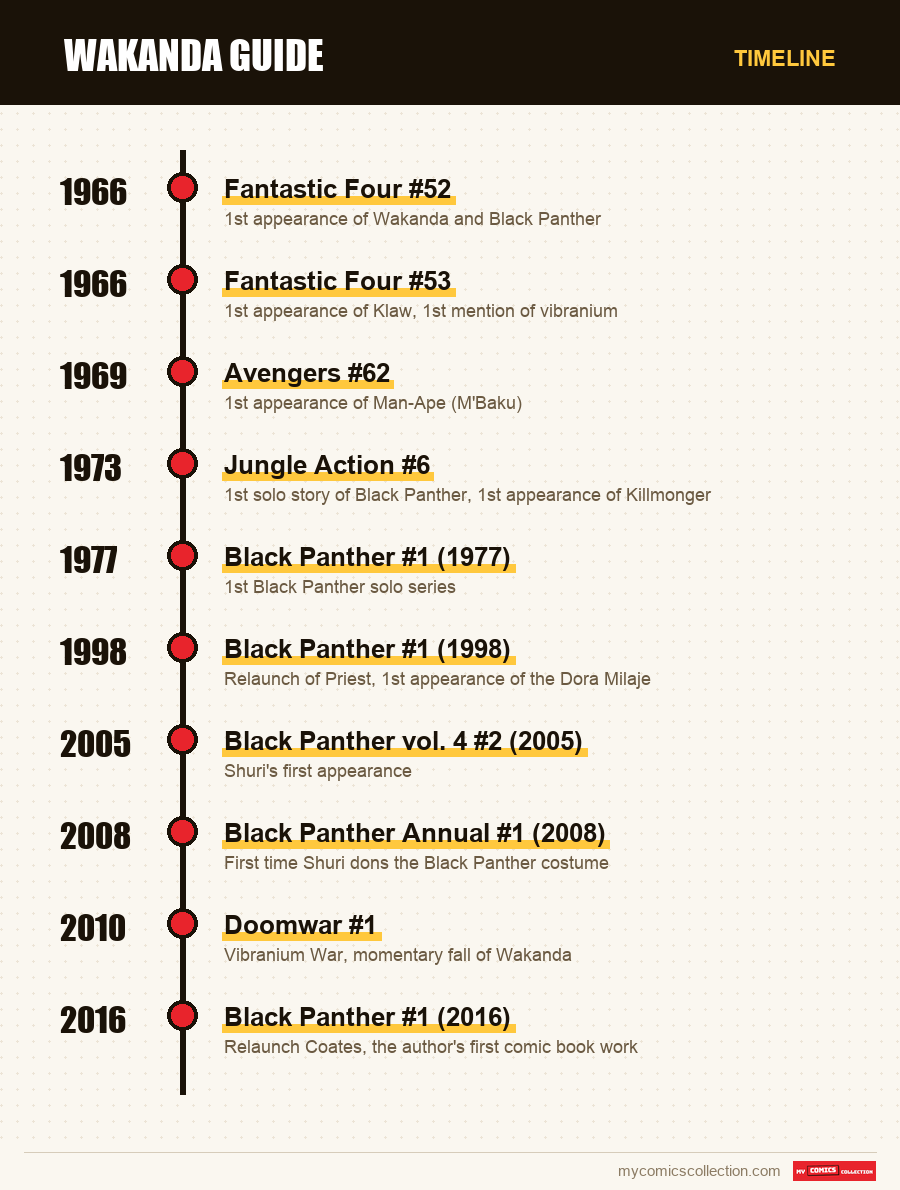
The absolute key number for Wakanda remains Fantastic Four #52 (July 1966), which introduces both the kingdom and its ruler, T'Challa. Around ten essential episodes revolve around it: Fantastic Four #53 (birth of Klaw and vibranium), Jungle Action #6 (first solo story and first appearance of Killmonger), both relaunches of Black Panther #1 (1977 by Kirby and 1998 by Priest), Shuri's first appearance in 2005, and the 2016 launch of Ta-Nehisi Coates. Prices range from a few tens of euros in medium grade to several tens of thousands of dollars for CGC 9.8 copies of the Silver Age episodes.
Wakanda is not a simple background setting in the Marvel universe: it is a character in its own right, a fictional nation that has spanned six decades of publication while maintaining rare editorial consistency. Unlike many kingdoms or planets created for one arc and then forgotten, T'Challa's country has been reworked, deepened and reinvented by several generations of screenwriters: from Stan Lee and Jack Kirby to Ta-Nehisi Coates via Don McGregor, Christopher Priest and Reginald Hudlin. Each of these authors has left a visible mark in specific episodes, which explains why the list of key Wakanda-related issues is as long as it is diverse.
For a collector, this continuity poses an interesting challenge: it is not enough to own the first appearance of the kingdom to say that you have “the” centerpiece. Vibranium, Killmonger, the Dora Milaje, Shuri or even the Doomwar civil war are all narrative milestones which each have their own market, their own rarity and their own valuation curve: often connected to cinema releases rather than to the sole quality of the original story.
This guide lists the episodes that actually count towards a coherent Wakanda holding, with verified rating data (documented CGC sales, population census, auctions) rather than rough estimates. When no reliable recent sales can be confirmed for a number, we clearly state this rather than putting forward a made-up number.
Wakanda in comics: origins and editorial evolution
Wakanda first appears in Fantastic Four #52, dated July 1966, penned by Stan Lee and penciled by Jack Kirby, inked by Joe Sinnott. In this episode, a mysterious African ruler invites the Fantastic Four to his high-tech kingdom hidden in the heart of the continent, and subjects them, one by one, to a series of trials to test their abilities before revealing his true intentions. This issue is included in the Overstreet Price Guide's Top 50 Silver Age, making it one of the most sought-after titles of the entire 1960-1969 period, alongside Amazing Fantasy #15 or X-Men #1.
The technical difficulty of this issue is due to its almost entirely black cover: the slightest handling leaves friction marks (“color breaks”) which cause the CGC rating to drop by several points. This is one of the reasons why very high grade copies are proportionally rarer than other Silver Age comics of the same year, and why the difference in grade between a CGC 9.0 and a CGC 9.8 is particularly spectacular there.
The following episode, Fantastic Four #53 (August 1966), immediately completes the picture: we discover the origin of T'Challa, the first explicit mention of vibranium, the metal which will become the central strategic resource of all Wakandan mythology, and the first appearance of Ulysses Klaw, the scientist who assassinated T'Challa's father to seize the precious ore. Without this episode, the geopolitics of Wakanda as we know it (an isolationist country fiercely protecting its unique resource) would have no narrative foundation.
It was not until 1973 that Wakanda became the scene of a long and in-depth story rather than a simple guest-star setting. In Jungle Action #6, screenwriter Don McGregor launches “Panther's Rage”, a thirteen-part saga which takes place entirely in Wakanda and which is considered by historians of the medium as one of the very first long-format arcs constructed for a black character in the American mainstream. McGregor explores the kingdom's internal politics, its tribal tensions and introduces Erik Killmonger, T'Challa's historical rival for the throne. This saga directly influenced the structure of the 2018 film Black Panther, which takes the dynastic clash between T'Challa and Killmonger as the backbone of its storyline.
The following decades saw Wakanda gain political depth with each relaunch of the series. Black Panther: Christopher Priest, in the late 1990s, turned it into a devious diplomatic power whose espionage and manipulation serve as a weapon as well as technology; Reginald Hudlin, in the mid-2000s, developed the royal dynasty in depth, notably through the introduction of Shuri; then Ta-Nehisi Coates, from 2016, re-examines the very legitimacy of the Wakandan monarchy through a more contemporary prism. Each of these editorial phases produced its own key issues, listed in detail below.
Fantastic Four #52
The absolute starting point for any Wakanda collection. T'Challa invites the Fantastic Four to his kingdom to test them before revealing his plan against Klaw. This is the issue that establishes the very existence of Wakanda in Marvel continuity. The black cover, very sensitive to friction, makes high grades rare: the most documented CGC 9.8 sold for $83,650 in 2016, a 9.6 around $24,500, a 9.4 around $16,200. In average grades, a 6.0 traded around $100 in 2017 before climbing to more than $500-600 during the media peak of 2018, the year the first Black Panther film was released in theaters. A GD 2.0 copy remains accessible around $380-400.
Fantastic Four #53
The direct continuation of episode 52: we learn the origin of T'Challa, the story of his father killed by Klaw for vibranium, and the reader witnesses the first appearance in costume of the sonic scientist who will become one of the recurring enemies most linked to Wakanda in the following decades. This is also the second appearance of Black Panther, often sought as a complement to #52 to make an original pair. A CGC 9.8 example sold for $12,070 in 2017; a GD 2.0 grade was trading around $100 in 2022.
Avengers #62
“The Monarch and the Man-Ape!” » introduces M'Baku, leader of a rival tribe in Wakanda who regularly opposes T'Challa for the throne, and who would, much later, become a central character in the 2018 film Black Panther in a reimagined version but faithful to the spirit of the original tribal conflict. It is a less expensive issue than the founding Fantastic Four but essential to cover the internal political mythology of Wakanda, with its factions and its rites of succession to the throne by ritual combat. Average grades (6.0 to 7.5) circulate regularly on the secondary market within a reasonable range for a late Silver Age comic of this importance.
Jungle Action #6
Opening of “Panther's Rage”, the first major solo saga dedicated to the character and entirely located in Wakanda. Erik Killmonger appears there for the first time, a dynastic rival whose confrontation with T'Challa will become, forty-five years later, the heart of the 2018 film. Historically, it is one of the very first long arcs devoted to a black hero in the American mainstream, which gives him a cultural importance that goes beyond just financial rating. According to the CGC census (October 2022), around 12 examples were graded 3.5 and around 700 examples graded above, which shows an overall modest population compared to large Bronze Age prints. The Overstreet 2022 valued a VG 4.0 example at around $74; the ranges observed go from around $30 in low grade to several hundred dollars in high grade.
Black Panther #1 (1977)
After co-creating the character in 1966, Jack Kirby returned ten years later to offer him his own monthly series: a notable return which marks the first permanent solo title carried in the name of T'Challa. Kirby's approach, very focused on the technological and cosmic exploration of Wakanda (notably via the introduction of the group of "King Solomon's Frogs"), contrasts with McGregor's more political tone and gives the kingdom an additional science fiction dimension. CGC 9.4 copies trade regularly on the collectors' market, with newsstand variants sought after for their relative rarity compared to the larger newsstand prints of the period.
Black Panther #1 (1998)
The relaunch by Christopher Priest reinvents Wakanda as a devious geopolitical power, with T'Challa as a strategist rather than a simple adventure hero. This run introduces the Dora Milaje, the all-female royal guard who will become a visual pillar of the 2018 film, as well as Everett K. Ross, a witness character through whom the reader discovers Wakandan diplomacy. It is today considered one of the most influential interpretations of the character on a narrative level, largely re-evaluated since the release of the MCU, although the grading market for this title remains less documented in public sales than the Silver Age episodes.
Black Panther vol. 4 #2 (2005)
Reginald Hudlin brings T'Challa's little sister into continuity, laying the foundations for the character who would, years later, become one of the most popular faces of Wakanda in cinema. It is not #1 of the series which bears this first appearance but rather #2, an important nuance for buyers who are looking for the right key rather than the simple opening number. Documented sales show CGC 9.8 copies around $800 and CGC 9.4s around $300 (2020 data); these levels have tended to progress since the release of Black Panther: Wakanda Forever in 2022, which established Shuri as a central character.
Doomwar #1
This six-issue mini-series features the invasion of Wakanda by Doctor Doom, determined to seize the country's vibranium reserves: estimated in the story at around 10,000 tonnes, a resource whose fictional value gives the measure of the strategic stake that the kingdom represents in the Marvel universe. This is an important milestone for understanding how vibranium has become, over the course of its runs, a geopolitical issue on a global scale and no longer just a local scientific curiosity. The issue remains affordable on the secondary market, without reaching the level of Silver Age titles, but it usefully completes a collection focused on the economic and political issues of Wakanda.
Black Panther Annual #1 (2008)
Before Shuri became the lasting ruler of Wakanda in Jonathan Hickman's run on Fantastic Four (2012), this annual issue shows her for the first time donning the costume and title of Black Panther, following T'Challa's temporary incapacity. It's an often underappreciated link between his first appearance in 2005 and his more definitive crowning achievement in the following years, making it a sought-after piece by collectors who specifically follow the character's story arc rather than just T'Challa's continuity.
Black Panther #1 (2016)
Published a few months before the character's first appearance on screen in Captain America: Civil War, this relaunch is also the very first comic book work by Ta-Nehisi Coates, an essayist and novelist already recognized at the time for his writings on the racial question in the United States. The run directly questions the legitimacy of the Wakandan monarchy, with the emergence of the Midnight Angels dissident movement. Driven by the anticipation of the film and the notoriety of its screenwriter, this #1 had a large circulation and multiple reprints, which makes first printing copies significantly more sought after than subsequent printings for collectors concerned with the exact variant.
Collecting this series?
Track what you own, what you are missing and what your collection is worth. 7 day trial.
Start my trial →The impact of adaptations on the rating
Few fictional Marvel kingdoms have benefited from such a clear alignment between cinema release and secondary market surge as Wakanda. T'Challa's first appearance in the cinema, in Captain America: Civil War (2016), had already begun to increase interest in Fantastic Four #52, but it was the release of the film Black Panther in February 2018 which produced the most documented valuation shock: in February 2018, nine sales of CGC 6.0 copies were recorded between $534 and $695, while a year earlier the average for the same grade was around $80. This acceleration mainly concerns the middle and high grades of the founding issue: very damaged copies followed a more modest progression, which illustrates a classic phenomenon of the comic collecting market: demand focuses on "presentable" copies rather than on the simple existence of the object.
The 2018 film Black Panther also indirectly revalued Jungle Action #6, whose narrative structure, the dynastic clash between T'Challa and Killmonger for the throne of Wakanda, directly inspired the screenplay of the feature film directed by Ryan Coogler. Collectors who follow the mythology rather than just the first appearance of the character have therefore focused on this Bronze Age title, whose CGC population remains comparatively small.
The release of Black Panther: Wakanda Forever in 2022, centering on Shuri becoming the new Black Panther after T'Challa's death, had a comparable but more focused effect on Black Panther vol. 4 #2 (2005) and on Black Panther Annual #1 (2008): two previously relatively confidential issues have become keys in their own right, with CGC 9.8 sales documented around $800 for the character's first appearance. This is a typical example of how an adaptation can revive the popularity of a secondary issue fifteen or seventeen years old without any change having taken place in the print market itself.
For collectors who want to follow this type of market movement in real time rather than relying on fixed estimates, the use of a monitoring tool based on actual eBay sales remains the most reliable method: prices change quickly after a cinema release or a casting announcement, and paper guides or databases updated quarterly are structurally behind the times.
Buying guide
- Distinguish clearly between Fantastic Four #52 and #53: #52 is the first appearance of Wakanda and Black Panther, #53 is the second appearance of the hero but the first of Klaw and vibranium. Many sellers confuse them in their descriptions, always check the exact number before purchasing.
- Check the condition of the black cover on #52: color breaks on a black background are the main factor that brings down the CGC rating of this specific issue; an ungraded copy advertised “like new” deserves a very careful photo examination of the edges and spine.
- For Shuri, target #2 and not #1 from Black Panther vol. 4 (2005): This is a common mistake among buyers looking for the first appearance without knowing the exact numbering of the Hudlin run.
- Spot first impression variations on Black Panther #1 (2016): the success of the Coates run has generated several reprints, and only the mention “1st printing” on the credits page (or confirmed by the grader) guarantees the most sought-after version.
- Always compare several recent sales rather than a single displayed price: Wakanda odds are particularly sensitive to Marvel cinema news, and a price seen six months ago may no longer reflect the current market, up or down.
- Favor graded numbers for Silver Age coins (Fantastic Four #52-53, Avengers #62): At this level of value, the difference between an unauthenticated copy and a confirmed CGC grade can be several hundred, if not thousands, of dollars.
- Don't neglect secondary numbers like Doomwar #1 or Black Panther Annual #1 (2008): cheaper to buy, they complete a thematic collection on Wakanda in a coherent way without requiring a Silver Age budget.
- Keep an accurate inventory of your collection, with number, publisher, year and grade, via a dedicated application like the collection management application, rather than a simple spreadsheet: this makes it easier to track prices over time and possible resale.