
Captain America: The Winter Soldier (2014), directed by Anthony and Joe Russo with Chris Evans , adapts the cult arc of Ed Brubaker (Captain America vol. 5, 2005), which revealed the return of Bucky Barnes as an assassin washed from his memory: the Winter Soldier, appearing in the 6th issue. The film also introduces the Falcon (Sam Wilson), born in Captain America #117 (1969). It retains the core of the Brubaker plot but grafts in a large-scale institutional betrayal. Detailed comparison, film versus comics.
Often cited as one of the best films in the saga, The Winter Soldier trades the original story for a paranoid spy thriller. This genre shift, orchestrated by the Russo brothers, builds on one of the character's most lauded modern runs. Let's see what the film owes to its source and what it transforms.
As in each article in the series, only verified data (distribution, dates, numbers, creators) are stated; the comparative analysis is ours, without reproduction of dialogue or protected images.
Title : Captain America: The Winter Soldier (2014)
Directors: Anthony and Joe Russo
Actors: Chris Evans (Steve Rogers), Sebastian Stan (Bucky / Winter Soldier), Scarlett Johansson (Black Widow), Anthony Mackie (Sam Wilson / Falcon), Robert Redford (Alexander Pierce), Samuel L. Jackson (Nick Fury)
Exit : April 4, 2014 (United States)
Studio: Marvel Studios
“The Winter Soldier”: Captain America vol. 5 (2005), Ed Brubaker & Steve Epting; Bucky revealed from #6
Captain America #117 (1969): First Appearance of the Falcon (Stan Lee & Gene Colan)
The HYDRA legacy: the shadow enemy of the Golden Age
- La shock revelation: Bucky, thought dead, resurfaces as an assassin with erased memory.
- Le Winter Soldier as a manipulated agent, an armed arm from the shadows.
- The moral dilemma of Steve Rogers, forced to confront his oldest friend.
- Le Falcon (Sam Wilson), winged ally of Captain America.
- The tone of spy thriller, inherited from the Brubaker run.
- The Betrayal of S.H.I.E.L.D. : the film grafts a massive infiltration by HYDRA, absent from the original story.
- The Falcon gains winged military equipment (jet harness), where the comic gave him real wings and a telepathic link with a falcon.
- The context moves from the comic's Kubik/Cosmic Cube plot to a threat of mass surveillance.
- Alexander Pierce, a figure in the film, condenses the corrupt apparatus that Cap must unmask.
- The movie tightens a long arc in a story of a few days, very rhythmic.
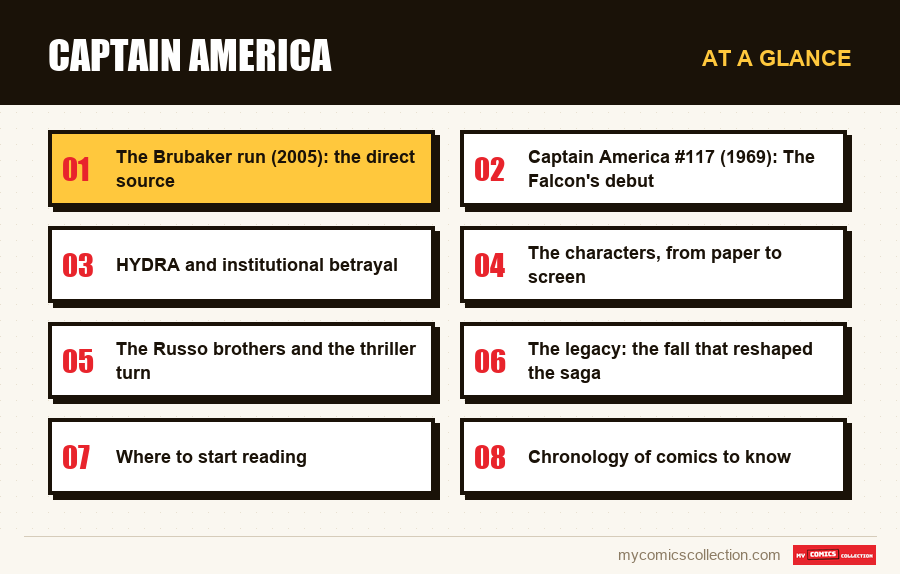
The Brubaker run (2005): the direct source
The film adapts one of Marvel's most celebrated modern arcs: "The Winter Soldier," written by Ed Brubaker and drawn by Steve Epting in Captain America vol. 5, launched in 2005. The big reveal (Bucky Barnes, Cap's war partner believed dead since 1945, survived and was transformed into a Soviet assassin with erased memories) comes in the sixth issue. This reversal, considered daring because it resurrected a character deemed untouchable, redefined the universe of Captain America and serves as a direct basis for the film. The feature film retains the essentials: the shock of recognition, Steve's moral torment in the face of a friend who has become an enemy, and the spy thriller tone which already contrasted, in the comics, with classic patriotic imagery.
This is a case of adaptation that is particularly faithful in spirit, to the point that the Brubaker run is often recommended as the best entry point to the character: an ideal “bridge” comic for those discovering Cap through the cinema.
Captain America #117 (1969): The Falcon's debut
The film introduces Sam Wilson, the Falcon, a supporting role destined to come of age. The character was born in Captain America #117 (September 1969), created by Stan Lee and Gene Colan: one of Marvel's first African-American superheroes, a social worker with a close bond with a falcon named Redwing. The film clearly modernizes his equipment: instead of the wings and the telepathic link from the comics, it offers him a military harness with reactors, more credible in a contemporary thriller. The function remains intact: Sam is the loyal ally, the trusted partner who supports Cap in his hunt.
HYDRA and institutional betrayal
The greatest freedom of the film lies in its political stakes. Where Brubaker's comic unfolded a plot combining Soviet manipulation and an object of power, the film grafts a large-scale betrayal: S.H.I.E.L.D. himself is revealed to have been infiltrated for decades by HYDRA. This shift transforms the story into a fable about mass surveillance and the corruption of institutions, a very contemporary theme. He also skillfully connects the film to the legacy of First Avenger, making HYDRA a threat that has never really disappeared since World War II: a continuity of enemy that spans the decades.
The characters, from paper to screen
- Steve Rogers: A disillusioned Cape, confronted with a world of shadows far from the moral clarity of war.
- Bucky / Winter Soldier: Faithful to Brubaker: the friend resurrected as a programmed killer, the emotional heart of the film.
- Sam Wilson / Falcon: Taken from 1969, with modernized equipment but the same loyalty.
- Black Widow: Action partner and moral mirror, very present.
- Alexander Pierce: Face of the corrupt apparatus, creation designed to embody the institutional threat.
Collecting this series?
Track what you own, what you are missing and what your collection is worth. 7 day trial.
Start my trial →The Russo brothers and the thriller turn
The choice of Anthony and Joe Russo, coming from television comedy, was surprising, but their film imposes a style of nervous political thriller, with obvious references to spy cinema of the 1970s, right down to the casting of Robert Redford. This approach extends the logic of the Brubaker run, which had already ripped Captain America away from naive patriotic imagery and installed him in a universe of double agents and state secrets. By treating a superhero like the protagonist of an adult thriller, the film permanently broadened the palette of the saga and proved that an adaptation could respect the spirit of a comic while radically changing genre.
The legacy: the fall that reshaped the saga
Beyond its plot, The Winter Soldier has a lasting impact on the entire saga: the revelation of HYDRA's infiltration causes the collapse of S.H.I.E.L.D., the organization that has structured the entire universe since the first Avengers. By bringing down this pillar, the film reshuffles the cards and deprives the heroes of their institutional safety net. This narrative earthquake has no exact equivalent in a specific comic, but it translates on a cinematic scale a common practice in comics: the event which calls into question the status quo and forces the characters to redefine themselves. Few superhero films dare to dismantle their own setting in this way.
This scope explains why The Winter Soldier is often considered a turning point: it moves the saga from a register of colorful adventures to that of an adult thriller, where trust is a rare commodity and where institutions can betray. The choice of Robert Redford, a figure in political cinema of the 1970s, seals this connection. By treating Captain America as the hero of a conspiracy thriller, the film permanently broadened the scope of possibilities for the entire genre.
Where to start reading
The priority reading is obvious: Ed Brubaker's run on Captain America (from 2005), and in particular the arc "The Winter Soldier", where everything is decided from the sixth issue. This is the direct source material for the film and one of the best modern stories of the character. We can then go back to Captain America #117 (1969) to discover the original Falcon, then explore the stories where Sam Wilson takes on increasing importance, until he takes on the shield himself. Finally, to understand the roots of HYDRA, a detour through Cap's Golden Age adventures sheds light on the enemy continuity that the film exploits. From 1969 to 2005, this route covers the three major sources of feature films.
Chronology of comics to know
- 1969: Captain America #117: First appearance of the Falcon (Sam Wilson).
- 2005: Captain America vol. 5: run by Ed Brubaker, Bucky revealed in Winter Soldier from #6.
- 2010s: Sam Wilson himself becomes Captain America (in the background, for the character's trajectory).
Collection side: what numbers to aim for after the film
Two avenues of collection emerge. Captain America #117 (first appearance of the Falcon) is a sought-after key to the Silver Age, interest in which has soared with the popularity of Sam Wilson on screen. On the modern side, the first issues of the Brubaker run, especially the one that reveals the Winter Soldier, are very accessible contemporary keys, ideal for a first thematic purchase related to the film. The complete run, available in collections, also offers excellent value for money. As always, condition and gradation determine value; relying on real recent sales remains the best compass. Note that Captain America #117 combines two advantages for the collector: it is both a first major appearance and an issue loaded with historical significance, the Falcon being one of Marvel's first African-American superheroes. This double value, symbolic and speculative, makes it a piece whose interest goes beyond the sole connection to the film.
The verdict: an adaptation of rare fidelity of spirit
- Loyalty: the return of Bucky, the moral heartbreak and the spy tone come directly from Brubaker.
- Freedoms: the massive infiltration of S.H.I.E.L.D. by HYDRA and the modernized equipment of the Falcon.
- Collectible numbers: Captain America #117 (the Falcon) and the first issues of the Brubaker run (2005).
The Winter Soldier achieves what few adaptations dare: change genre without betraying his character. Building on the Brubaker run, he proves that a superhero born in 1941 can carry a contemporary political thriller. For the reader, it's a clear invitation to experience one of Marvel's best modern runs, and one of the most sought-after early appearances of the Silver Age. Rarely has an adaptation made you want to read its source so much: this is undoubtedly the greatest compliment that one can pay to a superhero film.
Its place in the saga and for the collector
The Winter Soldier did much more than adapt an arc: it launched the careers of its directors within the saga, with the Russo brothers going on to become the architects of many of its biggest gatherings. The thriller tone that they impose here permeates the rest of Captain America's adventure. For the collector, the film highlights two complementary veins: the Silver Age, with the first appearance of the Falcon (Captain America #117), whose popularity benefited from the rise of Sam Wilson on the screen; and the modern comic, with the Brubaker run, whose first issues, in particular the revelation of the Winter Soldier, are affordable and highly sought-after contemporary keys. Few films point so clearly to a reference reading: the Brubaker run is regularly cited as the best entry point to the character. The Winter Soldier is thus doubly valuable: it offers a great film and a clear reading path to one of Marvel's modern peaks.
Frequently asked questions
From the arc “The Winter Soldier” by Ed Brubaker and Steve Epting (Captain America vol. 5, 2005), which reveals the return of Bucky Barnes as an assassin with erased memories from the sixth issue.
Not from this specific arc. The film grafts this institutional betrayal into a fable about mass surveillance, while connecting the story to the legacy of HYDRA established in First Avenger.
In Captain America #117 (1969), created by Stan Lee and Gene Colan. The film modernizes its equipment (reactor harness) instead of the wings and the telepathic link with a falcon from the comics.
Very faithful in spirit: Bucky's revelation, Steve's heartbreak and the spy thriller tone come directly from the run, often cited as the best entry point to the character.
Captain America #117 (first appearance of the Falcon) on the Silver Age side, and the first issues of the Brubaker run (2005) on the modern side, more accessible and directly linked to the film.
Does the film make you want to collect Captain America? Estimate the value for free of your numbers (Captain America #117…) with our tool based on current eBay listings.