
Falcon and the Winter Soldier (2021), created by Malcolm Spellman with Anthony Mackie and Sebastian Stan, depicts the accession of Sam Wilson to the role of Captain America, a passing of the torch in the comics in 2014. The series introduces John Walker / US Agent ( Captain America #323 , 1986) and Isaiah Bradley (“Truth: Red, White & Black”, 2003), and faces the Flag-Smashers. Here is the detailed comparison, series versus comics.
The second Disney+ series in the Marvel universe, Falcon and the Winter Soldier deals head-on with the question of the national symbol and the legitimacy of wearing the shield. The series draws from recent runs and important stories in the history of super-soldiers. Source-by-source decryption.
As in each article in this series, only verified information (creators, distribution, dates, comic numbers) is stated; the comparative analysis is ours, without reproducing dialogue or protected images.
Title : Falcon and the Winter Soldier (2021)
Creator: Malcolm Spellman
Actors: Anthony Mackie (Sam Wilson/Falcon), Sebastian Stan (Bucky), Wyatt Russell (John Walker), Carl Lumbly (Isaiah Bradley), Erin Kellyman (Karli)
Broadcast: March-April 2021, Disney+ (6 episodes)
Studio: Marvel Studios
Sam Wilson becomes Captain America (2014-2015)
Captain America #323 (1986): John Walker's first appearance
“Truth: Red, White & Black”(2003): Isaiah Bradley
Captain America #117 (1969). The Falcon; Flag Smasher
- Sam Wilson becoming Captain America, designated by Steve Rogers.
- John Walker, official imposed super-soldier, figure of ambiguity.
- Isaiah Bradley, the forgotten black super-soldier of history.
- Le duo Sam / Bucky and their friendly rivalry.
- The theme of national symbol and its legitimacy.
- The Flag Smashers become a group of young refugees, far from the lonely villain of the comics.
- John Walker sees its arc condensed and reoriented.
- Sam's costume and his shield merge elements from several runs.
- The geopolitical context (the GRC, the borders) is specific to the series.
- Zemo reappears, extending its cinematic version.
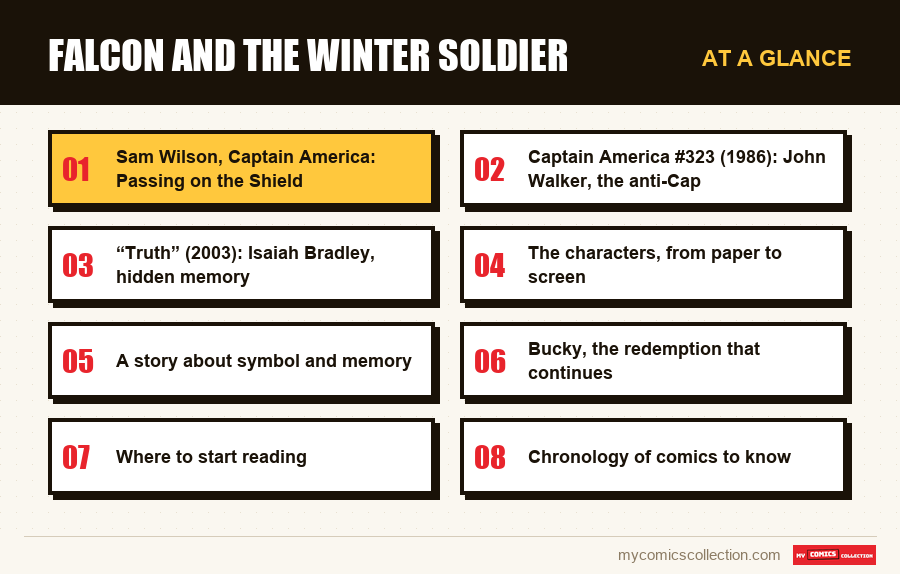
Sam Wilson, Captain America: Passing on the Shield
The heart of the series is the question that runs through each episode: Can, should Sam Wilson become Captain America? In the comics, this passing of the torch takes place in 2014: Steve Rogers, deprived of his serum and aging prematurely, designates his former partner the Falcon like his successor (Captain America vol. 7 #25). Sam then wears the shield in the series “All-New Captain America” then “Captain America: Sam Wilson” (2015-2017). The series faithfully adapts this transmission and its profound issue: the legitimacy of an African-American hero to embody a national symbol steeped in history. She even makes it her central subject, through Sam's doubts, the weight of others' gaze and the painful memory carried by Isaiah Bradley. Anthony Mackie embodies this hesitation then this acceptance, faithful to the spirit of Nick Spencer's run.
This reflection on what it means to carry the shield, when you are a black man in contemporary America, is directly inherited from the modern comics of Sam Wilson, which already addressed these questions head-on. The series continues this legacy until its conclusion, prepared since The Winter Soldier and completed in Brave New World.
Captain America #323 (1986): John Walker, the anti-Cap
The series introduced John Walker, an essential counterpoint to Sam. The character was born in Captain America #323 (1986), created by Mark Gruenwald and Paul Neary, first as Super-Patriot, an arrogant media vigilante. In the comics, he became Captain America for a time in place of Steve Rogers, before taking on the identity of US Agent. The series faithfully takes up this figure: a super-soldier officially designated by the government, whose rigid patriotism and instability offer a dark mirror to Sam. John Walker embodies the idea that the shield does not make the hero, and that entrusting this symbol to the wrong person can corrupt him. His arc, condensed for the series, illustrates the drift of a man broken by a load that exceeds him.
“Truth” (2003): Isaiah Bradley, hidden memory
The most poignant contribution of the series is Isaiah Bradley, from the story “Truth: Red, White & Black” (2003) by Robert Morales and Kyle Baker. This comic revealed that before Steve Rogers, the U.S. Army had conducted super-soldier experiments on unwilling African-American soldiers: a story inspired by the Tuskegee Trials. Isaiah, one of the survivors, embodies a painful memory erased from history. The series faithfully takes up this character and his tragic story, making him the bearer of a truth that America prefers to forget. His presence gives the series a rare historical and political depth, faithful to one of the most courageous comics of the 2000s. Through him, the series questions the price paid by those whom history has erased.
The characters, from paper to screen
- Sam Wilson / Captain America: Faithful to the passing of the torch in 2014, his doubts at the heart of the story.
- Bucky / Winter Soldier: In search of redemption, extending his cinematic arc.
- John Walker / US Agent: True to Captain America #323, Sam's Dark Mirror.
- Isaiah Bradley: The forgotten super-soldier of “Truth” (2003), hidden memory.
- The Flag Smashers: Reinvented as a group of young refugees, far from the villain of the comics.
Collecting this series?
Track what you own, what you are missing and what your collection is worth. 7 day trial.
Start my trial →A story about symbol and memory
The series is distinguished by its political dimension, inherited from modern Captain America comics. By entrusting the shield to an African-American hero and by exhuming, via Isaiah Bradley, the hidden past of super-soldier experiences, she questions the national symbol head-on: what does it represent, for whom, and at what cost? This reflection, courageous for mainstream entertainment, continues a tradition of the character, thought of since 1941 as a mirror of the ideals and contradictions of America. The series is not content with an action story: it addresses racism, historical memory and legitimacy, making Sam's journey a conquest of meaning as much as a series of battles.
This thematic ambition brings the series closer to the best runs of Captain America, those which always refused to make the character a simple hollow patriotic symbol. By asking the question “who has the right to carry the shield?” ", the series remains faithful to the spirit of a hero defined by his values, and not by his costume: a statement which will find its conclusion on screen with Sam's full accession to the title.
Bucky, the redemption that continues
If the series is also called “The Winter Soldier”, it is because Bucky Barnes continues his long path to redemption. After being revealed as the assassin wiped from his memory in Ed Brubaker's run (2005), source of the 2014 movie, Bucky has undergone a spectacular evolution in the comics: from a programmed killer, he becomes a hero in his own right, going so far as to wear Captain America's shield himself during a period when Steve Rogers was presumed dead. The series takes up this dynamic of redemption by showing Bucky haunted by his past actions, seeking to repair the evil committed under the control of HYDRA. His “fine book”, where he records the wrongs to be repaired, embodies this quest for redemption, faithful to the spirit of the character's modern comics.
Bucky's journey illustrates one of Marvel's most powerful themes: the possibility of redemption, even after the worst. By pitting him against Sam and John Walker, the series mirrors three different relationships to Captain America's shield and legacy: the rightful heir, the repentant and the usurper. This thematic richness, inherited from the comics, makes the series much more than an action story: a reflection on guilt, forgiveness and the way in which we carry the weight of our past. For the reader, Brubaker's run remains the key to understanding this Bucky in search of peace.
Where to start reading
To extend the series, priority reading is “Captain America: Sam Wilson” by Nick Spencer (2015), which depicts Sam's debut under the shield and his political issues. “Truth: Red, White & Black” (2003) is essential to understanding Isaiah Bradley. For John Walker, Captain America #323 (1986) and the Gruenwald period are the source. Finally, the Falcon is discovered in Captain America #117 (1969). From 1969 to 2015, this journey covers the sources of a series anchored in the history of the character.
Chronology of comics to know
- 1969: Captain America #117: First appearance of the Falcon (Sam Wilson).
- 1986: Captain America #323: First appearance of John Walker.
- 2003: “Truth: Red, White & Black”: Isaiah Bradley.
- 2014-2015: Sam Wilson becomes Captain America.
Collection side: what numbers to aim for after the series
The series highlights keys from various eras. Captain America #117 (first appearance of the Falcon) is a sought-after Silver Age key, whose popularity has benefited from Sam's rise to power. Captain America #323 (first appearance of John Walker) is an affordable Copper Age key and directly related to the series. Issues of “Truth” (2003) and “Sam Wilson: Captain America” (2015) are important modern targets. These numbers cover all budgets. As always, condition and gradation determine value; relying on real recent sales is strongly recommended. Captain America #117 remains the priority target for a Falcon collector, a first appearance all the more popular as it marks the entry on the scene of one of the very first African-American superheroes in the Marvel universe, a milestone that is both historical and symbolic.
Its place in the saga and for the collector
The series begins the passing of the shield to Sam Wilson, a major arc completed in Brave New World. For the collector, it revived interest in Captain America #117, #323 and “Truth”. It illustrates the effect of series on the market, in the same way as films: the first appearance of the Falcon or John Walker gains value with their visibility on the screen. Beyond speculation, the series invites us to discover essential stories on memory and identity, notably “Truth: Red, White & Black”, one of the most significant comics of the 2000s. By tackling questions of race and legitimacy head-on, the series extends the historical vocation of Captain America: to reflect, in each era, the debates of his time.
The verdict: the shield and its history
- Loyalty: the passing of the torch to Sam, John Walker, Isaiah Bradley and the theme of the symbol come from the comics.
- Freedoms: the reinvented Flag-Smashers, the condensed Walker arc, a geopolitical context specific to the series.
- Collectible numbers: Captain America #117 (the Falcon), #323 (John Walker), “Truth” (2003).
Falcon and the Winter Soldier adapts the passing of the shield to Sam Wilson into a courageous reflection on national symbol, race, and memory. Faithful to the passing of the torch from the comics, to John Walker and Isaiah Bradley, the series anchors its story in the character's history. For reader and collector alike, it is an invitation to discover essential stories about what it really means to bear the shield. By daring to make the national symbol a subject of debate rather than a slogan, the series proves that the best adaptations are not afraid to question the heritage of their heroes: a boldness faithful to the spirit of modern Captain America comics.
Frequently asked questions
From the passing of the torch to Sam Wilson (2014-2015), John Walker (Captain America #323, 1986), Isaiah Bradley ("Truth: Red, White & Black", 2003) and The Falcon (Captain America #117, 1969).
A super-soldier who appeared in Captain America #323 (1986), first as Super-Patriot, then Captain America in place of Steve Rogers, before becoming US Agent. The series makes him a dark mirror of Sam.
An African-American super-soldier, unwilling guinea pig in experiments carried out before Steve Rogers, revealed in “Truth: Red, White & Black” (2003). He embodies a painful and obscured memory of the history of super-soldiers.
In part: the Flag-Smasher of the comics is a nasty anti-nationalist loner who appeared in the 1980s. The series reinvents him as a group of young refugees driven by the super-soldier serum, with more nuanced motivations.
Captain America #117 (the Falcon) on the Silver Age side, and Captain America #323 (John Walker) on the Copper Age side, more accessible. The issues of “Truth” (2003) are other important targets.
Does the series make you want to collect? Estimate the value for free of your issues (Captain America #117, #323…) with our tool based on current eBay listings.