Thunderbolts* (2025), directed by Jake Schreier, brings together a team of antiheroes inspired by Thunderbolts , appeared in Thunderbolts #1 (1997) by Kurt Busiek and Mark Bagley: famous for a twist: they were actually villains disguised as heroes. The film also introduces the Sentry (Bob Reynolds), born in The Sentry #1 (2000), and his evil double, the Void. It maintains the team's spirit of redemption while bringing different characters together. Detailed comparison, film versus comics.
A gathering of antiheroes and shadowy figures, Thunderbolts* offers the saga its most atypical team. Under the direction of Jake Schreier, the film draws on a strong concept from the comics, villains seeking redemption, and introduces one of Marvel's most powerful and tormented characters. Source-by-source decryption.
As in each article in the series, only verified information (distribution, dates, numbers, creators) is stated; the comparative analysis is ours, without reproducing dialogue or protected images.
Title : Thunderbolts* (2025)
Director: Jake Schreier
Actors: Florence Pugh (Yelena Belova), Sebastian Stan (Bucky), David Harbor (Red Guardian), Wyatt Russell (US Agent), Hannah John-Kamen (Ghost), Lewis Pullman (Bob / Sentry), Julia Louis-Dreyfus (Valentina)
Exit : May 2, 2025 (United States)
Studio: Marvel Studios
Thunderbolts #1 (1997): the team (Kurt Busiek & Mark Bagley)
Incredible Hulk #449 (1997): team's first appearance
The Sentry #1 (2000): Bob Reynolds, the Sentry and the Void
Antiheroes in search of redemption: the founding concept
- The concept of a team of antiheroes and former villains in search of redemption.
- The role of a shadow manipulator orchestrating the team.
- Le Sentry, to be of almost unlimited power.
- Le Void, evil double of the Sentry, incarnation of his darkness.
- Characters morally ambiguous, neither quite hero nor quite villain.
- The composition of the team differs from the line-ups in the comics.
- Yelena, Bucky, US Agent, Ghost, Red Guardian form a group specific to the film.
- Le famous twist comics (villains disguised as heroes) is not reproduced as is.
- The Sentry sees his story condensed for the film.
- The emphasis is placed on the mental health and depression, an angle specific to the film.
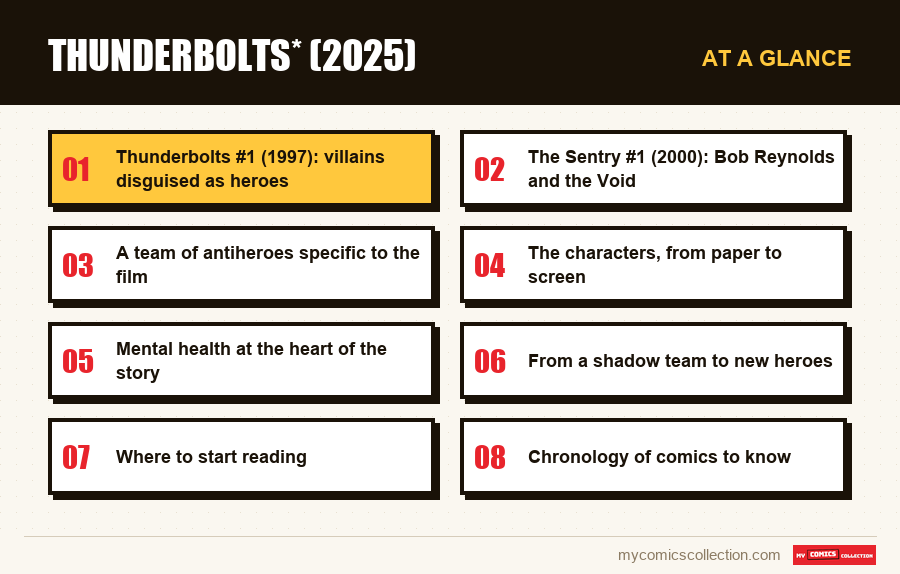
Thunderbolts #1 (1997): villains disguised as heroes
The Thunderbolts are one of the cleverest ideas in Marvel comics. The team appeared in Incredible Hulk #449 (January 1997) and then in its own series, Thunderbolts #1 (April 1997), created by Kurt Busiek and Mark Bagley. The concept is based on a famous twist, carefully kept secret by the publisher: presented as a new team of heroes coming to fill the void left by the Avengers, the Thunderbolts were revealed, on the last page of the first issue, to actually be the Masters of Evil in disguise: villains manipulating public opinion. From this starting point will be born a fascinating story about redemption: some of these villains, by dint of playing heroes, end up really becoming heroes. The film takes up the spirit of this concept, a team of antiheroes and former criminals in search of redemption, without reproducing the exact twist, its composition being entirely specific to the cinematographic saga.
This idea of redemption, of the hero's mask that ultimately transforms the wearer, is the philosophical heart of Thunderbolts. The film uses this to explore morally ambiguous characters, haunted by their past actions, who are offered a chance to redeem themselves.
The Sentry #1 (2000): Bob Reynolds and the Void
The most important character introduced by the film is the Sentry. Bob Reynolds is born in The Sentry #1 (2000), created by Paul Jenkins and Jae Lee: a being endowed with almost unlimited power, "the power of a million exploding suns", but whose very existence has been erased from all memories. His tragic particularity is the Void, his evil double, the incarnation of his depression and his darkness, inseparable from his power: the stronger the Sentry, the more the Void threatens to destroy everything. The film faithfully takes up this duality, making Bob a character torn between divine power and devastating psychological distress. This exploration of mental health, depression and self-destruction, at the heart of the character in the comics, becomes a central theme of the film, which gives it unexpected depth.
A team of antiheroes specific to the film
If the concept comes from the comics, the composition of the film team is new. It brings together characters introduced in previous productions of the saga: Yelena Belova, Bucky Barnes, US Agent, Ghost, Red Guardian: several of whom come from Black Widow. This ragtag group of broken agents, failed super-soldiers and former criminals share the spirit of the Thunderbolts: they are shadowy, morally ambiguous figures who are offered a chance at redemption. Orchestrated by a manipulator, Valentina Allegra de Fontaine, they form a team of odds and ends united by their flaws. This rereading, which draws on the available characters from the saga rather than a specific line-up from the comics, illustrates the film's method: retaining the spirit of the concept by adapting it to its own universe.
The characters, from paper to screen
- Elena Belova: Antiheroine with a murderer's past, in search of meaning after Black Widow.
- Bob/Sentry: True to The Sentry #1: unlimited power and Void, the embodiment of his depression.
- US Agent (John Walker): Controversial former Captain America, figure of moral ambiguity.
- Ghost, Red Guardian, Bucky: Broken or ambiguous figures, brought together for a chance at redemption.
- Valentina: Shadow manipulator, orchestrating the team, in the spirit of the comics.
Collecting this series?
Track what you own, what you are missing and what your collection is worth. 7 day trial.
Start my trial →Mental health at the heart of the story
The uniqueness of the film lies in the way in which it places mental health at the center of its subject. Through the Sentry and his Void, but also through the traumas of Yelena and the others, the film explores depression, inner emptiness, the feeling of uselessness. This approach, faithful to the tragic dimension of the Sentry in the comics, is rare for a superhero film: it transforms an action story into a meditation on psychological pain and how to survive it. The Void, as the literal embodiment of depression, becomes a powerful metaphor: an enemy that cannot be defeated by force, only by support and human connection. By making redemption not a matter of combat but of inner reconstruction, the film extends and deepens the spirit of the Thunderbolts.
This gravity, unusual in the saga, distinguishes the film and gives it a particular resonance. By tackling themes rarely dealt with in the genre head-on, it proves that Marvel's antiheroes, often reduced to their violence, can carry stories of real emotional depth. The concept of Thunderbolts, born in 1997, thus finds new relevance.
From a shadow team to new heroes
The title of the film, adorned with an asterisk, hides a revelation: this team of antiheroes is called to become a new incarnation of the Avengers. This shift, from the status of shadowy agents to that of recognized heroes, is profoundly faithful to the spirit of the comics: the Thunderbolts, born as villains in disguise, have continued to evolve over the decades, oscillating between redemption team, government group and real team of heroes. The film captures this trajectory: that of broken figures who, by acting together, end up becoming what they claimed to be. This idea that we can reinvent ourselves, that the past does not irrevocably determine the future, is the philosophical heart of the team.
This journey, from the margins towards the light, gives the film a strong symbolic significance. He affirms that heroism is not a given of birth but a choice, renewed at every moment, including by those who have committed the worst. By transforming antiheroes into guardians, the film extends one of the most optimistic messages in comics: redemption is always possible. For the reader, it is an invitation to follow the evolution of the Thunderbolts throughout the runs, as their composition and their status have changed, reflecting in each era a new facet of this idea of second chance.
Where to start reading
To discover the Thunderbolts, the series by Kurt Busiek and Mark Bagley (from 1997) is the reference, with its founding twist and its theme of redemption. For the Sentry, Paul Jenkins and Jae Lee's "The Sentry" (2000) is the source, supplemented by his notable role in Bendis's "New Avengers." Those curious about Yelena, Red Guardian or Taskmaster will find them in the stories mentioned for Black Widow. From 1997 to today, this journey covers the sources of a film which adapts a strong concept from the comics.
Chronology of comics to know
- 1997: Incredible Hulk #449 then Thunderbolts #1: the team and its founding twist.
- 2000: The Sentry #1: Bob Reynolds, the Sentry and the Void.
- 2000s: the Sentry in Bendis’ “New Avengers”.
Collection side: what numbers to aim for after the film
Thunderbolts* highlights modern keys. Thunderbolts #1 (1997, with its famous twist) is a sought-after number, whose popularity has benefited from the adaptation. The Sentry #1 (2000, first appearance of Bob Reynolds and the Void) is another popular target, driven by the importance of the character on screen. These issues, available at still reasonable prices, are interesting targets for a collector attentive to trends. As always, condition and gradation determine value; relying on real recent sales is strongly recommended. The Sentry #1 is a great opportunity to build on a recent first appearance propelled by cinema.
Its place in the saga and for the collector
Thunderbolts* brings together the shadowy figures of the saga into a new team, while introducing the Sentry, one of Marvel's most powerful characters. For the collector, the film has revived interest in Thunderbolts #1 and The Sentry #1, two modern issues whose value can increase with the visibility of the characters. This film illustrates the effect of cinema on recent creations. Beyond speculation, it invites us to discover a brilliant concept from comics, villains who redeem themselves, and one of Marvel's most tragic characters, the Sentry, whose fight against the Void offers a powerful metaphor for depression. By daring to tackle mental health, the film gives a 1997 concept a deeply contemporary resonance.
The Verdict: The Redemption of Antiheroes
- Loyalty: the concept of antiheroes in search of redemption, the Sentry and the Void come from the comics.
- Freedoms: a team composition specific to the saga, the twist of the comics not included, the emphasis on mental health.
- Collectible numbers: Thunderbolts #1 (1997), The Sentry #1 (2000).
Thunderbolts* adapts a strong concept from the comics, the redemption of antiheroes and former villains, into a new team, while introducing the tragic Sentry. By placing mental health at the heart of its narrative, the film extends and deepens the spirit of its source. For the reader and the collector alike, it is an invitation to discover one of Marvel's most ingenious ideas and a character of rare depth, Bob Reynolds and his Void.
Frequently asked questions
A team that appeared in Thunderbolts #1 (1997) by Kurt Busiek and Mark Bagley, famous for a twist: they were actually the Masters of Evil disguised as heroes. Some people end up truly redeeming themselves, hence the theme of redemption.
Bob Reynolds, a being of almost unlimited power who appeared in The Sentry #1 (2000). His evil double, the Void, embodies his depression and his darkness: the stronger the Sentry, the more the Void threatens to destroy everything.
Not as is. The film retains the spirit of the concept, antiheroes and former villains in search of redemption, but brings together characters specific to the saga, without reproducing the twist of the Masters of Evil in disguise.
Because the Sentry and his Void embody, in the comics and in the film, the fight against depression. The film places mental health at the heart of its narrative, making the Void a metaphor for an evil that cannot be overcome by force.
Thunderbolts #1 (1997, with its twist) and The Sentry #1 (2000, first appearance of Bob Reynolds and the Void) are two modern targets to watch, propelled by the film.
Does the film make you want to collect? Estimate the value for free of your issues (Thunderbolts #1, The Sentry #1…) with our tool based on current eBay listings.