
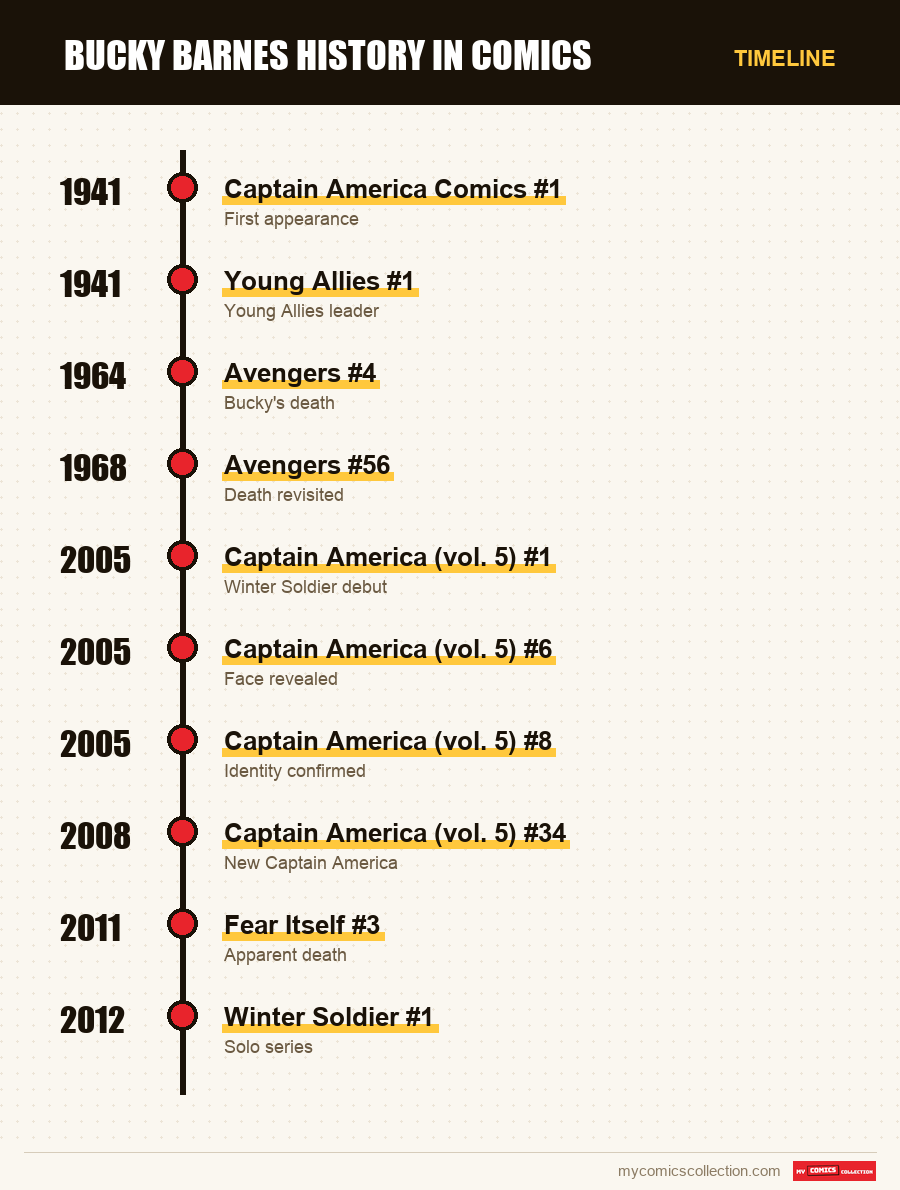
Bucky Barnes was born in March 1941 under the pen of Joe Simon and the pencil of Jack Kirby, in Captain America Comics #1. Sidekick then soldier, he was given up for dead in 1945 (restored in Avengers #4 in 1964, then recounted in detail in Avengers #56 in 1968), before being resurrected in 2005 as the Winter Soldier thanks to Ed Brubaker and Steve Epting. He even became Captain America from 2008 to 2011. Today, the CGC 9.4 copy of Captain America Comics #1 holds the character's all-time record, selling for $3,120,000 at auction in April 2022.
Few secondary characters in the Marvel universe have had as bumpy an editorial trajectory as James Buchanan "Bucky" Barnes. Conceived at the very beginning as a simple juvenile foil for Captain America, in the space of eight decades he became a soldier killed in combat, an editorial taboo explicitly protected for more than thirty-five years, an amnesiac Soviet assassin, then the bearer of the shield in his own right. Few characters have benefited, and suffered, so much from the weight of their own mythology.
This story is not only that of a character: it is also that of the evolution of the old comics market. From the Golden Age pulp printed in 1941 on cheap paper to the monitored prints of the Brubaker era in the mid-2000s, including the collecting tidal wave triggered by the casting of Sebastian Stan in the cinema, the price of Bucky Barnes alone tells the story of the superhero comics market. This article retraces, with supporting facts and sources, the complete editorial journey of the character and what it implies for those wishing to collect his key appearances.
We will first see the birth of the character in the context of the Second World War, then his "death" in the middle of the Silver Age, his shock resurrection in the 2000s, his passage under the costume of Captain America, and finally the lasting impact of cinematographic adaptations on the value of his founding comics.
The Origins of Simon & Kirby: A Sidekick Made for War (1941)
Bucky Barnes first appears in Captain America Comics #1, cover date March 1941 and published by Timely Comics, the forerunner of Marvel. The character is created by the duo Joe Simon (writer and editorial designer) and Jack Kirby (cartoonist), who simultaneously imagine Captain America and his young partner for this very first issue. Simon will later recount in his autobiography that he simply took the first name of a childhood friend, a basketball star at his high school, to name the character: “Bucky”, after Bucky Pierson.
In the original continuity, James Buchanan Barnes is presented as the mascot of the military camp where Steve Rogers is stationed before his transformation. Having accidentally overheard the secret of Captain America's identity, the teenager manages to become his combat partner rather than risk the information leaking. From the first issue, Bucky accompanies Captain America in almost every story published by Timely during the war, an intense publication rhythm characteristic of the Golden Age, where several monthly or bimonthly titles featured the duo simultaneously.
The character's success was such that Simon and Kirby very quickly offered him his own collective series: Young Allies #1 appeared during the summer of 1941, going on sale on July 10, 1941. Bucky led the "Sentinels of Liberty", a group of patriotic teenagers formed with Toro (the sidekick of the original Human Torch) and a group of young New Yorkers of diverse origins at the time. The issue is drawn under the collective signature "Charles Nicholas", with only the cover and the splash pages attributed to Kirby, and written by Otto Binder, with Simon credited as art director. This series confirms that Bucky was not a simple foil but a character capable of carrying a title on his own: a rare status for a sidekick of the time.
Captain America Comics #1 also marks the very first appearance of the Red Skull, making it one of the most sought-after seminal comics of the entire Golden Age. According to the CGC census, only around 189 copies were officially graded in mid-2023, an extremely low figure which reflects both the age of the issue (85 years in 2026), the fragility of the pulp paper of the time and the fact that it was a comic intended to be read, folded and thrown away by young readers rather than kept. The CGC 9.8 copy, from the "Allentown" collection, occupies the top of the census, followed by a CGC 9.4 copy from the "Denver" collection.
Bucky's death: a turning point for the Silver Age
The popularity of Captain America and his duo collapsed with the end of World War II, a fate shared by almost all of the patriotic heroes of the era. The series ends at the beginning of the 1950s without any real narrative conclusion for the character of Bucky, who simply disappears from the presses with the collapse of the post-war superhero genre.
It was not until the launch of the modern Marvel universe by Stan Lee and Jack Kirby in the early 1960s that the fate of the duo was finally sealed. In Avengers #4 (cover date March 1964), written by Stan Lee and drawn by Jack Kirby, Namor discovers a man cryogenically frozen in ice, worshiped as an idol by an Inuit tribe. Spotted by the Avengers (Iron Man, Thor, Wasp and Giant-Man), the man turns out to be Captain America, who has been missing since the end of the war. It is in this issue that Steve Rogers recounts for the first time how he and Bucky attempted to intercept a drone plane loaded with explosives sabotaged by a Nazi agent: the device explodes, killing Bucky and throwing Cap into the icy ocean where his body enters suspended animation until his discovery by the Avengers. This founding story permanently establishes Bucky's "killed in combat" status and makes Captain America an anachronistic hero, haunted by the loss of his young partner.
The complete and definitive account of this death would not arrive until four years later. In Avengers #56, “Death Be Not Proud!” (September 1968), scripted by Roy Thomas and drawn by John Buscema, Captain America completely relives this traumatic memory: gathered in an old castle housing Doctor Doom's time machine, the Avengers travel back in time to witness the scene. The scene has become cult in comics culture: Bucky's last words, "You're right, Cap! I see the fuse! It's going to blow!", precede by only a few boxes the explosion of the drone which ends his life. This issue crystallizes Bucky's death as one of the rare "definitive" deaths of the Silver Age, in a medium where the resurrection of characters is the norm rather than the exception.
For more than three decades, the Marvel editorial team maintained this status quo with unusual rigor. Bucky Barnes is one of a handful of characters (alongside Uncle Ben from Spider-Man and Bruce Wayne's parents from the competition) whose resurrection is explicitly prohibited by the editorial management, precisely because his death had given all its dramatic meaning to the adult character of Captain America. This unwritten rule makes "Bucky is dead and he's staying dead" an almost proverbial phrase among Marvel writers from the 1970s to 1990s.
The shock return: Winter Soldier (2005)
It is the screenwriter Ed Brubaker, associated with the designer Steve Epting, who breaks this thirty-seven year old taboo on the occasion of the launch of volume 5 of Captain America in January 2005. Inspired by spy fiction, Cold War novels and Jim Steranko's legendary run on Captain America in the 1960s, Brubaker constructed a six-chapter arc entitled "The Winter Soldier", published between Captain America (vol. 5) #1 and #6.
Captain America (vol. 5) #1 introduces the Winter Soldier only in silhouette, which has fueled a persistent debate among collectors: some consider this issue to be the true first appearance, others reserve this status for #6, the only issue where Bucky's face is formally revealed under the mask of the Soviet assassin. In Brubaker's rewritten sequel, Bucky actually survived the drone explosion in 1945, was recovered by Soviet forces, placed in suspended animation between missions, and conditioned by repeated brainwashing to become an elite assassin serving the Eastern Bloc throughout the Cold War: explaining both his survival and his lack of aging.
The critical and commercial success of this arc is immediate: it sustainably boosts sales of the series Captain America and established Brubaker and Epting as the character's go-to creative duo for the next decade. The collector's market only really took off in 2014, with the release of the film Captain America: The Winter Soldier, which loosely adapts this arc and propels a new generation of readers to the original 2005 issues.
Bucky becomes Captain America (2008-2011)
The rest of the Brubaker run pushes the reinvention of the character even further. After the presumed death of Steve Rogers at the end of the crossover Civil War , told in Captain America (vol. 5) #25 (2007), it is Bucky Barnes himself who takes up the costume and the shield in Captain America #34, cover date March 2008, still written by Brubaker and drawn by Epting. The character's new costume is designed by Alex Ross in collaboration with Brubaker, Epting and editor Tom Brevoort: Ross retains the hero's identity elements (the winged helmet, the "A" emblem) while modernizing the silhouette to mark the generational break between the soldier of the Second World War and the former assassin turned protector.
This Bucky version of Captain America occupies the costume for several years, until the return of Steve Rogers around 2010. Bucky nevertheless continues to wear the shield in parallel for a time, before disappearing again, temporarily, during the crossover Fear Itself in 2011. In this event, Bucky faces the villain Sin, temporarily invested with the Asgardian powers of Skadi, and seems to perish in battle. The character, however, is quickly brought back to life thanks to the Infinity Formula, the same compound that has preserved Nick Fury's vitality since World War II: a weakened version of the super-soldier serum. At the end of this arc, Bucky definitively abandons the costume of Captain America to Steve Rogers and once again takes on the identity of Winter Soldier, this time as an undercover agent in the service of S.H.I.E.L.D., in a solo series which will last nineteen issues.
Collecting this series?
Track what you own, what you are missing and what your collection is worth. 7 day trial.
Start my trial →The impact of adaptations on the rating
No recent development has shaken up the Bucky Barnes comic book market as much as its adaptation to the cinema. Actor Sebastian Stan is cast as James "Bucky" Barnes in Captain America: The First Avenger (2011), after initially auditioning for the lead role, ultimately going to Chris Evans. Stan himself said he thought this first film would be his only appearance in the Marvel cinematic universe, before producer Kevin Feige decided to keep it for a much longer arc, modeled on the trajectory of the paper character.
Captain America: The First Avenger (2011) adapts the Golden Age origin of the duo and the death of Bucky during a mission against a Hydra train, using the structure of the story established by Avengers #4. Three years later, Captain America: The Winter Soldier (2014) directly adapted Brubaker and Epting's arc, revealing that Bucky had survived and been transformed into a Soviet assassin-a critical and commercial success that sparked the first massive wave of collector demand for the 2005 issues. The character then reappeared in Captain America: Civil War (2016), the two parts of Avengers: Infinity War and Endgame , then in the series The Falcon and the Winter Soldier (2021) on Disney+, each release generating a peak of interest documented on the sales platforms for the corresponding key numbers.
This adaptation effect can be clearly seen in the sales figures of the founding comics. Captain America Comics #1, already sought after for its first appearance of Captain America and the Red Skull, also benefits from the status of Bucky's first appearance: the CGC 9.4 copy from the "Tom Reilly / San Francisco" collection, already sold for $915,000 in 2019, established a new absolute record for the title by selling for $3,120,000 at auction in April 2022: more than triple of his own record four years earlier. Such a gap in valuation in such a short time illustrates the extent to which the general public awareness generated by Marvel films redistributed the cards in the Golden Age market.
On much more accessible price levels, the same dynamic is observed on Captain America (vol. 5) #1 and #6 (2005): the demand for these issues, already sustained since their publication thanks to the critical reputation of the Brubaker run, has clearly strengthened since 2014, with a particularly marked valuation gap on the CGC 9.8 gradations. For a collector just starting out, these modern issues represent a much more affordable entry point than the Golden Age into the editorial history of the character.
This mechanism is not specific to Bucky Barnes: it has permeated the entire superhero comics market for around fifteen years, where each new cinematographic or serial adaptation rekindles interest in the founding paper issues, sometimes published decades before the general public discovered the character on screen. What distinguishes Bucky is the duration of his editorial eclipse: few Marvel characters have benefited from such a long gap, almost forty years, between their last significant appearance and their spectacular reintroduction, which mechanically limited the number of "intermediate" issues without much collector interest and concentrated all the value on a handful of very precise milestones: 1941, 1964, 1968, 2005 and 2008.
Buying guide
- Check the exact number you are looking for. Bucky has several distinct "first appearances" depending on identity: Captain America Comics #1 (1941) for the original character, Captain America (vol. 5) #1 (2005) for the silhouette of the Winter Soldier, and #6 (2005) for the full reveal of his face: don't confuse these three milestones when comparing ads.
- On the Golden Age, systematically favor a CGC or CBCS gradation. With only around 189 copies listed in the CGC for Captain America Comics #1 in mid-2023, independent authentication is essential before any four or five-digit purchase.
- In the 2005 issues, Epting's standard coverage remains the market benchmark faced with the numerous variants published at the time; aim for a CGC 9.8 gradation if your budget allows it, otherwise a VF/NM (8.0) constitutes a good readability-price compromise.
- Monitor the condition of pages on older copies. Timely pulp paper from the years 1941-1945 yellows quickly; look for "white pages" or "off-white to white" in the descriptions, which weigh heavily on the value of a Golden Age.
- Anticipate peaks in demand related to Marvel Studios releases. Each appearance of Sebastian Stan in cinema or streaming (Disney+) has historically increased interest in the source comics; Buying outside of these release windows may allow for better pricing conditions.
- Distinguish reading collection and investment collection. The modern runs of Brubaker and Andreyko ("Captain America and Bucky" type collections) offer a complete reading of the character at a lower cost than hunting for individual graded numbers.
Key issues to know
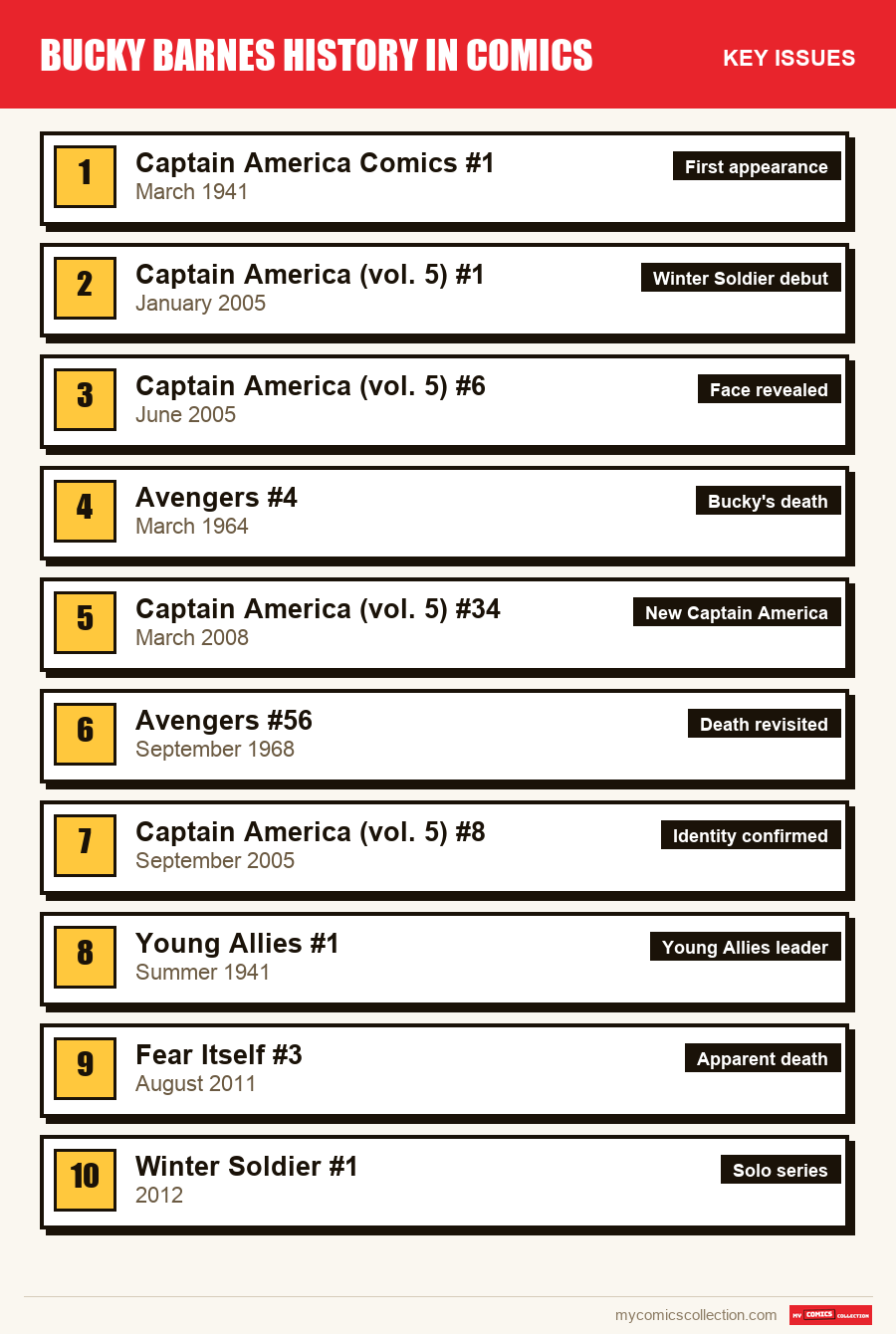
Captain America Comics #1
Joe Simon and Jack Kirby launch Captain America at Timely Comics and give him a young partner from this very first issue, James Buchanan "Bucky" Barnes. The boy stumbles on Steve Rogers' secret identity and becomes his sidekick. The issue is also the first appearance of the Red Skull.
Captain America (vol. 5) #1
Ed Brubaker and Steve Epting open their run with the murder of the Red Skull, shot by a killer working for former Soviet general Aleksander Lukin. This barely glimpsed assassin is the future Winter Soldier. It is his first appearance under that identity, still without a name or a face.
Captain America (vol. 5) #6
Final chapter of the Out of Time arc. Lukin's killer finally shows his face and Sharon Carter says she recognised Bucky. Steve Rogers also relives the explosion of Zemo's booby-trapped plane in a memory. Part of the collector market sees it as the true first appearance of the Winter Soldier.
Avengers #4
Stan Lee and Jack Kirby bring back Captain America, found frozen in ice, and make him an Avenger. In a flashback, Steve Rogers tells how Bucky died in the explosion of a drone plane sabotaged by a Nazi agent during the Second World War. This account fixes the character's death until 2005.
Captain America (vol. 5) #34
After Steve Rogers' presumed death, Bucky takes up the costume and heads out on his first mission as Captain America alongside Black Widow. Ed Brubaker and Steve Epting give him a new outfit designed with Alex Ross. He keeps the role until 2011.
Avengers #56
Roy Thomas and John Buscema deliver Death Be Not Proud!. Using Doctor Doom's time machine, the Avengers travel back to witness Captain America and Bucky's last fight against Baron Zemo. They see Bucky die destroying the drone, which confirms his death.
Captain America (vol. 5) #8
First chapter of the The Winter Soldier arc. Nick Fury shows Steve Rogers the evidence that this assassin, spotted near many killings over several decades and barely aged, is most likely Bucky Barnes. Rogers at first refuses to believe it.
Young Allies #1
A few months after his debut, Bucky leads the Young Allies, a gang of teenagers formed with Toro, the original Human Torch's sidekick. This first issue pits them against Nazi spies and then the Red Skull. Bucky thus becomes the leader of his own team book.
Fear Itself #3
In Matt Fraction and Stuart Immonen's crossover, Bucky, then Captain America, falls to Sin, empowered as Skadi by an Asgardian hammer. His death is only apparent: he is brought back by the Infinity Formula and later returns to the Winter Soldier identity.
Winter Soldier #1
Ed Brubaker and Butch Guice launch the ongoing Winter Soldier series, centred on Bucky, back as the Winter Soldier after Fear Itself. The title runs for nineteen issues until 2013.