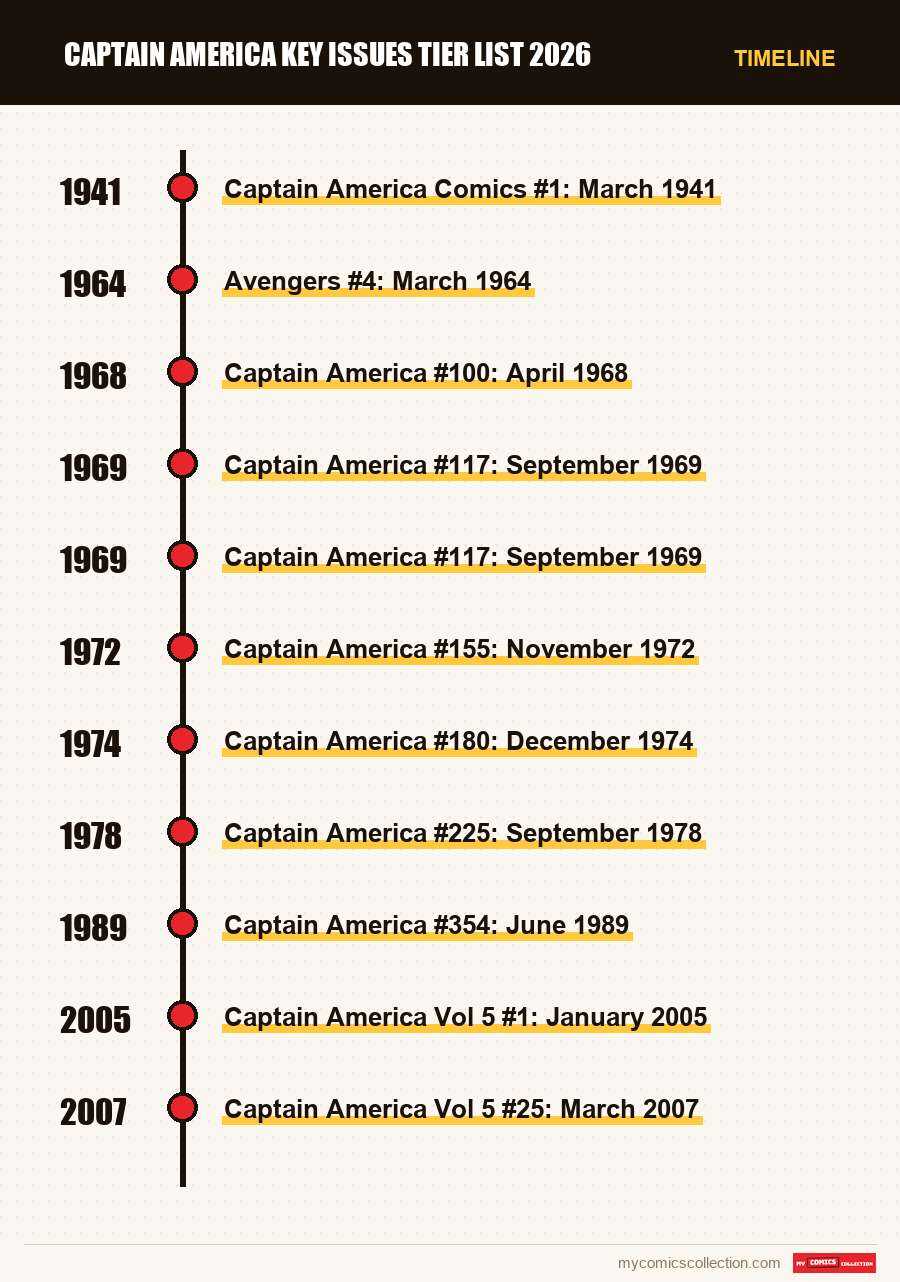
The 2026 tier list of Captain America key issues prioritizes the numbers by valuation potential: Tier S blue-chip (Captain America Comics #1 March 1941 Timely Simon/Kirby first Cap and Red Skull, Avengers #4 March 1964 Thawed Cap Lee/Kirby, Captain America #117 September 1969 first Falcon Lee/Colan, Captain America Vol 5 #1 January 2005 Brubaker Winter Soldier era): central assets at €1,500-450,000 depending on rank. Tier A (Captain America #100 April 1968 repeat vol 1, #117 first Falcon, #180 December 1974 identity Nomad, #354 June 1989 first USAgent Gruenwald). Tier B solid sleepers (Captain America #155 November 1972 1950s Cap Steranko, #225 September 1978 run Englehart, Vol 5 #25 March 2007 death Steve Rogers Brubaker). Tier C speculative bets 2026-2027 (Brave New World February 2025 Sam Wilson, Doomsday MCU 2027 build-up).
Building a coherent Captain America collection in 2026 requires a clear reading grid: without rigorous prioritization, the French-speaking collector dilutes his budget on secondary annuals while the real pillars (Captain America Comics #1, Avengers #4, the Brubaker run) continue to appreciate out of reach. The tier list operates as a disciplinary filter that distinguishes the defensive asset from the calculated bet, the urgency of purchase from opportunistic patience, and the museum piece from the exploitable sleeper.
Ce guide tier list Captain America 2026 classifies major key issues into four tiers (S, A, B, C) based on three weighted criteria: documented historical narrative significance, rolling five-year market performance verified via GoCollect and Heritage Auctions, and probability of MCU catalyst in the 2026-2030 window. Each issue is referenced with exact date, creative team and CGC price range by grade. Objective: to allow the French-speaking collector to build a budgeted purchasing strategy, without wasting a euro on the classic traps of the Cap catalog (Timely vs reprints, Bucky resurrection retcon, Brave New World post-promo crash).
Captain America 2026 tier list methodology
A useful tier list is not just about lining up numbers in descending order of price. It prioritizes acquisitions according to a coherent investment and collecting thesis, simultaneously integrating the historical centrality of the character, the documented performance of the secondary market, and the probability of a narrative or audiovisual catalyst in the short term. For Captain America in 2026, three methodological axes structure the classification and condition the attribution of a number to his tier.
Tier S/A/B/C classification criteria
- Narrative historical significance (40%): first appearances of structuring characters (Cap, Red Skull, Falcon, Winter Soldier, USAgent, Sam Wilson Cap), canonical events (resurrection 1964, death 2007, transmission of the shield), runs cited by academic criticism (Englehart, Gruenwald, Brubaker, Coates).
- Market performance 5 years (35%): CGC price trend documented on GoCollect, Heritage Auctions, ComicConnect and ComicLink between 2021 and 2026. The filter excludes ephemeral peaks linked to unconfirmed leaks and favors multi-grade linear curves.
- Probability of MCU catalyst 2026-2030 (25%): proximity of the character to official Marvel Studios announcements (Brave New World 2025, Thunderbolts*, Doomsday 2026, Secret Wars 2027), presence in confirmed Disney+ projects (Sam Wilson Cap, potential Winter Soldier), traction of verifiable rumors about The Cosmic Circus and Murphy's Multiverse.
Definition of third parties
- Tier S: blue-chip: central numbers with global status, value recognized by all major marketplaces, no imaginable risk of historical downgrading. These are the absolute defensive assets of the Captain America collection. If we had to keep only four Cap numbers, these would be them.
- Tier A: fundamentals: Historically critical issues with solid performance but without the absolute status of Tier S. Make up the backbone of a serious collection and represent the heart of a Silver/Bronze Age oriented collector's budget allocation.
- Tier B: sleepers with conviction: numbers undervalued in view of their narrative significance, with catalyst identified at 12-36 months. Moderate risk, re-rating potential documented by recognized market analysts.
- Tier C: speculative bets: issues with a strong thesis but dependent on uncertain future events (MCU announcement, narrative death/resurrection, major retcon). Limited budget allocation recommended, sometimes purchases in multiple copies if entry price is low.
Voluntary out-of-scope
This tier list does not classify secondary annuals without a major first appearance, event crossovers (Secret Empire, Civil War: unless there is a direct impact on Cap), nor modern post-2015 variants which have lost any lasting speculative premium. The parallel market for Marvel Tales and Fantasy Masterpieces reprints and Timely fakes is covered in the guide to Captain America forgeries and reprints, required reading before any purchase of issues prior to 1968 from unverified eBay. Cinema fans will find a complementary angle in the Brave New World analysis and comics spec.
Tier S: the central Captain America blue-chips
Four issues absolutely dominate the Captain America catalog and constitute the defensive core of any serious collection. They combine absolute rarity in high grade, indisputable historical importance, and maximum liquidity on major auction sites (Heritage, ComicConnect, ComicLink). No lasting market correction has been observed in these four numbers since 2015, placing them in a category that is almost immune to short speculative cycles.
Captain America Comics #1: March 1941 (Joe Simon / Jack Kirby, Timely)
The absolute founding myth. Published in March 1941 by Timely Comics (direct ancestor of Marvel), Captain America Comics #1 is written by Joe Simon and drawn by Jack Kirby. The issue simultaneously introduces Steve Rogers / Captain America and Red Skull, with its iconic cover where Cap punches Adolf Hitler: image published almost a year before the United States entered the war in December 1941. This political audacity foreshadows the entire geopolitical dimension of the character and makes the issue one of the three or four most historically charged Golden Age comics, alongside Action Comics #1 and Detective Comics #27. See the Captain America Complete Story for Timely editorial context.
- CGC 9.0: public sales 2023-2026 between €450,000 and €800,000. Census CGC 9.0 less than 5 copies worldwide.
- CGC 6.0: €95,000 to €140,000. High-end institutional investment grade.
- CGC 4.0: €38,000 to €58,000. The sweet spot for wealthy but non-super-institutional collectors.
- CGC 2.0: €14,000 to €22,000. The minimum acceptable to preserve historic blue-chip status.
- CGC 1.0 / Coverless authenticated: €5,500 to €9,000. Extreme entry point reserved for collectors accepting degraded condition for symbolic value.
5-year trend: +210% between 2021 and 2026 in CGC 4.0, with a continued post-pandemic acceleration which has never reversed. No documented correction greater than 10% over 36-month sliding windows since 2012. Competition for this title is global, with Asian markets (Hong Kong, Tokyo) having joined Heritage Dallas auctions as regular buyers since 2023. For authentication, please consult the CGC grading guide Captain America before any transaction exceeding €10,000.
Avengers #4: March 1964 (Stan Lee / Jack Kirby)
The return of the Silver Age. Published in March 1964 by Stan Lee (screenplay) and Jack Kirby (drawings, inking George Roussos), Avengers #4 recounts the recovery of Steve Rogers frozen in a block of ice since the end of World War II. Lee and Kirby thus relaunch a character abandoned since 1954, creating the archetype of the superhero displaced from his time which still structures the MCU today. This is the first Silver Age Captain America, the first direct crossover between the Timely/Atlas legacy and the modern Marvel universe, and therefore the second absolutely major issue to any Cap collection. Many markets consider that Avengers #4 shares the status of "first Silver Age key" with Fantastic Four #1, due to its structuring narrative impact.
- CGC 9.0: €32,000 to €48,000. Limited census, continued institutional demand.
- CGC 8.0: €16,000 to €24,000.
- CGC 7.0: €9,500 to €14,000. Most liquid median grade.
- CGC 6.0: €6,200 to €9,000. Institutional entry point.
- CGC 4.0: €2,800 to €4,200. Serious collector with a capped budget.
- CGC 2.0: €1,100 to €1,800. Minimum blue-chip status.
5-year trend: +95% in CGC 6.0 between 2021 and 2026, with a recent plateau which could represent a tactical entry window. The catalyst Avengers: Doomsday (December 2026) indirectly pulls the rating upwards, Captain America (Sam Wilson or Steve Rogers multiversal return) remaining the expected emotional pillar of the Multiverse saga. Major number to any combined Avengers/Cap portfolio, see cross-analysis in Captain America market trends 2026.
Captain America #117: September 1969 (Stan Lee / Gene Colan)
First appearance of Falcon. Published in September 1969 by Stan Lee (screenplay) and Gene Colan (drawings, inking Joe Sinnott), Captain America #117 introduced Sam Wilson: the first African-American superhero to bear his own name in the Marvel mainstream (Black Panther being African and appearing in 1966). Sam will become Captain America in 2014 in the comics and in 2023 in the MCU via The Falcon and the Winter Soldier then Captain America: Brave New World (February 2025). This double journey, first African-American sidekick then successor to Steve Rogers, makes #117 a double catalyst issue: fundamental historical importance AND continued MCU relevance. For character context, see story of Falcon in comics.
- CGC 9.8: €28,000 to €42,000. Restricted census, explosive demand since Brave New World.
- CGC 9.6: €6,500 to €9,800.
- CGC 9.4: €2,800 to €4,200. Sweet spot serious collector.
- GCC 9.2: €1,400 to €2,100.
- CGC 8.5: €650 to €950.
- CGC 7.0: €280 to €420. Accessible Bronze Age entry point.
5-year trend: +320% in CGC 9.4 between 2021 and 2026, with a major acceleration post-Brave New World announcement in 2023. The current window is neutral to slightly bullish: a possible official handover to Sam Wilson in Doomsday/Secret Wars could trigger a new wave +40 to +80%. The number is one of the most successful sleepers of the entire 2015-2025 decade, all franchises combined.
Captain America Vol 5 #1: January 2005 (Ed Brubaker / Steve Epting)
The Brubaker relaunch. Published in January 2005 (cover date, actual release November 2004) by Ed Brubaker (screenplay) and Steve Epting (art), Captain America Vol 5 #1 ushers in the franchise's most influential run since Gruenwald. Brubaker lays the narrative foundation that will lead to Bucky's return as Winter Soldier (revealed in #6, but prepared for from #1), the Death of Captain America arc, and the entire modern espionage aesthetic of the character. The issue became a structural Modern Age cornerstone, the first appearance of the new Cap iconography that would be adopted by the MCU films (Captain America: The Winter Soldier, 2014, draws directly on this run). For Bucky context, see Bucky's story in comics.
- CGC 9.8: €380 to €580. Uptrend continues.
- CGC 9.6: €140 to €210.
- CGC 9.4: €75 to €115.
- Director's Cut Variants: €250 to €450 in CGC 9.8.
- White Cover Variants: €800 to €1,400 in CGC 9.8 (very restricted census).
5-year trend: +180% in CGC 9.8. The regular issue remains accessible to French-speaking collectors with a modest monthly budget, which makes it an exceptional Tier S entry point: it is probably the only Tier S Cap purchasable under €600 in high grade. Any Marvel Studios announcement regarding a solo Winter Soldier project would trigger an immediate revaluation.
Tier A: Solid Captain America Fundamentals
Tier A brings together the issues that form the backbone of a serious Captain America collection. They combine documented narrative importance and continued market performance, without achieving absolute Tier S monument status. The budgetary weighting rule suggests that they represent 35 to 45% of the total allocation of a Silver/Bronze Age oriented collector accepting a 5-10 year horizon. The four issues selected here have all crossed a threshold of institutional recognition (regularly present in Heritage Signature Auctions lots) while remaining accessible at reasonable grades.
Captain America #100: April 1968 (Stan Lee / Jack Kirby)
The resumption of numbering vol 1. Published in April 1968 by Stan Lee (screenplay) and Jack Kirby (drawings), Captain America #100 marks Cap's return to his own solo series after his forced sharing of the title Tales of Suspense (where he occupied the backup feature since ToS #59 in November 1964). The issue inherits the Tales of Suspense numbering (#99 being the transition) and represents the first solo Captain America issue of the modern Silver Age era. The historical significance comes from its function as the official relaunch of the franchise, which would continue until #454 in 1996.
- CGC 9.4: €4,200 to €6,500.
- GCC 9.2: €1,800 to €2,700.
- CGC 9.0: €950 to €1,450.
- CGC 8.5: €580 to €850.
- CGC 7.0: €220 to €340. Sweet spot entry point.
5-year trend: +110% in CGC 9.0. Number frequently undercovered by the speculative retail market but recognized as a cornerstone by institutional collectors who put together complete Silver Age Cap sets. For technical arbitrations, the guide to the complete Captain America collection details the build strategy set #100-200.
Captain America #117: September 1969 (additional Tier A mention)
Although classified Tier S for its absolute historical importance (first Falcon), Captain America #117 can also be considered as Tier A in intermediate grades (CGC 7.0-8.0) where liquidity is less than on 9.4+ but where the price/historical ratio remains exceptional. A Tier A buyer with a limited budget can therefore choose a #117 CGC 7.5 at €350-450 rather than a #100 CGC 9.0 at an equivalent price. The choice between the two depends on the priority given to the identity of the character (Sam Wilson vs Steve Rogers) and the long-term MCU strategy.
Captain America #180: December 1974 (Steve Englehart / Frank Robbins)
Nomad identity and start of the Secret Empire arc. Published in December 1974 by Steve Englehart (screenplay) and Frank Robbins (art), Captain America #180 introduces Nomad: the identity that Steve Rogers adopts after abandoning the Captain America costume in response to the Secret Empire scandal (a direct allegory of Watergate). The issue is central to one of Englehart's most politically charged arcs and remains a gold standard for academic analyzes of the character. See context in Captain America story in comics.
- CGC 9.8: €1,800 to €2,800.
- CGC 9.6: €480 to €720.
- CGC 9.4: €220 to €340.
- GCC 9.2: €130 to €200.
- CGC 9.0: €80 to €125. Very accessible Bronze Age entry point.
5-year trend: +145% in CGC 9.6. The number remains underrated outside the specialized market, the Nomad identity having never been exploited by the MCU. Any announcement of a fallen Steve Rogers arc (plausible after Doomsday/Secret Wars according to theories) would trigger a strong revaluation. Buying in CGC 9.4-9.6 remains defensive.
Captain America #354: June 1989 (Mark Gruenwald / Kieron Dwyer)
First appearance of USAgent. Published in June 1989 by Mark Gruenwald (screenplay) and Kieron Dwyer (art), Captain America #354 introduced John Walker as USAgent: the government agent who had originally replaced Steve Rogers as Captain America in the Gruenwald run (since #333). The narrative evolution of the character towards USAgent establishes an identity which will then be integrated into the MCU via Wyatt Russell in The Falcon and the Winter Soldier (2021) then Thunderbolts* (May 2025).
- CGC 9.8: €950 to €1,450.
- CGC 9.6: €240 to €360.
- CGC 9.4: €110 to €165.
- GCC 9.2: €60 to €90.
5-year trend: +280% in CGC 9.8 between 2021 and 2026, with two peaks (FATWS 2020 announcement, Thunderbolts* 2025 release). The number remains one of the most profitable Bronze/Copper Age sleepers and regularly features in speculative recommendations published by spec keys 2027 analyzes. Note: Captain America #333 (September 1987, first John Walker as alternate Captain America) is also a legitimate Tier A with similar price dynamics.
Tier B: Captain America sleepers to be convinced
Tier B is the favorite playground of informed collectors. The issues are accessible at moderate budgets, their appreciation thesis is documented but not yet fully integrated into the price, and the potential/risk ratio remains favorable over an 18-36 month horizon. They typically represent 25-35% of a diversified Captain America allocation. The selection below favors numbers with a double signal: continued narrative importance AND identifiable catalytic window.
Captain America #155: November 1972 (Steve Englehart / Sal Buscema)
The 1950s Captain America (William Burnside). Published in November 1972 by Steve Englehart (screenplay) and Sal Buscema (drawings, cover by Jim Steranko on certain prints), Captain America #155 definitively introduces retro-continuity explaining the appearances of Captain America between 1953 and 1954 in Young Men then Captain America #76-78: another man, William Burnside, had worn the costume. This Englehart retcon has become canonical and remains fundamental to understanding the historical continuity of the character, as well as any subsequent stories involving alternate or corrupted Caps.
- CGC 9.8: €1,600 to €2,500.
- CGC 9.6: €480 to €720.
- CGC 9.4: €220 to €340.
- GCC 9.2: €130 to €200.
- CGC 8.5: €70 to €110.
5-year trend: +210% in CGC 9.6. The issue remains accessible and constitutes an excellent Tier B anchor for Bronze Age oriented collectors. The MCU potential is latent but very real: William Burnside is exactly the type of character that a Disney+ Sentinel of Liberty or Dark Captain America project could exploit in Phase 7. The Steranko cover on some prints is an additional bonus factor.
Captain America #225: September 1978 (Steve Englehart / Sal Buscema, Roger McKenzie)
Run Englehart late period and political arc closure. Published in September 1978 (pivotal issue of the run), Captain America #225 constitutes one of Englehart's last notable contributions to the franchise before the handover to Roger Stern then Mike W. Barr. The issue is of interest to collectors oriented towards canonical runs rather than first appearances. Its sleeper value is due to the rarity in high grade (fragile 1978 newsprint) and the consistency with the complete Englehart set (#153-186, then late collaborations), often acquired as a block by institutions.
- CGC 9.8: €380 to €580.
- CGC 9.6: €140 to €210.
- CGC 9.4: €70 to €105.
- GCC 9.2: €40 to €62.
5-year trend: +90% in CGC 9.6. Opportunistic purchase recommended in eBay or Heritage Weekly lots, the raw/CGC price gap remains favorable to selective grading for apparent NM+ examples.
Captain America Vol 5 #25: March 2007 (Ed Brubaker / Steve Epting)
The death of Steve Rogers. Published in March 2007 by Ed Brubaker (screenplay) and Steve Epting (drawings), Captain America Vol 5 #25 recounts the assassination of Steve Rogers outside a post-Civil War court, in one of the most publicized editorial events of the decade 2000-2010 (CNN and New York Times coverage). The Death of Captain America arc that followed, then the passage of the costume to Bucky Barnes, redefined the franchise for five years. The issue had five main printings (1st, 2nd, 3rd, 4th, 5th printing) plus variants: only the regular 1st print (Black & White) and the 1st print Variant Cover Turner are truly collectible.
- CGC 9.8 (1st print): €280 to €420.
- CGC 9.6 (1st print): €90 to €140.
- CGC 9.4 (1st print): €45 to €70.
- Turner CGC 9.8 variants: €480 to €720.
- Variants Director's Cut CGC 9.8: €180 to €270.
5-year trend: +160% in CGC 9.8 (1st print). The issue is underrated for its narrative impact and remains one of the best Modern Age sleepers in any franchise. Potential catalyst: any MCU revival of Steve Rogers' dead arc (likely in Doomsday or Secret Wars) would trigger an immediate +50 to +120% revaluation. For the complete Brubaker run context, see the Captain America complete collection guide.
Collecting this series?
Track what you own, what you are missing and what your collection is worth. 7 day trial.
Start my trial →Tier C: speculative bets 2026-2027
Tier C concentrates bets with a strong thesis but high uncertainty. Recommended budget allocation: 10-20% of total Captain America budget. Buying multiple copies of the same issue is sometimes relevant here if conviction is high and the entry price low (typically under €50 raw). The rule of discipline: no Tier C bet must exceed 5% of the total budget allocated to the franchise, regardless of conviction.
Captain America: Brave New World tie-ins: February 2025 (Sam Wilson Cap)
Build-up Brave New World (released February 2025 in cinemas). Several issues benefit from halo effects directly tied to the film, particularly those focusing on Sam Wilson as Captain America and the introduction of Red Hulk (Thaddeus Ross). The first appearances of Red Hulk (Hulk Vol 2 #1, March 2008 by Jeph Loeb/Ed McGuinness) experienced a complete cycle increase 2022-2024 then post-film correction 2025, illustrating the classic "buy the rumor, sell the news" pattern. For collectors who haven't purchased in 2023, the current entry point on Red Hulk remains defensible in raw.
- All-New Captain America #1 (November 2014, Sam Wilson Cap title): CGC 9.8 at €65-100. Flat-bullish trend.
- Captain America: Sam Wilson #1 (October 2015): CGC 9.8 at €35-55.
- Hulk Vol 2 #1 (2008, first Red Hulk): CGC 9.8 at €110-165. Post-correction Brave New World.
- Falcon #1 (November 1983): CGC 9.6 at €180-270. Historical sleeper on Sam Wilson solo.
For a detailed analysis of Brave New World market effects, see the analysis Brave New World spec comics.
Build-up Avengers: Doomsday and Secret Wars 2026-2027
Marvel Studios has confirmed Avengers: Doomsday (December 2026) and Avengers: Secret Wars (May 2027). Several Cap-adjacent numbers will benefit from halo effects depending on the narrative choices:
- Captain America #1 vol 4 (June 2002, Marvel Knights, John Ney Rieber/John Cassaday): post-9/11 relaunch currently underpriced (CGC 9.8 at €45-70) with potential if the geopolitical theme returns.
- Captain America #1 vol 7 (January 2013, Rick Remender): Dimension Z arc, Modern Age sleeper (CGC 9.8 at €30-50).
- Captain America: Steve Rogers #1 (July 2016, Spencer): revelation Hydra Cap (Secret Empire build-up). Controversial but historically important (CGC 9.8 at €60-95).
- Captain America #25 vol 9 (2024, J. Michael Straczynski): latest canonical developments before Doomsday, to be acquired in raw direct edition.
For technical purchasing arbitrations in the Doomsday/Secret Wars framework, the investment strategy analysis 2027 offers detailed budgetary weighting grids per identified catalyst.
Allocation strategy by collector budget
A tier list only has value when operationalized by a concrete budgetary strategy. Here are three typical profiles adjusted to the 2026 market, with breakdown by tier and target number. Each allocation leaves a 10-20% tactical reserve to capture occasional market opportunities (Heritage Weekly, ComicLink Featured, eBay solo seller raw).
Budget €5,000: the Bronze Age heart collection
- Captain America #117 CGC 7.0 (€320): first Falcon, accessible Tier S anchorage.
- Captain America #100 CGC 7.0 (280 €): vol. 1 return, Tier A anchorage.
- Captain America #180 CGC 9.0 (€110): Nomad identity, Tier A sleeper.
- Captain America #354 CGC 9.4 (€140): first USAgent, Tier A.
- Captain America #155 CGC 9.2 (€170): 1950s Cap, Tier B.
- Captain America Vol 5 #1 CGC 9.8 (€480): Brubaker, Tier S accessible.
- Captain America Vol 5 #25 CGC 9.6 (1st print)(€120): death of Steve Rogers, Tier B.
- Avengers #4 CGC 2.0 (€1,500): Tier S major, serious collector grade.
- Reserve €1,880: window opportunities + targeted Tier C (Brave New World tie-ins, Hulk #1 vol 2).
This allocation builds a base representative of the three ages (Golden via possible reprint, Silver, Bronze: Modern) while keeping a tactical reserve for MCU announcements and Heritage Weekly opportunities. See also the organizing a complete Cap collection to structure the evolution over 24-36 months.
Budget €15,000: the institutional collection
Suggested allocation: 55% Tier S, 25% Tier A, 12% Tier B, 8% Tier C.
- Avengers #4 CGC 6.0 (€7,500): cornerstone Silver Age Cap.
- Captain America #117 CGC 9.2 (€1,700): first high grade Falcon.
- Captain America Vol 5 #1 CGC 9.8 (€480): Brubaker Modern Age cornerstone.
- Captain America #100 CGC 9.0 (€1,200): Silver Age relaunch.
- Captain America #354 CGC 9.6 (€300): High-grade USAgent.
- Captain America #180 CGC 9.4 (€280): Nomad arc.
- Captain America #155 CGC 9.6 (€600): 1950s High grade cap.
- Captain America Vol 5 #25 CGC 9.8 (1st print)(€350): death Steve Rogers.
- Reserve €2,590: Tier C (Brave New World, Doomsday build-up) and Heritage opportunities.
Budget €50,000+: the blue-chip wallet
At this level, the top priority is grade quality and census rarity. Buy a Captain America Comics #1 CGC 4.0 (€45,000) rather than twenty mid-grade Tier B issues. Resale liquidity is paramount, and the Heritage Signature market concentrates its best performances on the higher grades of the founding Golden Age and Silver Age issues.
- Captain America Comics #1 CGC 4.0 (€42,000): absolute cornerstone.
- Avengers #4 CGC 7.0 (€11,000): Central Silver Age.
- Captain America #117 CGC 9.4 (€3,200): High grade Falcon.
- Captain America Vol 5 #1 CGC 9.8 + Director's Cut variant (€800): Complete Brubaker.
- Reserve €3,000: Complementary Tier A in CGC 9.4+.
For continued arbitration between Cap and other Marvel franchises, see investment analysis 2027 which details cross-franchise correlations and tactical windows by quarter.
Classic pitfalls to avoid in the Captain America franchise
The Captain America collection has specific pitfalls that can erode a well-planned budget. Four families of risks dominate and deserve particular vigilance, in particular for French-speaking buyers less exposed to signals from specialized English-speaking forums (CGC Forums, Reddit r/comicbookcollecting).
Captain America Comics #1 Timely original vs reprint Fantasy Masterpieces
The most expensive trap. Captain America Comics #1 from March 1941 (Timely, 64 pages, iconic cover Cap striking Hitler) is distinguished from several reprints which reproduce the cover or excerpts: Fantasy Masterpieces #5-13 (1966-1968) reproduces the original stories but is NOT Timely #1, and the Marvel Tales reprints from the 1970s sometimes include facsimiles. An authenticated Timely #1 raw costs at least €20,000 in good condition, compared to €30-80 for a Fantasy Masterpieces #5 reprint containing the stories.
- The original Timely is printed on newsprint from 1941 (yellowed, fragile, slightly larger format).
- The rating only applies to the March 1941 edition, verifiable by CGC certification.
- Any raw offer of “Captain America #1” under €5,000 is 99.9% suspect: either reprint or fake.
- Official Marvel facsimiles (2018, 2020 edition) are marked "Facsimile Edition" on the cover and are worth €8-15.
Le guide to fake Captain America reprints details all critical visual indicators, including differences in paper, imposition and legal notices in interior notices.
Bucky Barnes resurrection retcon: confusion first appearances
Bucky Barnes was killed in flashback continuity in Avengers #4 (1964), then resurrected as Winter Soldier in Captain America Vol 5 #1 (January 2005, Clues) and then officially revealed in Captain America Vol 5 #6 (June 2005). The speculative retail market often confuses:
- Vol 5 #1 (January 2005): first cameo appearance of the Winter Soldier (silhouette, build-up).
- Vol 5 #6 (June 2005): first official identification Bucky = Winter Soldier.
- Vol 5 #8 (August 2005): first appearance Winter Soldier undisguised.
- Vol 5 #14 (March 2006): Bucky regains his full memory.
The number to buy first is Vol 5 #1 for Tier S Brubaker run launch value, but Vol 5 #14 has long been promoted as "first cured Bucky" by sellers looking to differentiate their stock. Discipline: follow the official CGC canonization, which clearly favors #1 as the main key of the run. For full character background, see Bucky's story in comics.
Fake reprints Tales of Suspense and Captain America vol 1 before 1968
Issues Tales of Suspense #59-99 (November 1964 to March 1968, Cap backup then co-feature) and Captain America #100-150 (1968-1972) are regularly falsified via Marvel Tales reprints, Marvel Triple Action or pirate copies. The price difference between an original Tales of Suspense #63 (first Silver Age Cap origin, €2,500-4,500 in CGC 7.0) and a Marvel Tales reprint (€15-30) creates a strong incentive for scams.
- Buy exclusively CGC slabbed for pre-1970 issues, or through trusted sellers with guaranteed written authentication.
- The original Tales of Suspense covers have publisher codes (Marvel Comics Group, NY 10022) that are absent from the European pirate reprints.
- For the 1941-1942 Cap-Hitler stories reprinted in Special Marvel Edition (1971) or Marvel Super-Heroes (1966+), identical content confers NO Timely value.
Brave New World hype and post-promo correction
The Brave New World cycle illustrated the “buy the rumor, sell the news” pattern in quasi-textbook mode. Hulk Vol 2 #1 (first Red Hulk) in CGC 9.8 went from €90 in 2022 to €280 in September 2024, before correction to €130 post-release February 2025. Similar trend on All-New Captain America #1 and Sam Wilson Captain America #1. The lesson: for MCU bets 6-12 months from theatrical release, selling 60-90 days BEFORE release generally maximizes return, unless exceptional critical reception results in an extended cycle. Speculative overload and post-promo discounting are constants in the 2020-2026 collection market.
Captain America Portfolio Tracker 2026-2030
A tier list is not static. MCU catalysts, changes in editorial management at Marvel, editorial decisions (Sam Wilson vs. Steve Rogers as canonical Cap), and macro-economic cycles of the collection market cause the ranking to evolve year after year. This is the recommended revision method for the disciplined French-speaking collector.
Quarterly review cycle
- Q1: previous year report: Heritage Auctions and ComicConnect sales, calculation of progression by issue and by grade. Recalibration of budgetary weighting according to relative performance.
- Q2: analysis of San Diego Comic-Con / D23 announcements (July). Updated Tier C targets based on MCU confirmations. Reading Marvel Studios panels to identify the drawn comic arcs.
- Q3: monitoring of Disney+ releases and price impact observed D+30, D+90, D+180. Documentation of curves to calibrate future bets.
- Q4: end-of-year tax arbitrage, opportunistic sales of positions that have achieved their objectives. Opportunistic purchase on Heritage Weekly and HA Signature in December.
Re-classification indicators
Three signals can justify moving a Tier C number to Tier B, or Tier B to Tier A:
- Official Marvel Studios casting announcement on the central character of the issue (for example: announcement of a solo Winter Soldier project for Vol 5 #1, #6 or #8).
- Reduction of the CGC 9.8 census below a structural threshold (typically 75 copies in public circulation for Bronze Age, 150 for Modern Age).
- Price progression greater than 100% over 18 rolling months with maintenance over 24 consecutive months (ephemeral anti-speculative peak filter).
Operational monitoring tools
To manage a diversified Captain America portfolio over 30-150 issues, manual tools (Excel, Google Sheets) quickly reach their limits: particularly for simultaneously tracking CGC censuses, recent Heritage sales, and the MCU calendar. Dedicated applications like Comics Manager keep daily-updated eBay estimates in one place, to read alongside the CGC census and the MCU announcements calendar. See the complete guide Comics Manager for the initial setup, and the free estimate for individual arbitrations on numbers candidate for purchase or resale.
Horizon 2027-2030: areas to monitor
Four major theses will probably structure the following decade on the Captain America franchise:
- Post-Secret Wars film (May 2027): MCU reset announced, opportunity or correction depending on receipt. If Sam Wilson maintains the costume after Doomsday/Secret Wars, expect a continued revaluation of Captain America #117 and Captain America: Sam Wilson #1.
- Potential return multiversal Steve Rogers: any appearance by Chris Evans in Doomsday/Secret Wars would trigger a bull cycle on Avengers #4, Captain America #100, and the original Brubaker run.
- Winter Soldier solo project Disney+: Sebastian Stan has confirmed his continued interest in the character. Any official project would trigger +50 to +120% on Vol 5 #1, #6, #8 in 12 months.
- Disney+ saturation: risk of market fatigue if the Marvel Studios cadence drops below 2 films/year. Monitor Brave New World, Thunderbolts*, Fantastic Four First Steps box office as momentum indicators.
For collectors wishing to actively track the global market, the overview of referenced comics and the index of key issues comics provide a systematic entry point. For the Captain America franchise specifically, the Captain America character archive centralizes resources, and history of record prices at auction documents major Heritage and ComicConnect sales since 2015. For structuring antagonists, see also the story of Red Skull in comics.
Captain America 2026 tier list FAQ
Captain America Comics #1 (March 1941, Simon/Kirby, Timely) remains the absolute fundamental issue, but its entry ticket (€38,000 minimum in CGC 4.0) makes it inaccessible to the majority. For a collector with an intermediate budget, Avengers #4 (March 1964, return to Silver Age) is the second central choice, accessible in CGC 4.0 at €2,800-4,200. If the budget remains constrained, Captain America #117 (September 1969, first Falcon) in CGC 7.0 at €280-420 constitutes the most relevant Tier S entry point.
Captain America Vol 5 #1 (January 2005, Brubaker/Epting) offers a better budgetary entry point (CGC 9.8 at €380-580) than Captain America #117 (CGC 7.0 at €280-420, but on fragile Bronze Age paper). For a first Tier S Modern Age purchase without risk of degradation, Vol 5 #1 maximizes the importance/price/preservation ratio. For a collector oriented Bronze Age and Falcon as a major character, #117 remains more prestigious and historically central, but requires special attention to conservation.
The Brubaker run (Vol 5 #1-50 then Captain America vol 6 #1-19) remains one of the most liquid Modern Age pillars. Vol 5 #1 and Vol 5 #25 (death of Steve Rogers) are the two structural numbers to acquire in CGC 9.8 (€380-580 and €280-420 respectively). The full run in CGC 9.8 reaches €8,000-12,000 and has increased by 8 to 15% per year since 2020. Any MCU Winter Soldier or Death of Captain America project would trigger an immediate +50 to +120% revaluation.
Four strict rules: buy exclusively CGC slabbed copies for any Timely #1 (never in raw above €5,000), check the match of the CGC serial number on the official database, distinguish the original Timely (March 1941, yellowed newsprint, slightly larger format) from the Fantasy Masterpieces #5 (1966) and Marvel Tales reprints, refuse any raw purchase without third-party authentication even for attractive prices. Official Marvel facsimiles are marked "Facsimile Edition" and are worth €8-15. Any seller who is evasive about dating should be avoided.
For Captain America Comics #1 Timely: any certified grade is defensible, the market even values CGC 1.0 coverless. For Avengers #4: CGC 6.0 minimum is the institutional liquidity threshold, below (4.0-5.5) resale remains possible but with a negotiated discount. For Captain America #100 and #117: CGC 7.0-9.0 offer the most relevant preservation/price ratio. For Captain America #354 and #155 Bronze/Copper Age: CGC 9.6-9.8 are the sweet spots, with 9.8 often overpricing the census rarity but offering the most relevant long-term liquidity.
Related articles
- Captain America Key Numbers: Complete Guide
- Captain America market trends 2026
- Captain America Brave New World and comic spec
- Spec keys 2027 Marvel/DC films and series
- CGC grading guide Captain America
Do you own Captain America comics? Estimate the value of your collection for free to know their current rating.