CGC grading of Captain America presents specific challenges: restoration detection on the Golden Age (frequent recoloring on Cap #1-78), Marvel Chipping issues on issues 1965-1970, and brittleness of the war paper. A Captain America #1 CGC 6.0 restored (purple label) is worth 60-70% less than an equivalent blue label.
Having Captain America comics graded by CGC requires specific knowledge of the issues specific to this title. From the weakened war paper of the Golden Age to the manufacturing peculiarities of the 1960s, each era presents technical pitfalls that directly impact grade and value of your copy.
This guide covers the technical aspects of CGC grading as applied specifically to Captain America: rollback detection, common defects by era, submission strategy, and breakeven points for grading by issue value.
Restoration on the Golden Age Captain America (1941-1954)
Captain America Comics #1-78 are among the most frequently restored issues on the market. The high value encourages fraudulent restoration, and the following techniques are common:
- Color touch: color touch-up on the cover, particularly on the blue of the costume and the red/white of the shield. Examine under UV light: Retouch inks fluoresce differently from original printing inks.
- Replacement part: replacement of missing pieces of paper (corners, edges). Check the texture and thickness of the paper at the edge.
- Spine reinforcement: reinforcement of the edge with paper or fabric. Palpable to the touch, visible to the transparency.
- Cleaning/dry cleaning: professional dry cleaning is accepted by CGC (does not disqualify for a blue label), but chemical cleaning does. The distinction is crucial.
Financial impact: a Captain America Comics #1 CGC 6.0 blue label is worth around $380,000. The same in CGC 6.0 purple label (restored): $100,000-150,000. Or 60-70% loss of value. Always check raw before purchasing a Golden Age Cap: seek the advice of a professional presser before CGC submission.
Marvel Chipping and the Captain America Silver Age
“Marvel Chipping” affects Marvel comics from 1963 to 1971: a critical period for Captain America (Tales of Suspense #58-99, Cap #100-148). These are small flashes of color along the edges, caused by the trimming process on fragile paper.
This defect is manufacturing related and heavily impacts the grades: an otherwise perfect example can go down from 9.8 to 9.4 or even 9.2 because of chipping. The most affected numbers in the Cap range:
- Tales of Suspense #58-99: covers with a dark background (blue, black) where the chipping is most visible.
- Captain America #100-110: same production issues, Kirby covers with colored backgrounds.
- Captain America #117: orange/yellow background, frequent chipping on the upper edges.
Tip: Examine the top edges and the right side first. Chipping cannot be repaired without restoration: you must accept it or look for a copy that is free of it (significant premium in 9.6+).
Specific defects by era
Golden Age (1941-1954)
- Paper quality: war paper (1941-1945) extremely fragile, frequent browning (tanning).
- Spine splits: the staples rust and the paper gives way. Check the centerfold.
- Brittleness: the paper breaks when touched. CGC notes this defect and may refuse encapsulation if it is too severe.
Silver Age (1964-1968)
- Subscription creases: mail items for subscribers. Very common on Tales of Suspense. Goes down a grade by 1-2 full points.
- Spine roll: deformation of the slice due to flat storage under weight. Common on complete runs.
Bronze and Copper Age (1969-1995)
- Newsstand vs Live: newsstand editions (kiosk distribution) often have more handling wear. Direct editions (comic shops) are generally in better condition.
- Stress lines blanket: the glossy covers from the 80s and 90s show white stress lines at the slightest fold.
CGC Submission Strategy
Only grade numbers for which the cost of grading is justified by the potential added value:
- Standard CGC Cost: $50-85 per comic (depending on declared value and processing time).
- Break-even point: only submit if the difference in raw vs slabbed value exceeds $100 minimum.
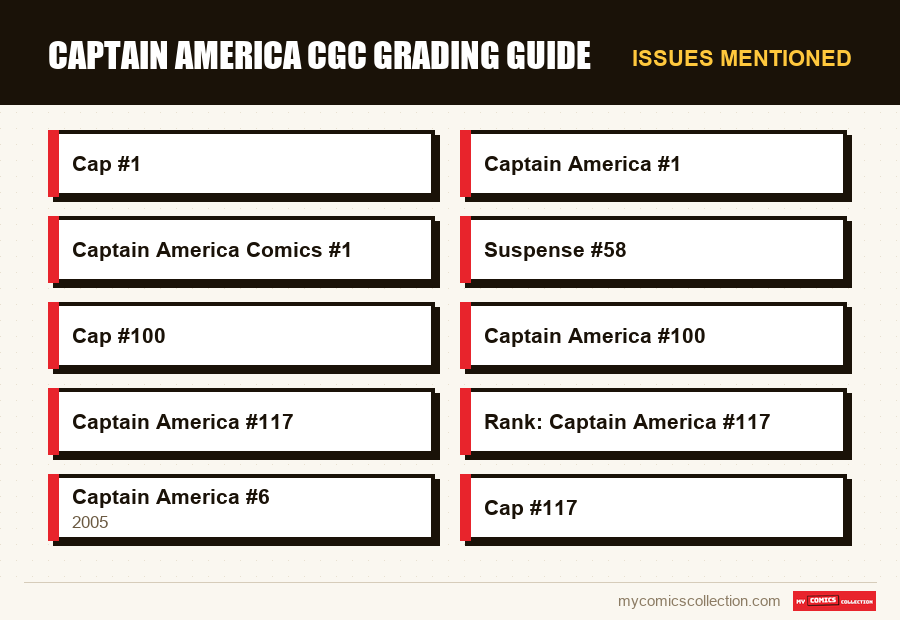
- Profitable Captain America Numbers to Rank: Captain America #117 (from VG+), Captain America #100 (from FN), Tales of Suspense #58 (from FN), Captain America #1 (2005) if NM/M, Captain America #6 (2005) if NM/M.
Pressing before submission
Professional dry cleaning can improve a grade by 0.5 to 1.5 points without being considered restoration by CGC. For Captain America:
- Golden Age: delicate pressing required by an experienced professional. Fragile paper may break. Never try it yourself.
- Silver Age: excellent return on investment. A Cap #117 that goes from FN to VF through pressing can gain $500-1000 in value.
- Modern: effective pressing to eliminate “tick marks” and small shipping creases. Gain from 9.6 to 9.8 = significant premium on Brubaker key issues.
Laundry budget: $15-30 per comic. Positive ROI on any number worth more than $75 in improved condition.
CGC vs CBCS for Captain America
The Captain America market is dominated by CGC: Heritage and ComicConnect auctions accept CGC exclusively. The CGC premium on Cap key issues is 10-20% compared to CBCS at the same grade. For serious investments (Golden and Silver Age), CGC is the rational choice despite the longer deadlines.
CBCS can be justified for modern mid-value ($50-200 range) where the CGC premium is lower and processing times are faster. But for a Captain America #117 or a Tales of Suspense #58, invest in the CGC slab: the resale liquidity is incomparably superior.
Frequently asked questions
Color touch (color retouching, visible under UV), piece replacement (missing paper pieces replaced), spine reinforcement and chemical cleaning. Professional pressing, however, is accepted and does not disqualify a copy from a blue label.
These are small flakes of color along the edges, caused by trimming fragile paper, affecting Marvel comics from 1963 to 1971. They can drop an otherwise perfect copy from 9.8 to 9.4 or 9.2, and cannot be repaired without restoration.
Captain America #117 (from VG+), Captain America #100 (from FN), Tales of Suspense #58 (from FN), plus Captain America #1 and #6 (2005) if they are NM/M. The criterion remains the value gap between the raw copy and the graded copy.
No, if done by a professional: it can improve a grade by 0.5 to 1.5 points without being considered restoration. On Golden Age books the fragile paper calls for an experienced presser, and you should never attempt it yourself.
Because the high value of early issues encourages fraudulent restoration, and the market penalizes restored copies heavily. The same grade can lose 60 to 70 percent of its value, so check everything before buying raw.
Do you own Captain America comics? Estimate the value of your collection for free to know their current rating.