
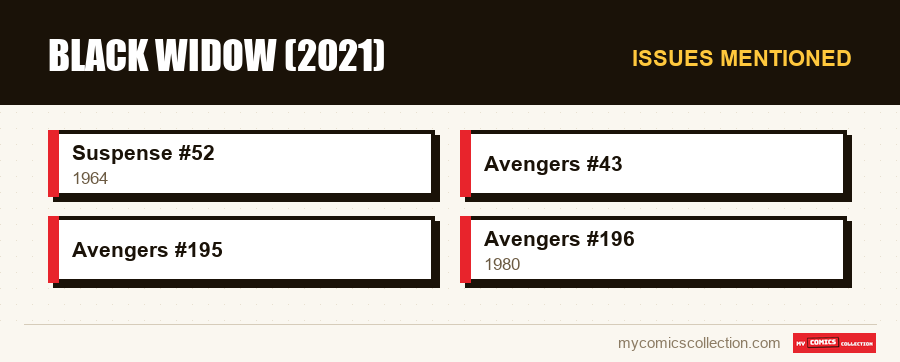
Black Widow (2021), directed by Cate Shortland with Scarlett Johansson, explores the past of Natasha Romanoff, born in Tales of Suspense #52 (1964). The film introduces his “sister”Elena Belova (created by Devin Grayson and J. G. Jones in the late 1990s), the Red Guardian Alexei Shostakov ( Avengers #43 , 1967) and Taskmaster ( Avengers #195-196, 1980). The film retains the mythology of the Red Room but reinvents several characters. Detailed comparison, film versus comics.
The first solo film dedicated to Natasha Romanoff, Black Widow looks back on her past as a spy and her front “family”. Under the direction of Cate Shortland, the film draws on several decades of comics to build its universe of Russian agents, super-soldiers and programmed assassins. Source-by-source decryption.
As in each article in the series, only verified information (distribution, dates, numbers, creators) is stated; the comparative analysis is ours, without reproducing dialogue or protected images.
Title : Black Widow (2021)
Director: Cate Shortland
Actors: Scarlett Johansson (Natasha), Florence Pugh (Yelena Belova), David Harbor (Alexei / Red Guardian), Rachel Weisz (Melina), Olga Kurylenko (Taskmaster)
Exit : July 9, 2021 (United States)
Studio: Marvel Studios
Tales of Suspense #52 (1964): Black Widow's first appearance
Avengers #43 (1967): 1st appearance of the Red Guardian (Alexei Shostakov)
Avengers #195-196 (1980): Taskmaster's first appearance
Elena Belova (late 1990s): the second Black Widow
- La Red room (Red Room), Soviet program training female killer spies.
- Elena Belova, second Black Widow, rival and mirror of Natasha.
- Le Red Guardian, Russian super-soldier, counterpart of Captain America.
- Taskmaster, capable of copying the movements of any fighter.
- The past of planned assassination of Natasha, heart of the character.
- Taskmaster becomes Antonia Dreykov, a woman, where the comic features Tony Masters.
- La " family " facade (Alexei, Melina, Yelena) is a construction specific to the film.
- Red Guardian is thematically rejuvenated and made more comical.
- Le Red Room mobile and the Widows' chemical control are developed for the film.
- The story is located between Civil War and Infinity War, a chronological insertion specific to cinema.
Tales of Suspense #52 (1964): Natasha's origins
Natasha Romanoff was born in Tales of Suspense #52 (1964), first as a Soviet spy adversary of Iron Man, before moving to the side of heroes. Her past (a stolen childhood, assassin training within a secret program) has expanded over the decades to become one of the character's richest sources. The film draws on this mythology of the Red Chamber, this program which transforms young girls into conditioned elite killers. Faithful to this idea, the film makes trauma and the reconquest of free will the heart of the story. Natasha literally confronts her past, embodied by the institutions that shaped her.
This exploration of the spy's past, long suggested in previous films, finds its most complete development here, faithful to the spirit of modern comics which have made guilt and redemption the driving forces of the character.
Yelena Belova and the Red Guardian
The film introduces two major figures from the comics. Elena Belova, created by Devin Grayson and J. G. Jones in the late 1990s, is the second Black Widow: in the comics, she considers herself the true heir to the title and often clashes with Natasha. The film reinvents her as a “sister” at heart, raised with Natasha in a false family, which gives the duo a new emotional dynamic, carried by Florence Pugh. THE Red Guardian, Alexei Shostakov, appears in Avengers #43 (1967): the Soviet counterpart of Captain America, a patriotic super-soldier, he is in the comics linked to Natasha's past. The film makes him a gruff and comical father figure, nostalgic for his past glory.
Avengers #195-196 (1980): Taskmaster, reimagined
The film's antagonist, Taskmaster, comes from Avengers #195-196 (1980), created by David Michelinie and George Pérez. His power is as original as it is formidable: a “photographic muscle memory” allows him to instantly reproduce the movements of any fighter he observes. The film faithfully retains this ability: Taskmaster imitates the styles of Captain America, the Winter Soldier, Spider-Man and others. On the other hand, it radically changes the identity of the character: in the comics, Taskmaster is a man, Tony Masters, an independent mercenary; the film makes Antonia Dreykov, a woman with a scarred face, victim as well as weapon of the Red Chamber. This rewriting, much commented on, links the antagonist to Natasha's personal drama.
The characters, from paper to screen
- Natasha Romanoff: Her past as a planned assassin, outlined in the comics, is fully explored here.
- Elena Belova: From rival in the comics to accomplice “sister”, an emotional rereading.
- Red Guardian: Russian super-soldier from Avengers #43, made more comical and endearing.
- Taskmaster: Loyal power, but changed identity (Antonia Dreykov instead of Tony Masters).
- Melina: Maternal figure of the false family, largely constructed for the film.
Collecting this series?
Track what you own, what you are missing and what your collection is worth. 7 day trial.
Start my trial →Cate Shortland and the family spy film
The success of the film lies in its tone of a spy thriller tinged with family drama. Cate Shortland makes the front “family”, four agents who played the role of a home for a mission, the emotional heart of the story. This idea, specific to the film, offers a touching meditation on what makes a family: blood or the chosen bond. Around Natasha, the film explores sisterhood, forgiveness and the reconquest of autonomy in the face of institutions that exploit bodies and minds. This very contemporary statement extends themes present in the character's modern comics, where the question of consent and control is central. By finally giving a solo film to one of its major heroines, the saga corrects a long-standing lack.
From Soviet spy to Avenger: a long evolution
The character of Black Widow has undergone one of Marvel's most spectacular evolutions in the comics. Introduced in 1964 as a Soviet spy against Iron Man in the midst of the Cold War, Natasha was originally a seductive antagonist tasked with trapping the hero. Over the decades, she switched to the side of heroes, joined the Avengers, and became one of the most respected figures in the universe, the embodiment of redemption through action. The film draws from this trajectory everything that makes the character complex: the weight of a troubled past, the guilt of acts committed under duress, and the permanent quest for free will confiscated from childhood. This moral depth, absent from the character's caricatured beginnings, was built slowly, run after run.
The film thus fits in with modern stories that have made Natasha much more than a spy: a haunted survivor, whose every heroic gesture is an attempt to redeem an imposed past. This very contemporary reading resonates with the major themes of the saga: consent, control of bodies, emancipation. By finally offering Natasha a film centered on her origins, the saga honors one of its richest heroines, whose editorial history reflects, in its own way, the evolution of an entire genre towards greater psychological complexity.
Where to start reading
To discover Black Widow, we can go back to Tales of Suspense #52 (1964) for her debut, then explore the major modern runs which have deepened her past as a spy, notably those of the 2000s and 2010s. Those curious about Yelena Belova will find her in the stories of the late 1990s. For Taskmaster, Avengers #196 (1980) is the source, and for the Red Guardian, Avengers #43 (1967). From 1964 to today, this journey covers the source material for a film that draws on several decades of Marvel espionage history, a genre of which Natasha remains the emblematic figure and the best entry point for any curious reader.
Chronology of comics to know
- 1964: Tales of Suspense #52: First appearance of Black Widow.
- 1967: Avengers #43: First appearance of the Red Guardian.
- 1980: Avengers #195-196: First appearance of Taskmaster.
- Late 1990s: first appearance of Yelena Belova.
Collection side: what numbers to aim for after the film
Black Widow points to several keys. Tales of Suspense #52 (Natasha's first appearance) is the centerpiece, a sought-after Silver Age number, whose popularity has risen markedly with the character's popularity. Avengers #196 (Taskmaster's first full appearance) is an affordable Bronze Age key that ties directly into the movie. Avengers #43 (first Red Guardian) will appeal to fans of historical figures. These targets cover various budgets. As always, condition and gradation determine value; relying on real recent sales is strongly recommended. Tales of Suspense #52 remains the priority target for a Black Widow collector, a first appearance of a major heroine whose high-grade rarity makes her a solid and sought-after value.
Its place in the saga and for the collector
Released after the conclusion of the great saga, Black Widow offers a farewell to the character while introducing Yelena Belova, called to take over. For the collector, the film reignited interest in Tales of Suspense #52 and boosted Avengers #196, the first appearance of Taskmaster: once again illustrating the effect of cinema on the market. This film also highlights endearing secondary characters, whose first appearances become targets for collectors. Beyond speculation, it recalls the richness of the “espionage” side of the Marvel universe, often overshadowed by costumed heroes, but rich in stories of great psychological intensity. By finally offering Natasha a solo film, the saga does justice to a heroine whose editorial history, made up of redemption and gray areas, is among the most complex. It's also a reminder that Marvel's richest characters aren't necessarily the most powerful, but those whose pasts and contradictions offer the deepest material: a lesson the savvy collector keeps in mind when choosing which issues to hunt.
The verdict: the faithful Red Room, identities revisited
- Loyalty: the Red Room, Yelena, the Red Guardian and Taskmaster's power come from the comics.
- Freedoms: Taskmaster turned female (Antonia Dreykov), the front “family”, a more comical Red Guardian.
- Collectible numbers: Tales of Suspense #52 (Natasha), Avengers #196 (Taskmaster), Avengers #43 (Red Guardian).
Black Widow draws on several decades of spy comics to build an intimate story about family and reclaiming oneself. Faithful to the mythology of the Red Room and characters like Yelena and the Red Guardian, the film takes notable liberties, particularly with Taskmaster. For the reader as well as the collector, it is an invitation to explore the espionage side of Marvel, and a great opportunity to target the first appearance of one of its major heroines. By finally giving the spotlight to Natasha and introducing Yelena, who will succeed her, the film also ensures a transmission: that of a title and a legacy which, like so many others at Marvel, is passed on from one generation to the next. For the collector, this continuity opens up so many first appearances to hunt, from Tales of Suspense #52 to the debut of Yelena.
Frequently asked questions
From Natasha's past (Tales of Suspense #52, 1964) and the mythology of the Red Room, with Yelena Belova (late 1990s), the Red Guardian (Avengers #43, 1967) and Taskmaster (Avengers #195-196, 1980).
No: in the comics, Taskmaster is a man, Tony Masters, an independent mercenary. The film makes her Antonia Dreykov, while faithfully retaining her power to copy the movements of any fighter.
The second Black Widow, created in the late 1990s. In the comics, she considers herself the true heir to the title and confronts Natasha. The film reinvents her as Natasha's “sister” at heart.
In broad terms: Alexei Shostakov, Russian super-soldier counterpart to Captain America, appears in Avengers #43 (1967). The film makes him more comical and endearing, nostalgic for his past glory.
Tales of Suspense #52 (Black Widow's first appearance) is the centerpiece. Avengers #196 (Taskmaster's first full appearance) is a more accessible key and directly related to the film.
Does the film make you want to collect? Estimate the value for free of your issues (Tales of Suspense #52, Avengers #196…) with our tool based on current eBay listings.