Iron Man 2 (2010), directed by Jon Favreau with Robert Downey Jr., extends the first film by drawing on several aspects of the comics: the subtext of alcoholism comes from “Demon in a Bottle”(Iron Man #120-128, 1979), crooked businessman Justin Hammer appears in Iron Man #120 (1979), Black Widow is born in Tales of Suspense #52 (1964) and War Machine formalized his armor in the early 1990s. The villain Ivan Vanko merged two classic villains: Whiplash and Crimson Dynamo. Here's the full comparison, film versus comics.
Direct sequel to the founding film of the saga, Iron Man 2 has the difficult task of expanding the universe while deepening Tony Stark. To do this, the scenario is not based on a single story, but brings together several scattered elements from the comics: a famous intimate theme, two merged villains, and the introduction of two characters destined to become adults. This mastered patchwork deserves to be dissected source by source.
Faithful to our method, we only present verified facts (distribution, dates, numbers, creators) and an original comparative analysis, without reproducing any dialogue or protected images.
Title : Iron Man 2 (2010)
Director: Jon Favreau
Actors: Robert Downey Jr. (Tony Stark), Don Cheadle (James Rhodes / War Machine), Mickey Rourke (Ivan Vanko / Whiplash), Sam Rockwell (Justin Hammer), Scarlett Johansson (Natasha Romanoff / Black Widow), Gwyneth Paltrow (Pepper Potts)
Exit : May 7, 2010 (United States)
Studio: Marvel Studios
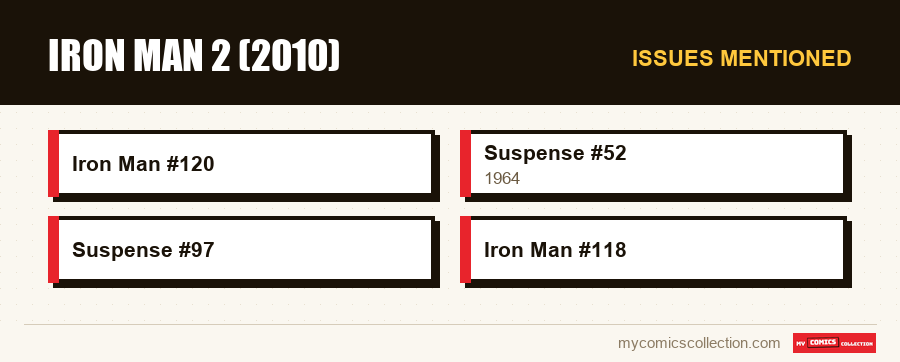
“Demon in a Bottle”: Iron Man #120-128 (1979), Michelinie & Layton (alcoholism)
Justin Hammer: 1st appearance Iron Man #120 (1979)
Black Widow: 1st appearance Tales of Suspense #52 (1964)
Whiplash (Tales of Suspense #97, 1968) +Crimson Dynamo: merged for Ivan Vanko; War Machine armor (early 1990s)
- Le Stark's personal decline, echoing “Demon in a Bottle”: the hero who destroys himself at the height of his glory.
- Justin Hammer, an unscrupulous industrial rival, taken directly from the 1979 comics.
- Black Widow (Natasha Romanoff), a double-dealing spy, faithful to her role as an undercover agent.
- War Machine: Rhodey who dons heavy, militarized armor, like in the comics.
- An antagonist to energy whip, visual signature directly inherited from Whiplash.
- Ivan Vanko is a new character: it merges Whiplash and Crimson Dynamo (Russian technology), without existing as is in the comics.
- Alcoholism is softened: the film transposes it into a crisis linked to the palladium poisoning of its reactor, more than to a frontal dependence.
- Justin Hammer is rejuvenated and transformed into a grating rival, far from the older comic book mogul.
- Black Widow goes from Iron Man's initial enemy (in the comics) to S.H.I.E.L.D.'s ally. from its introduction.
- War Machine sees his armor formalized much earlier in the character's journey on screen than on paper.
“Demon in a Bottle”, transposed without being named
The emotional heart of Iron Man 2 lies in Tony Stark's self-destruction, a theme which inevitably refers to the character's most famous arc, "Demon in a Bottle" (Iron Man #120-128, 1979) by David Michelinie and Bob Layton. In the comic, Stark descends into alcohol at the worst time, when his professional life is falling apart. The film takes up this dynamic of public decline, the billionaire who scuttles himself in the spotlight, but shifts it: here, it is not the bottle which eats Stark, but the palladium poisoning of his reactor, which pushes him to erratic behavior. The first film had already touched on this avenue; the sequel puts it in the foreground, while reformulating it for a family audience.
This choice illustrates the saga's adaptation strategy: retaining the dramatic charge of a cult arc while changing its mechanism, in order to keep its spirit without literally repeating its letter. To extend the film, reading “Demon in a Bottle” remains the essential reference.
Justin Hammer, the rival from the same pages
Tasty detail: Justin Hammer appears for the first time in Iron Man #120 (March 1979), precisely the issue that opens the “Demon in a Bottle” arc. The film therefore draws its theme and one of its villains from the same block of comics. On paper, Hammer is an elderly European tycoon, saboteur who takes control of Stark's armor remotely. The film turns him into a younger, pushy, buffoonish rival, played by Sam Rockwell: a retelling that favors the comic contrast with Stark rather than the cold menace of the original.
Black Widow: from enemy to ally
Iron Man 2 marks Natasha Romanoff's first on-screen appearance. The character is born in the comics with Tales of Suspense #52 (April 1964), and made her debut... as an enemy of Iron Man, a Soviet spy responsible for trapping him. The film reverses the logic: Natasha is from the outset a S.H.I.E.L.D. agent. infiltrated with Stark, ambiguous ally rather than adversary. This reorientation reflects the evolution of the character in the comics themselves, where the spy gradually moved from the opposing camp to that of the heroes.
War Machine: Rhodey's armor
Iron Man 2 formalizes James Rhodes as War Machine, pillar of the Iron Man universe. In the comics, Rhodey appears at the end of the 1970s (Iron Man #118, 1979) and ends up donning heavy and militarized armor whose identity "War Machine" crystallizes at the beginning of the 1990s. The film accelerates this journey: Rhodey seizes a Stark armor and entrusts it to the army, laying the foundations of the character much earlier in his personal chronology than over the course of the decades of comics.
Collecting this series?
Track what you own, what you are missing and what your collection is worth. 7 day trial.
Start my trial →Ivan Vanko: two villains in one
The main antagonist of the film does not exist as is in the comics: Ivan Vanko is a creation which condenses two classic Iron Man villains. From Whiplash (whose original version, Mark Scarlotti, appeared in Tales of Suspense #97 in 1968), he draws the energy whips and silhouette. From Crimson Dynamo, he inherits Russian ancestry, technological warfare background, and resentment towards the Stark dynasty. This fusion allows the film to have a visually spectacular and personally connected adversary to Tony, without constraining itself to a single origin story.
A crossroads film towards the Avengers
Beyond its own plot, Iron Man 2 assumes a function that the comics did not have to manage in the same way: preparing for the great gathering to come. This is where S.H.I.E.L.D. and its director Nick Fury gain momentum, as Black Widow's true mission is revealed, evaluating Stark for a mysterious "Initiative", and as the film sows clues to a larger universe. This bridging dimension explains certain choices: if the story sometimes seems torn between Stark's story and the installation of the collective setting, it is because it carries a double charge. The comics, for their part, constructed the Avengers from 1963 as a separate series; cinema had to weave this thread within the solo films.
This crossroads role gives the film a particular value for the collector: it concentrates in a single story the entry on the scene of several characters whose first appearances in comics become, in turn, sought-after targets. Following the threads laid out by Iron Man 2 is already entering into the shared universe logic that will make the saga successful.
Palladium, a reformulated decline
The most clever feature of the film remains the way in which it transposes the self-destruction of “Demon in a Bottle”. Rather than alcohol, it is the palladium from his reactor that slowly poisons Stark, turning the source of his power into a deadly countdown. The symbol is strong: what keeps him alive is also what kills him, and his reaction (headlong flight, provocations, irresponsible behavior) mimics the effects of an addiction without directly showing its face. This metaphor makes it possible to retain the tragic charge of the 1979 arc while remaining accessible to a family audience, illustrating once again the method of adaptation of the saga: keep the emotion, change the mechanism.
Chronology of comics to know
- 1964: Tales of Suspense #52: First appearance of Black Widow.
- 1968: Tales of Suspense #97: first appearance of Whiplash (Mark Scarlotti version).
- 1979: Iron Man #120: First appearance of Justin Hammer and opening of “Demon in a Bottle” (#120-128).
- Early 1990s: crystallization of Rhodey's War Machine armor.
Where to start reading
The best starting point remains “Demon in a Bottle” (Iron Man #120-128, 1979), which contains both the emotional core transposed by the film and the first appearance of Justin Hammer: two major elements in a single arc. We ideally continue with the modern rereading “Extremis” (Iron Man vol. 4, 2005-2006), already the source of the design of the armor on screen, to understand the contemporary Stark. Black Widow fans will benefit from going back to Tales of Suspense #52 (1964) and then following her gradual shift towards the hero camp. Finally, for War Machine, the issues where Rhodey permanently dons the armor at the turn of the 1990s complete the picture. This journey, from the intimate drama of the 1970s to the rereadings of the 2000s, follows exactly the logic of the film's assembly.
Collection side: what numbers to aim for after the film
Iron Man 2 opens up several avenues for collection. Tales of Suspense #52 (first Black Widow) is a sought-after key to the Silver Age, even more so since the character's on-screen popularity. Iron Man #120 combines two attractions: first appearance of Justin Hammer and first chapter of “Demon in a Bottle”, which makes it a doubly interesting and yet accessible issue. For War Machine fans, the pivotal issues from the early 1990s remain affordable. The ratings vary depending on the condition and gradation, it is better to refer to recent sales before making any purchase.
The verdict: a skillful assembly
- Loyalty: the spirit of “Demon in a Bottle”, the function of Hammer, the identity of Black Widow and War Machine are respected.
- Freedoms: alcoholism transposed into poisoning, a new villain (Vanko) merging two villains, and reoriented roles.
- Collectible numbers: Tales of Suspense #52 and Iron Man #120, two keys that are both affordable and rich in meaning.
Iron Man 2 does not adapt a story, but composes its own from selected fragments. It's a risky method, which explains certain tensions in the story, but also its richness in references. For the collector, it is above all an open door to several significant first appearances, and an invitation to return to the first film, the shadow of which hangs over the entire sequel.
With hindsight, Iron Man 2 occupies a pivotal place in the saga: less successful than the first part in its story, it nonetheless remains the film which broadened the horizon, by installing Black Widow, War Machine and the growing shadow of S.H.I.E.L.D. For the collector, it is this density of characters that counts: each refers to concrete first appearances, from Tales of Suspense #52 to Iron Man #120, so many issues whose price has followed the trajectory of the characters on screen. The film perfectly illustrates how cinema can restore value to decades-old comics, by shining the spotlight on hitherto secondary figures.
Frequently asked questions
Mainly from “Demon in a Bottle” (Iron Man #120-128, 1979) for the fall of Stark, with Justin Hammer (Iron Man #120), Black Widow (Tales of Suspense #52, 1964) and a villain merging Whiplash (Tales of Suspense #97) and Crimson Dynamo.
Not as is. The character is a creation of the film that combines two classic Iron Man villains: Whiplash (energy whips) and Crimson Dynamo (Russian technology and ancestry).
The film transposes the decline of “Demon in a Bottle” into a crisis linked to the palladium poisoning of its reactor. The spirit of self-destruction is retained, but the mechanism is changed for a wider audience.
Yes, Natasha Romanoff made her screen debut in Iron Man 2. In the comics, she appeared in Tales of Suspense #52 (1964), first as an enemy of Iron Man before moving to the hero side.
Iron Man #120 is ideal: it opens “Demon in a Bottle” and contains the first appearance of Justin Hammer. Tales of Suspense #52 (first Black Widow) is the other key to aim for.
Want to collect around Iron Man 2? Estimate the value for free of your issues (Iron Man #120, Tales of Suspense #52…) with our tool based on current eBay listings.