
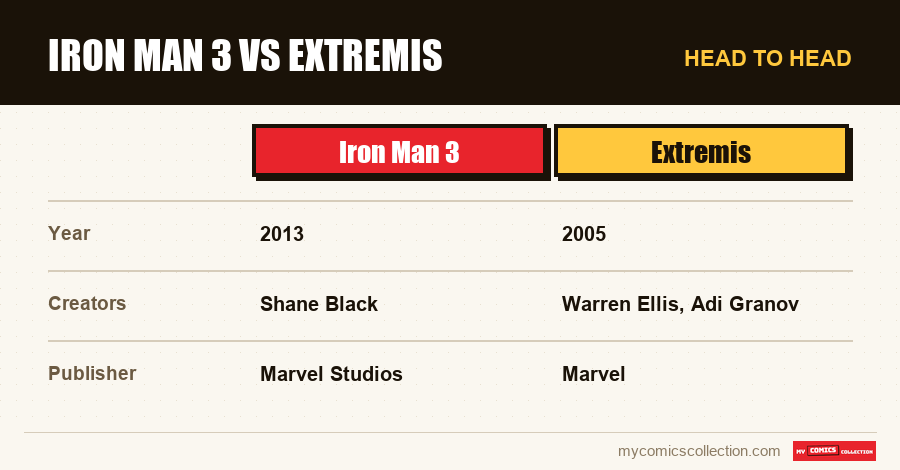
Iron Man 3 (2013), directed by Shane Black with Robert Downey Jr. , mainly fits the arc “Extremis”(Iron Man vol. 4 #1-6, 2005-2006) by Warren Ellis and Adi Granov: the Extremis virus, scientist Maya Hansen and Aldrich Killian are directly taken from it. The film also summons the Mandarin, great historical enemy born in Tales of Suspense #50 (1964), but gives it a radical twist. He finally borrows the name of Iron Patriot, which belonged to another character in the comics. Here is the detailed comparison, film versus comics.
Tony Stark's third solo film and conclusion of "phase 1" on the character side, Iron Man 3 takes an unexpected turn under the leadership of Shane Black: an offbeat action film tone, a weakened hero, and above all a provocative rereading of the character's mythology. For this, the film relies on a precise arc of the comics while allowing itself one of the most commented liberties of the entire saga.
As in each article in the series, only verified information (distribution, dates, numbers, creators) is stated; the comparative analysis is ours, without reproduction of dialogue or protected images.
Title : Iron Man 3 (2013)
Director: Shane Black
Actors: Robert Downey Jr. (Tony Stark), Guy Pearce (Aldrich Killian), Ben Kingsley (Trevor Slattery), Rebecca Hall (Maya Hansen), Gwyneth Paltrow (Pepper Potts), Don Cheadle (James Rhodes / Iron Patriot)
Exit : May 3, 2013 (United States)
Studio: Marvel Studios
“Extremis”: Iron Man vol. 4 #1-6 (2005-2006), Warren Ellis & Adi Granov (virus, Maya Hansen, Killian)
Tales of Suspense #50 (1964): 1st appearance of the Mandarin (Stan Lee & Don Heck)
Iron Patriot: identity from “Dark Reign” (2009), originally worn by another character
- Le Extremis virus, heart of the 2005 arc: regeneration, heat, bodies become weapons.
- Maya Hansen, the scientist behind Extremis, directly from the comic.
- Aldrich Killian, present in “Extremis” in a secondary form.
- Le Mandarin, Stark's historical nemesis, and his imagery of ten rings of power.
- The idea of a Stark diminished, forced to make do without his armor, echoing stories where man takes precedence over machine.
- The Mandarin twist: the film makes it a media cover, a manipulated actor (Trevor Slattery), where the comic presents a real warlord.
- Aldrich Killian goes from minor character to main antagonist, promoted to true mastermind.
- Iron Patriot: the name belonged to another character in the comics; the film reattributes it to Rhodey's armor.
- The Rings of Power of extraterrestrial origin of the comic disappear in favor of a scientific explanation (Extremis).
- Le your, close to the Christmas action film by Shane Black, moves away from the seriousness of the original arc.
“Extremis” (2005-2006), the backbone of the film
Iron Man 3 is the most direct adaptation of the "Extremis" arc (Iron Man vol. 4 #1-6), written by Warren Ellis and drawn by Adi Granov: the same artist who defined the look of the armor from the first movie. In the comic, Extremis is an experimental treatment capable of reprogramming the human body, transforming individuals into living weapons. The film faithfully takes up this idea: guinea pigs endowed with superhuman strength and heat, spectacular regeneration, but also an instability which sometimes causes them to explode. This is the raw material for the entire plot.
Two characters come directly from this arc. Maya Hansen, the brilliant scientist behind Extremis, plays a central role; the film preserves it, although with a modified trajectory. Aldrich Killian is only a secondary figure in the comic. The film operates its first great freedom here by promoting him to the rank of main antagonist, mastermind of the entire plot.
Tales of Suspense #50 (1964): the Mandarin and his twist
The Mandarin is, in the comics, Iron Man's greatest enemy. He appears in Tales of Suspense #50 (February 1964), created by Stan Lee and drawn by Don Heck: a warlord with ten rings of power of extraterrestrial origin, each with a different effect. Iron Man 3 summons this figure and its imagery (the rings, international terrorism, the aura of threat) but reserves for him one of the most discussed twists of the saga: the publicized Mandarin is only a facade, an actor named Trevor Slattery hired to play a bogeyman, while the real strategist is Killian. This bias, praised by some for its satirical audacity and criticized by others for its betrayal of the character, illustrates the extent to which the film undertakes to shake up its source.
Iron Patriot: a name borrowed from another
Another notable shift: the Iron Patriot. In the comics, this patriotically colored armor is worn by Norman Osborn during the “Dark Reign” period (2009), when the former Green Goblin takes control of the security apparatus. The film simply reassigns this name and design to Rhodey's armor, repainted for communication reasons. It's a typical example of how cinema draws a strong visual element from comics while completely changing the context and the bearer.
The characters, from paper to screen
- Tony Stark: Weakened by the events in New York, he is more vulnerable here, often separated from his armor: a choice which reconnects with the idea that man is better than machine.
- Aldrich Killian: Promoted from the status of sidekick to that of central villain, he embodies the freest rereading of the film.
- Maya Hansen: Faithful to her role as creator of Extremis, with an ambivalent moral trajectory.
- The “Mandarin” / Trevor Slattery: Satirical diversion of a mythical enemy, reduced to a cover.
- Rhodey / Iron Patriot: Stark's military ally, whose armor changes name and colors.
Collecting this series?
Track what you own, what you are missing and what your collection is worth. 7 day trial.
Start my trial →Shane Black and the offbeat action film
The choice of Shane Black to direct the entire film. Iconic screenwriter of the action film of the 1980s and 90s, Black imbues Iron Man 3 with his humor, his “buddy movie” structure and his winter setting close to the Christmas story. This tone partly explains the twist in The Mandarin: Black and his co-writer sought less to honor the letter of the comics than to surprise, even if it meant dividing. The result is an atypical Iron Man film, more centered on the man than on the superhero: an approach which, paradoxically, joins the spirit of certain great stories of the character, where the armor is only an extension of Stark's will.
A haunted Stark and an army of armor
Iron Man 3 adds a new psychological dimension to the saga: Tony Stark is traumatized by the Battle of New York, subject to anxiety attacks which consume him. This fragile insomniac hero, unable to sleep without tinkering with new armor, has no direct equivalent in a specific comic, but he extends a recurring idea of the character: the obsession with control, the flight into technology as a bulwark against fear. The film pushes this logic to the absurd with a veritable legion of autonomous armors, controlled remotely, which intervene in the finale. This motif of the multiplication of armor echoes the numerous variations that Stark accumulates in the comics, where each situation calls for its specific model.
This introspection gives the film a particular color: more than a classic superhero story, it is the portrait of a man who must relearn to define himself outside of his armor. This is also what paradoxically brings Iron Man 3 closer to the spirit of “Extremis”, where Warren Ellis already questioned the border between man and machine, the body and technology. Under its summer blockbuster exterior, the film therefore extends a reflection well anchored in the modern comics of the character.
Where to start reading
The obvious starting point is the “Extremis” arc (Iron Man vol. 4 #1-6), both a direct source of the film and a modern rereading of the character: there we find Maya Hansen, Killian and the virus, as well as the armor design used on screen since 2008. To understand the real Mandarin, we must go back to Tales of Suspense #50 (1964) then follow his recurring clashes with Iron Man over the decades: the contrast with the film version is all the more striking. Finally, those curious about the “Dark Reign” period (2009) will discover the original Iron Patriot and the context of which the film only kept the name. This journey, from 1964 to 2009, sheds light on the three main sources from which Iron Man 3 drew.
Chronology of comics to know
- 1964: Tales of Suspense #50: First appearance of the Mandarin.
- 2005-2006: Iron Man vol. 4 #1-6, “Extremis”: the virus, Maya Hansen, Killian.
- 2009: “Dark Reign”: the original Iron Patriot, worn by Norman Osborn.
Collection side: what numbers to aim for after the film
Iron Man 3 highlights two very different collectible targets. Tales of Suspense #50 (first appearance of the Mandarin) is a key to the Silver Age, sought after all the more since the character's presence on screen; its high ranks reach high amounts. Iron Man vol. 4 #1 (“Extremis”, 2005) remains, conversely, a very accessible modern number, directly linked to the film and the aesthetic of the entire franchise. In between, the issues from the “Dark Reign” period offer an affordable lead for anyone interested in the original Iron Patriot. The ratings vary according to the state and the gradation, relying on real recent sales remains recommended.
The verdict: the most daring adaptation of Iron Man
- Loyalty: strong on “Extremis” (the virus, Maya Hansen) and on the imagery of the Mandarin.
- Freedoms: the fake Mandarin twist, Killian's promotion and the reassignment of the Iron Patriot name.
- Collectible numbers: Tales of Suspense #50 (The Mandarin) and Iron Man vol. 4 #1 (“Extremis”).
By choosing to divert one of Stark's most emblematic enemies, Iron Man 3 took the most commented risk of the saga. But its base remains solid: it is the most direct adaptation of “Extremis”, the arc which, since 2005, has defined the modern Iron Man. For the collector, the film opens up as much towards a Silver Age classic (The Mandarin) as towards a must-have from the 2000s (“Extremis”): two facets of the same character.
Its place in the saga and for the collector
The last solo film dedicated to Tony Stark, Iron Man 3 closes a cycle that began in 2008: it completes the arc of the billionaire, from initial carelessness to the most intimate questioning. Its twist on the Mandarin, long debated, even saw an extension in the saga, proof that the question of the “real” Mandarin remained a living subject. For the collector, the film has a double effect: it has maintained attention on "Extremis", which has become an essential and easy-to-find modern read, while recalling the existence of the original Mandarin, whose first appearance (Tales of Suspense #50) remains a prized key to the Silver Age. It is this ability to link a recent rereading and a 1964 classic which makes the thematic richness of the film for those who want to collect around Iron Man. Beyond the debates, Iron Man 3 confirms a constant in the saga: the best stories of the character talk less about the armor than about the man who wears it, an idea that comics have been exploring for decades and that cinema has been able to make its own.
Frequently asked questions
Mainly from the "Extremis" arc (Iron Man vol. 4 #1-6, 2005-2006) by Warren Ellis and Adi Granov, from which the Extremis virus, Maya Hansen and Aldrich Killian come. The film also summons the Mandarin (Tales of Suspense #50, 1964).
The film has a twist: the media Mandarin is a cover played by an actor (Trevor Slattery), the real mastermind being Killian. In the comics, the Mandarin is a very real warlord with ten rings of extraterrestrial origin.
Norman Osborn, during the “Dark Reign” period (2009). The film reassigns this name and colors to James Rhodes' armor, with no connection to the original context.
Yes, but as a supporting character in the “Extremis” arc. The film promotes him to the rank of main antagonist, mastermind of the whole scheme.
Tales of Suspense #50 (first appearance of the Mandarin) is the key to the Silver Age. Iron Man vol. 4 #1 (“Extremis”) is the most accessible modern entry and most directly related to the film.
Does the film make you want to collect Iron Man? Estimate the value for free of your issues (Tales of Suspense #50, Iron Man…) with our tool based on current eBay listings.