Iron Man (2008), directed by Jon Favreau with Robert Downey Jr., is inspired by Iron Man's first appearance in Tales of Suspense #39 (1963) and especially the arc “Extremis”(Iron Man vol. 4 #1-6, 2005-2006), whose designer Adi Granov designed the armor for the film. The film keeps the heart of the original, the captured arms industrialist who builds armor to escape, but updates the setting (Vietnam → Afghanistan) and has Stark reveal his identity in public. Here, film versus comics, all the similarities and all the differences.
Iron Man is not only the first film in the Marvel cinematic universe: it is an adaptation that draws on nearly fifty years of comics to compose its story. Released in 2008, the feature film draws on both the 1960s origin and a much more recent rereading of the character, before making its own directorial choices. This guide puts the movie next to the specific numbers who inspired it, then methodically lists what the adaptation preserves and what it transforms.
The rule we apply here: every factual information (creators, dates, comic numbers) is verified, and the comparative analysis is ours. No dialogue is copied, no plate or poster is reproduced: only the editorial work of comparison is presented.
Title : Iron Man (2008)
Director: Jon Favreau
Actors: Robert Downey Jr. (Tony Stark), Jeff Bridges (Obadiah Stane), Terrence Howard (James Rhodes), Gwyneth Paltrow (Pepper Potts), Shaun Toub (Yinsen)
Exit : April 30, 2008 (France) · May 2, 2008 (United States)
Studio: Marvel Studios: first film in the Marvel Cinematic Universe
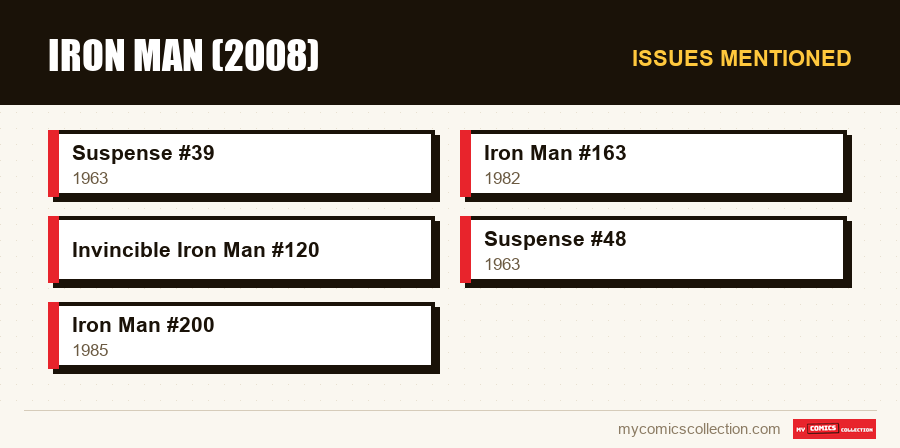
Tales of Suspense #39 (1963): 1st appearance of Iron Man (Stan Lee, Larry Lieber, Don Heck; cover Jack Kirby)
“Extremis”: Iron Man vol. 4 #1-6 (2005-2006), Warren Ellis & Adi Granov (film armor designer)
Iron Monger: Obadiah Stane appears in Iron Man #163 (1982), Iron Monger armor in #200 (1985), O'Neil & McDonnell
“Demon in a Bottle”: Invincible Iron Man #120-128 (1979), Michelinie & Layton
- L'founding origin: a rich arms industrialist, captured and wounded, builds a makeshift armor to escape.
- Le Dr. Yinsen, a captive scientist who helps Stark build the first armor and sacrifices himself for him.
- Le device in the chest which prevents shards from reaching his heart: pacemaker in the comic, ARK reactor in the film.
- La moral redemption of Stark, who renounces weaponry to become a hero.
- Obadiah Stane, the associate who betrays Stark and dons the armor Iron Monger for the final confrontation.
- Armor design taken from the bow “Extremis” by Adi Granov.
- The setting of the capture: the Vietnam of the 1963 comic becomes the Afghanistan of 2008: an update to the conflict of the time.
- The secret identity: in the comics, Iron Man is Stark's "bodyguard"; the film ends with Stark revealing publicly that he is Iron Man.
- The ARK reactor is an invention of the film (the comic talks about a breastplate/pacemaker).
- Obadiah Stane is condensed: long-term antagonist in the comics (1980s), here he becomes the immediate mentor-traitor.
- The jailers become the organization of Ten Rings (the comic featured the warlord Wong-Chu).
- The roles of Pepper Potts and Rhodey are modernized; Stark's alcoholism ("Demon in a Bottle") is only sketched, for the sequels.
Iron Man in 2008: the film that started it all
Before comparing the film to its sources, a reminder of the context is necessary, because it sheds light on many adaptation choices. Iron Man is the very first feature film produced directly by Marvel Studios, without a partner studio at the creative helm. At the time, the character was not a sure thing for the general public: he was much less known than Spider-Man or the X-Men, whose rights were then exploited elsewhere. Entrusting this bet to Jon Favreau, then to Robert Downey Jr. in search of professional redemption, is like a poker move.
This context explains the tone of the film: much dialogue is improvised, Stark's casual humor becomes his signature, and the emphasis is on the man behind the armor rather than the spectacular. The public success that followed, a worldwide box office of more than $585 million, validated the formula and launched the long chain of interconnected films that we know. Understanding where each brick borrowed from the comics comes from helps measure the magnitude of what the film managed to condense into a single origin story.
Tales of Suspense #39 (1963): the birth certificate
Iron Man first appears in Tales of Suspense #39 (March 1963), based on an idea by Stan Lee, a screenplay by his brother Larry Lieber and drawings by Don Heck, the cover being signed Jack Kirby. The origin is set there: Tony Stark, brilliant arms industrialist, is captured in a theater of war, injured by shrapnel which threatens his heart. With the help of Professor Yinsen, he builds a survival armor, and becomes Iron Man. The 2008 film takes up this plot almost as is, simply moving the conflict into its time.
A detail that the gum film deserves to be known to readers: the first armor in the comic is not red and gold, but gray and massive, a makeshift shell. She quickly switched to gold, then adopted her iconic red and gold silhouette in Tales of Suspense #48 (1963), a redesign attributed to Steve Ditko. This evolution in three stages (survival, prototype, completed armor) is also found in the film in the form of the Mark I, Mark II and Mark III, a clever nod to the way in which the character has matured on paper. The original context is that of the Cold War: the jailer of the first issues is the warlord Wong-Chu, where the film substitutes an anonymous terrorist organization.
Collecting this series?
Track what you own, what you are missing and what your collection is worth. 7 day trial.
Start my trial →“Extremis” (2005-2006): the true visual model
If the origin comes from 1963, the allure of the film comes from much later. The bow “Extremis”(Iron Man vol. 4 #1-6), written by Warren Ellis and drawn by Adi Granov, modernizes Stark in the mid-2000s. The story directly updates the origin in a contemporary context and introduces a technological virus, "Extremis", which redefines Tony's relationship with his own armor. Graphically, Granov imposes an almost photorealistic, very mechanical rendering, which breaks with the classic comics style.
It is precisely this rendering that appealed to the production. Adi Granov was tapped by Jon Favreau to translate his boards into a believable armor design for the screen: the film's Mark III armor owes a huge debt to his work on "Extremis." In other words, the film doesn't just adapt a story: it hires the artist whose style will define the visual identity of an entire saga. This is also the reason why “Extremis” remains, even today, one of the most recommended arcs for those who want to extend the film in reading.
The characters, from paper to screen
Beyond the plot, the adaptation plays out in the treatment of the characters. Here's how each travels from comic to film.
- Tony Stark: The heart of the story is preserved: the industrial genius, the cynical businessman who is transformed by captivity. The great freedom of the film lies in its ending: Stark publicly claims his identity, when the classic comic kept it secret for decades (Iron Man is presented as Stark's bodyguard).
- Yinsen: The captive scientist who helps Stark and sacrifices himself is present from Tales of Suspense #39. The film deepens his relationship with Tony and makes him the moral trigger for his transformation, a more fleshed-out role than in the original story.
- Obadiah Stane: Late antagonist of the comics (1982), he is here advanced to the rank of immediate mentor-traitor. The film compresses years of plot into a single arc.
- Pepper Potts and James “Rhodey” Rhodes: The two figures have existed for a long time in the comics, but the film clearly modernizes their roles: Pepper gains strategic importance, and Rhodey lays the foundations for his future as War Machine.
- The Ten Rings: The organization that captures Stark implicitly evokes the character's great comic book enemy, the Mandarin, without naming him directly. The film sows a trail that the saga will exploit later.
Obadiah Stane and Iron Monger (1982-1985)
The film's main villain, Obadiah Stane, is taken from the comics of the 1980s. The character, created by Dennis O'Neil and Luke McDonnell, first appeared in Iron Man #163 (1982). A cold manipulator, he attacks Stark both on a business and personal level, before donning his own giant armor, Iron Monger, which debuts in Iron Man #200 (1985). The film compresses this long rivalry into a single story, but retains the essential: the intimate betrayal coupled with an armor duel, the mentor becoming executioner.
“Demon in a Bottle” (1979): the seed of sequels
One of Iron Man's most famous arcs,“Demon in a Bottle”(Invincible Iron Man #120-128, 1979), written by David Michelinie and Bob Layton and drawn in particular by John Romita Jr., deals head-on with Stark's alcoholism. The first film only scratches the surface, but it sets a scene that the sequels will openly exploit. This is a typical example of the Marvel Studios method: sowing references very early on that subsequent feature films will reap, along the way rewarding comic book readers capable of recognizing the source.
Chronology of comics to know
To locate the film sources on a simple timeline:
- 1963: Tales of Suspense #39: first appearance of Iron Man, gray armor, wartime origin.
- 1963: Tales of Suspense #48: appearance of the classic red and gold armor (redesign attributed to Steve Ditko).
- 1979: Invincible Iron Man #120-128: “Demon in a Bottle”, Stark's alcoholism.
- 1982: Iron Man #163: First appearance of Obadiah Stane.
- 1985: Iron Man #200: First appearance of the Iron Monger armor.
- 2005-2006: Iron Man vol. 4 #1-6: “Extremis”, modern rereading and visual matrix of the film.
Collection side: what numbers to aim for after the film
The film makes you want to go back to the source, and that's where the collector comes in. Two entry points emerge, at two very different budget levels. Tales of Suspense #39 is a holy grail of the Silver Age: rare in good condition, systematically sought after, it is among the most coveted Marvel key issues: a copy rated by a grading service like CGC reaches new heights. In contrast, Iron Man vol. 4 #1 (“Extremis”, 2005) remains an accessible modern issue, easy to find, and directly linked to the visual DNA of the film: an excellent first thematic acquisition.
Between the two, the pivotal issues (Tales of Suspense #48 for the classic armor, Iron Man #163 and #200 for Stane and Iron Monger) offer a coherent collecting journey, from the most affordable to the most prestigious. As prices are constantly changing depending on condition, edition and demand, it is better to rely on recent actual sales rather than theoretical estimates before any purchase.
The verdict: an adaptation true to spirit
- Loyalty: high on origin (Stark, Yinsen, makeshift armor, redemption) and design (Granov).
- Freedoms: the updated setting and especially the public revelation of identity: a choice that redefines the entire character on screen and breaks with decades of comics.
- Collectible numbers: Tales of Suspense #39 (the grail, highly rated) and Iron Man vol. 4 #1 (“Extremis”, more accessible).
By condensing the 1963 origin, the 2005 design and a 1980s antagonist into a single tight narrative, Iron Man achieves a feat: remaining recognizable to longtime readers while providing a clear gateway to the general public. It is this ability to sort, merge and modernize its sources that makes the adaptation successful, and the model that most of the films in the saga will follow.
Frequently asked questions
Mainly from Iron Man's first appearance in Tales of Suspense #39 (1963) for the origin, and arc “Extremis”(2005-2006) for the design of the armor, its designer Adi Granov having worked on the film.
Identity Reveal: In the classic comics, Iron Man is Stark's secret identity (introduced as his bodyguard), while the film ends with Stark publicly announcing that he is Iron Man.
The 1963 comic set Stark's capture during the Cold War, in Vietnam. The 2008 film updates this starting point to the contemporary conflict of its release, without changing the logic of the story: an arms dealer confronted with the consequences of his own weapons.
Created by Dennis O'Neil and Luke McDonnell, Obadiah Stane appears in Iron Man #163 (1982). He is a manipulative business rival who pushes Stark to the limit before donning the Iron Monger armor (Iron Man #200, 1985). The film condenses this plot into a single story.
Tales of Suspense #39 (1963) is the seminal issue, but it is rare and rated. Iron Man vol. 4 #1 (“Extremis”, 2005) is a more accessible gateway and directly linked to the film.
Does the film make you want to collect Iron Man? Estimate the value for free of your issues (Tales of Suspense #39, Iron Man…) with our tool based on current eBay listings.