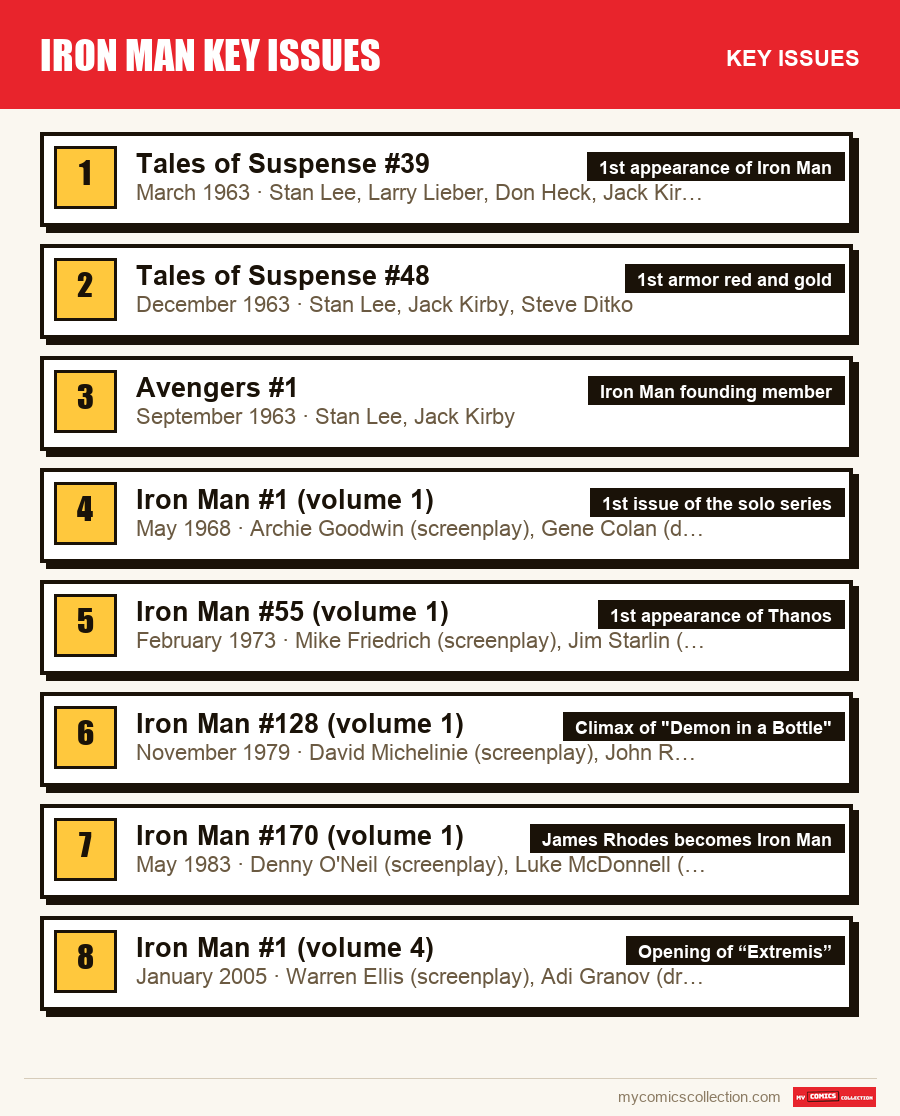
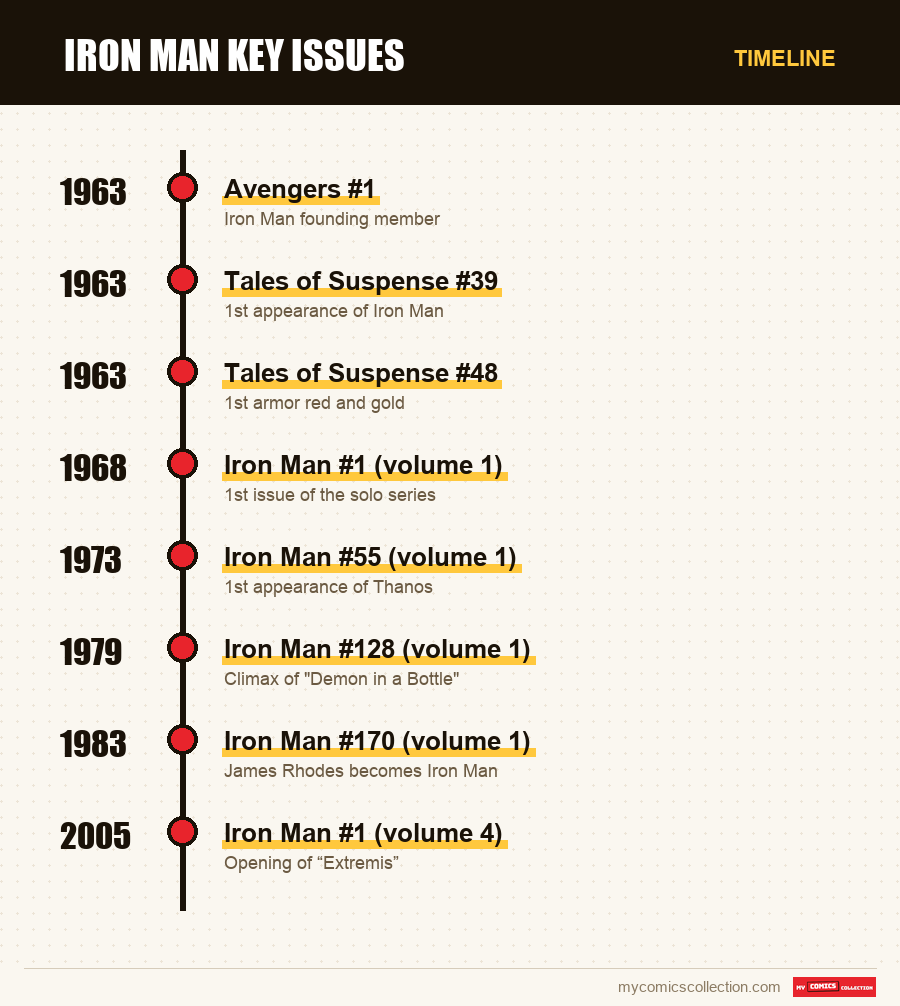
The key issues of Iron Man Comics to know are Tales of Suspense #39 (March 1963, first appearance, sold for up to $840,000 in CGC 9.8), Tales of Suspense #48 (first red and gold armor), Avengers #1 (Iron Man founding member), Iron Man #1 (1968, launch of the solo title), Iron Man #55 (1973, first appearance of Thanos), Iron Man #128 ("Demon in a Bottle", 1979) and Iron Man #170 (1983, James Rhodes becomes Iron Man). Unlike a general guide to the character, this article focuses on the proper numbering of the parent "Iron Man" series and its multiple relaunches, a point that often causes confusion among collectors.
Iron Man is one of the rare Marvel characters whose eponymous series has crossed six decades without ever really stopping, but not without reinventing itself: renumberings, "Heroes Reborn" relaunches, short volumes linked to editorial events, returns to legacy numbering... Navigating the "Iron Man Comics key issues" requires distinguishing two things that many collectors confuse: the character's notable appearances throughout the Marvel universe (Avengers, Tales of Suspense, crossovers) on the one hand, and the own editorial history of the title "Iron Man" itself on the other hand, with its five volumes and its various "#1s".
This guide deals specifically with this second dimension: which issues of the parent series deserve a place in a collection, why some "Iron Man #1" are worth tens of thousands of dollars while others trade for the price of a coffee, and how to read a grader without getting trapped by a reissue or variant. For an overview of the character's key appearances in all titles, our article Iron Man key numbers remains the complementary reference; for investment logic (what to buy, when, why), consult invest in Iron Man comics.
A title born in the middle of the Cold War, shaped by five editorial relaunches
Iron Man did not have a series to his name upon its creation. The character first appeared in March 1963 in Tales of Suspense #39, an anthological title where Stan Lee, Larry Lieber, Don Heck and Jack Kirby introduce Tony Stark, an industrialist injured in Vietnam who builds an armor to survive. Iron Man shared the poster with other heroes until becoming the exclusive featured character of the comic from issue #59, in 1964. It was not until May 1968 that he finally obtained his own solo title, soberly titled Iron Man, drawn by Gene Colan and written by Archie Goodwin: "volume 1" which ran continuously until issue #332 in 1996.
This 28-year continuity comes to an abrupt end with "Heroes Reborn", the editorial experiment which temporarily entrusts Iron Man, Avengers and Fantastic Four to the Image studios of Rob Liefeld and Jim Lee. A new volume 2 begins in 1996, before a "Heroes Return" brings the character back into classic continuity via volume 3 in 1998, signed Kurt Busiek and Sean Chen. Then comes the most commercially decisive relaunch: volume 4, initiated in January 2005 by Warren Ellis and digital painter Adi Granov, which opens the "Extremis" arc: the direct source of the armor and the origin adapted to the cinema in 2008. Since then, the series has undergone other renumberings (volume 5 in 2012, "Invincible Iron Man" on several occasions, return to legacy numbering in 2017-2018), which explains why a collector can come across no less than four or five different comics bearing the words "Iron Man #1" on their covers.
Understanding this editorial mechanic is not an academic detail: it directly determines value. An "Iron Man #1" from 1968 in average condition is already trading at several hundred dollars thanks to its age rarity, while an "Iron Man #1" from volume 4 from 2005, printed in a much larger edition in the direct market era, remains accessible even in very high grade. The numbering alone says nothing about the real rarity: you must always cross number, volume and year.
This confusion did not stop in the 2000s. Marvel continued the relaunches over the following decades, with new starts at #1 during the launch of "Invincible Iron Man" in 2008 and again in 2012, before a one-off return to "legacy" numbering in 2017-2018 which briefly brought the title close to its former historic number. For a buyer who simply types "Iron Man #1" into a search engine or on a marketplace, there is therefore a real risk of ending up with a comic published in 2012 thinking they are getting an issue from 1968 or 2005 - hence the interest in always checking the year of printing, mentioned in full within each issue, before any purchase.
Tales of Suspense #39
The absolute starting point for any Iron Man collection. This issue contains the complete origin of the character, the first appearance of Tony Stark in gray armor, that of Wong-Chu, and the first appearance (and death) of Professor Yinsen, whose sacrifice conditions the entire mythology of the character. Although it's not technically part of the "Iron Man" series per se, it's an anthology comic that evolved into Captain America in 1968, it remains the absolute cornerstone of any key issue related to the character. The CGC census recorded, a few years ago, around 153 copies graded 5.0 and 586 copies in higher grades, a population which remains rare for such a popular comic, which explains the permanent tension on prices at high grades. The issue's cultural importance reached a new milestone in July 2026, when the original cover page of this story sold for $3,875,000 at Heritage Auctions, becoming the most expensive piece of comic book art ever auctioned.
Tales of Suspense #48
After the gray and then gold armor of the very first issues, this issue introduces the red and gold "Model II" design that will become the character's eternal visual signature: the one repeated, with variations, in almost every screen adaptation since 2008. For a collector who seeks to tell the visual evolution of the character rather than just his first appearance, this issue is often considered just as important as #39.
Avengers #1
This is not an issue of the "Iron Man" series, but it systematically features in any serious discussion of key comics related to the character since it marks the origin and first appearance of the Avengers, with Iron Man alongside Thor, Hulk, Ant-Man and Wasp. The title occupies 13th place in the Overstreet ranking of "Top 50 Silver Age Comics", which gives an idea of its gray status among collectors of all ranges.
Iron Man #1 (volume 1)
This is where the “Iron Man” series first exists as a standalone title, after five years co-starring in Tales of Suspense. Goodwin and Colan revisit the origin of the character while pitting him against Whiplash and A.I.M. The dark purple cover, particularly fragile with spine marks and scratches, makes very high grade copies significantly rarer than the overall print run would suggest.
Iron Man #55 (volume 1)
One of the most popular issues of the entire Bronze Age, all series combined: Jim Starlin introduces Thanos, Drax the Destroyer, Mentor, Starfox (Eros) and Kronos in a single story. Thanos' cinematic popularity since the Avengers films has caused demand for this issue to rise well beyond its initial status. It is ranked 23rd in Overstreet's ranking of "Top 25 Bronze Age Comics".
Iron Man #128 (volume 1)
This issue concludes the "Demon in a Bottle" arc, considered one of the most acclaimed stories in the entire Iron Man bibliography, in which Tony Stark confronts his alcoholism head-on: an extremely rare subject in the superheroic mainstream of the time. It is a key "narrative" issue rather than "first appearances", sought after by readers as much as by investors, with a rating which remains very accessible compared to Silver Age grails.
Iron Man #170 (volume 1)
Titled "And Who Shall Clothe Himself in Iron?", this issue marks the first full appearance of James "Rhodey" Rhodes donning the Iron Man armor, at a time when Tony Stark, consumed by alcohol, is removing himself from the suit. It is the editorial basis of everything that would later become War Machine, and an issue whose popularity has clearly increased since Don Cheadle played the character in the cinema.
Iron Man #1 (volume 4)
This fourth "Iron Man #1" in the title's editorial history opens the "Extremis" arc, which redefines the origin of Tony Stark and the design of his armor. It is this version, and not the 1968 one, that the first Iron Man film of 2008 visually and narratively adapts very closely: armor included. Printed on a much larger scale than the comics of the 1960s and 1970s, it remains an accessible issue even in high grade, but remains essential for understanding the visual DNA of the cinematic Iron Man.
Collecting this series?
Track what you own, what you are missing and what your collection is worth. 7 day trial.
Start my trial →The impact of film adaptations on the rating
Few Marvel characters have seen their collectible market as directly shaped by cinema as Iron Man. The 2008 film directed by Jon Favreau, starring Robert Downey Jr., had two distinct effects on the key numbers listed above. First of all, a classic rediscovery effect: Tales of Suspense #39 and Iron Man #1 (1968) saw their demand increase mechanically, as is the case for any first appearance as soon as a character becomes a familiar face to the general public. Then a more specific and less frequent effect: the film directly drew its origin and its armor design from Iron Man #1 of volume 4 (2005), which permanently linked this modern issue to the cinematographic imagination rather than to historical comics.
The exit of Avengers in 2012 produced a comparable effect on Avengers #1 (1963), while the arrival of Thanos as the great antagonist of the films Avengers: Infinity War and Avengers: Endgame made Iron Man #55 one of the most in-demand Bronze Age issues of the entire period, a status it maintains for the long term rather than simply experiencing a temporary peak. The character of James Rhodes / War Machine, played by Don Cheadle since 2008, has similarly reinforced interest in Iron Man #170, long considered a secondary number.
A point of vigilance for collectors: this “cinema” effect almost exclusively affects the very first appearances and the origins. A narratively strong issue but without a major first appearance, like Iron Man #128 ("Demon in a Bottle"), sees its rating evolve much more slowly, driven more by its critical reputation among readers than by the news of Marvel Studios releases. This is an essential nuance to integrate before buying a number when betting on a future film or series.
Buyer's Guide: How to Tackle Iron Man Comics' Key Issues
- Always identify the volume before the number."Iron Man #1" alone means nothing: always specify the volume (1968, 1996, 1998, 2005, 2012...) and the year, otherwise you risk comparing a Silver Age grail to a modern comic without any particular rarity.
- Prioritize first appearances and origins rather than simple “#1” numbered raises. A “#1” relaunch is only interesting if it corresponds to a real creative turning point (new design, new origin) like Iron Man volume 4 #1, not just a change in marketing numbering.
- Check the nature of the edition on modern issues. From the 1980s-1990s, many issues exist in newsstand editions and direct editions, with print runs and therefore rarities sometimes very different for the same issue.
- On Silver Age issues like Tales of Suspense #39 and #48, condition takes precedence over everything else. Dark coverts (purple, black) easily mark spine defects; a deviation of just half a grade point can multiply the value by two or three.
- Don’t confuse scarcity with demand. Iron Man #170 isn't a rare issue in itself, but War Machine's popularity in theaters has driven up demand on the high grades; conversely, certain Bronze Age numbers in low demand remain difficult to find in very fine or better despite a correct print run.
- Use the grade comparison before purchasing in CGC. A spread between 9.6 and 9.8 can represent a considerable prize multiplier on a Silver or Bronze Age number; our article CGC grade 9 vs 9.8 precisely details these odds differences.
- Always cross-reference the estimate with recent actual sales rather than with a fixed list price, the Silver Age and Bronze Age markets evolving quickly according to the cinematographic news of the character.
To follow the evolution of your collection of Iron Man comics as you acquire them, the collection management application allows you to centralize numbers, editions and grades in one place, which considerably simplifies the comparisons between volumes mentioned above. To delve deeper into the character beyond just his solo series, the page Iron Man brings together all of his notable appearances in all series combined.
Frequently Asked Questions
In summary, the value of a key issue of Iron Man Comics can never be read on a single criterion. The number and the volume place the comic in the editorial history of the title, the presence or absence of a first major appearance determines its grail status, the condition and CGC grade set the real price range, and the cinematographic news of the character finally modulates demand in the short and medium term. These four filters applied together help avoid the most common confusion in the Iron Man market: believing that a simple "#1" alone guarantees rarity or value, when five different volumes have had this same number on their covers since 1968.