Shang-Chi and the Legend of the Ten Rings (2021), directed by Destin Daniel Cretton with Simu Liu, adapts the martial arts master born in Special Marvel Edition #15 (1973) by Steve Englehart and Jim Starlin. Great audacity: the film makes his father the Mandarin (Wenwu), merging Iron Man's great enemy with Shang-Chi's father, who in the comics was the villainous Fu Manchu. It retains the spirit of the character while reinventing the Ten Rings. Detailed comparison, film versus comics.
The first film in the saga featuring a martial arts hero and a predominantly Asian cast, Shang-Chi is a milestone. Under the direction of Destin Daniel Cretton, the film adapts a character from the 1970s while elegantly resolving a problem inherited from the comics: that of his father. Source-by-source decryption.
As in each article in the series, only verified information (distribution, dates, numbers, creators) is stated; the comparative analysis is ours, without reproducing dialogue or protected images.
Title : Shang-Chi and the Legend of the Ten Rings (2021)
Director: Destin Daniel Cretton
Actors: Simu Liu (Shang-Chi), Tony Leung (Wenwu / the Mandarin), Awkwafina (Katy), Meng'er Zhang (Xialing), Michelle Yeoh, Ben Kingsley (Trevor Slattery)
Exit : September 3, 2021 (United States)
Studio: Marvel Studios
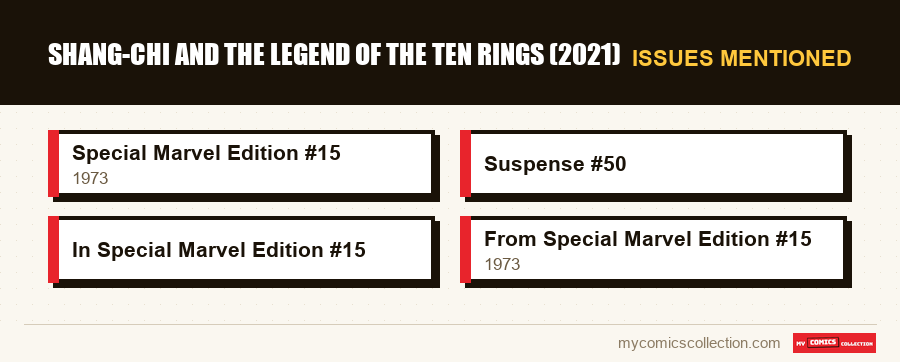
Special Marvel Edition #15 (1973): Shang-Chi's first appearance (Englehart & Starlin)
The Mandarin: great enemy of Iron Man (Tales of Suspense #50, 1964)
The Ten Rings: weapons of power of the Mandarin
Fu Manchu: Shang-Chi's father in the original comics
- Shang-Chi, martial arts master raised to become a living weapon.
- The central conflict: a son who stands against his father tyrannical.
- L'rigorous training and the flight far from the paternal empire.
- THE Ten Rings, organization and weapons of power.
- La search for identity between family heritage and free will.
- The father goes from the villainous Fu Manchu to the Mandarin (Wenwu), an unprecedented fusion.
- The Ten Rings become mystical bracelets worn on the arms, not extraterrestrial rings.
- The real Mandarin fixes the sham of Iron Man 3 (Trevor Slattery reappears).
- The film adds a fantastic dimension (creatures, hidden kingdom of Ta Lo).
- The story modernize and rehabilitates a character linked to dated stereotypes.
Special Marvel Edition #15 (1973): the birth of Shang-Chi
Shang-Chi appears in Special Marvel Edition #15 (December 1973), created by Steve Englehart and Jim Starlin, at the height of the kung fu film craze. Master of martial arts with absolute discipline, raised in isolation to become a living weapon, he rebels upon discovering the true criminal nature of his father. The film faithfully preserves this founding plot: the merciless training, the moral awareness, the flight from the paternal empire, and the heartbreak of a son who must confront the one who shaped him. This father-son conflict, universal and intimate, remains the beating heart of the story, on screen as well as on paper.
Where the film innovates is in the treatment of the character: long associated with dated stereotypes, Shang-Chi is here rehabilitated and modernized, carried by a cast and a team who make him a figure of pride rather than a cliché. The film transforms a 1970s hero into a contemporary icon.
Father Problem: From Fu Manchu to The Mandarin
The greater freedom of the film resolves a puzzle inherited from the comics. In Special Marvel Edition #15, Shang-Chi's father is Fu Manchu, a novel character licensed at the time by Marvel: a figure today recognized as a racist stereotype, and whose rights ended up escaping the publisher (the character has since been renamed Zheng Zu in the comics). The film circumvents this problem entirely by replacing the father with the Mandarin, great enemy of Iron Man born in Tales of Suspense #50 (1964). Renamed Wenwu and played by Tony Leung, this father becomes a nuanced character, immortal leader of the Ten Rings organization. This bold fusion connects Shang-Chi to the Iron Man mythology while providing an antagonist with remarkable depth.
The Ten Rings and the Iron Man 3 fix
The film also reinvents the Ten Rings. In the comics, there are ten rings of extraterrestrial origin worn on the Mandarin's fingers, each with a different power. The film makes them ancestral mystical bracelets, worn on the forearms, a source of almost immortal power. Above all, the film skillfully corrects a controversy: in Iron Man 3, the “Mandarin” was revealed to be a sham, an actor named Trevor Slattery. Shang-Chi reestablishes the existence of a real Mandarin, while reinstating Slattery in a comedic role. This clever continuity responds to the criticisms raised by the 2013 twist and reconciles the two visions of the character.
The characters, from paper to screen
- Shang-Chi: Faithful to its founding plot: the master of martial arts who stands up against his father.
- Wenwu / the Mandarin: Fusion of the father of comics and the great enemy of Iron Man, made profoundly human.
- Xialing: Sister of Shang-Chi, character largely developed for the film.
- Trevor Slattery: The fake Mandarin from Iron Man 3, reinstated in a comic role.
- Kate: Friend and sidekick, bringing humor and an outside perspective.
Collecting this series?
Track what you own, what you are missing and what your collection is worth. 7 day trial.
Start my trial →Destiny Daniel Cretton and the modern martial arts film
The success of the film lies in its ability to combine the superhero blockbuster and the pure martial arts film, with choreographies inspired by the great classics of the genre. Destin Daniel Cretton anchors the story in a reflection on heritage, mourning and dual culture, giving the film an emotional depth that goes beyond the action. The character of Wenwu, in particular, embodies a tragic antagonist whose pain is understandable, in line with the nuanced villains of the saga. By rehabilitating a hero long tainted by clichés and offering an empowering representation, the film has a cultural reach comparable to that of Black Panther, proving that an adaptation can also repair and reinvent the sometimes problematic legacy of its sources.
Martial arts at Marvel: a tradition from the 1970s
The creation of Shang-Chi in 1973 is no coincidence: it is part of a global craze for kung-fu films, then at their peak. Marvel, sniffing out the trend, launched several martial arts heroes in quick succession, of which Shang-Chi became the leading figure with his long-running “Master of Kung Fu” series. At the same time, other emblematic characters of this register were born, such as Iron Fist or the Daughters of the Dragon (Colleen Wing and Misty Knight). This “martial arts” side of Marvel, which has long remained on the fringes, constitutes a rich tradition that the film brilliantly revives. By choosing Shang-Chi to open this territory to cinema, the saga pays homage to a whole generation of stories born from the meeting between American comics and Asian action cinema.
The film does not just repeat a character: it celebrates a genre. The careful choreography, the tributes to the masters of martial arts cinema, the care taken in the bare-handed fights testify to a desire to honor this lineage. Where many blockbusters drown the action in digital effects, Shang-Chi puts the body and technique at the center, faithful to the spirit of the “Master of Kung Fu” comics. This authenticity, praised by critics, partly explains why the film left its mark and gave new legitimacy to a little-known part of the Marvel universe.
Where to start reading
To learn about Shang-Chi, one can go back to Special Marvel Edition #15 (1973) and the subsequent "Master of Kung Fu" series, keeping in mind the dated context of certain elements. Modern runs, notably the 2020 series, offer an updated version free of stereotypes, closer to the spirit of the film. For the Mandarin, Tales of Suspense #50 (1964) is the source, and Iron Man 3 (2013) sheds light on the controversy the film corrects. From 1964 to today, this journey covers the sources of a film that reinvents as much as it adapts.
Chronology of comics to know
- 1964: Tales of Suspense #50: First appearance of the Mandarin.
- 1973: Special Marvel Edition #15: First appearance of Shang-Chi.
- 2020s: new Shang-Chi series, free of stereotypes.
Collection side: what numbers to aim for after the film
Shang-Chi highlights a sought-after Bronze Age key. Special Marvel Edition #15 (first appearance of Shang-Chi) is the centerpiece, a 1973 issue whose popularity rose sharply with the announcement and release of the film. Tales of Suspense #50 (first appearance of the Mandarin) is the other big target, a key to the Silver Age linked to the hero's father. These issues cover different budgets, from the Bronze Age to the Silver Age. As always, condition and gradation determine value; relying on real recent sales is strongly recommended. Special Marvel Edition #15 is a good example of a long-confidential issue propelled by an adaptation, illustrating the value of monitoring film announcements to anticipate the next surge in ratings.
Its place in the saga and for the collector
Shang-Chi introduces martial arts and a fantasy dimension to the saga, while elegantly correcting the Mandarin controversy. For the collector, its impact was spectacular: Special Marvel Edition #15, a Bronze Age issue that had long been undervalued, saw its value soar as soon as the film was made official: a textbook case of the anticipation enabled by knowledge of comics. This film also illustrates a rarer facet of the power of cinema: rehabilitating a character tainted by clichés to make him a source of pride. Beyond speculation, it invites us to discover a little-known part of Marvel, that of martial arts, and to measure the path traveled between the context of the 1970s and the rewarding representation of today. By merging Shang-Chi and the Mandarin, the film creates an unprecedented synthesis, richer than the sum of its sources.
The verdict: an adaptation that repairs and reinvents
- Loyalty: Shang-Chi's father-son conflict, training and quest for identity come from the comics.
- Freedoms: the father goes from Fu Manchu to the Mandarin, the Ten Rings reinvented, the correction of the Iron Man 3 twist.
- Collectible numbers: Special Marvel Edition #15 (Shang-Chi), Tales of Suspense #50 (The Mandarin).
Shang-Chi achieves a feat: adapting a hero from the 1970s while resolving his father's thorny problem and correcting a controversy in the saga. By merging Shang-Chi and the Mandarin, the film creates an antagonist of rare depth and rehabilitates a character long tainted by clichés. For the reader as well as the collector, it is an invitation to discover the martial arts side of Marvel, and a Bronze Age key whose value has been transformed by the film. Rare are the adaptations to have accomplished so much in a single film: revealing a little-known hero, repairing a controversy, rehabilitating a character tainted by clichés and rediscovering an entire genre. Shang-Chi will remain as an example of an adaptation which, far from betraying its sources, elevates them by correcting their original faults.
Frequently asked questions
From Special Marvel Edition #15 (1973) by Steve Englehart and Jim Starlin, first appearance of the martial arts master. The film adds the Mandarin, Iron Man's great enemy (Tales of Suspense #50, 1964).
In the comics, Shang-Chi's father is Fu Manchu, a licensed character recognized as a racist stereotype and whose rights escaped Marvel. The film replaces him with the Mandarin (Wenwu), connecting the hero to the Iron Man mythology.
Yes: Iron Man 3 revealed a false Mandarin (actor Trevor Slattery). Shang-Chi reestablishes the existence of a real Mandarin while reinstating Slattery in a comedic role.
In part: in the comics, there are ten alien rings worn on the Mandarin's fingers. The film makes them ancestral mystical bracelets, worn on the forearms, a source of almost immortal power.
Special Marvel Edition #15 (first appearance of Shang-Chi) is the centerpiece, a Bronze Age key whose popularity has jumped. Tales of Suspense #50 (The Mandarin) is the other big target.
Does the film make you want to collect? Estimate the value for free of your issues (Special Marvel Edition #15…) with our tool based on current eBay listings.