Captain America: First Avenger (2011), directed by Joe Johnston with Chris Evans , adapts the hero born in Captain America Comics #1 (1941) by Joe Simon and Jack Kirby, which already contained Bucky and the Super-Soldier Serum. His enemy, the Red Skull version of Johann Schmidt, appears in Captain America Comics #7 (1941). The tone and several visual choices also owe to the modern rereading “The Ultimates”(2002) by Mark Millar and Bryan Hitch. The film respects the WWII origin but reimagines Bucky and the ending. Detailed comparison, film versus comics.
The third solo hero presented by Marvel Studios, Captain America posed a particular challenge: anchoring a patriotic character born in 1941 in a period adventure film, while making him universal. The choice of a retro war story, directed by Joe Johnston, allowed us to reconnect with the character's Golden Age roots. Let's see what the film keeps and what it transforms.
As with each article in the series, only verified data (distribution, dates, numbers, creators) are stated; the comparative analysis is ours, without reproduction of dialogue or protected images.
Title : Captain America: The First Avenger (2011)
Director: Joe Johnston
Actors: Chris Evans (Steve Rogers), Hugo Weaving (Johann Schmidt / Red Skull), Hayley Atwell (Peggy Carter), Sebastian Stan (Bucky Barnes), Tommy Lee Jones (Colonel Phillips), Stanley Tucci (Dr. Erskine)
Exit : July 22, 2011 (United States)
Studio: Marvel Studios
Captain America Comics #1 (1941): 1st appearance of Cap, Bucky and the Super-Soldier Serum (Simon & Kirby)
Captain America Comics #7 (1941): Red Skull version Johann Schmidt
“The Ultimates”(2002), Millar & Hitch: modern tone, costume, Cap founding member of the Avengers
Golden Age Stories: war adventures of the Cap / Bucky duo
- L'super soldier origin: Steve Rogers, a puny young man, transformed by Dr. Erskine's serum.
- The framework of the World War II and the fight against the Axis forces.
- Le Red Skull, Johann Schmidt, Nazi nemesis of the hero.
- Bucky Barnes, the comrade in arms, and the shield emblematic.
- The end in frozen sleep, which projects Cap into the present: an idea taken up and modernized.
- Aged Bucky: young teenage mascot in the 1941 comic, here he becomes Steve's adult friend, preparing for his future as the Winter Soldier.
- HYDRA in the foreground: the film makes the Red Skull the leader of a quasi-science fiction organization, doped with a cosmic relic.
- Peggy Carter gains a central role as an agent and love interest, much more developed than in the comics of the period.
- Le costume and tone are inspired by “The Ultimates” rather than the strict Golden Age.
- The movie tightens decades of war stories in one campaign against HYDRA.
Captain America Comics #1 (1941): a hero born before Marvel
Captain America precedes the Marvel era: he was born at Timely Comics in Captain America Comics #1 (March 1941), created by Joe Simon and Jack Kirby. This issue, which remained famous for its cover showing Cap hitting an Axis dignitary while the United States was not yet at war, establishes everything that the film will take up: Steve Rogers, young man deemed unfit, volunteer for a super-soldier program which transforms him, the serum, the shield, and the sidekick Bucky. The founding gesture, a fragile body sublimated by science and put at the service of a cause, survives intact seventy years later.
The great freedom of the film concerns Bucky. In the 1941 comic, he is a teenager, the regiment's mascot, the hero's juvenile companion. The film makes him an adult friend of Steve, a choice which humanizes their bond and, above all, prepares the character's subsequent trajectory towards his identity as the Winter Soldier, popularized by the comics of the 2000s.
Captain America Comics #7 (1941): The Red Skull
The film's enemy, the Red Skull, has a storied editorial history. A first version appeared as early as Captain America Comics #1, but the definitive Red Skull, Johann Schmidt, debuted in Captain America Comics #7 (October 1941). It is him that the film adapts: a fanatical Nazi leader, evil double of Cap, also the product of a serum. The feature film amplifies his dimension by placing him at the head of HYDRA and linking him to a relic of cosmic power, which moves him away from a simple Reich officer and closer to a science fiction supervillain: a way of discreetly connecting the film to the cosmic mythology of the saga.
“The Ultimates” (2002): the modern veneer
If the framework is Golden Age, the finish owes a lot to “The Ultimates” (2002) by Mark Millar and Bryan Hitch, a contemporary rereading of the Avengers. This series updated Captain America as a World War II soldier found frozen, made him a founding member of a modern team, and gave him a more realistic and martial appearance. The film draws on this register for its costume and its tone, mixing nostalgia for the war serial and contemporary efficiency. It was also “The Ultimates” which solidified the idea of Captain America as a bridge between two eras, the central driving force of the character on screen.
Collecting this series?
Track what you own, what you are missing and what your collection is worth. 7 day trial.
Start my trial →The characters, from paper to screen
- Steve Rogers: Faithful to the original spirit: the little man with a big heart, whose value precedes strength.
- Bucky Barnes: Aged and deepened, he goes from mascot to adult friend, a milestone in his future as a Winter Soldier.
- Red Skull (Johann Schmidt): Faithful nemesis, whose dimension is amplified by HYDRA and the cosmic.
- Peggy Carter: Clearly expanded role compared to period comics, determining agent of the story.
- Dr. Erskine and Colonel Phillips: Figures from the super-soldier program, faithful to their original function.
Joe Johnston and the retro adventure film
Director Joe Johnston had, before Captain America, signed The Rocketeer (1991), a tribute to the adventure serials of the 1930s and 40s. This baggage is felt in First Avenger, which fully embraces its period setting: pulp aesthetics, retro-futuristic gadgets, frank and irony-free heroism. Rather than transposing Captain America into the present, as its sequels will do, the film chooses to first tell the legend at its source, in World War II. This retro bias, commercially risky, pays off: it gives the character a sincerity that few patriotic adaptations achieve, and it visually anchors the film in the imagination of the Golden Age comics from which Cap comes.
A detail dear to readers is faithfully integrated: Captain America's shield is presented as being made of an exceptional metal, vibranium, almost indestructible and capable of absorbing shocks. It is an element directly inherited from the comics, which discreetly connects the film to other parts of the Marvel universe where this metal plays a central role.
Bucky, from sidekick to Winter Soldier
The aging of Bucky in the film takes on its full meaning in light of recent comics. In 2005, screenwriter Ed Brubaker and artist Steve Epting created the event by bringing Bucky back as the Winter Soldier, an agent with an erased past: a revelation that occurred in the sixth issue of their series. This story, praised by critics, redefined the character and clearly serves as a basis for his trajectory in cinema. By making Bucky an adult friend of Steve's rather than a teenage mascot, First Avenger sets the stage for this evolution, which the sequel will fully exploit. It's a clear example of how films draw not only from 1940s origins, but also from modern retellings that have updated the characters.
Chronology of comics to know
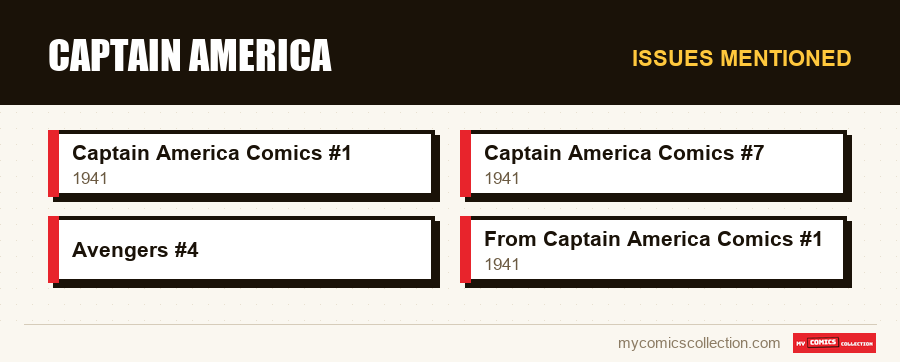
- 1941: Captain America Comics #1: First appearances of Cap, Bucky and the super-soldier serum.
- 1941: Captain America Comics #7: the Red Skull, Johann Schmidt version.
- 1964: Avengers #4: Cap's return to modern times, found frozen (reference, background).
- 2002: “The Ultimates”: modern rereading, tone and costume adopted by the film.
Where to start reading
The ideal reading path follows the very evolution of the character. We can start with the Golden Age origin (Captain America Comics #1, 1941) for the raw material of the film, then switch to the modern rereading "The Ultimates" (2002), the closest to the tone and costume on screen. But the most enlightening reading to understand the sequels remains Ed Brubaker's run, started in 2005: it is he who resurrects Bucky as the Winter Soldier and permanently redefines the universe of Cap. Finally, to grasp the hero's place in the present Marvel, Avengers #4 (1964), which pulls him from the ice, closes the loop between the man of 1945 and the modern world. From 1941 to 2005, this path shows how a patriotic character managed to remain relevant in each era.
Collection side: what numbers to aim for after the film
Captain America lines up one of the most legendary issues in all of comics: Captain America Comics #1 (1941), a Golden Age piece whose examples in good condition reach prices reserved for the most fortunate collectors. It is a historical grail more than a current purchase. More attainable, Captain America Comics #7 (first appearance of Johann Schmidt) remains a popular key. To tie the film into the rest of the saga, Avengers #4 (Cap's return to modern times) is another logical target. As always, condition and grading are everything: it's best to rely on actual recent sales before getting started. For a more measured budget, Ed Brubaker's run collections (from 2005) offer excellent value for money and constitute the reading most directly linked to the film's sequels; this is often where new readers enter the Captain America universe before aiming for the historical pieces.
The verdict: the Golden Age brought up to date
- Loyalty: the super-soldier origin, the 39-45 frame, the Red Skull, Bucky and the shield are respected.
- Freedoms: an adult Bucky, a central Peggy Carter, amped-up HYDRA and an “Ultimates” polish.
- Collectible numbers: Captain America Comics #1 (the historical grail) and #7 (first appearance of Johann Schmidt).
By embracing its period setting rather than fleeing from it, First Avenger succeeds where many patriotic adaptations fail: making Steve Rogers a hero of values, not slogans. The film draws most of its material from the Golden Age, adds the modernity of “The Ultimates”, and skillfully prepares the future of Bucky: linking, in the process, one of the oldest superhero comics to today's blockbusters.
The ending of the film, which sees Steve Rogers sink into ice only to wake up decades later, is directly inherited from the comics: this is how Cap was brought back to modern times in Avengers #4 (1964). But the film makes it much more than a plot point: it establishes the theme that will define the character on screen, that of the man from another era, bearer of ancient values in a world that has changed. This melancholy of the soldier displaced in time, absent from the 1941 origin, becomes the common thread of his subsequent appearances. First Avenger is therefore not just an origin story: it is the first stone of a much larger arc, whose roots extend both into the Golden Age and into modern rereadings.
Frequently asked questions
From Captain America Comics #1 (1941) by Simon and Kirby for the origin (Steve Rogers, the serum, Bucky, the shield), from #7 for the Red Skull Johann Schmidt, and from "The Ultimates" (2002) for the modern tone and costume.
In the 1941 comic, Bucky is a teenage mascot. The film ages him into an adult friend of Steve Rogers, which humanizes their relationship and prepares for his future identity as the Winter Soldier.
Essentially yes: Johann Schmidt, Nazi leader and Cap's evil double, appears in Captain America Comics #7 (1941). The film amplifies his dimension by placing him at the head of HYDRA and linking him to a cosmic relic.
It precedes the Marvel era: created in 1941 at Timely Comics, the ancestor of Marvel. His return to modern times, found frozen, is later formalized in Avengers #4 (1964).
Captain America Comics #1 (1941) is the historical grail, but very rare and expensive. Captain America Comics #7 (first appearance of Johann Schmidt) is a more attainable key to a themed collection.
Does the film make you want to collect Captain America? Estimate the value for free of your numbers with our tool based on current eBay listings.