What If…? (animated series, 2021, Disney+) explores alternate realities of the Marvel Universe, narrated by the Watcher (Uatu). She adapts the concept of the comic What If? #1 (1977) by Roy Thomas, where Uatu: born in Fantastic Four #13 (1963) by Stan Lee and Jack Kirby: observes alternative futures. The series applies this principle not to the comics but to the events of the films, while developing a largely original overall plot. Here is the detailed comparison, series versus comics.
Animated anthology covering the “what ifs” of the saga, What If…? reinvents for the screen a concept born in comics in 1977. It is based on a founding figure of Marvel, the Watcher, and on a long tradition of alternative stories. Source-by-source decryption.
As in each article in this series, only verified information (creators, distribution, dates, comic numbers) is stated; the comparative analysis is ours, without reproducing dialogue or protected images.
Title : What If…? (2021-2024, animated)
Showrunner: A.C.Bradley
Voice : Jeffrey Wright (the Watcher), and the return of many actors from the films
Broadcast: from August 2021, Disney+ (3 seasons)
Studio: Marvel Studios Animation
What If? #1 (1977): 1ᵉʳ issue (Roy Thomas)
Fantastic Four #13 (1963): 1st appearance of the Watcher (Lee & Kirby)
The concept of alternative realities: at the heart of the series
Uatu, the Watcher: the cosmic observer and narrator
- Le anthological concept alternative realities.
- Le Watcher (Uatu) as narrator and common thread.
- The question “what if a key event had changed?».
- The idea of a multiverse with endless possibilities.
- The principle of independent stories, one per episode.
- The “what ifs” start from movies, not comics.
- Le Watcher breaks his oath and intervenes: an overarching plot.
- New scenarios (Captain Carter, Marvel Zombies revisited, T'Challa Star-Lord).
- The format animated, with the voices of the actors from the films.
- A serial continuity absent from the original anthology.
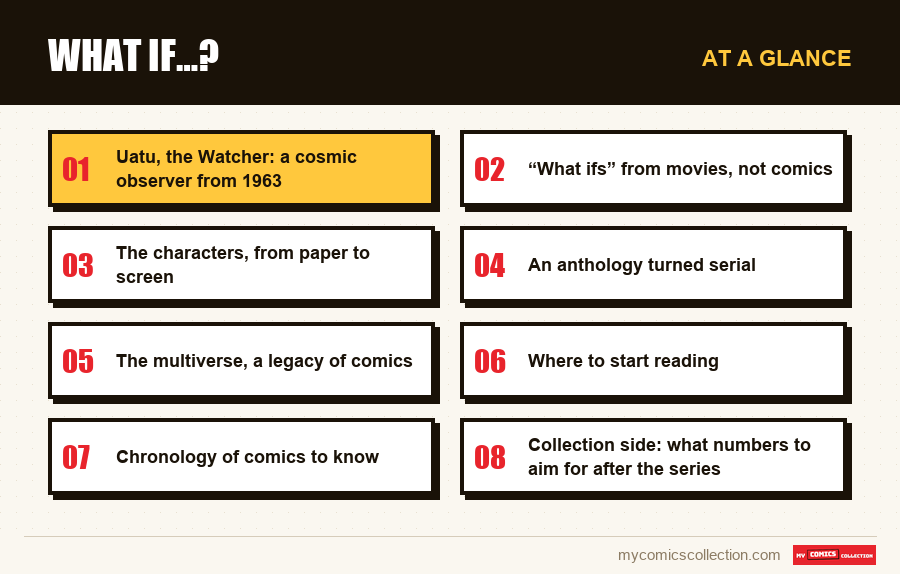
What If? #1 (1977): alternate realities in comics
The concept of the series comes directly from the magazine What If?, the first issue of which appeared in February 1977 from the pen of Roy Thomas. Each issue asked a question: “What if Spider-Man had joined the Fantastic Four?” » for the inaugural, and unfolded an alternative, often tragic, narrative from a single point of divergence. These stories did not belong to the main continuity: they were exercises of imagination, free to explore outcomes impossible in the regular series. The animated series faithfully follows this principle: each episode isolates a moment from the saga and imagines what would have happened if a single decision, a single coincidence, had changed differently. This is the very spirit of the magazine, transposed from paper to screen.
Where the magazine drew on the great moments of comics (the death of heroes, unnatural alliances, twisted origins) the series draws on the films. The point of divergence is no longer a comic panel but a scene from a feature film. This translation demonstrates the way in which the cinematographic universe has become, for the general public, the primary reference, to the point of serving as material for a concept born in comics almost half a century earlier.
Uatu, the Watcher: a cosmic observer from 1963
The central figure of the series, the Watcher, is one of Marvel's most unique characters. Uatu first appears in Fantastic Four #13 (1963), created by Stan Lee and Jack Kirby. Member of a race of cosmic beings dedicated to observing the universe without ever intervening, he embodies the omniscient gaze placed on the affairs of mortals. In the comics as in the magazine What If?, it is he who, from his base on the Moon, contemplates alternative realities and presents them to the reader. The series takes up this role of narrator, magnified by the deep voice of Jeffrey Wright, making the Watcher the common thread of otherwise independent episodes.
But the series allows itself a boldness absent from the magazine: it makes the Watcher's oath of non-intervention a dramatic spring. Faced with a threat capable of devouring the multiverse, Uatu ends up breaking his sacred vow and bringing together heroes from different realities. This shift transforms the anthology into a serialized story with a global issue, where comics were content with closed stories. This is one of the great freedoms of the series, which gives The Watcher a new dramatic depth.
“What ifs” from movies, not comics
The most visible difference is the starting material. The episodes revisit key moments from the cinematic saga: what if Peggy Carter had received the serum instead of Steve Rogers, becoming Captain Carter? What if T'Challa had become Star-Lord? What if the heroes faced a zombie pandemic? These storylines draw on the characters and events from the films, with many returning actors lending their voices to their characters. This fidelity to the cinematic canon anchors the series in a universe familiar to the general public, while playing on the surprise effect of “what if”.
Some of these scenarios echo stories from the comics: the zombies are reminiscent of the “Marvel Zombies” series launched in 2005, where the Marvel Universe was ravaged by a contagion. But most are inventions specific to the series, designed to dialogue with the films. Captain Carter, in particular, is a creation of the series that has become so popular that it has joined other productions in the saga. This circulation between the animated anthology and the rest of the universe illustrates the growing porosity between formats.
Collecting this series?
Track what you own, what you are missing and what your collection is worth. 7 day trial.
Start my trial →The characters, from paper to screen
- The Watcher (Uatu): Cosmic narrator of the comics, he here becomes an actor in the story by breaking his oath.
- Captain Carter: Alternative version of Peggy Carter, creation of the resoundingly successful series.
- T'Challa Star-Lord: A “what if” that reimagines the Wakandan’s destiny as a space raider.
- Doctor Strange Supreme: A dark variant of the sorcerer, consumed by grief.
- Multiverse heroes: Brought together by the Watcher into a new team, the “Guardians of the Multiverse”.
An anthology turned serial
The great success of What If…? is due to its ability to combine the anthological spirit of the journal with its own narrative ambition. Each episode functions as an autonomous story, in the style of the 1977 issues, but the series gradually weaves a common thread that culminates in a confrontation on the scale of the multiverse. This hybrid structure (independence of the episodes, continuity of the whole) distinguishes the series from its paper source, which never sought to connect its stories. It demonstrates a modern way of storytelling, where even an anthology must provide an overall arc to retain its audience.
This approach also has a virtue for the Marvel universe: it explores the multiverse, a concept that has become central in recent productions. By showing dozens of divergent realities, the series broadens the horizon of the saga and prepares the ground for stories where the boundaries between worlds become blurred. What If…? is therefore not a simple offbeat piece of entertainment: it is also a narrative laboratory where the logic of the multiverse is tested, as an extension of the major comic book crossovers.
The multiverse, a legacy of comics
If the series popularizes the multiverse among the general public, the idea is anything but new. Marvel comics have been juggling parallel realities, numbered Earths and alternate versions of their heroes for decades. The What If? was one of the vectors, alongside sagas exploring dark futures or mirror worlds. The animated series inherits this abundant tradition and makes it crystal clear for an audience accustomed to films. In this, it plays the role of a conduit: it translates into accessible images a narrative mechanism that comics have patiently constructed over the years.
For the reader, it is an invitation to go back to the sources: discover the magazine What If?, its cruel and inventive scenarios, but also the great multiverse sagas which forged this mythology. The animated series is only the tip of a conceptual iceberg whose roots lie deep in the heart of the Marvel universe. It makes you want to explore these founding stories, where the imagination of the authors freed itself from the rules of continuity to dare all the hypotheses.
Where to start reading
To extend the series, the magazine “What If?” » (from 1977) remains the ideal gateway: its independent issues can be enjoyed individually and set the tone of the anthology. For the zombie episode, the series “Marvel Zombies” (2005) offers a direct counterpart in the comics. Finally, to understand the Watcher, his appearances in the Fantastic Four stories, from Fantastic Four #13 (1963), shed light on the character. This course covers the sources of a series which draws as much from a concept as from a founding figure.
Chronology of comics to know
- 1963: Fantastic Four #13: First appearance of Uatu, the Watcher.
- 1977: What If? #1: the launch of the magazine and its concept.
- 2005: Marvel Zombies: the saga that inspires the zombie episode of the series.
Collection side: what numbers to aim for after the series
What If…? points to keys that are both old and affordable. Fantastic Four #13 (1963, first appearance of the Watcher) is a sought-after Silver Age issue, important to Marvel's entire cosmic mythology. What If? #1 (1977) is the starting point of the review, an emblematic issue for fans of the concept, often more accessible. The issues of “Marvel Zombies” (2005) will be of interest to those who enjoyed the contagion episode. These targets cover various budgets. As always, condition and gradation determine value; relying on real recent sales is strongly recommended.
Its place in the saga and for the collector
What If…? transposed a concept dear to comics to the screen, while putting it at the service of films and the multiverse. For the collector, it revived interest in Fantastic Four #13 and the What If? magazine, as well as alternative sagas. It illustrates the effect of adaptations on the market, including for old concepts. Beyond speculation, the series invites you to discover Marvel's long tradition of alternative stories, this freedom to imagine impossible outcomes that has nourished the universe for decades. By bringing the multiverse to life, it pays homage to the inventiveness of the authors who, as early as 1977, dared to ask the question “what if?” ".
The verdict: a faithful concept, a new ambition
- Loyalty: the anthological concept, the Watcher and the “what if” question come directly from the 1977 magazine.
- Freedoms: the “what ifs” start from the films, the Watcher breaks his oath, a global continuity emerges, new scenarios (Captain Carter).
- Collectible numbers: Fantastic Four #13 (Watcher), What If? #1 (1977), Marvel Zombies (2005).
What If…? reinvents for the screen a concept born in comics in 1977, by applying it to films and grafting a new multiverse plot. Faithful to the spirit of the magazine and the figure of the Watcher, the series dares to have a serialized continuity absent from its source. For both the reader and the collector, it is an invitation to discover the magazine What If? and Marvel's rich tradition of alternate realities.
Frequently asked questions
From the magazine “What If?” », the first issue of which appeared in 1977 from the pen of Roy Thomas. Each issue imagined an alternate reality from a single point of divergence, a principle that the series faithfully follows.
Uatu, a cosmic being dedicated to observing the universe without intervening. He appears as early as Fantastic Four #13 (1963), created by Stan Lee and Jack Kirby. In the series, he narrates the episodes then breaks his oath to face a multiverse threat.
No: the “what ifs” come from the events of the films, not the comics. A few scenarios echo sagas (the zombie episode is reminiscent of “Marvel Zombies”), but most, like Captain Carter, are creations of the series.
An alternate version of Peggy Carter, who receives the super-soldier serum in place of Steve Rogers. Creation of the series, it became so popular that it joined other productions of the saga.
Fantastic Four #13 (1963, first appearance of the Watcher) is the most sought after key. What If? #1 (1977) is the starting point of the review, often more accessible.
Does the series make you want to collect? Estimate the value for free of your issues (Fantastic Four #13, What If? #1…) with our tool based on current eBay listings.