The Flash (2023) Andy Muschietti , with Ezra Miller, adapts the scarlet speedster Barry Allen (Showcase #4, 1956) and is inspired by the story “Flashpoint”(2011) by Geoff Johns: by going back in time to save his mother, Barry breaks reality. The film summons the multiverse, a Batman alternative and Supergirl. Faithful to the spirit of “Flashpoint”, he reinvents the plot. Here is the detailed comparison, film versus comics.
A multiverse adventure centered on time travel, The Flash brings to the screen one of the most memorable stories of the scarlet car. It draws on the mythology of the Speed Force. Source-by-source decryption.
As in each article in this series, only verified information (creators, distribution, dates, comic numbers) is stated; the comparative analysis is ours, without reproducing dialogue or protected images.
Title : The Flash (2023)
Director: Andy Muschietti
Actors: Ezra Miller (Barry Allen), Michael Keaton (Batman), Sasha Calle (Supergirl), Ben Affleck (Batman)
Exit : June 2023
Studio: Warner Bros.
Showcase #4 (1956): 1st appearance of Barry Allen (Flash)
“Flashpoint”(2011): Geoff Johns & Andy Kubert
The Speed Force: the source of Flash's powers
The multiverse: the parallel realities of DC
- Barry Allen, the scarlet racing car, and its speed.
- Le time travel to save his mother.
- La broken reality by this change (“Flashpoint”).
- Le multiverse and its parallel realities.
- Le childhood trauma of Barry, the driving force of the story.
- The plot differs from "Flashpoint" (Keaton's Batman, Supergirl).
- Le cinematic multiverse replaces that of the comics.
- Supergirl replaces Superman in the altered reality.
- Two versions of Barry coexist.
- Of the winks to old DC films.
Showcase #4 (1956): Barry Allen, the scarlet speedster
The Flash stars Barry Allen, who appeared in Showcase #4 (1956), created by Robert Kanigher and Carmine Infantino. This issue is historically significant: it marks the beginning of the silver age of comics, by reinventing the character of Flash in the guise of Barry Allen, a police scientist endowed with super-speed after a laboratory accident. Capable of running at speeds exceeding the speed of light, Barry draws his power from the "Speed Force", a cosmic energy linked to movement. An iconic DC character, he embodies the concept of speed and is closely linked to time travel and the multiverse, central themes of the film.
The film captures the essence of the character: Barry Allen, his super-speed, his childhood trauma: the murder of his mother and the unjust imprisonment of his father. Ezra Miller plays this hero marked by loss, whose desire to repair the past is the driving force of the story. The film exploits Flash's ability to travel through time, one of the most fascinating aspects of the character in the comics. This loyalty to Barry Allen and his mythology of speed anchors the film in the world of the scarlet car. The main narrative inspiration, however, comes from a specific story: “Flashpoint”, which explores the catastrophic consequences of time travel.
“Flashpoint” (2011), film source
The film is directly inspired by “Flashpoint” (2011), a major story by Geoff Johns and Andy Kubert. In this comic, Barry Allen goes back in time to prevent the murder of his mother, but this change shatters reality, creating a nightmarish alternate timeline where the world is on the brink of destruction. This story explores the disastrous consequences of changing the past, even with the best intentions: each change causes an uncontrollable butterfly effect. “Flashpoint” had a profound impact on the DC Universe, even serving as the starting point for a complete editorial overhaul. The film takes up this central premise: Barry saves his mother and triggers a multiversal catastrophe.
The film, however, largely reinvents the plot of “Flashpoint”. Where the comic presents a dark alternative timeline with different versions of the heroes, the film opts for a journey into the cinematic multiverse, notably summoning Michael Keaton's Batman (from Tim Burton's films) and a Supergirl in place of Superman. These choices, which exploit the nostalgia of old DC films, move away from the original story while retaining its heart: the tragic consequences of the desire to rewrite the past. The film conveys the central message of “Flashpoint”, you can't change the past without paying the price, through a spectacular multiverse adventure. For the reader, it is an invitation to discover “Flashpoint”, one of the most influential Flash and DC stories.
Time travel and the price of the past
At the heart of the film is the theme of time travel and its consequences, central to the Flash mythology. Barry, haunted by his mother's murder, uses his speed to go back in time and prevent this tragedy. But this change alters reality, creating a world where heroes don't exist or are different, and where an alien threat threatens to destroy everything. This story illustrates a moral lesson: the desire to repair the past, however understandable it may be, can have catastrophic consequences. Barry must learn to accept his loss rather than deny it, a powerful emotional theme at the heart of the character.
This reflection on mourning, acceptance and the price of the past gives the film its depth. Flash, in the comics, is closely linked to time travel and its paradoxes, which makes him the ideal character to explore these themes. The film depicts the temptation to rewrite history and the need to accept reality, even painful. This dimension, faithful to the spirit of “Flashpoint” and the character, transcends simple multiverse entertainment. For the reader, it reminds that Flash is not just a fast hero, but a tragic figure confronted with the limits of his own power: that of not being able to save everyone, nor rewrite the past without disrupting its balance. The film captures this emotional dimension.
Collecting this series?
Track what you own, what you are missing and what your collection is worth. 7 day trial.
Start my trial →The characters, from paper to screen
- Barry Allen/Flash: The scarlet racing car, faithful to Showcase #4, of which two versions coexist.
- Batman (Michael Keaton): Alternative version from Burton's films, a nod to the multiverse.
- Supergirl: Kryptonian replacing Superman in the altered reality.
- Young Barry: The alternate version of Barry, born from the temporal shift.
- Barry's mother: Whose murder is the founding drama of the story.
The multiverse, a concept inherited from comics
The film deploys the concept of the multiverse, one of DC's richest ideas. Since the 1960s, the publisher's comics have explored the existence of parallel realities, numbered Earths and alternative versions of their heroes. Flash, with his mastery of speed and time travel, is closely linked to this concept: it is he who, in the comics, discovers the existence of other Earths. The film exploits this multiversal dimension, by summoning alternative versions of the heroes and playing on the nostalgia of old DC films, such as Michael Keaton's Batman. This celebration of DC's cinematic multiverse is one of the standout aspects of the film.
This use of the multiverse illustrates the richness of a concept born in comics and which has become central in modern productions. By allowing different versions of heroes to coexist, the multiverse offers endless narrative possibilities and honors the history of DC adaptations. The film makes nostalgic and spectacular use of it, bridging eras of superhero cinema. For the reader, this dimension is an invitation to discover the long tradition of the multiverse in DC comics, where Flash plays a founding role. The film reminds us that this concept, now omnipresent in cinema, has its roots in comics, where parallel realities have nourished the imagination for decades, with the scarlet racing car as a privileged guide.
The Speed Force, driving force of mythology
At the heart of Flash's powers is the Speed Force, a fundamental concept developed in the comics. Much more than just super-speed, the Speed Force is an extradimensional cosmic energy that powers all the cars in the DC Universe, from Barry Allen to Wally West to Jay Garrick. By tapping into this source, Flash can not only run at speeds beyond light, but also travel through time, cross dimensions, and access the multiverse. This mythology of speed makes Flash a unique character, intimately linked to DC's most complex concepts. The film implicitly evokes this power by showing Barry manipulating time and traveling between realities.
This cosmic dimension of the Speed Force explains why Flash is the ideal character for a multiverse story like “Flashpoint”. His mastery of time and space makes him a pillar of DC's major events, often at the center of crises that redefine the universe. The film exploits this ability, making Barry's time travel the trigger for the entire plot. For the reader, the Speed Force is an invitation to discover the conceptual richness of Flash comics, where speed becomes a door to the infinity of possible realities. This mythology, developed over decades, places the scarlet racing car at the crossroads of time, space and the multiverse, themes that the film brings to the screen.
Where to start reading
To extend the film, Showcase #4 (1956) features the first appearance of Barry Allen. “Flashpoint” (2011) by Geoff Johns and Andy Kubert is the direct source of the story, a must-read. “The Flash: Rebirth” (2009) revisits the character. This journey covers the source material for a film centered on time travel and the multiverse.
Chronology of comics to know
- 1956: Showcase #4: the first appearance of Barry Allen (Flash) and the start of the Silver Age.
- 2009: “The Flash: Rebirth”: the return of Barry Allen.
- 2011: “Flashpoint”: the story that inspires the film.
Collection side: what numbers to aim for after the film
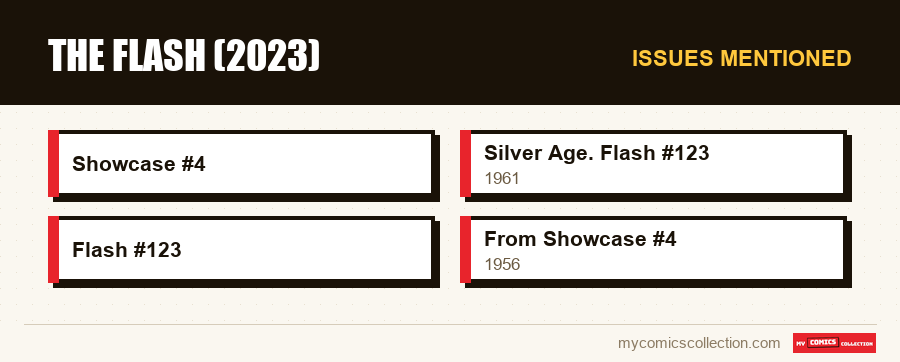
The Flash points to major keys. Showcase #4 (1956, first appearance of Barry Allen) is a highly sought after key to the Silver Age, marking the beginning of the Silver Age. Flash #123 (1961, "Flash of Two Worlds", which introduces the multiverse) is another important key. The collection “Flashpoint” (2011) is an accessible modern target. These numbers cover various budgets. As always, condition and gradation determine value; relying on real recent sales is strongly recommended.
Its place in the saga and for the collector
The Flash brought the time travel of “Flashpoint” to the screen and celebrated DC’s cinematic multiverse. For the collector, it revived interest in Showcase #4 and Flash #123, keys to the Silver Age. It illustrates the effect of adaptations on the market. Beyond speculation, the film invites you to discover the mythology of Flash in the comics, from the founding story of 1956 to “Flashpoint”. By exploring the price of the past and the multiverse, it reminds us that Flash is much more than a speedy hero: a figure linked to time, grief and parallel realities, at the heart of DC's mythology.
The Verdict: Time Travel Inspired by “Flashpoint”
- Loyalty: Barry Allen, his speed, time travel to save his mother, broken reality and the multiverse come from the comics.
- Freedoms: the reinvented plot, Keaton's Batman, Supergirl in place of Superman, the cinematic multiverse, the nods to old films.
- Collectible numbers: Showcase #4 (Barry Allen), Flash #123 (multiverse), “Flashpoint” (2011).
The Flash brings to the screen the time travel of “Flashpoint”: by saving his mother, Barry Allen breaks reality and plunges into the multiverse. Faithful to the spirit of the story and the mythology of speed but reinventing the plot around the cinematic multiverse, the film explores the price of the past. For both the reader and the collector, it is an invitation to discover Showcase #4 and “Flashpoint”.
Frequently asked questions
From Showcase #4 (1956), created by Robert Kanigher and Carmine Infantino. This issue reinvents Flash in the guise of Barry Allen and marks the beginning of the Silver Age of comics. The film faithfully takes up the character and his mythology of speed.
From “Flashpoint” (2011) by Geoff Johns and Andy Kubert, where Barry goes back in time to save his mother, shattering reality. The film takes up the central premise, while reinventing the plot around the DC cinematic multiverse.
The film exploits the multiverse to summon alternative versions of heroes, including Michael Keaton's Batman from Tim Burton's films. This nostalgic nod celebrates the history of DC adaptations, moving away from the original "Flashpoint" story.
True to “Flashpoint”: you can’t change the past without paying the price. Barry, haunted by his mother's murder, must learn to accept his loss rather than deny it, a powerful emotional theme at the heart of the character.
Showcase #4 (1956, first by Barry Allen) is a crucial key to the Silver Age. Flash #123 (1961, which introduced the multiverse) and the collection “Flashpoint” (2011) are other targets.
Does the film make you want to collect? Estimate the value for free of your numbers (Showcase #4, Flash #123…) with our tool based on current eBay listings.