
Supergirl debuted in May 1959 in Action Comics #252 , created by Otto Binder and Al Plastino at DC Comics. Kara Zor-El, Superman's Kryptonian cousin, shares the solar-powered abilities of the House of El and has headlined several solo series since 1972, including Peter David's 1990s run and Sterling Gates's 2005 series. This guide traces her origin , her full biography , the series timeline , the key issues to know and the major arcs worth collecting.
Supergirl holds a unique place in the DC catalog: as early as 1959 she paved the way for the solar-powered heroines who would populate Kryptonian mythology, and sixty-six years later she remains the most enduring female character in the Superman line. Her first appearance in Action Comics #252 (May 1959), at the height of the Silver Age, came two years after Krypto's official return and structured the entire family sub-universe around the Last Son. More than 1,800 appearances, seven solo series and a central role in the Legion of Super-Heroes make her a strategic figure for anyone collecting DC's Kryptonian corner.
This article traces the origin of Kara Zor-El, her in-universe biography, the complete timeline of her solo series, the top 10 issues to know on the collecting side and the iconic arcs that shaped her modern status. It pairs well with our key Supergirl issues breakdown, which details current values for the sensitive editions, and the history of Superman to place the El family in its full context.
Supergirl biography
Supergirl is a DC Comics character created by Otto Binder and Al Plastino. Her first appearance is in Action Comics #252 (May 1959). She brings an openly familial dimension to the Superman mythos and lets DC extend Kryptonian mythology beyond Clark Kent alone, with a teenage heroine first hidden at Midvale Orphanage and later adopted by the Danvers.
Supergirl ID card
- Real name: Kara Zor-El (Earth civilian identity: Linda Lee Danvers)
- First appearance : Action Comics #252 (May 1959)
- Creators: Otto Binder, Al Plastino
- Publisher: DC Comics
- Affiliations: Justice League, Legion of Super-Heroes, El Family
- Status: Lead heroine of the Superman sub-universe
Character origins
Otto Binder and Al Plastino designed Supergirl at the request of Mort Weisinger, editor of the Superman line, who was looking to energize Action Comics as the 1960s approached. The headline test had been set up by Action Comics #123 (1958) with the short-lived "Super-Girl" dreamed up by Jimmy Olsen; the definitive character arrived a year later. In the story itself, Kara Zor-El comes from Argo City, a fragment of Krypton preserved under a dome after the planet's explosion. When Argo's ground turns to kryptonite, her father Zor-El sends her to Earth in a rocket, where her cousin Kal-El takes her in. Superman places her at Midvale Orphanage under the identity of Linda Lee so she can train to master her powers before any public appearance. The Linda Lee Danvers dual identity takes hold when Fred and Edna Danvers adopt her. The character's editorial trajectory is marked by her death in Crisis on Infinite Earths #7 (October 1985), her absence from canon for two decades, and her reintegration in 2004 in Jeph Loeb and Michael Turner's Superman/Batman #8.
Powers and abilities
- Flight and super-strength: standard Kryptonian abilities fueled by yellow solar radiation, on a level comparable to Superman
- Invulnerability: dense skin, resistance to bullets, extreme temperatures and underwater pressure
- X-ray vision and heat vision: controllable eye beams, identical to her cousin's
- Super-breath and super-hearing: able to put out a fire or freeze a target, with heightened sensory perception
- Vulnerabilities: green kryptonite (pain, loss of powers), magic, red sunlight: shared with Superman
Costume and visual identity
The original 1959 outfit, designed by Plastino, echoes Superman's blue, red and yellow palette with a pleated blue skirt, a blue bolero bearing the El crest and a red cape. The costume evolves in the 1970s (Cary Bates and Bob Oksner) toward more contemporary cuts, then radically from 2003 onward with Michael Turner, who introduces a crop top and a short, slit skirt. The Sterling Gates and Jamal Igle run (2008-2011) returns to a more athletic silhouette. Since Rebirth in 2016, Kara wears the El symbol on a more saturated blue, with a buttoned red cape and high boots.
Supergirl series timeline
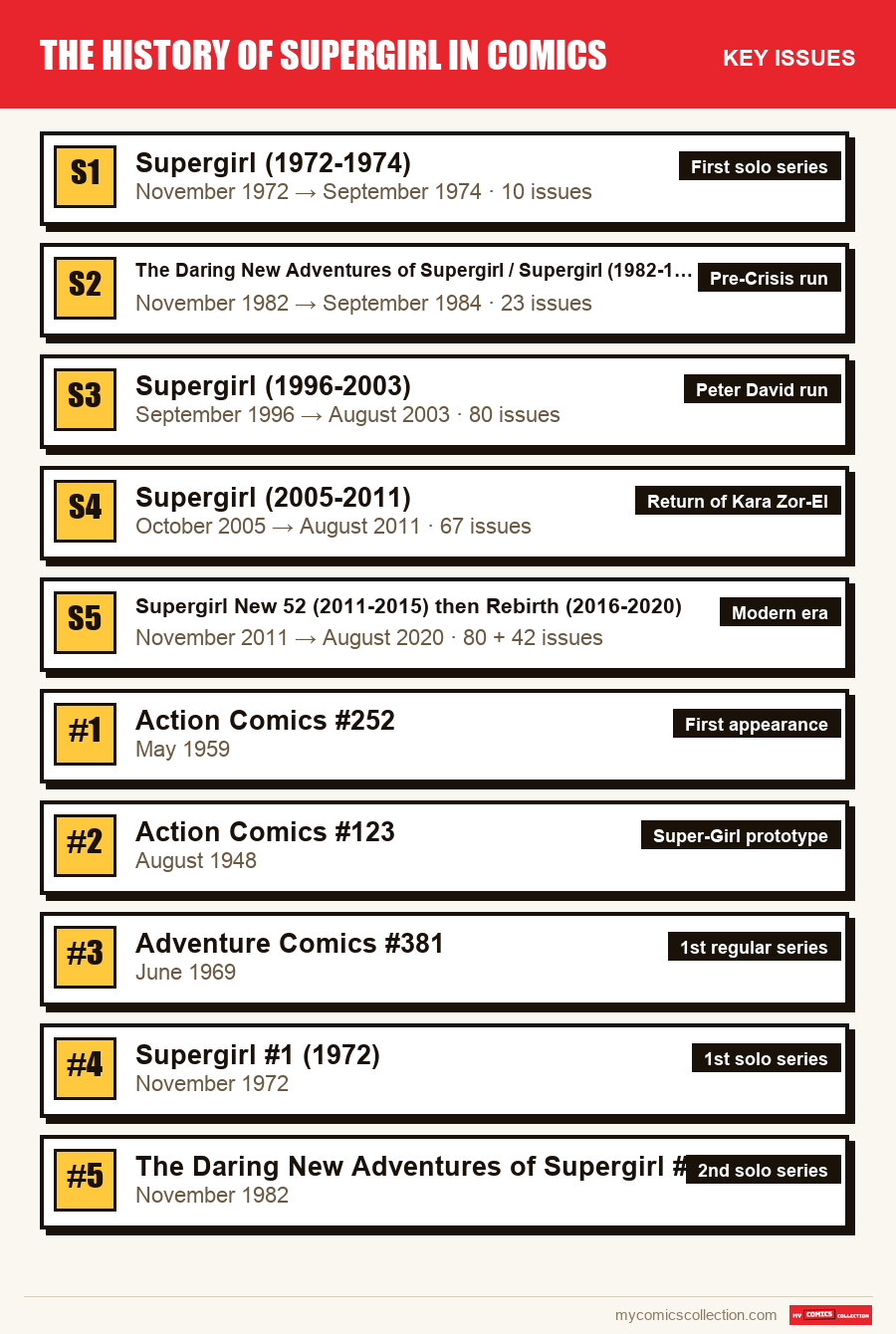
Before 1972, Kara appears as a backup in Action Comics, in Adventure Comics (starting with #381) and then Superman Family. Seven solo series follow in succession, each tied to an editorial overhaul of the character.
Supergirl (1972-1974)
Kara's first solo title, launched with Cary Bates writing and Art Saaf on art. The series tries to establish an identity independent of Superman and fits the post-1971 push to modernize DC's heroines. A short cancellation after ten issues sent the character on to Superman Family.
The Daring New Adventures of Supergirl / Supergirl (1982-1984)
Paul Kupperberg on script, Carmine Infantino on pencils. Linda Lee Danvers enrolls at Lake Shore University; the series winds up cut short at 23 issues before the character's death in Crisis on Infinite Earths. It remains one of the most readable series for getting a handle on the classic Kara.
Supergirl (1996-2003)
Peter David reinvents the character through Linda Danvers and Matrix, with a religious and supernatural dimension that breaks from canon. Eighty issues and several annuals make this run the longest solo Supergirl title and one of the most sought-after in singles among collectors.
Supergirl (2005-2011)
Launched after Kara's return in Superman/Batman, the series hands her to Jeph Loeb and then, above all, to Sterling Gates and Jamal Igle from #34 onward. The Gates/Igle run, built around the Bizarrogirl and Day of the Dollmaker arcs, is now regarded as the character's best modern period.
Supergirl New 52 (2011-2015) then Rebirth (2016-2020)
The New 52 reboot hands the title to Michael Green and Mike Johnson, with an angrier Kara. Rebirth in 2016 launches a new Steve Orlando series that leans on the CW TV show and structures the DEO sub-universe around Kara. Forty-two issues before the end of the Rebirth line.
Collecting this series?
Track what you own, what you are missing and what your collection is worth. 7 day trial.
Start my trial →Top 10 key Supergirl issues
A selection of the issues that shape both the character's value and the way you read her. For updated CGC 9.6 and 9.8 valuations, our key Supergirl issues breakdown gives the latest ranges.
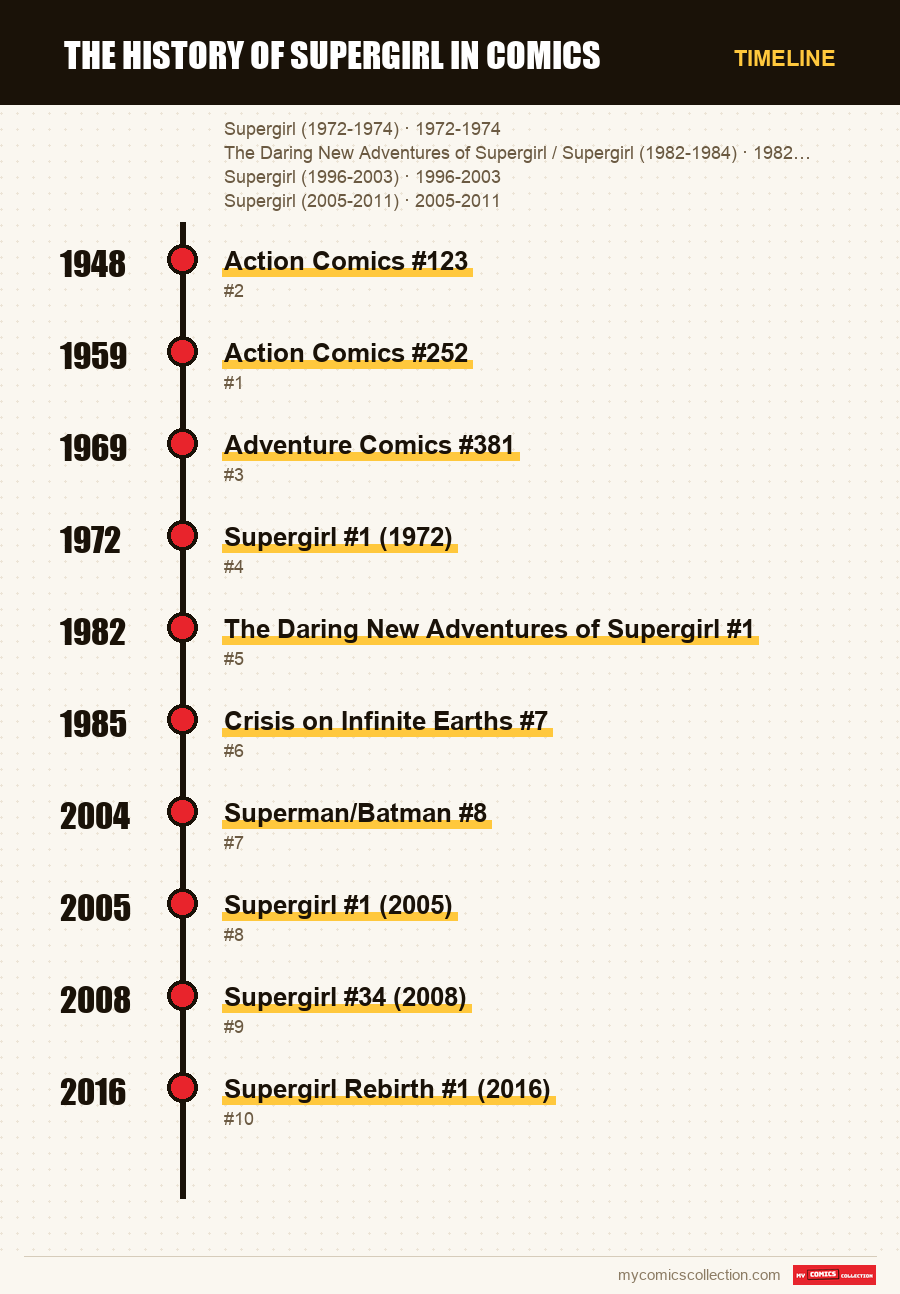
Action Comics #252
First appearance of Kara Zor-El / Supergirl, one of the major DC Silver Age issues. Iconic Curt Swan cover. High print run for the era but rare survival in high grade, which makes it one of the most closely watched Silver Age issues at auction. See also our Action Comics #1 value page to put the series in context.
Action Comics #123
First mention of "Super-Girl" as a character imagined by Jimmy Olsen, considered a conceptual precursor. It shows up in high-grade sales for Golden Age collectors who want to document the character's lineage.
Adventure Comics #381
The first issue of Adventure Comics devoted entirely to Supergirl after the Legion moved over to Action Comics. It marks her move to headline status and the first true dedicated series, even without a title change.
Supergirl #1 (1972)
The first title to carry her name, with the Cary Bates / Art Saaf creative team. A solo first issue sought by collectors who want every one of the character's first issues. Iconic cover with the modernized 1970s costume.
The Daring New Adventures of Supergirl #1
The first issue of the Paul Kupperberg / Carmine Infantino series. Renamed Supergirl from #14 onward. Wider post-1982 print run, but an editorial key to understanding the character's pre-Crisis transition.
Crisis on Infinite Earths #7
The issue of Kara Zor-El's death at the hands of the Anti-Monitor, written by Marv Wolfman and drawn by George Pérez. One of DC's most reproduced covers and a defining scene of the Crisis maxiseries. Highly in demand in high-grade CGC, with a range steadily climbing since 2010.
Superman/Batman #8
The first full issue devoted to Kara Zor-El's return to post-Crisis canon, written by Jeph Loeb with art by Michael Turner. Considered Kara's "first modern appearance" and a centerpiece of modern Supergirl want lists.
Supergirl #1 (2005)
The first issue of the post-Infinite Crisis series, with the Jeph Loeb / Ian Churchill team. The modern Kara Zor-El's first solo series, printed at a higher level thanks to the post-return buzz.
Supergirl #34 (2008)
The first issue of the Sterling Gates and Jamal Igle team, opening the "Who is Superwoman?" arc. A reference point for the most critically acclaimed modern run and a recommended entry point for new readers.
Supergirl Rebirth #1 (2016)
The first Rebirth issue by Steve Orlando, tuned to the aesthetic of the CW show. The first solo series to explicitly fold in the DEO and the TV-style Kara Danvers civilian identity, tracked by cross-media collectors.
Major arcs and iconic runs
A handful of arcs anchor the modern reading of Supergirl. The Supergirl Saga (Superman vol.2 #21-23, 1988) by John Byrne introduces the post-Crisis Matrix Supergirl and resolves the character's absence after her death. Many Happy Returns (Supergirl vol.4 #75-80, 2002-2003) by Peter David is the most moving closing arc of the David run, with the return of the pre-Crisis Kara. Who is Superwoman? and Bizarrogirl (Supergirl vol.5 #34-50, 2008-2010) by Sterling Gates and Jamal Igle build a fresh supporting cast around the new Kara. Crucible (Supergirl vol.6 #36-40, 2014-2015) by K. Perkins and Mike Johnson reconnects Kara to the Legion's cosmos. Finally, Tom King: Woman of Tomorrow (2021-2022, miniseries) offers a sci-fi reimagining with Bilquis Evely on art, which becomes the basis for the DC Studios Supergirl film.
Adaptations and cultural impact
Supergirl made it to the screen in 1984 under Jeannot Szwarc with Helen Slater, a cult version but a commercial disappointment. Smallville reintroduced her in 2010 with Laura Vandervoort. The CW series Supergirl (2015-2021), led by Melissa Benoist, ran 126 episodes and strongly revived the back-issue market for Sterling Gates and Rebirth as early as 2015-2016. On the film side, the announcement of the DC Studios project "Supergirl: Woman of Tomorrow" with Milly Alcock triggered a wave of buying on the Tom King arcs in 2024. In animation, Kara appears in Superman: The Animated Series, Justice League Unlimited and, more recently, in My Adventures with Superman.
Build your Supergirl collection methodically
Catalog the Supergirl series in 1 click, identify your missing key issues, track their estimated value from current eBay listings. Free 7-day trial.
🚀 Start your free 7-day trial