Justice League (2017) Zack Snyder brings together the league of DC's greatest heroes for the first time in the cinema -Batman, Superman, Wonder Woman, Flash, Aquaman and Cyborg: team born in The Brave and the Bold #28 (1960). The film pits them against steppenwolf , sent from Darkseid. True to the team concept, he suffers from troubled production. Here is the detailed comparison, film versus comics.
The culmination of the DC cinematic universe, Justice League brings together the pantheon of the publisher's heroes. It draws on the founding team concept of comics. Source-by-source decryption.
As in each article in this series, only verified information (creators, distribution, dates, comic numbers) is stated; the comparative analysis is ours, without reproducing dialogue or protected images.
Title : Justice League (2017)
Directors: Zack Snyder (and Joss Whedon)
Actors: Ben Affleck (Batman), Gal Gadot (Wonder Woman), Ezra Miller (Flash), Jason Momoa (Aquaman), Ray Fisher (Cyborg)
Exit : November 2017
Studio: Warner Bros.
The Brave and the Bold #28 (1960): 1st appearance of the League
The DC Trinity: Batman, Superman, Wonder Woman
Flash, Aquaman, Cyborg: the other founders
Darkseid and Steppenwolf: the threat of Apokolips
- La meeting of the great heroes of DC into a league.
- La trinity Batman, Superman, Wonder Woman.
- Flash, Aquaman and Cyborg, founding members.
- steppenwolf and Darkseid, the menace of Apokolips.
- La resurrection of Superman after his death.
- La founding composition differs from that of the comics.
- The plot (the Mother Boxes) is largely original.
- A troubled production (two directors) marks the film.
- The tone hesitates between seriousness and humor.
- La mythology of Darkseid is outlined.
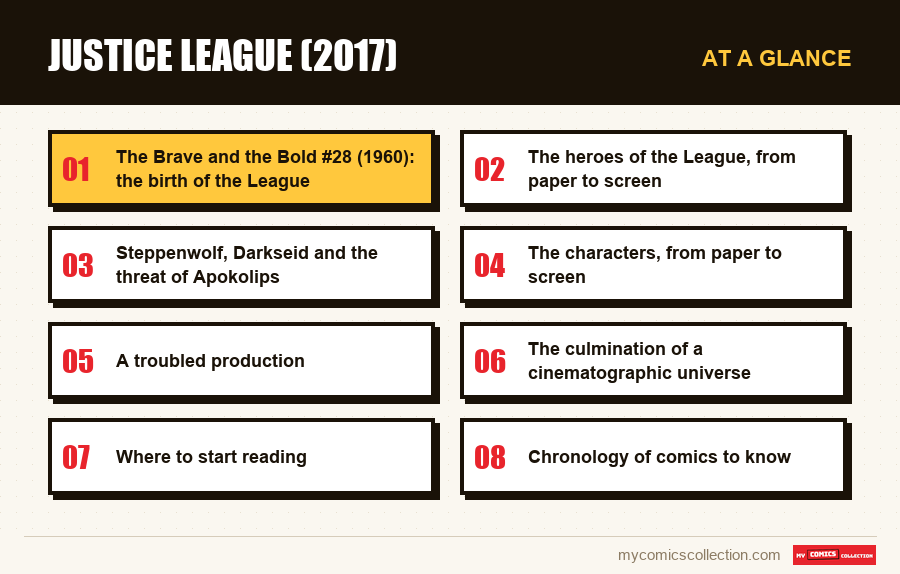
The Brave and the Bold #28 (1960): the birth of the League
The Justice League appears in The Brave and the Bold #28 (1960), created by Gardner Fox and Mike Sekowsky. This team brings together DC's greatest superheroes to take on threats that none could defeat alone. Originally, the League brings together Superman, Batman, Wonder Woman, Flash, Green Lantern, Aquaman and Martian Manhunter. This concept of a superhero team, which has inspired so many other formations, is one of the pillars of the DC universe. The League embodies the ideal of a union of heroes in the service of good, each bringing their powers and personality to an invincible collective force. It has fueled decades of stories, from cosmic threats to intimate dramas.
The film takes up this founding concept: the gathering of the great heroes of DC into a league to face a common threat. It brings together Batman, Superman, Wonder Woman, Flash, Aquaman and Cyborg, offering this iconic team for the first time in cinema. The main freedom concerns the composition: the film replaces Green Lantern and Martian Manhunter, founding members of the comics, with Cyborg, a more recent hero who became a member of the League in modern rereadings (notably “The New 52”). This adaptation reflects the team's contemporary versions. The film nevertheless captures the essence of the concept: heroes who are distinguished by everything, united in the face of a danger that exceeds them.
The heroes of the League, from paper to screen
The film develops several heroes alongside the already established trinity. Flash (Barry Allen), the scarlet racing car capable of moving at supersonic speeds, brings humor and youth to the team. Aquaman (Arthur Curry), king of the seas of Atlantis, embodies power and independence. Cyborg (Victor Stone), half man, half machine, offers a technological dimension and a personal drama. These characters, all from the comics, complete the Batman-Superman-Wonder Woman trinity to form the League. The film introduces these heroes to the general public, setting up their own films and developments in the DC Cinematic Universe.
Each of these heroes has a rich mythology in the comics, which the film only sketches. Flash, one of DC's oldest characters, embodies the concept of speed and the multiverse; Aquaman rules an underwater kingdom with epic stakes; Cyborg symbolizes the fusion of human and machine. The film brings them together for an adventure, without being able to fully develop their respective universes. For the reader, these heroes are so many invitations to discover their origin stories in the comics, where each carries stories of great richness. The League, by bringing them together, celebrates the diversity and complementarity of the DC pantheon, one of the largest and oldest in comics.
Steppenwolf, Darkseid and the threat of Apokolips
The film pits the League against Steppenwolf, an alien warrior in the service of Darkseid, the tyrant of the planet Apokolips. Darkseid is one of DC's greatest villains, an evil deity obsessed with conquering the universe and finding the "Anti-Life Equation." Steppenwolf, his lieutenant, seeks to bring together the “Mother Boxes”, artifacts of cosmic power, to enslave the Earth. This threat, from the mythology of the “Fourth World” created by Jack Kirby, offers the League an enemy worthy of its collective power. The film sketches the figure of Darkseid, preparing a larger threat for future stories.
This mythology of Apokolips, one of the richest in DC, is adapted here in a condensed manner. Kirby's "Fourth World", with Darkseid, the Mother Boxes and the New Gods, is a cosmic saga of considerable magnitude, which the film can only touch on. Steppenwolf, a secondary antagonist in the comics, becomes the main threat, while Darkseid remains in the background. This adaptation, dictated by the format, reduces the scale of this fascinating mythology. For the reader, it is an invitation to discover Kirby's “Fourth World”, where Darkseid and Apokolips unfold a cosmic fresco of unequaled richness. The film offers a glimpse of this, setting the stage for a threat that his later productions will develop.
Collecting this series?
Track what you own, what you are missing and what your collection is worth. 7 day trial.
Start my trial →The characters, from paper to screen
- Batman, Superman, Wonder Woman: The founding trinity of DC, pillar of the League.
- Flash (Barry Allen): The scarlet racing car, bringing humor and youth.
- Aquaman (Arthur Curry): King of Atlantis, powerful and independent.
- Cyborg (Victor Stone): Half-man, half-machine, technological and tragic dimension.
- steppenwolf: Sent from Darkseid, seeking the Mother Boxes.
A troubled production
Justice League will be remembered as much for its content as for its chaotic production. Original director Zack Snyder had to leave the current project for personal reasons, and Joss Whedon took over as director, imposing significant reshoots and a lighter tone. This dual authorship resulted in a film with a hesitant tone, torn between the seriousness of Snyder's vision and the humor added by Whedon. The result, considered disjointed, divided the public and the critics. This troubled production hurt the film's coherence and reception, despite the appeal of DC's heroes coming together.
This turbulent history gave rise to a rare phenomenon: the subsequent release of an alternative version called the “Snyder Cut”, reflecting the director's original vision, following fan mobilization. This double destiny illustrates the tensions between author's vision and studio imperatives, as well as the public's attachment to the DC mythology. For the reader, Justice League is an invitation to discover the rich history of the League in the comics, where the team has enjoyed decades of epic adventures. Despite its difficulties, the film offered the general public the first cinematic reunion of the DC pantheon, a long-awaited moment, celebrating the ideal of the union of heroes at the heart of the concept of the League.
The culmination of a cinematographic universe
Justice League represents the culmination of the DC Cinematic Universe launched with Man of Steel: the long-awaited reunion of the publisher's pantheon into one team. This moment, prepared over several films, concretizes the studio's ambition to bring the Justice League to the screen, mirroring the success of competing superhero teams. By bringing together Batman, Superman, Wonder Woman, Flash, Aquaman and Cyborg, the film offers the general public a first cinematic meeting of these icons, celebrating the ideal of the union of heroes at the heart of DC mythology.
This meeting, despite production difficulties, illustrates the enduring appeal of the League concept. The idea of the greatest heroes uniting in the face of a common threat has fascinated people since 1960, and the film seeks to capture its magic. It also lays the foundations for future development, with the solo films of Aquaman, Flash and the other members. For the reader, Justice League is an invitation to discover the decades of adventures of the League in the comics, where the team faced the most epic threats in the DC universe. Despite its imperfections, the film marked a symbolic milestone: the first time the DC pantheon came together on the big screen, a fans' dream finally come true.
Where to start reading
To extend the film, The Brave and the Bold #28 (1960) features the League's first appearance. “Justice League: Origin” (2011), Geoff Johns and Jim Lee’s “New 52” retelling, matches the film’s composition. Jack Kirby's "Fourth World" introduces Darkseid and Apokolips. This journey covers the source material for a film that unites the DC pantheon.
Chronology of comics to know
- 1960: The Brave and the Bold #28: the first appearance of the Justice League.
- 1970s: Jack Kirby's "Fourth World" introduces Darkseid and Apokolips.
- 2011: “Justice League: Origin” (New 52): the composition that inspires the film.
Collection side: what numbers to aim for after the film
Justice League points to major keys. The Brave and the Bold #28 (1960, first appearance of the Justice League) is a highly sought after issue of the Silver Age. The first issues of Kirby's "Fourth World", introducing Darkseid, are targets for fans of his mythology. The collection “Justice League: Origin” (2011) is an accessible modern target. These numbers cover various budgets. As always, condition and gradation determine value; relying on real recent sales is strongly recommended.
Its place in the saga and for the collector
Justice League offered the first cinematic reunion of the DC pantheon, despite a troubled production. For the collector, it reignited interest in The Brave and the Bold #28 and the mythology of Darkseid. It illustrates the effect of adaptations on the market. Beyond speculation, the film invites you to discover the rich history of the League in comics, from the founding story of 1960 to Kirby's “Fourth World”. By bringing together the great heroes of DC, it celebrates the ideal of union at the heart of the concept of the League, a moment long awaited by fans.
The verdict: the League united despite the difficulties
- Loyalty: the reunion of the great heroes, the trinity, Flash, Aquaman, Cyborg, Steppenwolf and Darkseid come from the comics.
- Freedoms: the modified founding composition (Cyborg instead of Green Lantern), the plot of the Mother Boxes, the troubled production, the hesitant tone.
- Collectible numbers: The Brave and the Bold #28 (League), the “Fourth World” (Darkseid), “Justice League: Origin”.
Justice League brings together for the first time in the cinema the pantheon of DC (Batman, Superman, Wonder Woman, Flash, Aquaman, Cyborg) against Steppenwolf and Darkseid. Faithful to the founding team concept but marked by troubled production and a hesitant tone, the film was divisive. For both the reader and the collector, it is an invitation to discover The Brave and the Bold #28.
Frequently asked questions
From The Brave and the Bold #28 (1960), created by Gardner Fox and Mike Sekowsky. The team brings together DC's greatest heroes to face threats none could defeat alone. The film takes up this founding concept.
In part: the film replaces Green Lantern and Martian Manhunter, original founding members, with Cyborg, a more recent hero who became a member in modern rereadings ("New 52"). The film reflects this contemporary version of the team.
One of DC's greatest villains, tyrant of the planet Apokolips, from Jack Kirby's “Fourth World”. Obsessed with conquest and the “anti-life equation”, he sends his lieutenant Steppenwolf to threaten the Earth. The film sketches his figure.
Because of a troubled production: director Zack Snyder had to leave the project, and Joss Whedon took it over with reshoots and a lighter tone. The result, with a hesitant tone and considered disjointed, gave rise to an alternative version, the “Snyder Cut”.
The Brave and the Bold #28 (1960, League premiere) is a sought-after issue of the Silver Age. Other targets include the first issues of Kirby's "Fourth World" (Darkseid) and "Justice League: Origin" (2011).
Does the film make you want to collect? Estimate the value for free of your issues (The Brave and the Bold #28…) with our tool based on current eBay listings.