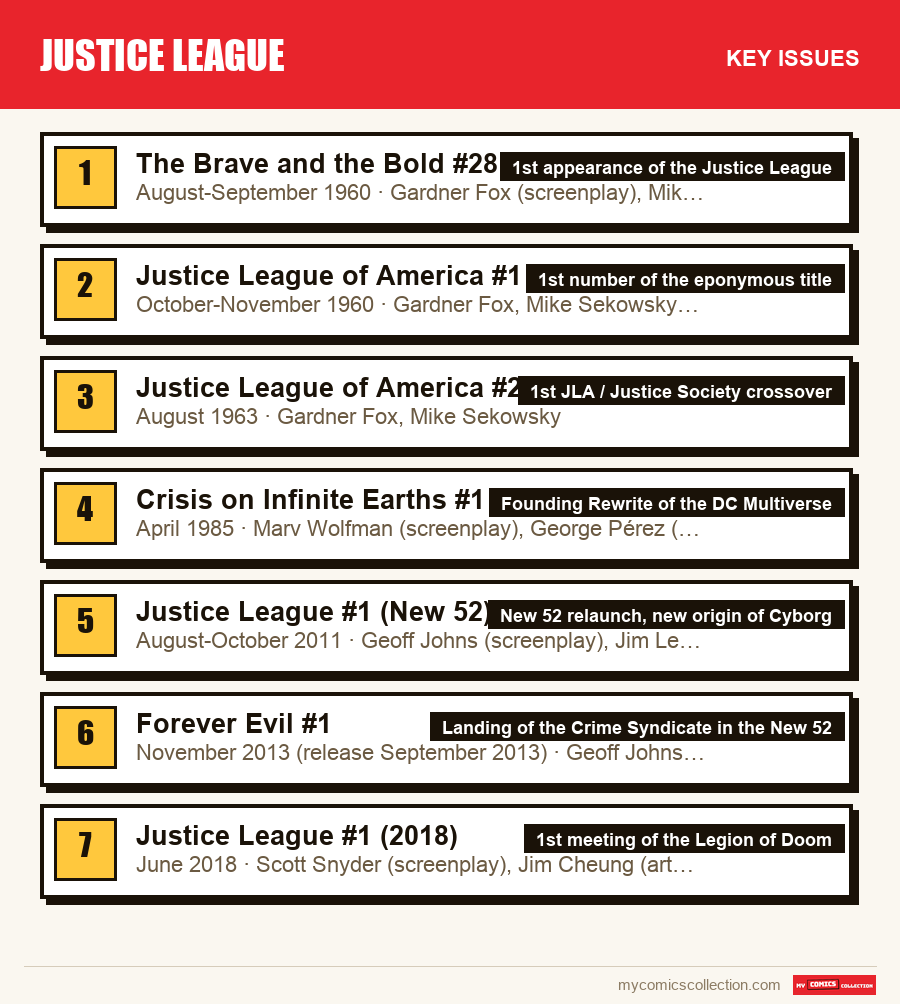
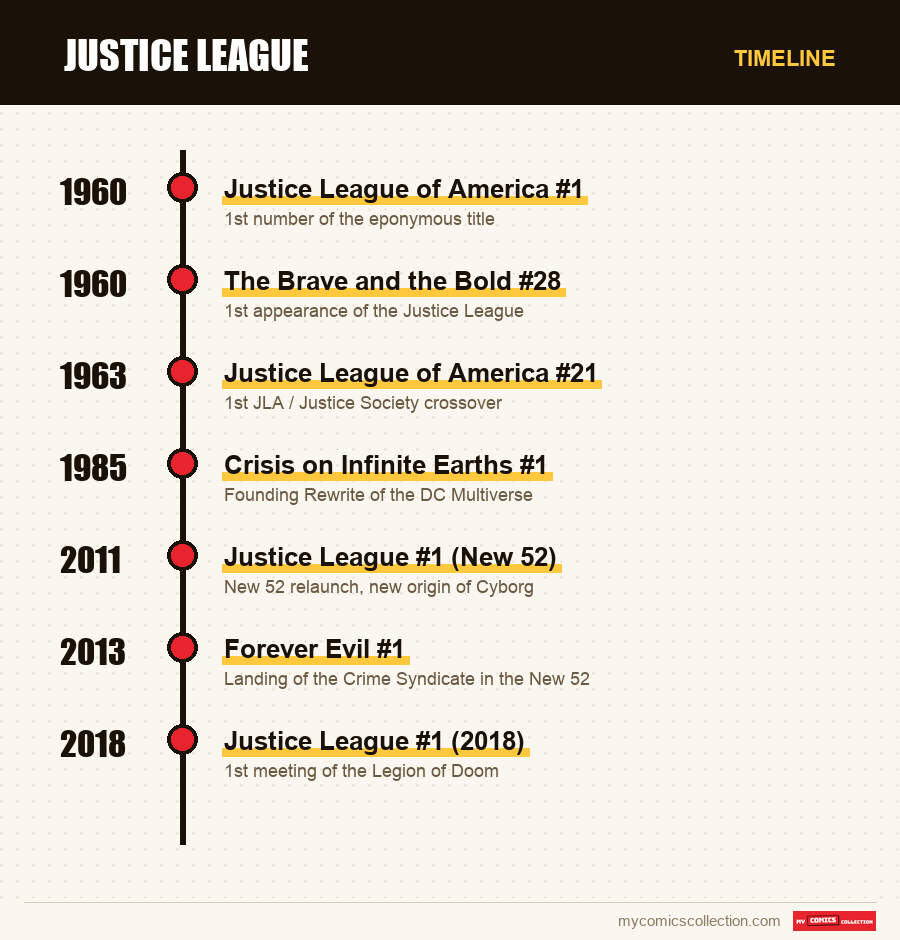
Key Justice League comics open with The Brave and the Bold #28 (1960), the team's first appearance, a CGC 9.6 example of which sold for $810,000 in January 2024. Followed Justice League of America #1 (1960, record at $215,000 in NM 9.6), Justice League of America #21 (1963, first crossover with the Justice Society) and Crisis on Infinite Earths #1 (1985). On the modern side, Justice League #1 from the New 52 (2011) and Justice League #1 by Scott Snyder (2018, 1st Legion of Doom collected) remain the most sought-after entries by recent collectors.
Few superhero teams embody a publisher's identity as well as the Justice League embodies DC Comics. Born in the midst of the Silver Age explosion, it has endured six decades of revivals, cosmic crises and screen adaptations, each leaving a measurable mark on the collecting market. Unlike a solo character like Superman or Batman, a team generates key issues on several levels: the very first collective appearance, the launch of the eponymous title, the first significant recruits, the founding crossovers and the editorial relaunches which redefine the formation for each generation of readers.
This guide lists the issues that really matter to a Justice League collector, with sales data, CGC censuses and editorial context verified at the time of writing. The objective is not to draw up an anecdotal list but to understand why these specific copies are in demand, and how to evaluate a copy that you already own or that you are considering acquiring.
As with any multi-title team, the difficulty is to distinguish the truly founding numbers from simple commercial revivals. We favored issues that introduce a character, a formation or an arc that has lastingly changed the mythology of the team: it is this filter which explains why certain issues with high media notoriety do not appear here, for lack of real impact on the rating.
The origins of the Justice League: from Brave and the Bold to the Snyder-Cheung era
It all began in February 1960, when publisher Julius Schwartz, then in the midst of relaunching golden age superheroes in modern form, asked Gardner Fox to assemble the characters who were already a hit in their own titles: Superman, Batman, Wonder Woman, Flash, Green Lantern, Aquaman and Martian Manhunter. The chosen showcase title is not a new series but The Brave and the Bold, until now a classic anthology-book, which serves as a test bed for the formula before incurring the costs of a dedicated launch. The bet paid off: sales of Brave and the Bold climbed to the point that DC launched, a few months later, an eponymous title, Justice League of America, which would become the editorial backbone of the DC universe for more than twenty years under the pens of Gardner Fox then Denny O'Neil, Len Wein, Gerry Conway and many others.
The 1980s brought a radical break with Crisis on Infinite Earths, the 12-issue maxi-series by Marv Wolfman and George Pérez which consolidated the DC multiverse into a single continuity and repositioned the Justice League at the center of this new editorial coherence. Then, in 2011, the New 52 relaunch orchestrated by Geoff Johns and Jim Lee reinvented the group by placing it, for the first time in its history, at the head of the gondola of an entire universe restarted from scratch: an editorial choice that had never been made before for this title. Finally, the Scott Snyder era from 2018 introduces the cosmic mythology of the Sixth Kingdom and an organized opposition, the Legion of Doom, which breathes new life into the team's big bad guys. Each of these stages produced one or more issues that collectors actively seek today, with very different market dynamics between the Silver Age and the contemporary period.
The Brave and the Bold #28
This is the absolute holy grail of the Justice League collection. This issue of an anthological title hitherto devoted to isolated heroes brings together for the first time Superman, Batman, Wonder Woman, Flash (Barry Allen), Green Lantern (Hal Jordan), Aquaman and Martian Manhunter facing Starro the Conqueror, a giant alien starfish. This is also the first appearance of Snapper Carr, the team's honorary young sidekick during the series' early days. The comic is ranked 8th in Overstreet's ranking of "Top 50 Silver Age Comics", alongside the very first issues of Spider-Man and the Fantastic Four.
The CGC census recorded at the end of 2023 a single copy graded 9.6 (the highest known), a single 9.4 and three copies in 9.2 only: a rarity in high conservation which can be explained by the cheap paper of the time and an edition widely read and handled by young readers.
Justice League of America #1
After the success of Brave and the Bold #28, DC immediately launched the dedicated title Justice League of America, with the first issue an origin story which takes up and develops the formation of the team, completed by the first appearance of the alien tyrant Despero. Murphy Anderson's chess board cover became one of the most copied and parodied images in DC history. Publisher Julius Schwartz oversees this launch which will establish Justice League as the flagship title of the DC stable for the following two decades.
As with many Silver Age comics with a large popular circulation, copies in very high conservation are rare: the market clearly distinguishes entry-level grades, which are still accessible, from "gem mint" copies that are almost impossible to find.
Justice League of America #21
This issue begins the first-ever annual "team-up" between the Justice League and the Justice Society of America, the Golden Age formation based on Earth-2 in the multiverse continuity of the time. This concept of an annual meeting between the two teams would become an editorial tradition that would run for nearly twenty years and lay the narrative foundations of the DC multiverse that Crisis on Infinite Earths would later consolidate. The episode also marks the first Silver Age appearances of Hourman and Doctor Fate, two historical figures of the Justice Society reintroduced on this occasion.
The market for this issue remains significantly more accessible than that of Brave and the Bold #28 or JLA #1, often making it the entry point chosen by collectors who want to own a major publishing milestone of the Silver Age without aiming for the financial heights of the very first issues.
Crisis on Infinite Earths #1
First of twelve issues of the maxi-series which puts an end to the original DC multiverse to unify its parallel universes into a single continuity, an editorial project of a scale hitherto unprecedented in the industry. The Justice League plays a central role against the Antimonitor, alongside dozens of heroes from all eras of the publisher. This first issue also contains the first appearance of Blue Beetle (Ted Kord) in the main DC continuity, the character having been purchased from Charlton Comics shortly before. George Pérez's full-page cover, saturated with characters, became an iconic image of the era.
Unlike the Silver Age issues, Crisis #1 benefits from a massive print run typical of the direct market of the 1980s, which explains an abundant supply even in very high conservation: the CGC census already had 713 copies graded 9.8 in August 2021, with only two copies better rated.
Justice League #1 (New 52)
Starting point of the New 52 relaunch which restarted the entire editorial continuity of DC Comics in 2011, this issue is the very first title published in this new era: a strong editorial choice which places the Justice League, and not Superman or Batman, in the position of flagship of the publisher's revival. Geoff Johns and Jim Lee rewrite the origin of Victor Stone / Cyborg, who for the first time becomes a founding member of the team and no longer a secondary hero from the Teen Titans, with a technological origin linked to Apokolips. The story takes place five years before the present of the New 52 universe and lays the foundation for the first meeting between Batman and Green Lantern in this continuity.
Published at a time of very high digital and print print runs for a high-profile DC launch, this issue remains plentiful on the market, including in very high curation, which limits its value outside of low-run variants.
Forever Evil #1
This major New 52 event features the Crime Syndicate of America, the evil mirror of the Justice League from Earth-3, including Ultraman, Superwoman, Owlman, Deathstorm, Johnny Quick and Power Ring. This issue marks the beginning of their takeover of Earth during the absence of the Justice League, given up for dead, and permanently establishes this version of the Crime Syndicate as the recurring antagonist of the team in the New 52 continuity. Forever Evil #1 ranked at the top of comic book sales in the United States for the month of its release, confirming the commercial attractiveness of the Johns/Finch duo on the major DC events of this period.
Like many high-circulation New 52 events, collector interest is focused on the limited variant covers rather than the widely available standard edition.
Justice League #1 (2018)
Launch of Scott Snyder's run which inaugurates the "No Justice" era and the concept of the Sixth Kingdom, with the backdrop of the very first appearance as a team made up of the Legion of Doom led by Lex Luthor, bringing together Joker, Black Manta, Cheetah, Gorilla Grodd and Sinestro. This issue met with notable commercial success, with sales two to three times higher than those of Man of Steel #1 released in the same period, and exists in numerous variant covers, including very limited editions such as the inked only variant by Jim Cheung at the 1:100 ratio or the penciled only variant by Jim Lee at the 1:500 ratio.
The high overall mintage of the standard edition makes this issue easy to find in good condition, with the actual rarity being on the side of high-ratio variants rather than the classic first printing.
Collecting this series?
Track what you own, what you are missing and what your collection is worth. 7 day trial.
Start my trial →The impact of adaptations on the rating
The Justice League has had two notable appearances on screen in recent years, with contrasting effects on the general public's interest in the original comics. Justice League was released in theaters in November 2017 under the direction of Zack Snyder and then Joss Whedon, who took over the project during production. The film grossed $661.3 million worldwide, a result considered a commercial failure given an estimated break-even point of $750 million given its high production budget.
The truly significant turning point for the collecting community comes in March 2021, with the release on HBO Max, on March 18, 2021, of Zack Snyder's Justice League, the director's cut version demanded for years by an unprecedented mobilization of fans in the recent history of superhero cinema. This release generated renewed media interest in the team and its editorial origins, maintaining demand for reissues and trade paperbacks compiling Johns and Lee's New 52 runs, a narrative basis directly mobilized by Snyder's vision for the big screen. On period issues from the Silver Age such as Brave and the Bold #28 or Justice League of America #1, the effect of the cinematographic adaptations remains marginal: their rating is primarily driven by the structural rarity of copies in high conservation, a phenomenon specific to collectible comics prior to the 1970s, much more than by audiovisual news.
For collectors who follow cinema or streaming news around Justice League, the best approach remains to anticipate: peaks in demand for modern issues (New 52, Snyder/Cheung run) generally occur in the weeks preceding a release, before declining once the film or series is available. Silver Age issues follow a completely different market dynamic, closer to that of rare collectibles than to that of a derivative product linked to current events.
Buying guide
- Always check the grade before comparing prices. A two-point deviation on the CGC scale can multiply the value tenfold on a Silver Age issue like Brave and the Bold #28 or Justice League of America #1; our comparison CGC 9 vs 9.8 precisely details the difference in value between these levels.
- Distinguish between abundant circulation and real rarity on modern issues. Justice League #1 (New 52, 2011) and Justice League #1 (2018) had very high print runs: the premium is on the low ratio variant covers, not on the standard edition.
- Favor copies with documented provenance on large tickets. The record sales of Brave and the Bold #28 ($810,000 in 2024) or Justice League of America #1 ($215,000 in 2018) were for copies with known collecting history, a factor that weighs on bidding at the highest grade levels.
- Don't overlook "transitional" issues like JLA #21. Less publicized than the very first appearance, this issue remains a real editorial milestone (first JLA/JSA crossover) at a budget that is much more accessible to build a coherent collection on the history of the team.
- Always cross-reference several price sources before buying or selling. Guides like Overstreet provide a useful reference value but are often out of sync with recent actual sales; supplement with sales completed on eBay for an up-to-date estimate.
- Catalog your collection as you acquire it. With a team as prolific in runs and rerolls as the Justice League, keeping an accurate inventory avoids duplicates and makes it easier to track value; L'comics collection application allows you to centralize numbers, grades and estimates.
- Be wary of undeclared restorations on old examples over 60 years old. On issues like Brave and the Bold #28 where high-end copies are extremely rare, the temptation of invisible restoration exists: always require an up-to-date CGC or CBCS certificate before any significant purchase.