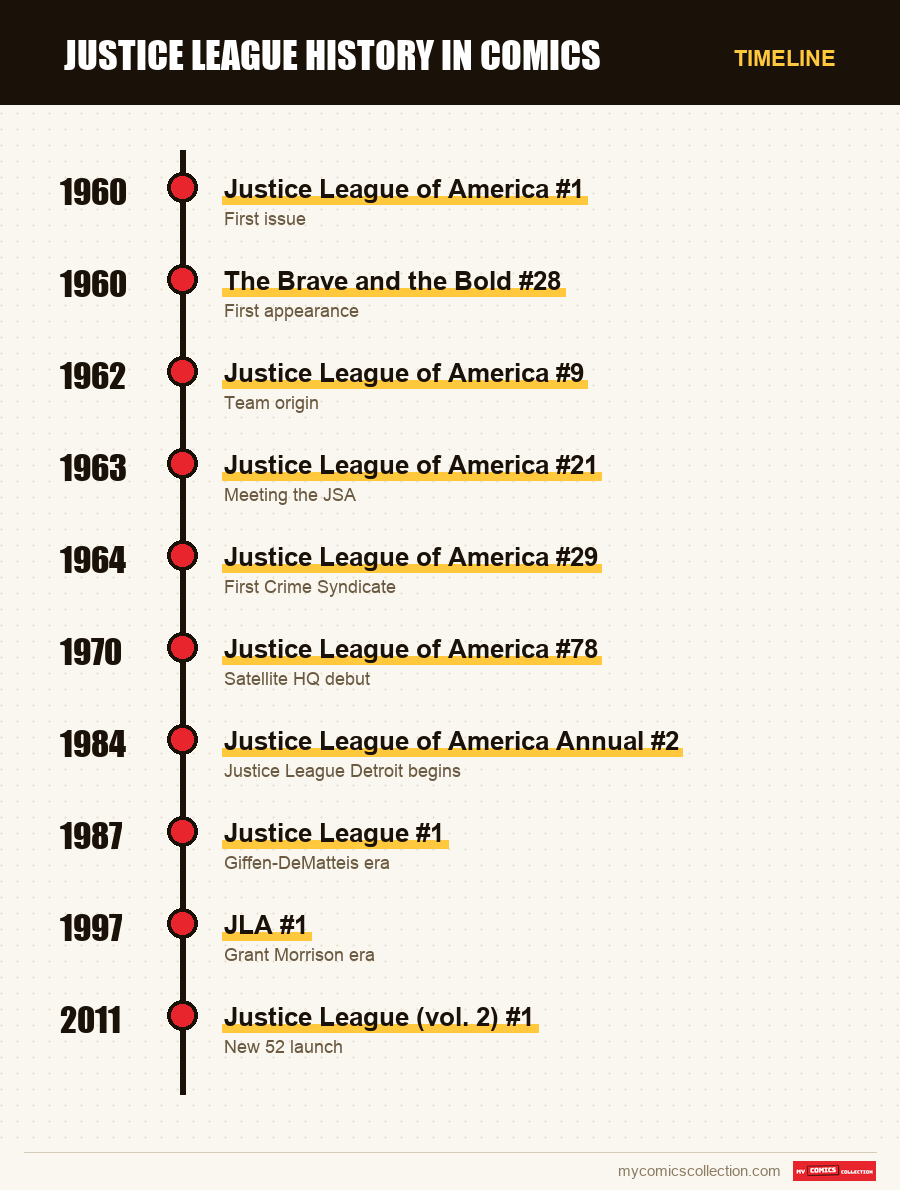
The Justice League was born in March 1960 in The Brave and the Bold #28, under the pen of Gardner Fox and the pencil of Mike Sekowsky, before obtaining its own title, Justice League of America, the same year. Since then, the concept has spanned at least six major editorial eras (1970s satellite Silver Age, 1987 comedy revival Detroit, Grant Morrison's "Big Seven" in 1997, then the New 52 in 2011) each redefining the formula of DC Comics' most famous supergroup.
Unlike a simple catalog of superheroes gathered on a cover, Justice League is above all an editorial idea: that of bringing together in the same story the best-selling characters from the same shared universe. This idea, now banal as it has been copied by the entire industry, was still risky in 1960. Understanding its history means understanding how DC Comics constructed, corrected and relaunched its flagship concept for more than six decades, with direct consequences on the value of the comics that mark its journey.
This article traces the complete chronological thread of the Justice League as a publishing franchise: its birth in the wake of the superhero revival of the 1950s, its major creative overhauls, its founding crossovers with the Justice Society, and the influence of television and film adaptations on collector demand. For a different approach, focused on the precise numbers to search for and their odds, our guide to keys from the Justice League remains the additional reference to consult alongside this historical retrospective.
Historical and editorial context: how DC came to create the Justice League
The idea of a supergroup didn't start with the Justice League. As early as the 1940s, DC (then National Comics) had brought together its heroes of the Golden Age within the Justice Society of America in the pages of All-Star Comics. But the superheroic genre had collapsed commercially at the turn of the 1950s, victim of competition from horror and western comics, then the moral crusade led by psychiatrist Fredric Wertham. Most of the superhero titles had disappeared from the shelves.
The reboot comes from a specific editor: Julius Schwartz. In 1956, he relaunched Flash with a new identity, Barry Allen, in Showcase #4, a success which officially opens what historians call the Silver Age. Green Lantern, reinvented in the guise of Hal Jordan, followed in 1959. Building on these individual relaunches, Schwartz entrusted screenwriter Gardner Fox, already author of Justice Society twenty years earlier, with the mission of assembling the DC heroes once again into a single team, this time for the modern era. The choice of the essay title, The Brave and the Bold, then served as a showcase for new concepts before they merited, or not, their own series.
Brave and the Bold #28: the birth certificate
It is therefore in The Brave and the Bold #28, dated March 1960 and went on sale in late January of the same year that the Justice League of America first appeared. The story, written by Gardner Fox and drawn by Mike Sekowsky (cover by Sekowsky and Murphy Anderson), brings together Superman, Batman, Wonder Woman, Flash, Green Lantern, Aquaman and Martian Manhunter against Starro the Conqueror, a giant, telepathic starfish who remains, even today, one of the most recognizable antagonists in the DC Universe. The issue therefore marks a double first appearance: that of the Justice League itself and that of Starro.
This number is one of the absolute pillars of the Silver Age market today. A certified CGC 9.6 copy (the highest grade ever given to this comic, a unique copy in the CGC census) sold for $750,000, a record then surpassed by a transaction at $810,000 for the same title. These figures illustrate the extent to which the market values not only the first appearance of a founding concept, but also its extreme rarity in very high conservation: the census only counts one 9.4 and three copies in 9.2, which makes any authentic NM copy almost impossible to find.
The official birth: Justice League of America (1960-1969)
The success of Brave and the Bold #28 pushes DC to launch a dedicated title at the end of 1960: Justice League of America #1, dated October-November 1960, still signed by Gardner Fox on the screenplay and Mike Sekowsky on the drawings, with a cover by Murphy Anderson. This issue also introduces Despero, one of the team's great recurring adversaries, and establishes the formula that will become the norm for the entire decade: a threat on a planetary or cosmic scale, too vast for a single hero, which justifies the union of the biggest names in the DC stable. This first issue is now in twentieth place in Overstreet's ranking of the fifty best Silver Age comics, an indicator of its status as an essential collector's item, regardless of its financial rating.
The decade saw the original team (Superman, Batman, Wonder Woman, Flash, Green Lantern, Aquaman and Martian Manhunter) gradually enriched with new members, while retaining its base of operations, the secret cave and then the famous orbiting satellite introduced a little later. But the most structuring event of this first decade remains editorial as much as narrative: the meeting, in 1963, with the sister team of the golden age.
1963: The Justice League meets the Justice Society, and the DC multiverse is born
In Justice League of America #21 (August 1963) and #22 (September 1963), still written by Gardner Fox, the Justice League of Earth-One faces the Crime Champions (Chronos, Doctor Alchemy and Felix Faust) while the Justice Society of Earth-Two, reactivated for the occasion, fights a parallel threat on its own world. A session held by the Justice League over a crystal ball eventually brought the two teams together in a story remembered as "Crisis on Earth-One" and "Crisis on Earth-Two". This diptych officially introduced the word "Crisis" into the DC lexicon, which would later become the title of the mega-series that would overhaul the entire editorial universe in 1985. It also inaugurated a tradition of annual crossover between the two teams which would continue until the mid-1980s, and laid the conceptual foundations of the DC multiverse as we still know it today.
Satellites in Detroit: expansion and the creative crisis of the 1970s and 1980s
The 1970s saw the Justice League settle in an orbital satellite, symbol of a team now all-powerful and disconnected from daily terrestrial concerns: an effective narrative choice to justify recurring cosmic threats, but which ends up distancing the title from a readership looking for more embodied characters. At the beginning of the 1980s, successive screenwriters sought to reinject humanity into the formula.
The most radical turning point came in 1984 with the arrival of screenwriter Gerry Conway and artist Chuck Patton, who virtually dissolved the original team to rebuild it in Detroit. In Justice League of America Annual #2 (October 1984), only Aquaman, Elongated Man, Martian Manhunter and Zatanna remain historical figures; they are joined by new or little-used characters (Vixen, Steel (Hank Heywood III, grandson of the Golden Age hero Commander Steel), Vibe and Gypsy) in a base installed in an abandoned factory loaned by Heywood. This "Justice League Detroit", which runs until issue #261, remains one of the most controversial periods in the title's history: hailed at the time for its creative risk-taking, it is mainly studied today as a counter-example, illustrating the limits of a supergroup deprived of its headliners. In terms of collecting, these issues remain much less sought after than the publications surrounding the original team, except for collectors specializing in the first appearances of Vibe or Steel.
This period of creative hesitation ends with Crisis on Infinite Earths (1985-1986), the maxi-series by Marv Wolfman and George Pérez which merges the entire DC multiverse (Earth-One, Earth-Two and the other parallel worlds) into a single continuous universe. The event puts a definitive end to the tradition of annual JLA/JSA crossovers born in 1963, since the two teams now share the same timeline.
1987: the humorous renaissance of Giffen and DeMatteis
In the wake of Crisis on Infinite Earths, DC is relaunching a large part of its catalog. Justice League returned in May 1987 under a completely new tone, entrusted to Keith Giffen (essentially a designer until then, promoted here to co-writer and designer of the narrative structure), to J.M. DeMatteis for the screenplay and to Kevin Maguire for drawing. Issue #1 shows the team forming for the first time before rescuing the United Nations from a terrorist hostage situation. The title is renamed Justice League International from the seventh issue, reflecting the ambition of a team that is now global and no longer just American.
Forced by editorial conflicts to deal with second-rate characters rather than with house icons, Giffen and DeMatteis transformed this constraint into a stylistic signature: the tone became resolutely comic, carried by reinvented characters like Guy Gardner, transformed into an arrogant hothead, Booster Gold, more greedy and clumsy than ever, or even a Captain Marvel with a childish personality. This "Bwah-Ha-Ha era", nicknamed by fans in reference to a recurring laugh in the title pages, remains cult today for its writing and the play of facial expressions of Kevin Maguire, more than for the rating of its issues, generally more affordable than the Silver Age publications.
Grant Morrison and the Return of the Heavyweights (1996-2000)
After a decade of fragmentation into several parallel titles (Justice League Europe , Justice League Task Force , Extreme Justice...), DC refocused the franchise in 1996-1997 around a new title soberly titled JLA. Screenwriter Grant Morrison, supported by artist Howard Porter and inker John Dell, put the first issue on sale on November 6, 1996 (dated January 1997). Morrison's bet is the opposite of that of 1987: to go back to basics by bringing together what fans will call the "Big Seven" (Superman, Batman, Wonder Woman, Flash (then Wally West), Green Lantern (then Kyle Rayner), Aquaman and Martian Manhunter) presented as the ultimate defenders of the planet in the face of threats on a cosmic scale, operating from a new base, the Lunar Watchtower.
The opening issue, which features the infiltration of Earth by the Hyperclan, a group of fake alien heroes actually affiliated with the White Martians, exceeded 100,000 copies sold through Diamond Comic Distributors, making JLA #1 best-selling DC title of the month. This commercial success confirms, almost forty years later Brave and the Bold #28, the intact relevance of the original formula: bringing together the headliners rather than dispersing them.
The New 52 and the modern era (2011-present)
In 2011, DC Comics completely relaunched its editorial continuity under the banner of "New 52", and chose Justice League as the locomotive of the operation. Screenwriter Geoff Johns and artist Jim Lee sign this new issue 1, which recounts the very first meeting between Batman and Green Lantern (Hal Jordan) and lays the foundations for a redesigned origin of the team in a DC universe rebooted from scratch after the event Flashpoint. Buoyed by the notoriety of the two creators and by the scale of the editorial relaunch, this issue quickly became a pillar of the collection for readers who entered the hobby via the 2010s, even if its availability, mass edition and multiple printing, places it in a category of rarity very different from Silver Age publications.
The following years saw several notable arcs succeed one another (Throne of Atlantis, Darkseid War) then, from 2016, the “Rebirth” era which reconciles part of the pre-New 52 heritage with modern continuity. Today, the Justice League continues to exist in parallel in several formats: main title, derivative series centered on sub-teams, and incarnations linked to major DC events, perpetuating sixty-five years after its debut the same founding logic: bringing together the strongest characters from the DC stable as soon as a threat exceeds the capabilities of a single hero.
The impact of adaptations on the rating
Few DC concepts have benefited as much from exposure outside of print as Justice League, and this exposure directly influenced demand in the collectible market. From 1973, the ABC channel broadcast Super Friends, produced by Hanna-Barbera, which adapts Justice League and its universe for Saturday mornings: the series totaled nine seasons and 93 episodes until 1985, introducing several generations of young American viewers to DC heroes long before they read a single comic book.
The relay was taken in 2001 by the animated series Justice League on Cartoon Network, which extends the universe already constructed by Batman: The Animated Series and Superman: The Animated Series , before evolving into Justice League Unlimited. This iteration, praised for the quality of its writing and its relative fidelity to the comics, has lastingly shaped the image of the team for an entire generation of collectors who are now adults, helping to maintain the demand for the comics of the 1990s which inspired its aesthetic.
The big cinematic turning point came in 2017 with Justice League, worn by Zack Snyder then completed by Joss Whedon after the director's departure. The film brought in $661.3 million in worldwide revenue, a result considered disappointing given a break-even point estimated at $750 million given its production budget. Far from closing the subject, this commercial failure triggered an unprecedented mobilization of fans, the #ReleasetheSnyderCut movement, which resulted in the broadcast in March 2021 of Zack Snyder's Justice League on the HBO Max platform: a four-hour version financed by an additional $70 million in visual effects, editing and music, which became the fourth most streamed film on the platform that year and was generally better received by critics than the 2017 version.
This episode illustrates a classic phenomenon of the vintage comic market: each peak of media exposure (theatrical release, casting announcement, broadcast of a trailer) generates an upsurge in searches and purchases on the founding comics of the team, in particular Brave and the Bold #28 and Justice League of America #1, two titles whose record sales mentioned above were also concentrated in the years following these peaks of attention. A collector who follows the news of DC adaptations thus has a reliable signal to anticipate windows where demand, and therefore prices, tend to rise on the secondary market.
Collecting this series?
Track what you own, what you are missing and what your collection is worth. 7 day trial.
Start my trial →Buying guide
Building a coherent Justice League collection requires clearly distinguishing between the different editorial eras described above, each having its own scale of rarity and price. Here are the essential points to watch out for before investing in a number:
- Identify the correct volume and series."Justice League of America" (1960-1996), "JLA" (1997-2006), "Justice League" New 52 (2011-2016) and "Justice League" Rebirth designate distinct titles with numberings which each start from 1: always check the copyright year printed on the inside page before any purchase.
- Distinguish between first appearance and simple appearance of the team. An issue showing the Justice League on the cover does not have the same value as a first appearance of a character or concept (Starro and the Justice League itself in Brave and the Bold #28, Despero in JLA #1, the multiverse in JLA #21-22): it is the narrative novelty, not the simple presence of the team, that increases the rating.
- Be wary of reissues and facsimile editions. DC has reprinted several classics, including Justice League of America #21, in the form of a "Facsimile Edition": these modern reprints, recognizable by their explicit mention on the cover or title page, do not have the value of a period copy and must be purchased with full knowledge of the facts, never as a substitute for the original.
- Check the restoration on Silver Age examples. Issues from the 1960s, in particular Brave and the Bold #28 and Justice League of America #1, sometimes circulate restored (spine regluing, corner reinforcement) without the seller always clearly mentioning this: favor CGC or CBCS certified copies with the mention "Universal" rather than "Restored" if you are aiming for an investment copy.
- Consider team transition numbers. The beginnings of the Detroit era (JLA Annual #2), the Justice League International (Justice League #1, 1987) or the New 52 (Justice League #1, 2011) mark changes in editorial direction that are clearly identifiable and sought after by thematic collectors, even when their high circulation limits their potential for long-term added value.
- Cross this chronological approach with an approach by number. To precisely target publications with the highest added value rather than an entire era, complete this historical reading with our guide to keys from the Justice League, which details first appearances and rarity markers number by number.
- Use a tracking tool to organize your acquisitions. On such a long franchise, with so many volumes and reminders, keeping an accurate inventory avoids duplicates and oversights: our collection management application allows you to catalog each number acquired, era by era.
Key issues to know
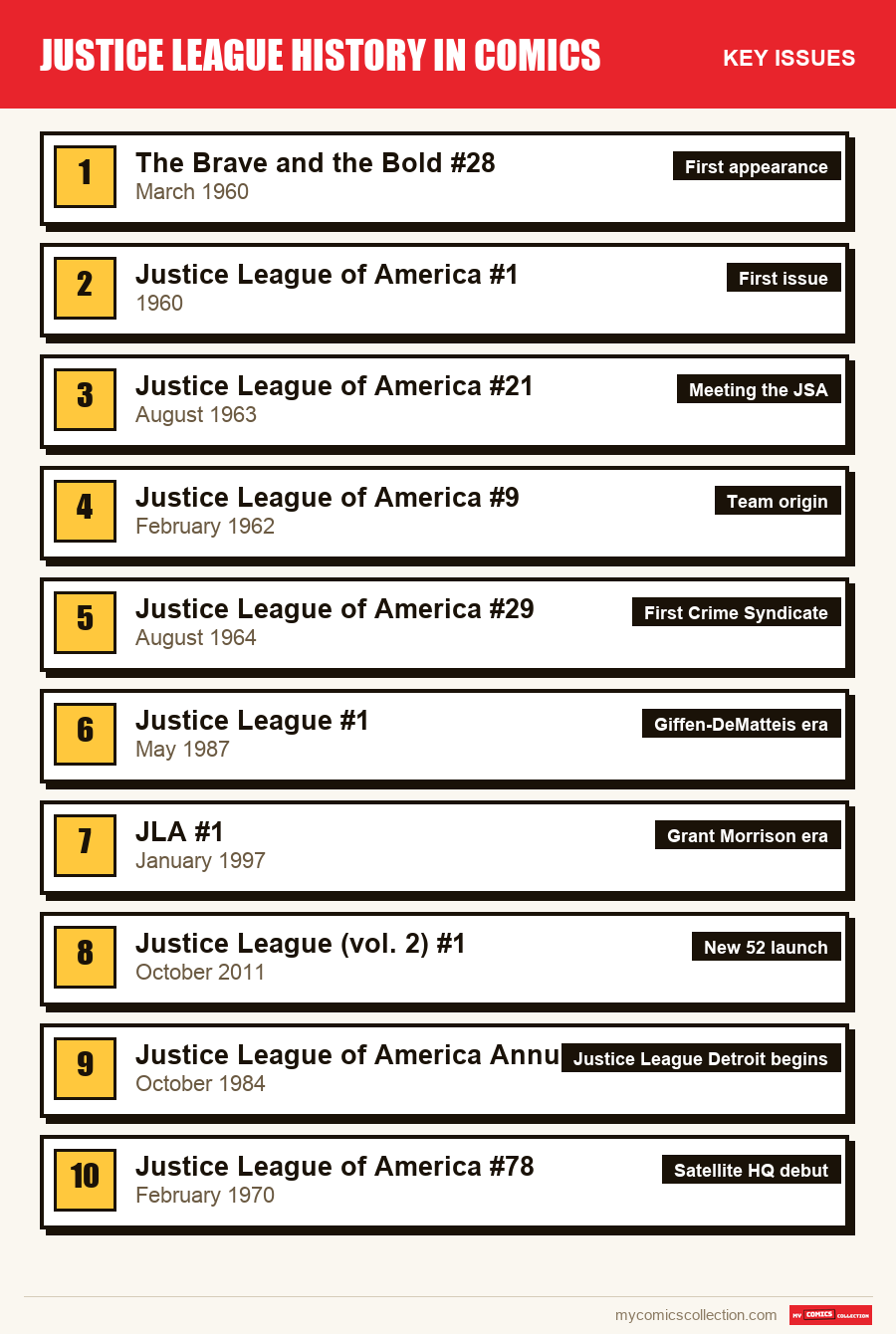
The Brave and the Bold #28
Gardner Fox and Mike Sekowsky bring together Superman, Batman, Wonder Woman, Flash, Green Lantern, Aquaman and Martian Manhunter for the first time against Starro the Conqueror. The issue also introduces Snapper Carr, the team's future mascot. It is the birth certificate of the Justice League of America.
Justice League of America #1
Cover-dated October-November 1960, this first issue of the team's ongoing title is again by Gardner Fox and Mike Sekowsky. It contains the first appearance of Despero, one of the League's great recurring foes. It sets the formula for the whole decade: a threat too big for any single hero.
Justice League of America #21
With "Crisis on Earth-One!", Gardner Fox and Mike Sekowsky deliver the first team-up between the Justice League and the Justice Society of Earth-Two. The story, which concludes in #22 (September 1963), introduces the Crime Champions. It launches the tradition of annual JLA/JSA crossovers and brings the word "Crisis" into DC's vocabulary.
Justice League of America #9
For the League's third anniversary, Gardner Fox and Mike Sekowsky finally tell how the team came together. The founding members join forces against the invaders from the planet Appellax. It is the Justice League's official Silver Age origin story.
Justice League of America #29
In "Crisis on Earth-Three!", Gardner Fox and Mike Sekowsky introduce the Crime Syndicate of America, evil counterparts of the League from Earth-Three. That world, where the heroes are criminals, appears here for the first time. The Syndicate keeps returning right up to the modern era.
Justice League #1
Keith Giffen, J.M. DeMatteis and Kevin Maguire relaunch the team after Crisis on Infinite Earths with a decidedly comic tone. The issue features the first appearance of Maxwell Lord, and the title becomes Justice League International from #7. Its cover has been parodied and homaged countless times.
JLA #1
Grant Morrison and Howard Porter reunite DC's seven pillars: Superman, Batman, Wonder Woman, Flash (Wally West), Green Lantern (Kyle Rayner), Aquaman and Martian Manhunter. They face the Hyperclan, alien false heroes who make their first appearance here. The issue gives the franchise a lasting new start.
Justice League (vol. 2) #1
Geoff Johns and Jim Lee deliver the flagship title of the New 52 relaunch, which restarts the whole DC universe after Flashpoint. The story shows the first meeting between Batman and Green Lantern (Hal Jordan), the first step in a reimagined League origin. Its huge print run makes it a very accessible issue.
Justice League of America Annual #2
Gerry Conway and Chuck Patton have Aquaman disband the League and re-form it with Martian Manhunter, Zatanna and Elongated Man. Vixen joins them, and the issue introduces Vibe, Gypsy and Steel (Hank Heywood III) as the team moves to Detroit. The regular series follows this lineup from #233.
Justice League of America #78
Dennis O'Neil and Dick Dillin move the Justice League into a satellite orbiting Earth, complete with its teleporter system. This base becomes the team's symbol throughout the 1970s. It is destroyed in 1984, paving the way for the Detroit era.