
Martian Manhunter (J'onn J'onzz) is created by screenwriter Joseph Samachson and artist Joe Certa. It appears for the first time in Detective Comics #225 (November 1955), as a companion story titled “The Strange Experiment of Dr. Erdel.” A founding member of the Justice League (Brave and the Bold #28, March 1960, then Justice League of America #1, October-November 1960), he spans nearly seven decades of editorial history, between long crossings of the desert, cult solo series and persistent rumors of an appearance in James Gunn's DCU.
There are DC characters whose name alone evokes a silhouette, a color, a posture. Martian Manhunter belongs to this very restricted category: green skin, red cape, the fixed gaze of a being who does not belong to any world. However, unlike Superman or Batman, his editorial career has never been linear. It is a story made up of troughs and resurgences, of decades of anonymity followed by daring relaunches, and a status of “forgotten founding member” which has stuck to its legend since the 1950s.
For a collector, this editorial irregularity is precisely what makes Martian Manhunter exciting to follow. Unlike omnipresent characters whose every issue is scrutinized, J'onn J'onzz has experienced long periods of commercial silence interspersed with clearly identifiable pivotal moments: his creation in 1955, his entry into the Justice League in 1960, his first miniseries in 1988, his first ongoing series in 1998, his relaunch in 2015, and today the feverish wait for his possible arrival on screen in James Gunn's DCU. Each of these milestones has left a precise trace in the catalogs and in the ratings.
This article retraces, issue by issue and decade by decade, the real editorial history of Martian Manhunter: its genesis at DC in the mid-1950s, its role in the founding of the Justice League, its long absence from newsstands between 1968 and the beginning of the 1980s, its attempts at a solo relaunch, and the (still hypothetical) effect that a cinematic appearance could have on collector demand.
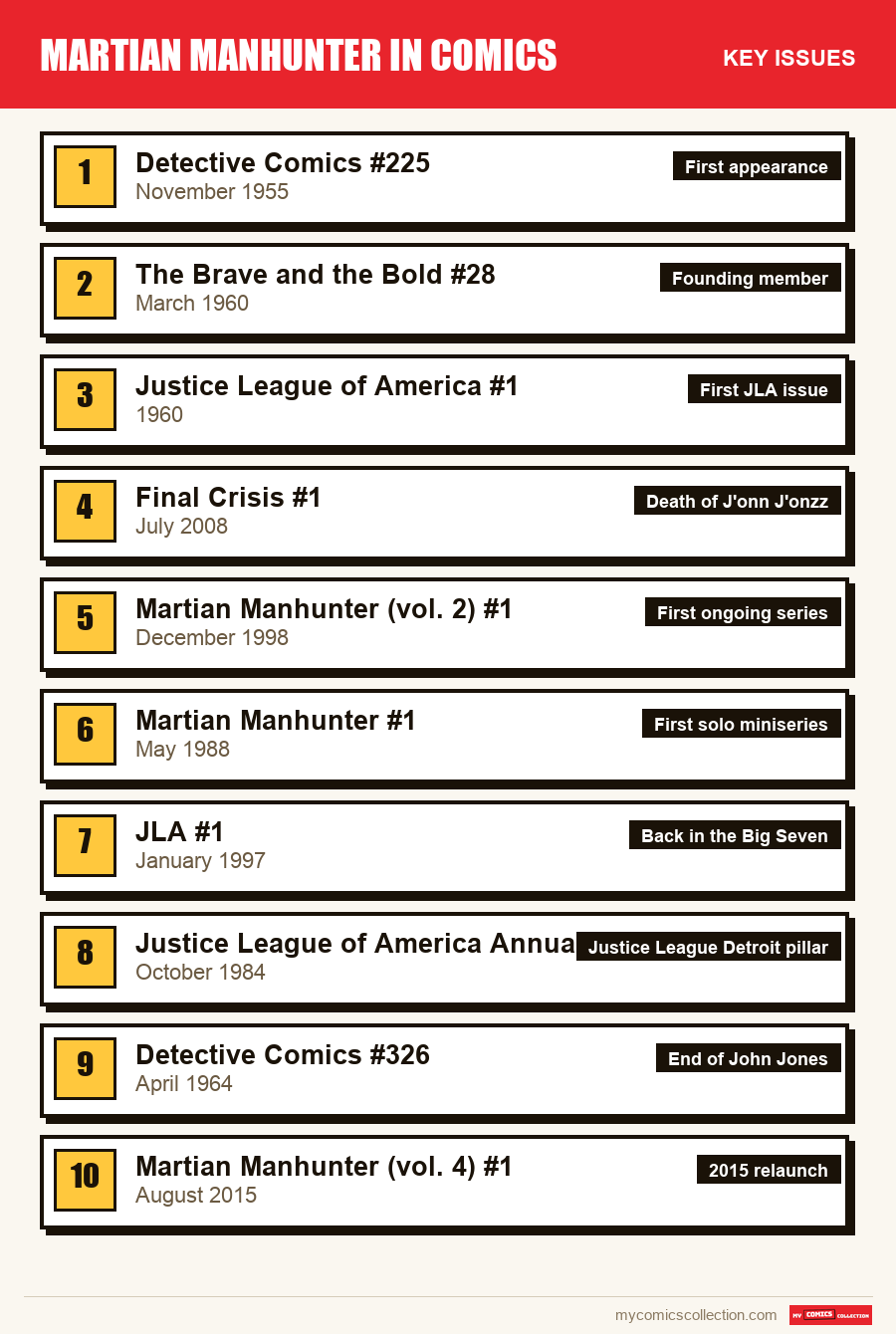
From the quiet origins of Detective Comics to the founding of the Justice League
Martian Manhunter was born in a very particular context in the history of DC Comics. In November 1955, the house published Detective Comics #225, an issue whose cover highlights Batman and Robin, as has been customary since the creation of the title. But on the interior pages, in the position of a complementary story, there is a short story signed by the screenwriter and scientist Joseph Samachson and illustrated by the artist Joe Certa: “The Strange Experiment of Dr. Erdel”.
The founding pitch fits into a few boxes: Professor Saul Erdel, in his laboratory in the fictional town of Middletown, develops an experimental teleportation ray. The device, supposed to be a simple test, mistakenly sucks in a green-skinned humanoid being from the planet Mars: J'onn J'onzz. Panicked by this unknown creature, in shock, Erdel dies instantly of a heart attack, and J'onn finds himself alone, stranded on a planet that is not his, with no way to return home. Endowed with powers of metamorphosis, he chooses to adopt a human appearance and live incognito under the identity of John Jones, Middletown police detective.
This initial premise (a solitary exile, the last representative of a vanished civilization, forced to blend into a humanity that he observes from the inside) will remain the backbone of the character for seven decades, whatever the alterations made to his continuity. Samachson and Certa continue the adventure in the form of a regular supplementary story in Detective Comics, a modest format, far from the covers, which largely explains why Martian Manhunter never benefited from the same editorial relief as the star heroes of the time.
The turning point came in the spring of 1960. In The Brave and the Bold #28 (March 1960), scripted by Gardner Fox and drawn by Mike Sekowsky, DC brings together its leading figures for the first time around a common threat: Starro the Conqueror, a giant alien starfish capable of creating clones in his image to enslave the planet. This issue marks the first-ever appearance of the Justice League of America as a team, with an original lineup of seven members: Superman, Batman, Wonder Woman, Flash (Barry Allen), Green Lantern (Hal Jordan), Aquaman, and Martian Manhunter. J'onn J'onzz is therefore part of the founding core of DC's most famous supergroup from its very first written gathering.
A few months later, the Justice League got its own regular title with Justice League of America #1 (October-November 1960), which also contains the origin and first appearance of the highly sought-after supervillain Despero. This issue now ranks 20th in Overstreet's ranking of the fifty best comics of the Silver Age, a recognition that speaks to its status as a cornerstone of DC mythology, and by extension, an important milestone for any collector following Martian Manhunter since its debut.
From gradual disappearance to crossing the desert (1968-1984)
The paradox of Martian Manhunter lies in this striking contrast: a founding member of a team which will become one of the most profitable in the history of comics, he nevertheless remains, individually, one of the least highlighted characters of his time. Its series of companion stories in Detective Comics continued throughout the 1960s, eventually migrating to House of Mystery, before being abandoned altogether in 1968.
There followed a period of almost fifteen years during which Martian Manhunter did not benefit from any regular support. He certainly continues to appear occasionally in the pages of the Justice League of America or in collective stories, but without ever regaining the exposure he had experienced in his beginnings. This prolonged eclipse lastingly shapes the perception of the character among the general public: a founder of the League, certainly, but a founder who is rarely associated with significant series, unlike a Batman or a Green Lantern who never left the shelves.
It wasn't until 1984, as the original Justice League fell apart in the pages of the DC continuity of the time, that Martian Manhunter returned to take center stage. Alongside Aquaman, he takes charge of the reconstruction of a completely new formation, composed almost exclusively of new or secondary characters, installed in Detroit: an episode that fans retrospectively nickname the "Justice League Detroit". This turn marks the definitive return of J'onn J'onzz to the forefront of the DC universe: since this date, he has never left the spotlight for a long time, whether as a recurring member of the various incarnations of the League or as the protagonist of his own stories.
1998: the first solo series, finally
It was not until more than forty years after its creation that Martian Manhunter obtained, for the very first time, an ongoing series entirely dedicated to his character. In 1998, DC Comics launched Martian Manhunter, written by John Ostrander and drawn by Tom Mandrake, a creative duo known for their work on tortured and morally complex characters like Specter and Suicide Squad.
This series marks a major narrative turning point for the character. Ostrander significantly deepens the mythology of the Green Martians, explores J'onn's trauma in the face of the near-total extinction of his species, and establishes the idea that the hero maintains several secret identities scattered across the world, particularly in the southern hemisphere, far from the radar of traditional US-based superheroes. The character gains an unprecedented psychological depth: more than just a loyal ally of the Justice League, he becomes a haunted survivor, inhabited by guilt and mourning, whose deadpan humor (and pronounced taste for Chocos cereal, which has become an emblematic running gag) contrasts with the gravity of his past.
The series lasted several years before being stopped, due to a lack of sufficient readership to justify its continuation in the face of competition from more commercial series of the time: a fate which, ironically, once again illustrates the chronic difficulty of Martian Manhunter to establish itself commercially as a headliner, despite the recognized quality of the work of Ostrander and Mandrake, today considered by a large part of the fandom as the best solo incarnation of the character.
The New 52 relaunch of 2015 and the repositioning of the myth
Nearly twenty years after the Ostrander/Mandrake series, DC is retrying the solo experience with Martian Manhunter (2015), launched in June of that year (cover-dated August) as part of the New 52 era, under the pen of screenwriter Rob Williams and the pencil of Eddy Barrows, accompanied by inking by Eber Ferreira. This iteration adopts a decidedly different tone from the previous ones: it directly questions the reliability of everything readers thought they knew about the character, by setting up a paranoid thriller plot around a covert Martian invasion, where shapeshifting Martians discreetly infiltrate human society.
The first six issues are collected in the collection "The Epiphany", followed by a second arc collected under the title "The Red Rising". If this relaunch did not meet with resounding commercial success, it has the merit of offering a modern and autonomous entry point into the mythology of the character, without requiring in-depth knowledge of its previous continuity: a significant point for any reader or collector wishing to discover J'onn J'onzz without going back to the comics of the 1950s or 1990s.
The impact of adaptations on the rating
Martian Manhunter occupies a unique position in the history of DC television and film adaptations: he appears regularly, but almost always in the background, which explains why his appearance on screen has never provoked the same speculative excitement as Batman or Superman.
In Smallville, actor Phil Morris plays a version of the character presented as an old friend of Jor-El who comes to watch over Kal-El and intervene when needed; the character temporarily loses his powers before they are restored to him by Doctor Fate. In the Arrowverse, it is David Harewood who lends his features to J'onn J'onzz, first hidden under the identity of Hank Henshaw, director of the DEO in the series Supergirl, before also appearing in The Flash, Arrow and Legends of Tomorrow: the most developed and recurring version of the character on screen to date.
On the cinema side, Harry Lennix plays Martian Manhunter in Zack Snyder's Justice League (2021), the long version broadcast on HBO Max. The plot twist reveals that the character was actually hiding under the guise of General Swanwick, a supporting role that Lennix already played in Man of Steel (2013) and Batman v Superman: Dawn of Justice (2016): an idea initially carried by a fan theory before being officially integrated into Snyder's continuity.
As for the current DCU piloted by James Gunn, no appearance of Martian Manhunter is officially confirmed at the time we publish this article (July 2026). The character does not appear in Superman (2025). On the other hand, the clues have multiplied: James Gunn has repeatedly published on social networks direct references to Chocos cereals, the character's favorite brand in the comics, fueling speculation of an arrival in "Man of Tomorrow", the fourth feature film of the DCU expected for July 2027. Casting rumors have also circulated, without official confirmation from DC Studios to date. For a collector, this climate of anticipation deserves to be followed closely, but without giving in to haste: as long as no official confirmation exists, any variation in price linked to this rumor remains strictly speculative in nature.
Collecting this series?
Track what you own, what you are missing and what your collection is worth. 7 day trial.
Start my trial →Buying Guide: How to Approach the Martian Manhunter Collection
Collecting Martian Manhunter requires a different approach from that applied to DC's most high-profile heroes: the offer is less abundant on major milestones, but the accessible entry points are numerous for those who want to build a coherent collection without breaking the bank.
- Identify the three distinct milestones of 1955-1960: Detective Comics #225 (first appearance of the character, November 1955), The Brave and the Bold #28 (first appearance of the Justice League as a team, March 1960), and Justice League of America #1 (first issue of the team's solo title, October-November 1960, with the first appearance of Despero). These are three different issues, with distinct rarity and demand profiles: don't confuse them when making a purchase.
- On Detective Comics #225, systematically check for the presence of a restoration. As this is a 1955 comic over 70 years old, predating the Silver Age, copies not restored to high grade are rare; a blue CGC label (“Universal”) guarantees the absence of restoration, while a “Qualified” or “Restored” label should result in a significantly lower price.
- The 1998 Ostrander/Mandrake series remains an affordable entry point to experience the most accomplished exploration of character psychology, without the price tag of 1950s or Silver Age milestones.
- The 2015 New 52 relaunch (Williams/Barrows) is a modern gateway, easy to find in TPB ("The Epiphany", "The Red Rising"), ideal for those who want to read the character's story without investing in vintage copies.
- Keep an eye out for DCU announcements: an official casting confirmation for “Man of Tomorrow” (2027) could generate a one-off surge of interest in the key numbers listed above. It is better to buy in advance, based on the actual rarity of the issue, than to chase an increase once the announcement is made.
- Before any purchase, cross-reference several price sources (recent sales rather than asking prices) to avoid overpaying for an issue based solely on an old catalog rating.
To track real price developments on key issues of Martian Manhunter, the site's free estimator relies on current eBay listings rather than theoretical list prices, which makes it possible to obtain a realistic low, middle and high range before positioning yourself on an auction or an offer. It's also a good idea to keep your collection up to date: collection management application of the site allows you to centralize your numbers and track their valuation over time, which is particularly useful for a character whose rating can change quickly in the event of a cinematographic announcement.
Key issues to know
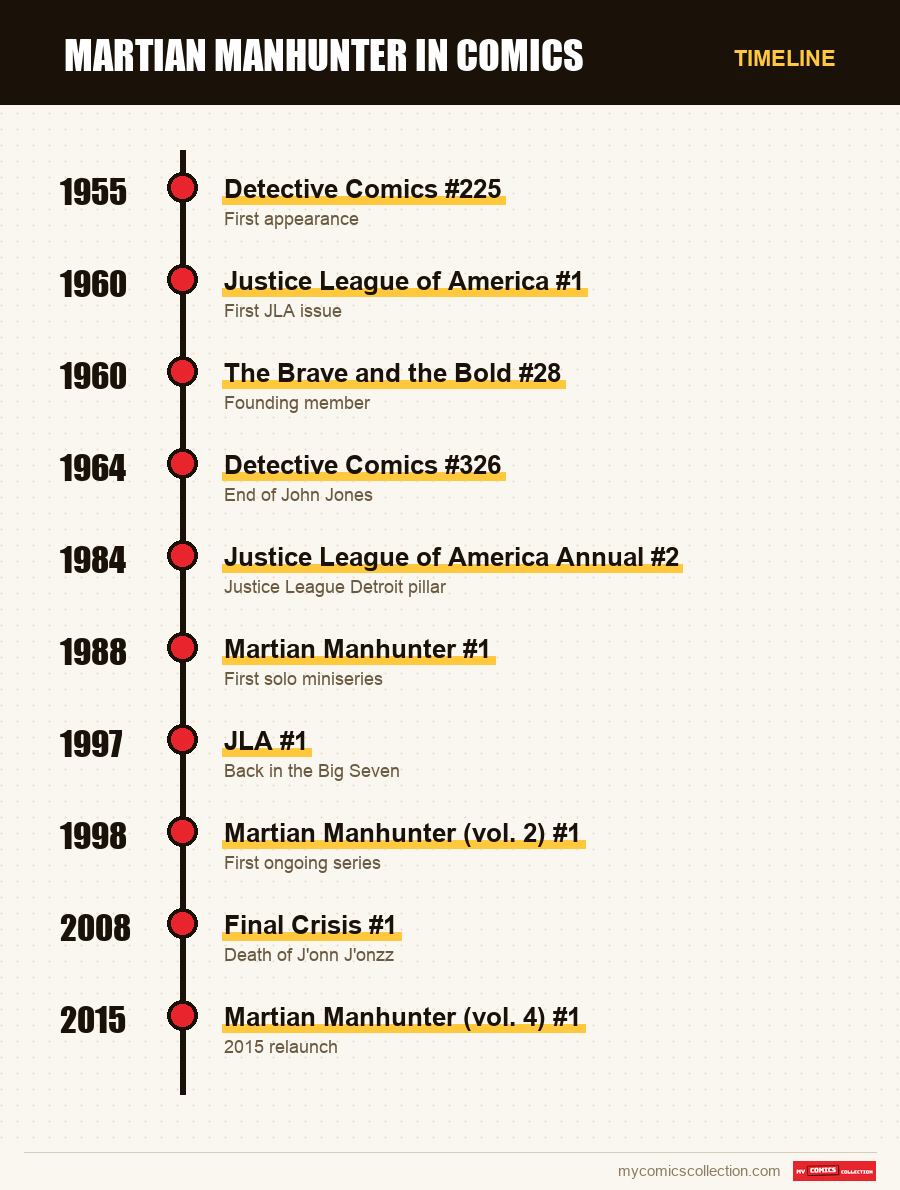
Detective Comics #225
In the backup story "The Strange Experiment of Dr. Erdel", Joseph Samachson and Joe Certa introduce J'onn J'onzz, pulled from Mars by Dr. Erdel's teleportation beam. The scientist dies of shock, and the stranded Martian becomes detective John Jones. It is the character's ultimate key issue.
The Brave and the Bold #28
Gardner Fox and Mike Sekowsky assemble the Justice League of America for the first time against Starro the Conqueror. Martian Manhunter is one of the seven original members, alongside Superman, Batman, Wonder Woman, Flash, Green Lantern and Aquaman. It is his first step beyond the backup stories.
Justice League of America #1
Cover-dated October-November 1960, this first issue of the League's ongoing title, by Gardner Fox and Mike Sekowsky, counts Martian Manhunter in its lineup. It contains the first appearance of Despero. For a collector of the character, it is the milestone that comes right after Brave and the Bold #28.
Final Crisis #1
In the first issue of Final Crisis, by Grant Morrison and J.G. Jones, Martian Manhunter is captured and murdered by Libra, who wants to prove himself to the Secret Society of Super-Villains. His death opens the event and is explored further in the one-shot Final Crisis: Requiem. The character later returns in Blackest Night and Brightest Day.
Martian Manhunter (vol. 2) #1
Following a #0 cover-dated October 1998, John Ostrander and Tom Mandrake launch the character's very first ongoing series. They deepen the mythology of the Green Martians and J'onn's grief over the loss of his people. The series runs 38 issues in all.
Martian Manhunter #1
J.M. DeMatteis and Mark Badger give the character his first title under his own name, a four-issue miniseries. It deeply redefines his psychology and origin, revealing among other things that Dr. Erdel did not die. It is the first title devoted to J'onn J'onzz, ten years before the ongoing series.
JLA #1
Grant Morrison and Howard Porter put Martian Manhunter back among the League's seven heavy hitters. The team faces the Hyperclan, a group of White Martians posing as heroes, which puts J'onn at the heart of the story. The issue opens one of the League's most memorable eras.
Justice League of America Annual #2
Gerry Conway and Chuck Patton have Aquaman disband the League and re-form it with those ready to commit fully: Martian Manhunter, Zatanna and Elongated Man. Joined by Vixen and newcomers Vibe, Gypsy and Steel, they set up in Detroit. J'onn regains a central role after years on the sidelines.
Detective Comics #326
In "The Death of John Jones, Detective", by Jack Miller and Joe Certa, the hero's human identity is presumed dead while fighting the Idol-Head of Diabolu, which makes its first appearance here. J'onn then gives up his police career. His feature leaves Detective Comics for House of Mystery starting with #143 (June 1964).
Martian Manhunter (vol. 4) #1
Rob Williams and Eddy Barrows, inked by Eber Ferreira, relaunch the character in a series with the tone of a paranoid thriller. The plot around a hidden Martian invasion questions everything readers thought they knew about J'onn, and the series gives him a new origin. It is a modern, self-contained entry point.