
The 2026 tier list of key issues Martian Manhunter ranks the numbers by valuation potential: Tier S blue-chip (Detective Comics #225 November 1955 Joe Samachson/Joe Certa first appearance J'onn J'onzz, The Brave and the Bold #28 February-March 1960 Gardner Fox/Mike Sekowsky JLA founding member, Justice League of America #1 October-November 1960 ongoing JLA, Martian Manhunter Vol 2 #1 December 1998 John Ostrander/Tom Mandrake): core assets at €800-100,000 depending on grade. Tier A (House of Mystery #143 June 1964 first Idol-Head of Diabolu, JLA #71 May 1969 departure from Earth, Justice League Annual #2 1984 Detroit era debut, Martian Manhunter Vol 1 #1 May 1988 mini-series). Tier B sleepers (Detective Comics #273 November 1959 Silver Age cover star, World's Finest #245 July 1977 backup feature, JLA: Year One #4 May 1998 retcon Mark Waid, Martian Manhunter Vol 4 #1 February 2015 Rob Williams New 52). Tier C speculative bets 2026-2027 (Justice League DCU James Gunn, Lanterns HBO Max tie-in).
Building a solid Martian Manhunter collection in 2026 requires rare methodological discipline: without rigorous prioritization of numbers, the collector disperses his budget on secondary issues while the J'onn J'onzz blue-chips, long undervalued due to the character's media modesty, continue their silent revaluation. The tier list separates must-have from nice-to-have, defensive investment from calculated gamble, purchasing urgency from opportunistic patience: a major tool when tackling a Silver Age catalog whose narrative depth far exceeds mainstream visibility.
Ce guide tier list Martian Manhunter 2026 classifies the major key issues into four tiers (S, A, B, C) according to three weighted criteria: narrative historical importance, market performance over five rolling years, and probability of DCU catalyst in the 2026-2030 window. Each issue is documented with exact date, creative team and price range by CGC grade. Objective: to allow the French-speaking collector to build a budgeted purchasing strategy, avoiding the classic pitfalls of the Martian Manhunter catalog (confusion Detective Comics #225 vs #226, multiplication of Martian Manhunter #1 between volumes, over-pricing of Silver Age covers without a real first appearance).
Martian Manhunter 2026 tier list methodology
A useful tier list does not simply align numbers in order of price: it prioritizes according to a coherent investment and collection thesis. For Martian Manhunter in 2026, three methodological axes structure the classification, with specificities linked to the atypical trajectory of the character: Silver Age hero relegated to backup feature for decades, then resurrected as a pillar of the modern Justice League by Grant Morrison in 1997, and now positioned as a potential Sun-Setting active for the decade 2026-2035.
Tier S/A/B/C classification criteria
- Narrative historical significance (40%): first appearances of structuring characters, founding events (team formation, death/resurrection, major retcon), canonical runs cited by academic criticism. For Martian Manhunter, the weighting includes the status of JLA founding member, often forgotten in favor of the publicized Superman/Batman/Wonder Woman formation.
- Market performance 5 years (35%): CGC price trend documented on GoCollect, Heritage Auctions, ComicConnect between 2021 and 2026. An issue that has doubled and then plateaued is not equivalent to an issue that is progressing linearly, nor to an issue that has been stagnant since 2018 but with an identified catalyst.
- Probability of DCU catalyst 2026-2030 (25%): proximity of the character with Chapter One DC Studios announcements under James Gunn, presence in confirmed HBO Max projects (Lanterns, Paradise Lost), traction of verifiable rumors on The Cosmic Circus, Murphy's Multiverse and The Direct.
Definition of third parties
- Tier S: blue-chip: central numbers, globally recognized value, no risk of historical downgrading. These are the defensive assets of the collection. If you could only own four Martian Manhunters, these would be them.
- Tier A: fundamentals: historically critical issues with solid performance but without the absolute status of Tier S. Make up the backbone of a serious collection, major beyond the three or four initial acquisitions.
- Tier B: sleepers with conviction: numbers undervalued in view of their significance, with catalyst identified at 12-36 months. Moderate risk, re-rating potential documented by internal comparables in the DC catalog.
- Tier C: speculative bets: numbers with a strong thesis but dependent on uncertain future events. Limited budget allocation recommended, never more than 15% of the annual Martian Manhunter budget.
Voluntary out-of-scope
This tier list does not classify secondary annuals without a documented first appearance, peripheral event crossovers (Crisis on Infinite Earths, Final Crisis), nor modern post-2015 variants which have lost any lasting speculative premium. Crossovers with other DC heroes are covered in the dedicated resources: to understand the JLA context, consult the history of the Justice League in comics and the key issues Justice League. For Silver Age equivalents, the tier lists Superman et Batman offer relevant comparables.
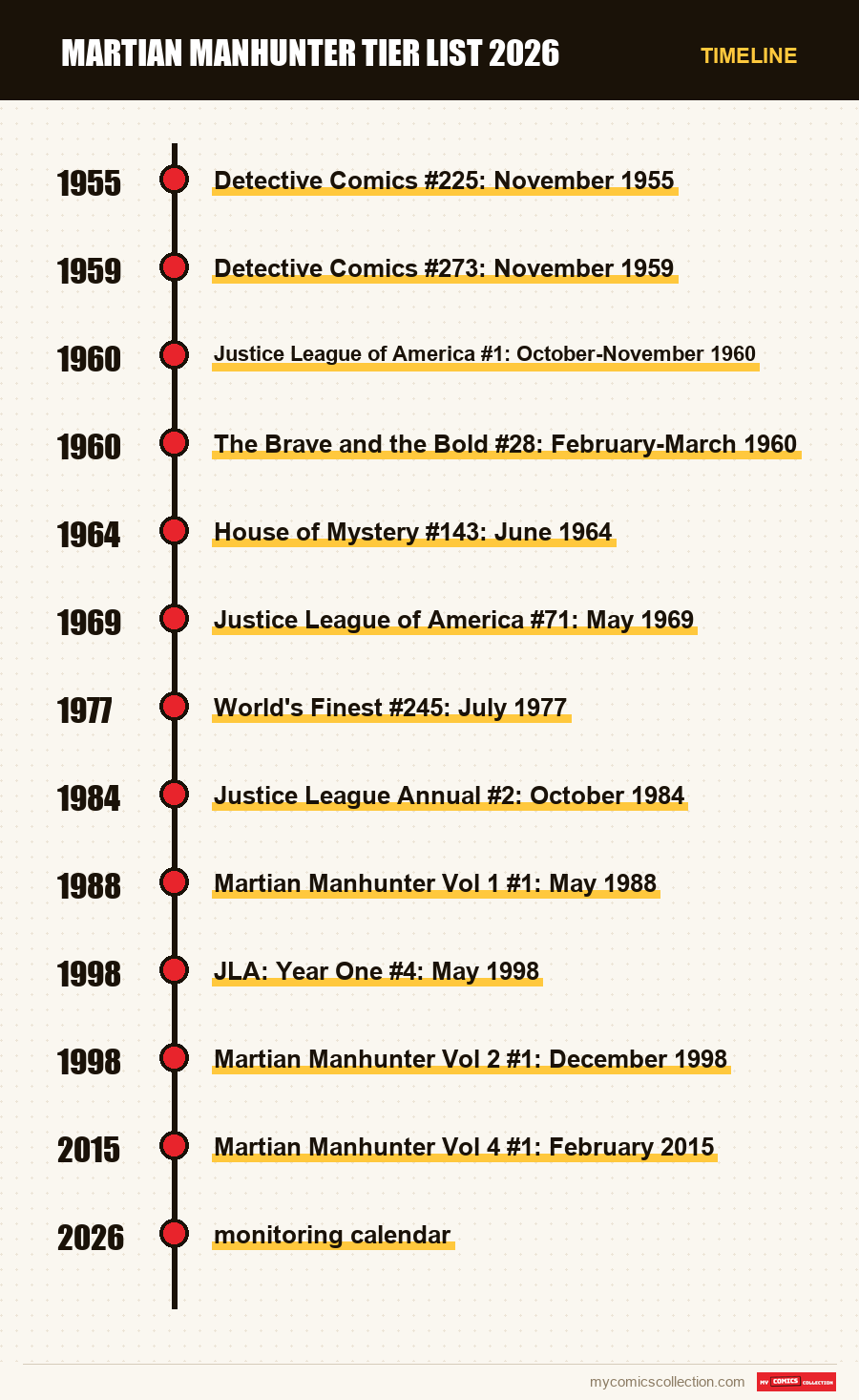
Tier S: the central Martian Manhunter blue-chips
Four issues absolutely dominate the Martian Manhunter catalog and constitute the defensive core of any serious collection. They combine absolute rarity in high grade, indisputable historical importance and maximum liquidity on major auction markets. The particularity of Tier S Martian Manhunter lies in its exceptional chronological spread: from 1955 to 1998, or 43 years, with a jump of 38 years between the second and fourth entry: a perfect illustration of the character's roller coaster trajectory.
Detective Comics #225: November 1955 (Joe Samachson / Joe Certa)
The founding number. Published by DC Comics in November 1955 under the aegis of Joe Samachson on screenplay and Joe Certa on art, Detective Comics #225 introduces J'onn J'onzz, the Martian Manhunter, in an eight-page backup feature entitled "The Manhunter from Mars". The initial pitch (a Martian accidentally teleported to Earth by an earthly scientist, who adopts the identity of detective John Jones) invents the archetype of the extraterrestrial superhero integrated into the forces of law and order, narrative predator of all the alien “police” heroes to come. The backup feature would become a signature of Detective Comics until 1964.
- CGC 9.0: public sales 2024-2026 between €80,000 and €100,000. Heritage Auctions documents a CGC 9.0 sale at $95,600 in May 2024. CGC 9.0 census less than 10 examples known worldwide.
- CGC 7.0: €22,000 to €32,000. It is the most accessible median grade for a high-end investment, with an expanded but still very limited census.
- CGC 6.0: €13,000 to €18,000. Institutional entry point for a Pre-Silver Age first appearance.
- CGC 4.0: €5,500 to €8,500. The grade for serious collectors with a capped budget, to be favored over a 10-year perspective.
- CGC 2.0: €2,200 to €3,800. The minimum acceptable to preserve blue-chip status and future resale liquidity.
5-year trend: +210% between 2021 and 2026 in CGC 7.0, with a marked acceleration in 2023-2024 driven by the growing academic recognition of the Martian Manhunter as a proto-Silver Age character. Crucial detail: Detective Comics #225 was technically published at the end of the Golden Age and 11 months before Showcase #4 (October 1956, first Barry Allen Flash): it belongs to a transitional window that some historians consider to be the true Silver Age narrative threshold, even if the industry retains Showcase #4 as a formal milestone.
The Brave and the Bold #28: February-March 1960 (Gardner Fox / Mike Sekowsky)
The founding of the Justice League. Published February-March 1960 by Gardner Fox on screenplay and Mike Sekowsky on drawings, The Brave and the Bold #28 introduces the original formation of the Justice League of America: Superman, Batman, Wonder Woman, Flash (Barry Allen), Green Lantern (Hal Jordan), Aquaman and, crucially for our subject, Martian Manhunter as a founding member. This status of founding member, often erased by mainstream adaptations which reduce the line-up to the trinity, makes Brave and the Bold #28 a double key issue: absolute JLA pillar and canonical confirmation of J'onn J'onzz's rank as a leading DC hero.
- CGC 9.0: €38,000 to €55,000. Census CGC 9.0 less than 25 copies worldwide.
- CGC 7.0: €10,500 to €15,500.
- CGC 6.0: €6,800 to €9,800.
- CGC 4.0: €3,200 to €4,800.
- CGC 2.0: €1,300 to €2,000.
5-year trend: +145% in CGC 6.0, with a recent plateau which could represent a tactical entry window for collectors with an institutional budget. The Justice League DCU catalyst under James Gunn (official Chapter One DC Studios announcement) indirectly pulls the rating upwards, Martian Manhunter being cited in leaks as a potential member of the live-action roster: reintegration which would validate his status as a forgotten founding member.
Justice League of America #1: October-November 1960 (Gardner Fox / Mike Sekowsky)
The first ongoing Justice League series. Published October-November 1960, scripted by Gardner Fox and drawn by Mike Sekowsky, Justice League of America #1 launched the first regular series dedicated to the team: operating as a narrative extension of the three Brave and the Bold essays (#28, #29, #30). For Martian Manhunter, this issue represents the solidification of his role as a recurring active member for 113 consecutive issues until JLA #228 (July 1984), making J'onn J'onzz one of the two or three most prominent characters in the entire Silver Age/Bronze Age JLA series.
- CGC 9.0: €22,000 to €32,000.
- CGC 8.0: €9,500 to €13,500.
- CGC 7.0: €5,800 to €8,200.
- CGC 6.0: €3,800 to €5,500.
- CGC 4.0: €1,600 to €2,400.
- CGC 2.0: €700 to €1,100.
5-year trend: +160% in CGC 7.0 between 2021 and 2026, with a strong correlation to the price movements of Brave and the Bold #28. JLA #1 functions as a “close hedge” to the founder: if the investor cannot access #28, #1 captures a substantial part of the same historical theme at a significantly lower price. Liquidity is excellent, with the issue being followed by both JLA completists and general Silver Age collectors.
Martian Manhunter Vol 2 #1: December 1998 (John Ostrander / Tom Mandrake)
The first ongoing solo Martian Manhunter series. Published December 1998, written by John Ostrander and drawn by Tom Mandrake, Martian Manhunter Vol 2 #1 launches a regular series of 36 issues which constitutes the longest continuous narrative exploration of the character to date. The Ostrander/Mandrake run redefines J'onn J'onzz as a tragic hero with almost unlimited cosmic powers, haunted by the Martian genocide and by his own fragmented identity: a reading which will lastingly influence the television iterations (Smallville, Supergirl, Young Justice) and which remains the absolute narrative reference for understanding the dramatic potential of the character.
- CGC 9.8: €280 to €420. Census CGC 9.8 limited, demonstrating high grade rarity for a modern yet recent comic.
- CGC 9.6: €120 to €180.
- CGC 9.4: €60 to €90.
- Raw VF/NM: €25 to €45. Reasonable entry point for Modern Age collectors who want to capture the benchmark run without investing in slab.
5-year trend: +180% in CGC 9.8 between 2021 and 2026, with post-2023 acceleration driven by the critical rediscovery of the Ostrander run. The current window remains tactically interesting: Vol 2 #1 is the only Tier S Martian Manhunter accessible under €500, which makes it the logical entry for any collector starting the series. Any solo Martian Manhunter project confirmed in the DCU would likely trigger a new bullish wave of +50% to +80% in 18 months.
Tier A: Martian Manhunter fundamentals
Four issues make up Tier A, forming the backbone of any serious collection beyond the four blue-chips. These outcomes capture the character's major narrative inflections (first recurring antagonist, symbolic departure from Earth, Detroit JLA era, first solo mini-series) and function as historical completion assets with a balanced return/risk profile.
House of Mystery #143: June 1964 (Jack Miller / Joe Certa)
First appearance of the Idol-Head of Diabolu. Published June 1964, scripted by Jack Miller and drawn by Joe Certa, House of Mystery #143 inaugurates the new era of the backup feature Martian Manhunter, transferred from Detective Comics to House of Mystery, and introduces its recurring antagonist: the Idol-Head of Diabolu, an evil artifact releasing a different demon every full moon. The issue also marks the moment when Martian Manhunter officially transitions from the status of an urban detective to that of a hunter of supernatural horrors: a tonal pivot which distances the character from Detective Comics and places him in the pre-Bronze Age horror movement that DC will explore massively from 1968.
- CGC 9.4: €2,400 to €3,800. Very limited census, House of Mystery #143 having never been the subject of sustained speculation.
- CGC 9.0: €950 to €1,450.
- CGC 8.0: €480 to €720.
- CGC 7.0: €280 to €420.
- CGC 6.0: €160 to €240.
5-year trend: +95% in CGC 8.0, with a more marked progression in high grades (absolute rarity of census 9.4+). The issue is a structural sleeper: low visibility, solid narrative importance, still reasonable prices for a Silver Age debut. Any return of the Idol-Head in a modern adaptation (recurring rumor for the animated series Justice League: Watchtower announced by DC Studios) would trigger an immediate re-rating.
Justice League of America #71: May 1969 (Denny O'Neil / Dick Dillin)
Martian Manhunter's departure for Mars II. Published May 1969, scripted by Denny O'Neil and drawn by Dick Dillin, Justice League of America #71 features the symbolic departure of J'onn J'onzz for a new Martian planet, removing the character from active JLA rotation for more than a decade. The issue represents the narrative transition between the Silver Age (where Martian Manhunter was a visible founding member) and the Bronze Age (where he becomes a background character, partially forgotten until the 1984 Detroit JLA reboot). This is the key issue for understanding the character's downward trajectory between 1969 and 1984.
- CGC 9.8: €1,800 to €2,600. Extremely small census.
- CGC 9.6: €480 to €720.
- CGC 9.4: €220 to €320.
- GCC 9.2: €120 to €180.
- CGC 8.0: €55 to €85.
5-year trend: +110% in CGC 9.4, solid performance for a secondary Bronze Age. The issue remains an excellent completionist purchase at intermediate grades (9.0-9.4), especially for collectors wishing to document the character's full trajectory and not just its peaks.
Justice League Annual #2: October 1984 (Gerry Conway / Chuck Patton)
The return of Martian Manhunter and birth of the Detroit Era JLA. Published October 1984, written by Gerry Conway and drawn by Chuck Patton, Justice League Annual #2 marks the official return of J'onn J'onzz to the JLA roster and establishes the controversial but historically decisive "Detroit Era Justice League" (Justice League Detroit, 1984-1987). The issue also introduces several new members (Vibe, Steel, Vixen, Gypsy) under the tacit leadership of Martian Manhunter: promoted to de facto team leader after the departure of Superman, Batman, Wonder Woman, Flash and Green Lantern due to disagreements with Aquaman.
- CGC 9.8: €380 to €580.
- CGC 9.6: €140 to €220.
- CGC 9.4: €70 to €110.
- Raw NM: €20 to €35.
5-year trend: +135% in CGC 9.8 between 2021 and 2026, supported by the critical reassessment of the Detroit Era (long mocked, now recognized as a bold narrative experiment). The issue is also the first appearance of Vibe (Paco Ramone), a character adapted into the television series The Flash (CW, 2014-2023): which adds a layer of external demand to the strict Martian Manhunter catalog.
Martian Manhunter Vol 1 #1: May 1988 (J.M. DeMatteis / Mark Badger)
The first solo mini-series. Published May 1988, written by J.M. DeMatteis and drawn by Mark Badger, Martian Manhunter Vol 1 #1 launches the first solo mini-series dedicated to the character (four issues), exploring in depth Martian origins and the trauma of the White Martian genocide. The run was a direct precursor to the Ostrander/Mandrake treatment ten years later, and was the first moment DC recognized the standalone commercial potential of the non-team character.
- CGC 9.8: €220 to €320.
- CGC 9.6: €85 to €130.
- CGC 9.4: €45 to €65.
- Raw NM: €12 to €20.
5-year trend: +120% in CGC 9.8, regular performance without speculative peak. The issue remains an excellent raw entry point for budget-constrained collectors who want to own a historic Martian Manhunter solo first appearance.
Tier B: Martian Manhunter sleepers to conviction
Four issues make up Tier B of the Martian Manhunter sleepers in 2026. These issues are characterized by a clear undervaluation with regard to their historical significance, combined with an identifiable catalyst at 12-36 months. The risk remains moderate, the potential for re-rating documented by internal comparables in the DC catalog. It is in Tier B that the most relevant opportunities for relative added value are found for collectors with an average budget and a reasoned investment thesis.
Detective Comics #273: November 1959 (Jack Miller / Joe Certa)
First Silver Age cover dedicated to Martian Manhunter. Published November 1959, scripted by Jack Miller and drawn by Joe Certa, Detective Comics #273 is one of the very rare Silver Age issues where Martian Manhunter occupies the main cover: an exceptional performance for a backup feature character. The issue marks the commercial recognition of the character by DC, just before his integration into the Justice League. For Martian Manhunter completists, this is the center of historical covers.
- CGC 9.0: €4,200 to €6,200.
- CGC 8.0: €1,600 to €2,400.
- CGC 7.0: €850 to €1,250.
- CGC 6.0: €480 to €720.
- CGC 4.0: €220 to €340.
5-year trend: +130% in CGC 7.0, structural sleeper from the Silver Age catalog. The issue would directly benefit from any media rehabilitation campaign for the character, the cover being one of the most visually recognizable (Martian Manhunter facing camera, telekinetic attack).
World's Finest #245: July 1977 (Denny O'Neil / Murphy Anderson)
The Bronze Age backup feature. Published July 1977, written by Denny O'Neil and drawn by Murphy Anderson, World's Finest #245 contains the backup feature which relaunches Martian Manhunter after eight years of absence since JLA #71. The issue is part of the "Dollar Comics" DC expansion (magazine format, multiple stories), and marks the first serious attempt to reintegrate J'onn J'onzz into the modern DC canon. This is a little-known Bronze Age sleeper but structurally important for the character's trajectory.
- CGC 9.8: €380 to €580.
- CGC 9.6: €120 to €180.
- CGC 9.4: €55 to €85.
- Raw NM: €15 to €25.
5-year trend: +90% in CGC 9.6, correct performance but with obvious room for improvement. The issue remains underpriced given its importance in the revival of the character.
JLA: Year One #4: May 1998 (Mark Waid / Barry Kitson)
The Mark Waid narrative retcon. Published May 1998, written by Mark Waid and drawn by Barry Kitson, JLA: Year One #4 is the centerpiece of the Waid retcon that redefines the formation of the Justice League for modern continuity (post-Crisis on Infinite Earths). The issue positions Martian Manhunter as a founding member and father figure of the team: a narrative that will become canon in all adapted media (Bruce Timm's animated Justice League, Young Justice, etc.). For Modern Age collectors, this is the reference number for the contemporary repositioning of the character.
- CGC 9.8: €140 to €220.
- CGC 9.6: €55 to €85.
- CGC 9.4: €25 to €40.
- Raw NM: €8 to €15.
5-year trend: +110% in CGC 9.8, Modern Age sleeper with direct DCU catalyst (Mark Waid being regularly consulted for live-action adaptations). The issue remains accessible to any budget and is an essential acquisition for understanding the modern JLA canon.
Martian Manhunter Vol 4 #1: February 2015 (Rob Williams / Eddy Barrows)
The New 52 reboot. Published February 2015, written by Rob Williams and drawn by Eddy Barrows, Martian Manhunter Vol 4 #1 launches the character's fourth ongoing solo series as part of the New 52. The series explores a darker Martian Manhunter, agent of a secret government organization, in a controversial but commercially notable reimagining. The issue contains many variant covers (Dale Eaglesham, Ken Lashley) which constitute interesting micro-markets.
- CGC 9.8: €75 to €115.
- CGC 9.6: €30 to €50.
- Raw NM: €6 to €12.
5-year trend: +60% in CGC 9.8, modest but stable performance. The issue remains an accessible sleeper for collectors wishing to complete the Martian Manhunter #1 series.
Collecting this series?
Track what you own, what you are missing and what your collection is worth. 7 day trial.
Start my trial →Tier C: speculative bets Martian Manhunter 2026-2027
Tier C brings together speculative bets with a strong thesis but dependent on uncertain future events. The budget allocation must remain limited, never more than 15% of the Martian Manhunter annual budget, and the collector must accept the possibility of a total loss in value if the expected catalyst does not materialize. The 2026-2027 Martian Manhunter bets are structured around two axes: the DCU James Gunn and the Lanterns HBO Max series.
Spec keys related to the DCU James Gunn (Chapter One 2025-2030)
James Gunn and Peter Safran announced in January 2023 the complete reconstruction of the DC Cinematic Universe under the label DCU Chapter One: Gods and Monsters. Several leaks and official statements raise the possibility of integrating Martian Manhunter into the live-action Justice League DCU, either as a founding member revealed late, or in an animated Watchtower or Justice League project. Potentially catalyzed comics include:
- Justice League Vol 2 #1 (August 2011, Geoff Johns/Jim Lee): modern canon JLA reboot, visual reference point for DCU designs. CGC 9.8 at €65-95.
- JLA #1 Vol 1 (January 1997, Grant Morrison/Howard Porter): absolute narrative reference for the modern Martian Manhunter, run cited by Gunn. CGC 9.8 at €280-420.
- Final Crisis #1 (July 2008, Grant Morrison/J.G. Jones): iconic death of Martian Manhunter, likely to be referenced if DCU exploits the Apokolips arc. CGC 9.8 at €75-115.
Spec keys related to Lanterns HBO Max
The Lanterns series announced for HBO Max (showrunners Chris Mundy/Damon Lindelof) explores the Green Lantern universe in a prestige format. Although Martian Manhunter is not directly announced, several keys from the Green Lantern/Martian Manhunter crossover could benefit from a halo effect if the series extends its scope to other DC alien races. To watch out for: key issues Green Lantern where Martian Manhunter appears, notably Green Lantern Vol 2 #74 (July 1969, Denny O'Neil) and Justice League International #1 (May 1987, Keith Giffen/J.M. DeMatteis) which brings the two characters together in the new team dynamic.
Recommended allocation Tier C
For an annual Martian Manhunter budget of €5,000, the Tier C allocation should not exceed €750 (15%) spread over 3 to 5 different issues. Diversification is key: a single concentrated bet on an unconfirmed DCU event represents adverse asymmetric risk. Tier C bets must be kept for a minimum of 24 months, while official announcements materialize or fade away: selling prematurely on a rumor consumes the speculative premium without lasting profit. For a broader view of cross-publisher speculative betting, see the guide spec keys 2027 Marvel/DC films and series.
Constitution strategy by budget
The Martian Manhunter tier list is only fully deployed through a purchasing strategy adjusted to the collector's real budget. Here are four typical budget profiles with precise allocation recommendations.
Budget €1,000: disciplined start
- Martian Manhunter Vol 2 #1 CGC 9.6 (€150): Tier S entry required.
- Martian Manhunter Vol 1 #1 CGC 9.6 (€100): Tier A first solo.
- Justice League Annual #2 CGC 9.6 (€180): Tier A Detroit Era + first Vibe.
- JLA: Year One #4 CGC 9.6 (€70): Tier B modern retcon.
- House of Mystery #143 CGC 7.0 (€350): Tier A Idol-Head, first Silver Age.
- Cash reserve (€150): opportunity raw Detective Comics #225 backup feature reprints.
This allocation captures three essential Tier S/A early appearances, a central Tier B Modern Age, and preserves a tactical reserve to seize an outstanding Silver Age cover opportunity.
Budget €5,000: structured collection
- Detective Comics #225 CGC 2.0 (€3,000): the founding Tier S entry, even in modest grade, changes the nature of the collection.
- JLA #1 Vol 1 1960 CGC 6.0 (€4,200, to be spread): Tier S accessible.
- House of Mystery #143 CGC 8.0 (€550).
- Detective Comics #273 CGC 7.0 (€950).
- Martian Manhunter Vol 2 #1 CGC 9.8 (€350).
Spread over 12 to 18 months, this budget builds a coherent collection with two major Tier Ss, two underrated Tier Bs, and a high grade Modern Age signature.
Budget €25,000: institutional collection
- Detective Comics #225 CGC 4.0-5.5 (€8,000).
- Brave and the Bold #28 CGC 4.0 (€4,000).
- JLA #1 Vol 1 CGC 7.0 (€6,500).
- Martian Manhunter Vol 2 #1 CGC 9.8 (€350).
- House of Mystery #143 CGC 9.0 (€1,200).
- Detective Comics #273 CGC 8.0 (€2,000).
- Reserve (€3,000): to upgrade Detective #225 to CGC 6.0 within 24 months.
Budget €100,000: complete blue-chip collection
- Detective Comics #225 CGC 7.0-8.0 (€35,000): absolute showpiece.
- Brave and the Bold #28 CGC 7.0-8.0 (€18,000).
- JLA #1 Vol 1 CGC 8.5-9.0 (€18,000).
- Detective Comics #273 CGC 9.0 (€5,500).
- House of Mystery #143 CGC 9.4 (€3,000).
- Justice League Annual #2 CGC 9.8 (€480).
- Opportunistic reserve (€20,000): upgrade to higher Tier S or rare variants.
For a broader discussion of 2026-2027 comics investment strategies, the pillar comics investment update 2027 offers a transposable methodological framework.
Classic traps from the Martian Manhunter catalog
The Martian Manhunter catalog contains several specific traps that the novice French-speaking collector often does not suspect. Five structural errors deserve particular vigilance.
Detective Comics #225 vs Detective Comics #226: do not confuse
Most common error. Detective Comics #225 (November 1955) is the real first appearance of Martian Manhunter in an eight-page backup feature: it's the absolute Tier S blue-chip. Detective Comics #226 (December 1955) contains the second part/proper origin of the character, more narrative in its exposition but less valued. Some eBay sellers present #226 as "first proper origin" at prices close to #225, exploiting the confusion. Firm rule: only #225 is the first appearance. #226 has its own value (CGC 7.0 at €800-1,200) but cannot replace #225 in a blue-chip strategy.
The Multiple Martian Manhunter #1: clarifying the volumes
Four distinct solo series begin with Martian Manhunter #1:
- Vol 1 #1: May 1988, DeMatteis/Badger, mini-series 4 issues. Tier A.
- Vol 2 #1: December 1998, Ostrander/Mandrake, ongoing 36 issues. Tier S.
- Vol 3 #1: October 2006, A.J. Lieberman/Al Barrionuevo, mini-series 8 issues. Tier C: poor performance.
- Vol 4 #1: February 2015, Williams/Barrows, ongoing New 52 12 issues. Tier B.
Buying a “Martian Manhunter #1” without specifying the volume exposes you to massive valuation errors: a Vol 3 #1 is not worth a Vol 2 #1. Serious sellers always indicate the year and the creator. Distrust generic ads.
DC Comics Presents reprints and JLA reprints
Many Martian Manhunter Silver Age issues have been reprinted in later DC collections (DC Special, Justice League of America TPB hardcovers, Showcase Presents Martian Manhunter). These reprints have no speculative value and cannot substitute the original editions. Systematic verification: internal indicia mentioning “reprint”, printing date, cover price (reprints from the 1970s-1980s have cover prices inconsistent with a 1955-1960 original).
Over-quotation of Silver Age covers without first appearance
Several Detective Comics 1955-1964 covers where Martian Manhunter appears visually without constituting a first appearance (Detective Comics #251, #267, #287) are sometimes listed at prices close to #273. Rule: only Detective Comics #273 deserves a Silver Age bonus cover. The others remain standard numbers from the Joe Certa run, valued around €80-150 in CGC 9.0.
The death trap in Final Crisis
Final Crisis #1 (July 2008) contains the iconic death of Martian Manhunter at the hands of Libra. This narrative moment is often cited as a “key issue”, but the issue experienced massive overprinting (300,000+ copies) which undermines its absolute rarity. Tier C is justified only as a bet on an explicit DCU benchmark. Note that a raw VF/NM sale at €25 remains reasonable, but overquoting the number beyond €100 in CGC 9.8 ignores the fundamentals of supply/demand. For a discussion of similar pitfalls on other franchises, see Aquaman story guide or the tier list Aquaman which share the same Modern Age overprint mechanics.
Martian Manhunter market monitoring 2026-2030
Tracking the Martian Manhunter tier list over time requires tracking discipline. Re-evaluation windows rarely open by chance: they respond to official DC Studios announcements, HBO Max publications, critical awards (Eisner Awards), or CGC census recompositions after waves of massive submissions.
2026 monitoring calendar
- Q1 2026: announcement roster Justice League DCU film (Cosmic Circus rumors). Any Martian Manhunter casting would trigger +40% to +80% on Brave and the Bold #28 in 90 days.
- Q2 2026: streaming Lanterns HBO Max. Halo effect on key issues alien races DC, including Martian Manhunter via Justice League International.
- Q3 2026: San Diego Comic-Con DC Studios panel. Watch schedule for Justice League Animated/Watchtower announcements.
- Q4 2026: Heritage Auctions/GoCollect annual report of DC Top Sales. Confirmation or denial of observed price trends.
Re-rating indicators to monitor
- Scalable CGC Census: submission spikes on Detective Comics #225 would indicate a wave of stock discovery. To be monitored monthly.
- Raw price eBay sold listings: divergence between raw and CGC indicates an ongoing market movement. Raw trend + 30% in 90 days often precedes a CGC revaluation of +50% in 12 months.
- Heritage Auctions Signature Auctions Quarterly: public results, the most reliable institutional barometer.
- Twitter/X mentions by Mark Waid, Geoff Johns, James Gunn: weak signals but correlated with peaks in demand.
Horizon 2027-2030: areas to monitor
Four major theses will probably structure the following decade on the Martian Manhunter franchise:
- DCU Chapter One Justice League movie: confirmation or denial of live-action Martian Manhunter casting. Absolute structural catalyst.
- Heritage detection Detective Comics #225: Heritage Auctions explicitly targets Pre-Silver Age first appearances, the issue could benefit from a curatorial re-positioning.
- Anniversary 70 years 2025: DC could organize anniversary publications (omnibus, variant covers, mini-series) which would revive the franchise.
- Reinstatement JLA Animated HBO Max: recurring leaks on a Justice League: Watchtower prestige animation project, which would necessarily include Martian Manhunter in the founding roster.
For collectors wishing to actively track the global market, the overview of referenced comics and the index of key issues comics provide a systematic entry point. For the Justice League franchise specifically, theMartian Manhunter character archivecentralizes resources, supplemented by the guide Flash story in comics which contextualizes the Silver Age JLA training of which J'onn J'onzz is an integral part.
FAQ tier list Martian Manhunter 2026
Detective Comics #225 (November 1955, Joe Samachson/Joe Certa) remains the absolute foundational issue. If the budget only allows one Tier S acquisition, this is it, ideally in CGC 2.0 minimum (€2,200-3,800) to preserve blue-chip status and resale liquidity. Brave and the Bold #28 (February-March 1960, JLA founding) is the second central choice if the budget reaches €4,000 and more.
Martian Manhunter Vol 2 #1 (December 1998, Ostrander/Mandrake) has priority: it is the only Tier S accessible under €500, which launches the longest ongoing solo series of the character (36 issues) and remains the absolute narrative reference. Vol 1 #1 (May 1988, DeMatteis/Badger mini-series) is a complementary Tier A to be acquired second, accessible in raw NM at €12-20 for constrained budgets.
Detective Comics #225 (November 1955) is the real first appearance of Martian Manhunter, valued as Tier S blue-chip (CGC 9.0 at €80,000-100,000). Detective Comics #226 (December 1955) is the immediate sequel with its own narrative origin, valued at about a third of #225 in equivalent grade. Only #225 opens the first appearance status. Some sellers play on confusion: systematically check the exact number before any purchase over €1,000.
Three strict rules: buy exclusively CGC slabbed copies (or CBCS for constrained budgets), check the concordance of the CGC serial number on the official CGC Cert Verification database, refuse any purchase of raw originals greater than €500 without third-party authentication. The DC Special and Showcase Presents Martian Manhunter reprints are the most frequent traps for issues before 1965. The internal indicia (date, cover price, reprint mention) are the absolute markers.
For Detective Comics #225 and Brave and the Bold #28: CGC 4.0 minimum is the acceptable liquidity threshold, CGC 6.0 the institutional threshold. Below (2.0-3.5), resale remains possible but with a negotiated discount. For JLA #1 1960: CGC 7.0-8.0 offer the most relevant preservation/price ratio. For House of Mystery #143 and Detective Comics #273: CGC 8.0-9.0 are the sweet spots, with 9.4+ often outperforming the census rarity. For Martian Manhunter Vol 2 #1: CGC 9.8 is mandatory, the Modern Age slab premium being major for value conservation.
Related articles
- Martian Manhunter Key Issues: Complete Guide
- Complete story of Martian Manhunter in comics
- Key issues Justice League: complete guide
- Spec keys 2027 Marvel/DC films and series
- Comics investment update 2027 pillar strategy
Do you own Martian Manhunter or Justice League comics? Estimate the value of your collection for free to know their current rating.