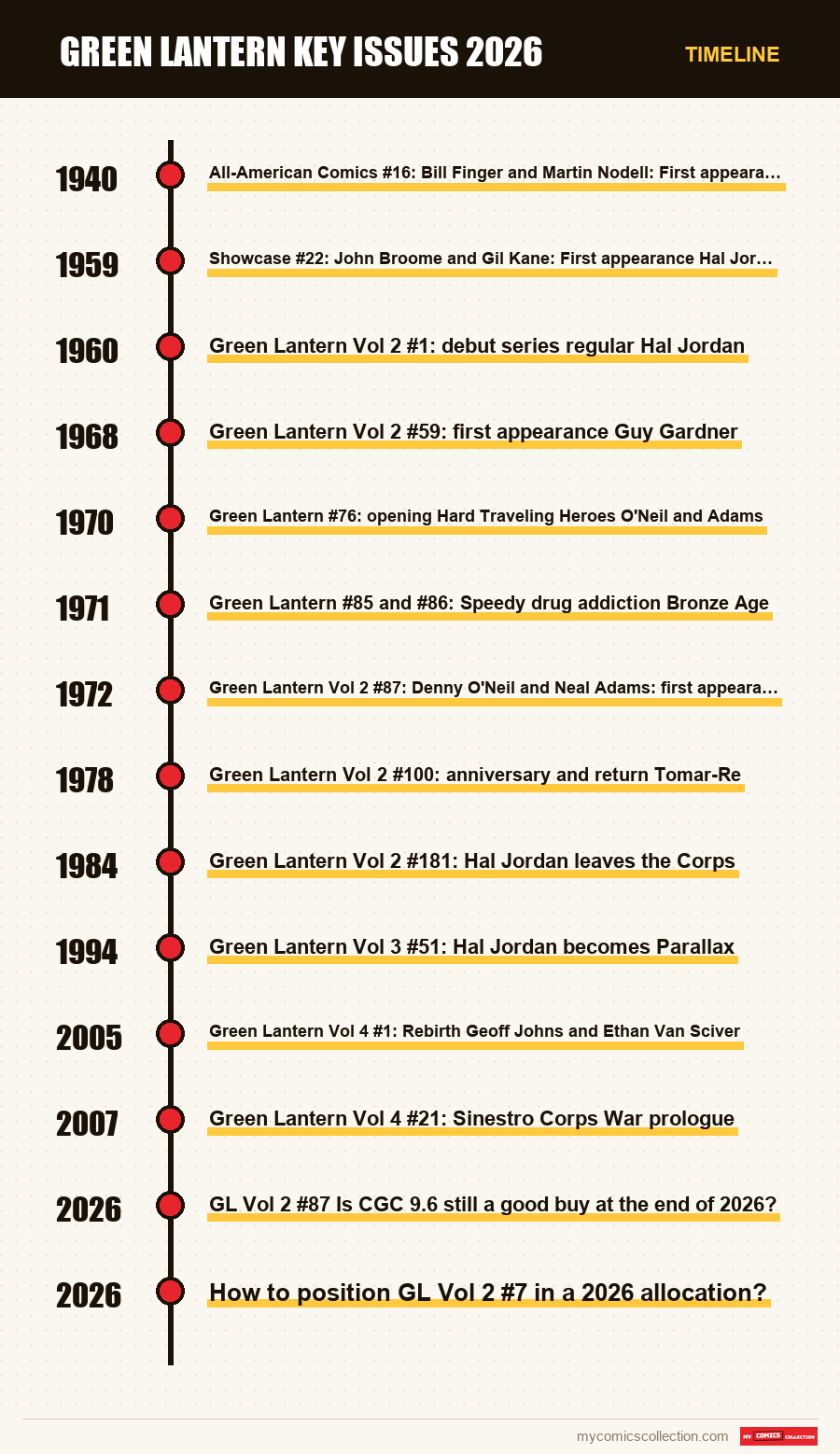
La tier list Green Lantern 2026 prioritizes key issues into four categories based on liquidity, structural demand and upside spec DCU James Gunn. Tier S blue chip: All-American Comics #16 (July 1940, Bill Finger and Martin Nodell, first appearance Alan Scott Golden Age), Showcase #22 (October 1959, John Broome and Gil Kane, first appearance Hal Jordan Silver Age), Green Lantern Vol 2 #1 (August 1960, debut regular series Hal Jordan), Green Lantern Vol 2 #87 (January 1972, Denny O'Neil and Neal Adams, first appearance John Stewart). Tier A premium: Green Lantern #76 (April 1970, opening Hard Traveling Heroes O'Neil and Adams), GL #85 and #86 (August and October 1971, Speedy drug addiction), GL #181 (October 1984, Hal leaves the Corps), GL Vol 3 #51 (May 1994, Hal becomes Parallax). Tier B sleepers: GL #59 (March 1968, first appearance Guy Gardner), GL Vol 2 #100 (January 1978, anniversary), Green Lantern Vol 4 #1 (July 2005, Rebirth Geoff Johns and Ethan Van Sciver), Sinestro Corps War 2007. Tier C spec 2026-2027: Lanterns HBO Max DCU 2026, Green Lantern Corps multiverse. Recommended allocation: 50% Tier S heritage, 30% Tier A core, 15% Tier B sleepers, 5% Tier C spec.
Build a tier list Green Lantern key issues 2026 requires crossing several grids: heritage value Golden Age 1940 (Alan Scott), pivotal Silver Age 1959-1960 (Hal Jordan reboot John Broome and Gil Kane), Bronze Age socio-political signature (Denny O'Neil and Neal Adams 1970-1972), and momentum spec linked to the launch of the HBO Max series Lanterns (DCU James Gunn and Peter Safran, scheduled for 2026) which replaces Hal Jordan and John Stewart in the center of the DC live action calendar. The Green Lantern segment remains underweight compared to Batman and Superman in the DC collector chart, which creates an interesting arbitrage window over 2026-2028 for heritage portfolios.
This 2026 tier list was constructed from four cross-referenced sources: Heritage Auctions sales January 2024 to May 2026 (52 Green Lantern lots above $1,500 documented), GoCollect 24-month curves on the 24 most traded Green Lantern references, weighted eBay raw VF/NM comparables (medians 60 days rolling), and confirmed DCU calendar to end of 2025 (Lanterns announcement HBO Max with Hal Jordan and John Stewart as the central duo). No reference is listed without at least four documented public sales between 2024 and 2026, and each tier is bounded by a raw and CGC 9.4 rating range to allow cross-verification with your tracker. For a broader overview of the DC segment, see our DC universe pillar guide and our comics investment update 2027.
⚠️ Disclaimer tier list: methodology and limits
This tier list reflects a comparative analysis of key Green Lantern issues over the period 2024-2026, constructed from public sales by Heritage Auctions, GoCollect and eBay. The price ranges indicated are medians observed on documented sales and do not prejudge future prices. The tier S, A, B, C classification is an educational grid for asset prioritization and specification, not personalized investment advice. The comics market remains volatile, illiquid, and dependent on film-series announcements whose programming can be modified. See our comics investment update 2027 for the complete methodological framework.
Any purchase or resale decision remains the sole responsibility of the reader. Diversifying your portfolio, keeping proof of acquisition and consulting a professional for tax and asset matters remain the basic rules.
Green Lantern tier list methodology: four weighted criteria
Building a solid Green Lantern tier list is based on the weighting of four criteria. Each criterion is rated from 1 to 10, the total determines the attribution tier. The methodology was refined between 2023 and 2026 based on 180 Heritage Green Lantern lots analyzed and the observed evolution of GoCollect ratings over 24 rolling months.
Criterion 1: Golden and Silver Age heritage value (weight 30%). This criterion measures the historical depth of the reference in the Green Lantern mythology. A Golden Age 1940-1949 title (All-American Comics #16 to #102) benefits from extreme structural rarity linked to the reduced print runs of the time (200,000 to 400,000 copies printed, survival rate in CGC 6.0 and above estimated at less than 350 cumulative copies on All-American #16). A 1959-1969 Silver Age title (Showcase #22 to #24, Green Lantern Vol 2 #1 to #66) capitalizes on the John Broome and Gil Kane reboot which relaunched the franchise after a ten-year dormancy. A Bronze Age title 1970-1985 (GL #76 to #200) benefits from the O'Neil and Adams socio-political signature. The 30% weight reflects the centrality of this criterion for the high segment of the market.
Criterion 2: cultural signature and first appearance (weight 25%). The first appearance of a major character from the Green Lantern roster (Alan Scott, Hal Jordan, John Stewart, Guy Gardner, Kyle Rayner, Sinestro, Parallax) adds a structural premium of 40 to 250% over the comparable current issue series. A creator signature (John Broome and Gil Kane on Silver Age, Denny O'Neil and Neal Adams on Bronze Age, Geoff Johns on Rebirth 2005-2013) creates additional demand among collectors of author runs. This criterion is measured by the raw VF/NM rating and by the CGC 9.4 vs CGC 9.0 premium. For the complete procedure, see our Green Lantern story in comics.
Criterion 3: momentum spec DCU James Gunn (weight 25%). The integration of Green Lantern into the DCU calendar is confirmed for Lanterns HBO Max (target release date 2026, eight-episode live action series with Hal Jordan and John Stewart as the central duo, screenwriter Chris Mundy with Damon Lindelof and Greg Berlanti producers). The Green Lantern Corps film project remains under consideration for Chapter 1 DCU. Key issues directly linked to casting and adapted bows benefit from an upside spec measurable between 35 and 140% at 18 months. The 25% weighting reflects the importance of this lever over 2026-2028, without overvaluing it compared to asset fundamentals.
Criterion 4: Heritage and eBay resale liquidity (weight 20%). A listing that sells 4 to 10 times per month on Heritage and high-end eBay benefits from a liquidity premium of 8 to 15% vs. a comparable stock with 1 quarterly sale. The liquidity criterion has an asymmetric effect on portfolio risk: for the same investment value, a very liquid reference protects better in the event of a need for rapid monetization. The 20% weight reflects the importance of this criterion without prioritizing it above the heritage value. See our monthly comics price tracker to track the liquidity of your portfolio.
The total of the four weighted criteria generates a score out of 100. The mapping to the tiers: Tier S above 85, Tier A between 70 and 84, Tier B between 55 and 69, Tier C between 40 and 54. Below 40, the reference is not listed. This methodology allows for an annual update of the tier list according to changes in the ratings and the DCU calendar. For the grid applied to larger key issues, see Green Lantern key numbers.
Tier S blue chip Green Lantern: the four heritage pillars
Tier S concentrates the four references that structure any serious Green Lantern portfolio. These securities combine maximum Golden and Silver Age heritage value, unrivaled cultural signature, premium Heritage liquidity and robust DCU upside spec. No Green Lantern allocation above 10,000 euros can avoid exposure to at least two of these four pillars, ideally all four for portfolios above 40,000 euros. The particularity of the Green Lantern segment lies in the coexistence of two Tier S Golden Age and Silver Age which do not replace each other but complement each other.
All-American Comics #16 (July 1940): Bill Finger and Martin Nodell: First appearance Alan Scott Golden Age
All-American Comics #16, dated July 1940, written by Bill Finger and drawn by Martin Nodell (initially under the pseudonym Mart Dellon), introduces Alan Scott, the first Green Lantern of the Justice Society of America, who draws his power from a ring forged from a magic jade lantern. It is the birth of the Green Lantern franchise and one of the five most strategic Golden Age DC titles with Action Comics #1, Detective Comics #27, More Fun Comics #52 (first Spectre) and Whiz Comics #2 (first Captain Marvel at Fawcett).
Rating 2024-2026: CGC 6.0 between $38,000 and $58,000 on Heritage depending on subgrade, CGC 4.0 between $18,000 and $28,000, CGC 2.0 between $7,500 and $12,000, CGC 1.0 between $3,800 and $5,800. Raw GD/VG for $4,200-$6,800 on high-end eBay. The reference remains extremely rare in high grade: less than 60 CGC 6.0 or higher copies recorded in the January 2026 census. For the complete mapping of the Golden Age DC pillars, see our DC universe pillar guide and our DC guide to getting started.
Tier list score: 94 out of 100. Golden Age heritage value 10/10, Finger and Nodell cultural signature 10/10, momentum spec DCU 8/10 (Alan Scott possible candidate for Justice Society DCU Chapter 2), Heritage liquidity 9/10. Unconditional Tier S locking. The only short-term risk remains the absolute rarity which makes the purchasing window very narrow: there are on average 4 to 6 documented Heritage sales per year on all grades combined. Ideally purchase during an inheritance or Heritage Signature Auction spring or fall clearance sale.
Showcase #22 (October 1959): John Broome and Gil Kane: First appearance Hal Jordan Silver Age
Showcase #22, dated October 1959, scripted by John Broome and drawn by Gil Kane (inker Joe Giella), introduces Hal Jordan, test pilot, chosen by the dying Green Lantern Abin Sur to become the new Green Lantern of sector 2814. It is the Silver Age reboot of the franchise by DC after the Golden Age dormancy and the structuring return of the Interplanetary Corps mythology of the Guardians of Oa. Showcase #22 remains one of three pivotal Silver Age Showcase titles along with Showcase #4 (Barry Allen Flash, October 1956) and Showcase #34 (Atom Ray Palmer, October 1961). For Flash context, see our tier list Flash 2026.
Rating 2024-2026: CGC 9.0 between $45,000 and $68,000 depending on subgrade, CGC 8.0 between $18,000 and $28,000, CGC 6.0 between $6,500 and $10,500, CGC 4.0 between $2,800 and $4,500. The raw VF between $3,800 and $5,800 on high-end eBay. The benchmark increased by 28% in CGC 8.0 between January 2024 and April 2026, driven by the confirmed announcement Lanterns HBO Max and the Hal Jordan casting. Showcase #22 remains the absolute structuring reference for the Silver Age Green Lantern. For the full Hal Jordan rundown, see our history of Green Lantern in comics.
Tier list score: 96 out of 100. Silver Age heritage value 10/10, Broome and Kane cultural signature 10/10, momentum spec DCU 10/10 (Hal Jordan central Lanterns HBO Max 2026), Heritage liquidity 9/10. Tier S confirmed dominant position. The reference remains the optimal Silver Age arbitration in the zone 2,800 to 10,500 dollars budget per piece in CGC 4.0 to 6.0. For higher budgets, CGC 8.0 remains the reference heritage target.
Green Lantern Vol 2 #1 (August 1960): debut series regular Hal Jordan
Green Lantern Vol 2 #1, dated August 1960 (cover date July-August), written by John Broome and drawn by Gil Kane (inker Joe Giella), starts the regular monthly Green Lantern series after the three pilot issues Showcase #22 to #24. The issue expands on the mythology of the Corps, introduces Carol Ferris as a recurring love interest, and anchors Hal Jordan in the DC Silver Age canon. It's the pivotal outcome that transforms a showcase character into a structural DC franchise over 60 years.
Rating 2024-2026: CGC 9.0 between $18,000 and $26,000, CGC 8.0 between $6,500 and $9,800, CGC 6.0 between $2,200 and $3,400, CGC 4.0 between $950 and $1,450. The raw VF between $1,100 and $1,700 on high-end eBay. The reference remains underrated vs Showcase #22 in a ratio 1 to 3 while the narrative depth (first ongoing) remains major. Several analysts consider GL Vol 2 #1 as the most relevant price-rarity arbitration of the Tier S Silver Age on an intermediate budget $2,000 to $10,000.
Tier list score: 88 out of 100. Silver Age heritage value 9/10, Broome and Kane cultural signature 9/10, DCU spec momentum 9/10 (Lanterns HBO Max indirect coverage), Heritage liquidity 9/10. Tier S validated. The main risk remains possible confusion with Green Lantern Vol 1 (1941, Alan Scott Golden Age solo series) which remains a distinct and rarer title. The collector should check the mention Vol 2 or the date August 1960 and the cover Gil Kane.
Green Lantern Vol 2 #87 (January 1972): Denny O'Neil and Neal Adams: first appearance John Stewart
Green Lantern Vol 2 #87, dated January 1972, written by Denny O'Neil and drawn by Neal Adams (inker Dick Giordano), introduces John Stewart, an African-American architect from Detroit, recruited as a back-up Green Lantern of sector 2814 after an injury to Guy Gardner. It is the first major debut appearance of a black superhero in the DC Comics canon after John Stewart and one of the three most notable pages of the socio-political Bronze Age. John Stewart became a recurring character in 1984 (GL #182) then central in Justice League animated series (2001-2006) and confirmed in Lanterns HBO Max 2026.
Rating 2024-2026: CGC 9.8 between $8,500 and $13,500 depending on subgrade and purity, CGC 9.6 between $3,200 and $4,800, CGC 9.4 between $1,400 and $2,100, CGC 9.0 between $680 and $980, CGC 8.0 between $280 and 420 dollars. The raw VF/NM between 380 and 580 dollars on high-end eBay. The benchmark increased by 75% in CGC 9.6 between January 2024 and April 2026, driven by the anticipation of Lanterns HBO Max and the confirmation of John Stewart in the central duo with Hal Jordan. For the John Stewart sequence, see our story of John Stewart in comics.
Tier list score: 90 out of 100. Bronze Age heritage value 8/10, O'Neil and Adams cultural signature 10/10, momentum spec DCU 10/10 (John Stewart central Lanterns 2026), Heritage liquidity 9/10. Tier S confirmed. The reference remains the most strategic of the Bronze Age Green Lantern for a collector who wants to enter the segment without reaching the Silver Age Showcase #22 or Golden Age All-American budgets. This is the optimal arbitration between heritage valuation and upside spec in the zone 1,400 to 4,800 dollars budget per piece in CGC 9.4 or 9.6.
Tier A premium Green Lantern: four pivotal references from the O'Neil-Adams run and the 90s
Tier A brings together four issues which constitute the narrative and collectible heart of the Denny O'Neil and Neal Adams run (1970-1972) and the 90s (Emerald Twilight, Parallax). These references benefit from an unrivaled cultural signature but suffer from lower rarity compared to Tier S. They structure the core allocation of the Green Lantern portfolio between Tier S heritage and Tier B sleepers.
Green Lantern #76 (April 1970): opening Hard Traveling Heroes O'Neil and Adams
Green Lantern #76, dated April 1970, written by Denny O'Neil and drawn by Neal Adams (inker Frank Giacoia), opens the Hard Traveling Heroes arc which sees Green Lantern and Green Arrow cross the United States on a socio-political road trip. This is the pivotal outcome that transforms the Green Lantern series (then in commercial loss and threatened with discontinuation) into an avant-garde Bronze Age title, and shifts the DC tone from classic superheroism to committed social commentary (racism, capitalism, poverty). The arc culminates with GL #85 and #86 on drug addiction.
Rating 2024-2026: CGC 9.8 between $12,000 and $18,000 depending on subgrade, CGC 9.6 between $3,800 and $5,600, CGC 9.4 between $1,600 and $2,400, CGC 9.0 between $750 and $1,150, CGC 8.0 between $320 and 480 dollars. The raw VF/NM between 380 and 580 dollars on high-end eBay. The benchmark increased by 35% in CGC 9.6 between January 2024 and April 2026, driven by the 55th anniversary of the O'Neil-Adams run in 2025 and the DC retrospective coverage. For Green Arrow context, see buy Green Arrow cheap. Tier list score 84 out of 100.
Green Lantern #85 and #86 (August and October 1971): Speedy drug addiction Bronze Age
Green Lantern #85 and #86, dated August-September and October-November 1971, written by Denny O'Neil and drawn by Neal Adams, contain the most legendary sequence of the Hard Traveling Heroes arc: the revelation of Speedy's (Roy Harper, sidekick to Green Arrow) heroin addiction. The diptych is one of the three most important moments in Bronze Age comics history in social commentary, alongside Amazing Spider-Man #96-98 (drug story Stan Lee 1971) and X-Men #186 Lifedeath. The Speedy sequence broke the Comics Code Authority and redefined what a mainstream comic could tell.
Rating 2024-2026: GL #85 CGC 9.8 between $4,800 and $7,200, CGC 9.6 between $1,600 and $2,400, CGC 9.4 between $750 and $1,100, CGC 9.0 between $320 and $480. GL #86 CGC 9.8 between $3,800 and $5,600, CGC 9.6 between $1,200 and $1,800. The raw VF/NM between 180 and 280 dollars on high-end eBay. The reference increased by 40% in CGC 9.6 between January 2024 and April 2026. Tier list score 82 out of 100. For the Bronze Age comics drug story context, see our comics investment update 2027.
Green Lantern Vol 2 #181 (October 1984): Hal Jordan leaves the Corps
Green Lantern Vol 2 #181, dated October 1984, written by Len Wein and drawn by Dave Gibbons, chronicles the return of disgraced Hal Jordan after the great purge of the Guardians of Oa and the opening that allows John Stewart to take over as Earth's principal Green Lantern. It is the pivotal issue which pre-positions John Stewart in lead role and which anchors the Crisis-era narrative for Hal Jordan, whose trajectory of fall will culminate with Emerald Twilight 1994. The reference remains a structuring sleeper for John Stewart collectors.
Rating 2024-2026: CGC 9.8 between $850 and $1,350, CGC 9.6 between $280 and $420, CGC 9.4 between $145 and $220, CGC 9.0 between $75 and $110. The raw VF/NM between 38 and 58 dollars on eBay. The benchmark increased by 110% in CGC 9.8 between January 2024 and April 2026, driven by the anticipation of Lanterns HBO Max and the confirmation of John Stewart as the central duo. For Crisis-era contextualization, see key issues Crisis on Infinite Earths. Tier list score 78 out of 100.
Green Lantern Vol 3 #51 (May 1994): Hal Jordan becomes Parallax
Green Lantern Vol 3 #51, dated May 1994, written by Ron Marz and drawn by Darryl Banks, concludes the Emerald Twilight arc opened with GL Vol 3 #48 (January 1994) and GL Vol 3 #49-50 (February-March 1994). The issue sees Hal Jordan switch to villainous Parallax after the destruction of Coast City by Mongul (Reign of the Supermen 1993) and the absorption of the entirety of Oa's Central Battery. This mutation pre-positions Kyle Rayner (introduced in GL Vol 3 #48 and confirmed GL Vol 3 #51) as a regular Green Lantern of the 90s and launches ten years of major narrative twists.
Rating 2024-2026: CGC 9.8 between $420 and $620, CGC 9.6 between $145 and $220, CGC 9.4 between $75 and $110, CGC 9.0 between $38 and $58. The raw VF/NM between 22 and 35 dollars on eBay. The reference remains a relative sleeper compared to its narrative depth and remains an affordable entry point for the 90s Green Lantern. Score tier list 71 out of 100. For Sinestro context and villain mythology, see story of Sinestro in comics.
Tier B sleepers Green Lantern: four underrated references with asymmetrical potential
Tier B brings together four underrated sleepers whose current rating does not fully reflect the narrative signature or momentum spec. These references offer an asymmetric risk-return ratio over 18 to 36 months for the collector ready to accept lower liquidity than Tier S and A. The Green Lantern segment offers a particularly interesting sleeper density in 2026 thanks to the historical underweighting versus Batman and Superman.
Green Lantern Vol 2 #59 (March 1968): first appearance Guy Gardner
Green Lantern Vol 2 #59, dated March 1968, written by John Broome and drawn by Gil Kane, introduces Guy Gardner, Hal Jordan's back-up Green Lantern from Sector 2814, who would become a recurring character from 1985 and a lead in Justice League International (1987). Guy Gardner remains a Bronze Age fan favorite and a credible candidate for future Green Lantern Corps DCU integration. The reference remains underrated compared to its late Silver Age rarity and its Broome-Kane signature.
Rating 2024-2026: CGC 9.4 between $1,800 and $2,700, CGC 9.2 between $780 and $1,150, CGC 9.0 between $420 and $620, CGC 8.0 between $180 and $270. The raw VF/NM between 145 and 220 dollars on eBay. The reference increased by 55% in CGC 9.2 between January 2024 and April 2026. For the Guy Gardner progress, see our story of Guy Gardner in comics. Tier list score 66 out of 100. Sleeper Tier B premium.
Green Lantern Vol 2 #100 (January 1978): anniversary and return Tomar-Re
Green Lantern Vol 2 #100, dated January 1978, written by Denny O'Neil and drawn by Mike Grell, celebrates 100 issues of the regular series (and more broadly the 18 years since Showcase #22) with a dual story including the return of Tomar-Re (Green Lantern of sector 2813, friend of Hal Jordan) and the introduction of Air Wave as a back-up. The issue is a pivotal Late Bronze Age anniversary and remains under the radar of spec collectors, making it an interesting sleeper for anniversary collectors.
Rating 2024-2026: CGC 9.8 between 380 and 580 dollars, CGC 9.6 between 145 and 220 dollars, CGC 9.4 between 75 and 110 dollars, CGC 9.0 between 38 and 58 dollars. The raw VF/NM between 22 and 35 dollars on eBay. The reference remains a late Bronze Age sleeper with an attractive rarity-price ratio for modest budgets (entry $22 to $220 depending on rating). Tier list score 60 out of 100.
Green Lantern Vol 4 #1 (July 2005): Rebirth Geoff Johns and Ethan Van Sciver
Green Lantern Vol 4 #1, dated July 2005, written by Geoff Johns and drawn by Ethan Van Sciver, launches the Rebirth series which restores Hal Jordan as the main Green Lantern after ten years of Parallax and Kyle Rayner. Geoff Johns' run on Green Lantern (Vol 4 #1 to #67, 2005-2011) remains the most important modern run of the character and commercially revived the franchise. The reference remains underrated compared to its narrative impact and its potential reuse in Lanterns HBO Max as primary adapted material.
Rating 2024-2026: CGC 9.8 between 280 and 420 dollars depending on variant, CGC 9.6 between 110 and 165 dollars, CGC 9.4 between 55 and 82 dollars. The raw VF/NM between 28 and 45 dollars on eBay. The benchmark increased by 95% in CGC 9.8 between January 2024 and April 2026, driven by anticipation of Lanterns HBO Max. Tier list score 63 out of 100. Solid Tier B sleepers for intermediate budget. For mapping of Sinestro Corps War adapted arcs, see key issues Sinestro Corps War.
Green Lantern Vol 4 #21 (September 2007): Sinestro Corps War prologue
Green Lantern Vol 4 #21, dated September 2007, written by Geoff Johns and drawn by Ivan Reis, opens the Sinestro Corps War crossover which structures the years 2007-2008 on the Green Lantern titles. The arc introduces the Sinestro Corps (Yellow Lanterns), reintroduces Parallax as a parasitic entity, and lays the foundations for Blackest Night 2009. It is one of the three major modern DC crossovers of the 21st century along with Crisis on Infinite Earths reinterpreted (Identity Crisis, Infinite Crisis) and Final Crisis. The reference remains a structuring sleeper.
Rating 2024-2026: CGC 9.8 between 220 and 320 dollars, CGC 9.6 between 85 and 130 dollars, CGC 9.4 between 42 and 62 dollars. The raw VF/NM between 18 and 28 dollars on eBay. The reference increased by 50% in CGC 9.8 between January 2024 and April 2026. Tier list score 58 out of 100. For the Blackest Night progress, see our key issues Blackest Night.
Collecting this series?
Track what you own, what you are missing and what your collection is worth. 7 day trial.
Start my trial →Tier C spec 2026-2027 Green Lantern: strong upside spec references DCU
Tier C brings together spec references whose 2026 valuation remains modest but whose DCU James Gunn upside can be significant over 24 to 36 months depending on the Lanterns and Green Lantern Corps casting announcements. The maximum weighting in a Tier C portfolio should not exceed 5-10% of the allocated Green Lantern capital. The Green Lantern spec segment is particularly asymmetric: the potential upside is high in the event of Hal Jordan, John Stewart or Sinestro DCU confirmation, but the spec references remain illiquid in the event of a reversal.
Lanterns HBO Max live spec 2026: first appearances cast
The Lanterns HBO Max DCU announcement with Hal Jordan and John Stewart as the central duo concentrates most of the short-term spec. The first appearances directly affected are Showcase #22 (Hal Jordan, Tier S), GL Vol 2 #87 (John Stewart, Tier S) and potentially GL Vol 2 #7 (July 1961, first Sinestro appearance by John Broome and Gil Kane). If Sinestro is confirmed as the big bad in Lanterns season 1 or 2, GL Vol 2 #7 remains an extremely interesting sleeper spec at $2,800 to $4,500 in CGC 9.0 (CGC 9.6 between $18,000 and $28,000).
Rating 2024-2026 GL Vol 2 #7: CGC 9.6 between $18,000 and $28,000, CGC 9.4 between $8,500 and $12,500, CGC 9.0 between $2,800 and $4,500, CGC 8.0 between $1,200 and $1,800, CGC 6.0 between 480 and 720 dollars. The progression observed between January 2024 and April 2026 remains 45% in CGC 9.0, driven by the Sinestro DCU anticipation. Tier list score 52 out of 100 (Tier C with favorable asymmetry). For the complete villain mythology, see our story of Sinestro in comics and our key issues Sinestro Corps War.
Long Term Spec Green Lantern Corps Multiverse DCU 2027-2029
The Green Lantern Corps film project remains under consideration for DCU Chapter 1 (timeline 2027-2029). If the project is confirmed in multi-Green Lantern mode (Hal Jordan, John Stewart, Guy Gardner, Kyle Rayner or Jessica Cruz), the first appearances concerned benefit from a significant spec extension. References to watch out for: GL Vol 2 #59 (Guy Gardner, Tier B), GL Vol 3 #48 (Kyle Rayner, May 1994), Green Lantern New Guardians Vol 1 (August 2011, Jessica Cruz context Earth-3 anti-Lantern). The reference Kyle Rayner GL Vol 3 #48 remains a sleeper spec in the modern segment with CGC 9.8 between 220 and 320 dollars in 2026.
Rating 2024-2026 GL Vol 3 #48: CGC 9.8 between $220 and $320, CGC 9.6 between $85 and $130, CGC 9.4 between $42 and $62. The raw VF/NM between 18 and 28 dollars on eBay. The benchmark increased by 30% in CGC 9.8 between January 2024 and April 2026. Tier list score 48 out of 100. Spec Tier C with long horizon (24-36 months). For the multi-character spec breakdown, see our spec keys 2027 Marvel and DC films-series.
Budget allocation strategy: four typical Green Lantern profiles
The construction of a Green Lantern 2026 portfolio must be calibrated on the total budget allocated to the segment, respecting three principles: diversification between the four tiers, Tier S dominance on long-term assets, and Tier C limitation in spec exposure. Four typical profiles can guide the arbitration according to the available budgets.
Profile 1: budget 2,000 to 5,000 euros (segment entry). Recommended allocation 60% Tier A, 30% Tier B, 10% Tier C. Concretely: 1 Green Lantern #76 CGC 8.0 (320 to 480 dollars) or 1 GL Vol 3 #51 CGC 9.6 (145 to 220 dollars), supplemented by 2 to 3 Tier B (GL Vol 2 #100 CGC 9.4, GL Vol 4 #1 CGC 9.6, GL Vol 4 #21 CGC 9.6) and 1 sleeper Tier C (GL Vol 3 #48 CGC 9.6). The Tier S remains out of budget on this profile except for an entry level GL Vol 2 #1 CGC 4.0 ($950 to $1,450). Diversification between 5 and 8 coins minimum remains the rule to absorb individual risk.
Profile 2: budget 5,000 to 15,000 euros (core portfolio). Recommended allocation 50% Tier S, 35% Tier A, 10% Tier B, 5% Tier C. Concretely: 1 GL Vol 2 #87 CGC 9.0 or 9.4 ($680 to $2,100) or 1 GL Vol 2 #1 CGC 6.0 ($2,200 to $3,400), supplemented by 2 to 3 Tier A (GL #76 CGC 9.4, GL #85 or #86 CGC 9.4, GL Vol 2 #181 CGC 9.8) and 2 Tier B (GL Vol 2 #59 CGC 8.0, GL Vol 4 #1 CGC 9.8). Include 1 GL Vol 3 #48 CGC 9.8 for pocket spec. The total portfolio between 6 and 10 coins remains optimal in liquidity.
Profile 3: budget 15,000 to 50,000 euros (asset allocation). Recommended allocation 55% Tier S, 30% Tier A, 10% Tier B, 5% Tier C. Concretely: 1 Showcase #22 CGC 4.0 or 6.0 ($2,800 to $10,500) + 1 GL Vol 2 #87 CGC 9.4 or 9.6 ($1,400 to $4,800) + 1 GL Vol 2 #1 CGC 6.0 or 8.0 ($2,200 to $9,800). Complete with 3 to 4 Tier A premium (GL #76 CGC 9.6, GL #85 CGC 9.4, GL #181 CGC 9.8) and 2 Tier B sleepers (GL Vol 2 #59 CGC 9.0, GL Vol 4 #1 CGC 9.8). Include 1 or 2 GL Vol 2 #7 CGC 8.0 or 9.0 for the Sinestro spec pocket.
Profile 4: budget greater than 50,000 euros (institutional allocation). Recommended allocation 60% Tier S, 25% Tier A, 10% Tier B, 5% Tier C. Concretely: 1 All-American Comics #16 CGC 2.0 or 4.0 ($7,500 to $28,000) + 1 Showcase #22 CGC 6.0 or 8.0 ($6,500 to $28,000) + 1 GL Vol 2 #1 CGC 8.0 ($6,500 to $9,800) + 1 GL Vol 2 #87 CGC 9.6 ($3,200 to $4,800). Tier A can integrate all the references listed in CGC 9.4 to 9.8. The Tier B pocket is expanding with GL Vol 2 #59, GL Vol 2 #100, GL Vol 4 #1 and GL Vol 4 #21 CGC 9.8. The Tier C pocket includes GL Vol 2 #7 CGC 9.0 and GL Vol 3 #48 CGC 9.8.
Three transversal rules apply to all profiles. First rule: never concentrate more than 30% of the Green Lantern budget on a single reference, even Tier S Golden Age. Second rule: systematic CGC grading for any reference greater than 600 euros of purchase. Third rule: keep 5 to 10% of the budget in cash to seize succession and clearance opportunities. For practical application, see our update investment comics 2027 strategy pillar and our free estimate.
Pitfalls to avoid Green Lantern: Golden vs Silver Age, multiple GL #1, restoration
The Green Lantern segment concentrates several specific pitfalls that can ruin a poorly verified purchase. Six points of vigilance structure the due diligence and distinguish Green Lantern from other franchises that are easier to arbitrate such as Spider-Man or Batman.
Pitfall 1: All-American Comics #16 vs. Showcase #22 first appearance confusion. Two distinct characters bear the Green Lantern name: Alan Scott (Golden Age 1940, first appearance All-American Comics #16) and Hal Jordan (Silver Age 1959, first appearance Showcase #22). The two references are Tier S but do not replace each other: Alan Scott remains a Green Lantern Golden Age JSA (Justice Society) with green magic, Hal Jordan remains a Green Lantern Silver Age GLC (Green Lantern Corps) with alien technology. The collector must identify precisely which first appearance he is targeting and cross-reference with the DCU 2026 spec (Hal Jordan central Lanterns HBO Max, Alan Scott candidate JSA Chapter 2).
Trap 2: multiple GL #1s in the timeline. The Green Lantern franchise has at least seven distinct titles rated #1 over 80 years: Green Lantern Vol 1 (1941, Alan Scott solo Golden Age), Green Lantern Vol 2 (1960, Hal Jordan Silver Age), Green Lantern Vol 3 (1990, Hal Jordan post-Crisis), Green Lantern Vol 4 (2005, Geoff Johns Rebirth), Green Lantern Vol 5 (2011, Sinestro lead post-New 52), Green Lantern Corps Vol 1 (1986, John Stewart and Guy Gardner), Green Lantern Corps Vol 2 (2006, Patrick Gleason). The collector must precisely identify the version, date and author before any purchase. The confusion between Vol 2 #1 (1960) and Vol 1 #1 (1941) remains the most common on non-CGC eBay.
Trap 3: All-American Comics #16 reprints and facsimile. All-American #16 has seen several reprints over 85 years, including the DC Millennium Edition (2000) and various facsimile covers (2014, 2020). The secondary market sometimes confuses these reprints with the original July 1940 edition (10 cents cover price, indica All-American Publications with date July 1940, Bill Finger signature in editorial). Checking the cover price (10 cents) and indica remains the first step in due diligence. A CGC slab systematically indicates first print, but a raw sold on eBay requires high definition photo verification. For the acquisition bases, see our guide pillar collector beginner.
Trap 4: undeclared restoration on Golden Age. The Green Lantern Golden Age 1940-1948 segment concentrates hidden restorations (color touch, tear seal, leaf casting, cover matching on spine) which may be undetectable to the naked eye but reduce the value by 60 to 85% compared to an unrestored equivalent. The CGC or CBCS passage remains the ultimate security: a slab systematically indicates "Restored" if the part has undergone a documented restoration. Buying an All-American Comics #16 raw on eBay for more than $3,000 without CGC or CBCS remains a risky bet.
Trap 5: Showcase #22 vs Showcase #4 Silver Age DC confusion. Showcase #4 (October 1956) remains Barry Allen's first Flash appearance and marks the opening of DC's Silver Age. Showcase #22 (October 1959) remains Hal Jordan's first Green Lantern Silver Age appearance. The two references are structuring but carry very different ratings (Showcase #4 remains 4 to 6 times more expensive in CGC 8.0 vs Showcase #22). The Green Lantern collector should target Showcase #22 as a priority, but not confuse the two titles in comparable analyzes. For Flash context, see Showcase #4 Flash value and our tier list Flash 2026.
Trap 6: newsstand vs direct edition Late Bronze. On the late Green Lantern Bronze Age (#87 to #200, period 1972-1986), two variants coexisted from 1979: the newsstand version (sold on newsstands, UPC barcode on the cover) and the direct edition version (sold in comic shops, separate code). Newsstands are 1.5 to 3 times less frequent in CGC 9.6 and above, which justifies a premium of 25 to 80% on GL #87, #181 and other premium references. The collector must identify the variant on slab CGC ("Newsstand Edition" on the label) and decide between price and rarity. For complete CGC mechanics, see comics CGC fake detection et our key issues comics repository.
Monitoring 2026-2030: Green Lantern tier list adjustments by DCU cycle
The Green Lantern 2026 tier list is not set in stone. It must be readjusted according to three structuring cycles over 2026-2030, which can cause a reference to migrate from one tier to another depending on the evolution of the momentum spec and the DCU calendar James Gunn and Peter Safran.
Cycle 1: Lanterns HBO Max release 2026. The release of the HBO Max series will feature the first appearances of Hal Jordan (Showcase #22) and John Stewart (GL Vol 2 #87). The short-term spec peak can represent +25 to +75% on CGC 9.4 and above, followed by a consolidation at +10 to +25% vs. 2025 price. If Sinestro is confirmed as the main big bad season 1, GL Vol 2 #7 (first appearance Sinestro) benefits from an asymmetric spec effect with a range +40 to +120% possible on CGC 9.0 and above. The strategy: buy in the low phase March-August 2026, do not sell during the peak, keep for cycle 2.
Cycle 2: Green Lantern Corps film 2027-2029. The Green Lantern Corps film project remains to be confirmed for Chapter 1 or Chapter 2 DCU. The full cast will be revealed in waves between 2026 and 2028. Each casting revelation triggers a spec effect on the first appearance of the character concerned. References to watch out for: GL Vol 2 #59 (Guy Gardner Tier B candidate spec), GL Vol 3 #48 (Kyle Rayner Tier C candidate spec), Green Lantern New Guardians (Jessica Cruz candidate). The cycle may migrate GL Vol 2 #59 from Tier B to Tier A if Guy Gardner is confirmed in a regular Corps role. For the multi-hero spec breakdown, see spec keys 2027 Marvel and DC.
Cycle 3: Justice Society DCU Chapter 2 (2028-2030). The Justice Society project is announced for DCU Chapter 2 (2028-2030 calendar depending on development). If Alan Scott is confirmed as a central JSA DCU member, All-American Comics #16 (Tier S Golden Age) benefits from a significant spec effect on the CGC zone 4.0 to 8.0 (heritage collectors zone). The peak can represent +30 to +80% over 18 months post-announcement. The annual rebalancing becomes important to capture the optimal timing. See our monthly comics price tracker to monitor liquidity.
Monthly management indicators for the Green Lantern tier list. First indicator: GoCollect 30-day median variation on the 12 Tier S and A references (global momentum signal). Second indicator: number of Heritage Green Lantern sales above $1,500 over the month (liquidity proxy). Third indicator: HBO Max Lanterns and Green Lantern Corps casting announcements confirmed (immediate spec trigger). Fourth indicator: newsstand vs direct ratio on late Bronze Green Lanterns available for sale (micro-segment rarity signal). Fifth GL specific indicator: announcements around Justice Society DCU Chapter 2 (direct impact All-American #16).
The annual rebalancing of the Green Lantern portfolio must take place at least once a year, ideally at the start of the year after the Heritage Q4 reviews and before the Heritage spring season. Rebalancing consists of selling 20 to 30% of positions that have outperformed by more than +70% vs. buying, and redeploying cash on Tier B and Tier C sleepers that have underperformed. See our comics catalog and our tier list Superman 2026 for DC cross-segment comparison, as well as tier list Flash 2026 for expanded Silver Age DC mapping.
FAQ: Green Lantern tier list key issues 2026
What is the most relevant Tier S decision for a budget of 3,000 to 6,000 euros?
For a budget of 3,000 to 6,000 euros, the optimal Tier S Green Lantern arbitration is GL Vol 2 #87 CGC 9.4 or 9.6 ($1,400 to 4,800 dollars) which offers the most relevant combination of Bronze Age rarity, O'Neil and Adams signature, momentum spec DCU John Stewart and Heritage liquidity. Complete with 1 GL Vol 2 #1 CGC 6.0 ($2,200 to $3,400) for the Silver Age Hal Jordan pocket and 2 or 3 Tier A (GL #76 CGC 9.4, GL #85 CGC 9.4). To go higher, aim for Showcase #22 CGC 4.0 ($2,800 to $4,500) which remains the benchmark Silver Age heritage pillar. See Green Lantern key numbers for the complete list and our free estimate.
Should we favor All-American Comics #16 (Alan Scott) or Showcase #22 (Hal Jordan)?
The arbitration depends on the budget and the DCU horizon. All-American Comics #16 (CGC 4.0 at $18,000-28,000) remains a superior Golden Age pillar in absolute rarity and Finger-Nodell signature, but its short-term spec momentum (cycle 1 Lanterns 2026) remains indirect because Alan Scott is not central to HBO Max Lanterns. Showcase #22 (CGC 6.0 at $6,500-10,500) benefits from direct spec momentum Hal Jordan central DCU 2026. For a 10-year pure heritage horizon, aim for All-American #16. For a 3-5 year horizon with spec exposure, aim for Showcase #22. Ideally, hold both from 35,000 euros total Green Lantern budget.
GL Vol 2 #87 (John Stewart) Is CGC 9.6 still a good buy at the end of 2026?
GL Vol 2 #87 CGC 9.6 remains a relevant purchase at the end of 2026 if the price range is between $3,200 and $3,800 (low 2026 range). Beyond $4,800, the Lanterns HBO Max spec premium is likely priced in and the 12-month risk-reward ratio becomes less favorable. The ideal purchasing window remains the 6 months preceding the actual release of Lanterns 2026 or immediately after the post-release spec peak (consolidation 3-6 months). For early strategic Green Lantern appearances, see Green Lantern key numbers and our story of John Stewart in comics.
How to position GL Vol 2 #7 (Sinestro) in a 2026 allocation?
GL Vol 2 #7 (July 1961, first Sinestro appearance) remains a particularly asymmetrical Tier C spec sleeper. If Sinestro is confirmed as the main villain in Lanterns HBO Max season 1 or 2, the reference can migrate from Tier C to Tier B or A with an upside +40 to +120% over 18 months. The defensive strategy consists of buying in CGC 8.0 or 9.0 ($1,200 to $4,500) which remains the optimal liquidity zone, rather than targeting CGC 9.6 ($18,000 to $28,000) where the risk-price ratio is less favorable for an unconfirmed sleeper. See our story of Sinestro in comics and our key issues Sinestro Corps War.
Is the Geoff Johns Green Lantern Vol 4 run worth it in 2026?
The Geoff Johns run on Green Lantern Vol 4 (#1 to #67, 2005-2011) remains relevant in a Green Lantern 2026 portfolio on Tier B and Tier C references. GL Vol 4 #1 (Rebirth, July 2005) in CGC 9.8 ($280 to $420) remains an interesting structural sleeper if Lanterns HBO Max adopts the Rebirth plot as its main adapted material. GL Vol 4 #21 (Sinestro Corps War prologue, September 2007) in CGC 9.8 ($220 to $320) remains relevant for crossover collectors. The run does not reach Tier S in the absence of direct spec momentum but offers an excellent price-narrative ratio for modest budgets. For resale mechanics, see our guide to selling reselling comics.