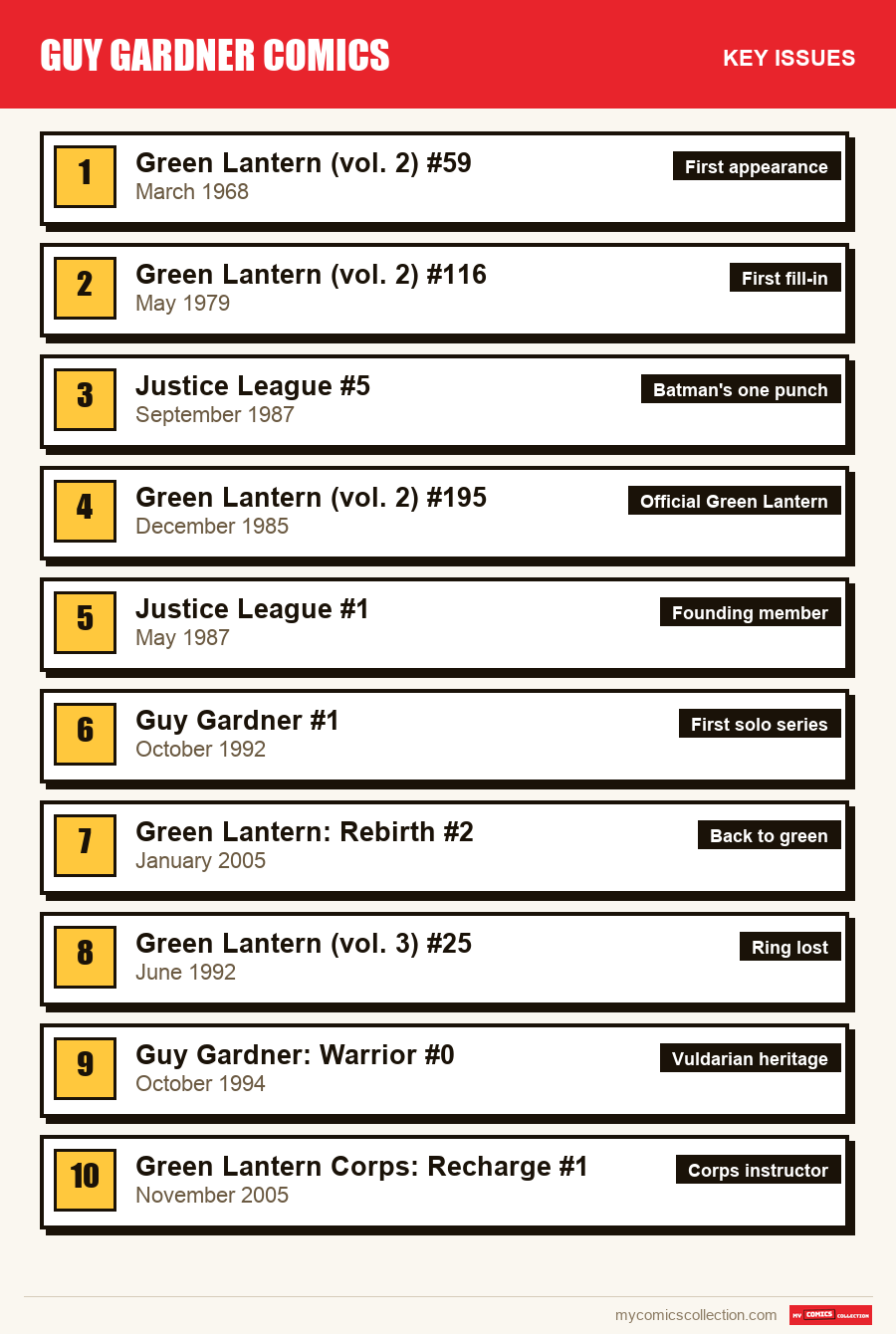
Guy Gardner arrived in March 1968 in Green Lantern (vol. 2) #59, created by John Broome and Gil Kane as a simple potential replacement for Hal Jordan. Long a secondary character, he became cult from 1987 thanks to Steve Englehart and Joe Staton, who made him an egocentric jingoistic macho within the Justice League International: the famous scene where Batman knocks him out with a single punch (Justice League #5, September 1987) remains his most quoted moment. Crossing through a voluntary yellow ring, a “Warrior” period with powers of Vuldarian origin, then a return to green during Green Lantern: Rebirth, the character has experienced a resurgence in notoriety since his incarnation by Nathan Fillion in Superman (2025) by James Gunn. Its first appearance remains accessible: the CGC still listed 92 copies in grade 7.0 and 529 copies in higher grades in February 2022, with Overstreet 2021 quotes of $96 in FN 6.0 and $230 in VF 8.0.
Guy Gardner occupies a special place in the Green Lantern universe: he is neither the first bearer of the green Earth ring (Hal Jordan) nor the most consensual (Kyle Rayner or John Stewart), but he is undoubtedly the most devious to identify for a collector. Its editorial history spans more than fifty-seven years of DC Comics publications, with radical breaks in tone: from the wise stooge of the years 1968-1979 to the macho buffoon of the 1980s, through the anti-hero with the yellow ring of the 1990s and the serious pillar of the Green Lantern Corps since 2005.
For those who collect Green Lantern comics, understanding this trajectory is not an exercise in nostalgia: it is what allows us to distinguish an anecdotal issue from a real milestone in the character's mythology. This article retraces, with supporting facts and sources, the stages which today structure the value and collector's interest of Guy Gardner, from his silent birth in 1968 until his return to the big screen.
Origins and editorial context: the birth of a second Green Lantern
Guy Gardner first appears in Green Lantern (vol. 2) #59, published by DC Comics with a cover date of March 1968 (on sale January 10, 1968), for a cover price of 12 cents and 36 pages. Screenwriter John Broome and artist Gil Kane, a duo already responsible for the overhaul of the character of Hal Jordan in the Silver Age era, tell a flashback to the night where Abin Sur, dying after the crash of his ship, sent his ring of power in search of a worthy successor on Earth. The ring then detected two candidates roughly equivalent in integrity: Hal Jordan and Guy Gardner, a teacher. Jordan was chosen simply because he was closer to the crash site when the ring scanned the area. Gil Kane constructed Gardner's physical appearance on the face of actor Martin Milner (known for Route 66 and Adam-12), while the name of the character combines two internal homages to the editorial staff: that of Guy H. Lillian III, an avid reader and author of very active readers' letters at the time, and that of Gardner Fox, co-creator of the Justice League of America. From this first story, Hal Jordan and the Guardians of the Universe designated Gardner as a reserve Green Lantern, responsible for taking over if Jordan were to be incapacitated: an understudy status which would, for more than a decade, confine the character to very sporadic appearances in the title Green Lantern.
The character remains largely secondary until the end of the 1970s. It is in Green Lantern #116 (May 1979), under the pen of Denny O'Neil and the pencil of Alex Saviuk, that Gardner returns to the forefront, years after being hit by a bus in Green Lantern #87 (1972). This accident, then a second trauma linked to a forced stay in the Phantom Zone where he is captured and tortured by the prisoners who wander there, cause brain damage which plunges the character into a coma prolonged for several years in DC continuity. It is this same injury, explicitly revealed by screenwriter Steve Englehart as the canonical origin of Gardner's personality change, which will serve as narrative justification for the radical metamorphosis of the character upon awakening, during the period of Crisis on Infinite Earths in the mid-1980s.
From foil to cult anti-hero: the evolution of the character
The real editorial turning point came in 1987. Steve Englehart and Joe Staton, who took over the character when he awoke from a coma, decided to transform a previously fairly smooth Guy Gardner into an assumed parody of the American macho of the Reagan years: haughty, histrionic, obsessed with his own superiority, willingly quoting the president in office and cultivating a pronounced taste for the muscular aesthetic of the action cinema of the era (Schwarzenegger, Stallone). It is this colorful version, and not the original creation of John Broome, which will lastingly define the image of the character among the general public: a point that Englehart and Staton only saw officially recognized by a creative credit and a share of royalties in 2025, almost forty years after the fact.
This new personality explodes within the Justice League International, the formation relaunched in 1987 by Keith Giffen, J.M. DeMatteis and Kevin Maguire after the dissolution of the old Justice League of America. Gardner becomes a founding member and single-handedly embodies the comic force of the series: arrogant to the point of declaring himself the legitimate leader of the Earth's Green Lantern Corps, he eventually challenges Hal Jordan to a duel whose rule is simple, the one who loses gives back his ring and his position. Gardner loses, and complies (Green Lantern vol. 3 #25, June 1992). It is in this same climate that the most reproduced scene of the character's entire career occurs: in Justice League #5 (September 1987), Gardner challenges Batman to single combat and is knocked out. with a single punch, a sequence that became a founding moment in DC humor of the 1980s-1990s and regularly cited in retrospectives on the character.
The Yellow Ring and Sinestro's Legacy
Deprived of his green ring after his defeat against Hal Jordan, Gardner goes in search of the power ring left by Sinestro, presumed dead, and ends up finding it on Oa. Unlike the green ring, this yellow ring does not recharge via a conventional power battery: Gardner discovers, first by accident during a confrontation with Kilowog, that he must draw the residual energy released by the green rings of the other Lanterns to maintain his charge. This unusual mechanic serves as a backdrop to his first solo series, soberly titled Guy Gardner, launched in October 1992 with a blue costume designed by Joe Staton, very different from the traditional green uniform of the Lanterns.
The Warrior period and the Vuldarian heritage
The series takes a further turn from number 17, renamed Guy Gardner: Warrior. The storyline reveals that Gardner is descended from an alien race, the Vuldarians, whose DNA was introduced into his family's genetic lineage generations earlier. In Guy Gardner: Warrior #23 (August 1994), the character undergoes ritual trials in a Vuldarian temple and drinks the "warrior waters" which awaken this heritage: he then acquires the ability to transform parts of his body into organic weapons (energy cannons, blades) and to steal or project energy without depending on a ring of power. This mutation occurs shortly after a key traumatic episode in Green Lantern continuity: in Green Lantern (vol. 3) #50 (March 1994), Hal Jordan, who had become the cosmic tyrant Parallax after the destruction of Coast City, destroyed Oa's Central Power Battery, before shattering Gardner's ring in Guy Gardner: Warrior #21 (June 1994), which precipitated the revelation of his Vuldarian nature during the crossover event Zero Hour.
Return to Green: Rebirth and the Modern Era of the Green Lantern Corps
Gardner's big return to classic Green Lantern status plays out during the event miniseries Green Lantern: Rebirth (2004-2005), signed by Geoff Johns and Ethan Van Sciver, which thoroughly rewrites the mythology of the Corps and reinstates Hal Jordan as a full-fledged hero after his passage to the dark side. In this story, Gardner's Vuldarian DNA is erased by the resurgence of his original human DNA when the Parallax entity possesses several Lanterns simultaneously; a double green ring is then placed on his finger within the Justice League HQ, permanently reestablishing him as an official wearer.
The miniseries Green Lantern Corps: Recharge (2005-2006), written by Geoff Johns and Dave Gibbons, confirms this institutional return: the Guardians of the Universe designate Gardner as one of the three main instructors of the reconstituted Corps, alongside Kilowog and Kyle Rayner, each responsible for training part of the 7,200 new members recruited after the reconstruction of the fleet of rings. The character here gains a stature that he had never had until then: that of a respected veteran rather than a tolerated troublemaker.
The crossovers that follow:Sinestro Corps War (2007) then Blackest Night (2009-2010): successively expose him to the fear embodied by the yellow rings of the Sinestro Corps, then to a transformation into a Red Lantern under the effect of extreme rage triggered by the apparent death of Kyle Rayner: a red ring then attaches to him, giving him access to flames similar to napalm capable of burning even in the vacuum of space, before he manages to free himself. With the launch of the New 52 in 2011, DC repositioned the character in Green Lantern Corps (vol. 3), with a slightly reworked origin while retaining most of its previous journey. More recently, the ongoing series Absolute Green Lantern (2025), signed by Al Ewing and Jahnoy Lindsay as part of DC's new Absolute universe, offers a radically different version of the character: police chief of a small town in Nevada called Evergreen at the time Abin Sur appears there, this alternative Gardner is one of the rare inhabitants deemed "worthy" and becomes the initiate of the Red Flame, whose powers he ends up fully mastering.
The impact of adaptations on the rating
Guy Gardner has long been a secondary character in audiovisual adaptations of the DC universe, appearing mainly in a wink in animated series or video games. The real tipping point for his general public notoriety (and, by extension, for the collector's interest around his first appearances) is his casting in Superman (2025), the film written and directed by James Gunn which relaunches the DC Cinematographic Universe. Actor Nathan Fillion, announced in the role for July 2023, plays a Guy Gardner member of the “Justice Gang” alongside Mister Terrific and Hawkgirl: a character described by Fillion himself as an unfiltered and fearless tough guy, of whom he says he was inspired by the outspokenness of Sophia Petrillo's character in The Golden Girls.
Notable fact for long-time fans: the production kept the character's famous bowl cut, initially considered as a subject of debate internally before Fillion insisted on keeping it as is, judging that abandoning it would have disappointed part of the public. James Gunn himself publicly mentioned having made it “the ugliest haircut known to humanity” on purpose, in a clear nod to the comic book aesthetic. Fillion must also reprise the role in the series Peacemaker season 2 as well as in the HBO series Lanterns, which establishes Guy Gardner as a recurring presence in the DC Universe for several years to come rather than a one-off appearance.
For a collector, this type of media exposure generally results in a renewed attention to the character's founding numbers rather than an immediate and lasting surge in prices: the recent history of the comics market shows that the clearest effect first affects the first appearance (here Green Lantern #59) and the runs most identified with the character on a visual level: the “bowl cut” period of the 1980s-1990s in mind, since it is this version which is directly reproduced on the screen. Copies in very high conservation, however, remain rare: the CGC census of February 2022 counted 92 copies of Green Lantern #59 grades 7.0 and 529 copies in higher grades, which indicates a credible total population but far from being abundant for a comic of this age, without the very high grading (9.6 and beyond) being massively represented.
Collecting this series?
Track what you own, what you are missing and what your collection is worth. 7 day trial.
Start my trial →Buying guide
Building a coherent collection around Guy Gardner requires clearly distinguishing the character's editorial eras, with their different profiles of rarity and interest. Here are the points to keep in mind before purchasing:
- Check the exact version of Green Lantern #59. This is the first appearance of the character (March 1968, DC Comics, John Broome on the screenplay, Gil Kane on the drawing): it is the reference number for any collection centered on Guy Gardner, and the one whose demand reacts the most to the news of the character on screen.
- Don't overlook Green Lantern #116 (May 1979). This issue, by Denny O'Neil and Alex Saviuk, marks Gardner's return after his first accident and prepares the narrative ground for the prolonged coma which will justify his personality overhaul a few years later: a milestone often underestimated compared to #59.
- Look for Justice League #5 (September 1987) for the iconic Batman punch scene. This number alone embodies the comic turn made by Englehart and Staton and remains one of the most cited moments in any retrospective on the character.
- Distinguish the Guy Gardner series (1992) from its title change to Guy Gardner: Warrior from issue 17. Sinestro's blue costume and yellow ring characterize the first phase; the powers of bodily metamorphosis only appear in issue 23 (August 1994), and the Vuldarian identity is explained in special issue 0 of October 1994.
- Green Lantern (vol. 3) #50 (March 1994) deserves special attention for its pivotal role in the general continuity of the Corps (destruction of the Central Battery by Parallax) as much as for its consequences for Gardner, whose ring Hal Jordan shatters in Guy Gardner: Warrior #21 (June 1994).
- Systematically favor the conservation status over the raw age of the number. On a Silver Age comic like #59, the difference in value between an FN 6.0 copy and a VF 8.0 copy is already significant ($96 versus $230 according to Overstreet 2021 quotes); Systematically check the pages for yellowing, the solidity of the spine and the absence of undeclared restoration before any purchase.
- Use an estimation tool based on actual sales rather than on static price guides: the rating of issues linked to Guy Gardner evolves with the news of adaptations (releases of Peacemaker S2 and series Lanterns in particular), and only recent sales faithfully reflect current demand.
If you are unsure about the precise value of a copy that you already own or are considering purchasing, the application collection tracking allows you to catalog your issues and track their rating over time, while the online estimate gives you a low, median and high price range based on the most recent eBay sales.
Key issues to know
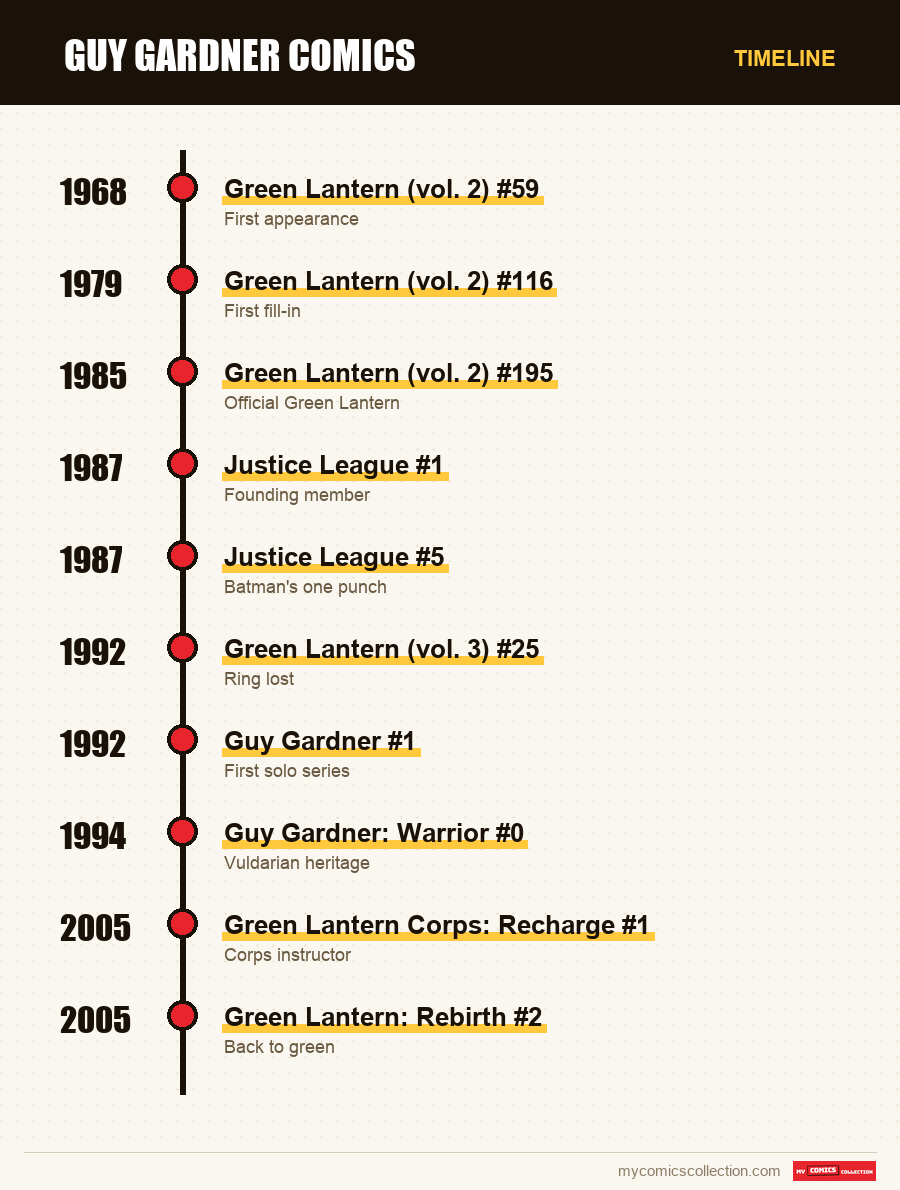
Green Lantern (vol. 2) #59
John Broome and Gil Kane reveal that Abin Sur's ring had found two worthy candidates: Hal Jordan and Guy Gardner, a teacher. Jordan was chosen because he was closer to the crash site. Gardner becomes his designated backup, and this is the character's reference issue.
Green Lantern (vol. 2) #116
While Hal Jordan has his ring repaired on Oa, Guy Gardner finally fills in for him and teams up with Green Arrow against Professor Ojo. The explosion of Jordan's power battery then makes him vanish, and everyone believes he is dead. A story by Denny O'Neil.
Justice League #5
Fed up with arguing with Batman over who leads the team, Guy Gardner takes off his ring and attacks him. Batman drops him with a single punch, to the delight of their teammates. By Keith Giffen, J.M. DeMatteis and Kevin Maguire, the scene remains one of the most quoted in Justice League International history.
Green Lantern (vol. 2) #195
In the middle of Crisis on Infinite Earths, the Guardians pick Guy Gardner as the new Green Lantern of Sector 2814, with John Stewart engaged elsewhere. After years in reserve, he receives his own ring and officially joins the Corps. An issue by Steve Englehart and Joe Staton.
Justice League #1
First issue of the new Justice League by Keith Giffen, J.M. DeMatteis and Kevin Maguire, born out of the Legends event. Guy Gardner is among the founding members, alongside Batman, J'onn J'onzz and Blue Beetle, and he is the first to show up at headquarters.
Guy Gardner #1
His first ongoing series, written by Gerard Jones and drawn by Joe Staton. Guy Gardner wields Sinestro's yellow ring and wears a blue costume designed by Staton. The book becomes Guy Gardner: Warrior from issue 17.
Green Lantern: Rebirth #2
In Geoff Johns and Ethan Van Sciver's miniseries, Guy Gardner has lost his Vuldarian DNA under Parallax's influence. During an explosion at the Justice League Watchtower, Hal Jordan's ring duplicates itself and Gardner becomes a Green Lantern again.
Green Lantern (vol. 3) #25
Back on Earth, Hal Jordan wants Sector 2814 back, and Guy Gardner demands a fight whose loser must quit the Corps. The battle ends bare-fisted in the streets of New York and Gardner loses, handing over his ring. Powerless, he later sets out to find Sinestro's yellow ring.
Guy Gardner: Warrior #0
Issue 0, released alongside the Zero Hour event, by Beau Smith and Mitch Byrd. Guy Gardner learns the source of his new powers: the Vuldarians, an alien warrior race, mixed their DNA into his bloodline. He can now turn his body into weapons.
Green Lantern Corps: Recharge #1
Geoff Johns, Dave Gibbons and Patrick Gleason begin rebuilding the Corps, set to number 7,200 members, two per sector. The Guardians name Guy Gardner one of the instructors of the new recruits, alongside Kilowog and Kyle Rayner.