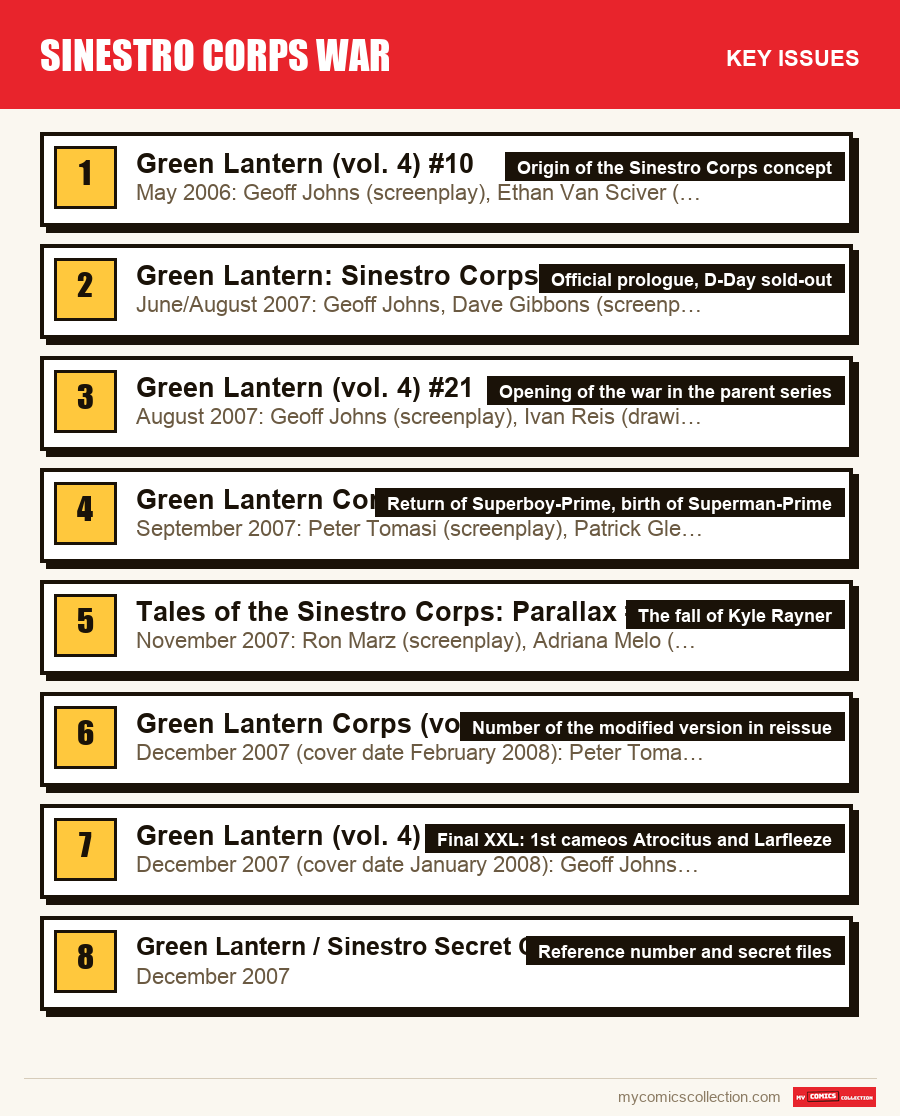
Sinestro Corps War (June-December 2007) is the Green Lantern crossover written by Geoff Johns, Dave Gibbons, and Peter Tomasi that launched Sinestro's Yellow Army against the Green Lantern Corps. The key numbers to know are Green Lantern: Sinestro Corps Special #1 (prologue, same-day sold-out, four prints), Green Lantern Corps #14 (return of Superboy-Prime), Green Lantern #21-25 (heart of the story) and above all Green Lantern #25, the XXL finale which introduces Atrocitus and Larfleeze as cameos, laying the foundations for Blackest Night.
Few Green Lantern crossovers have had the editorial impact of Sinestro Corps War. In seven months, Geoff Johns transformed a character previously considered a simple recurring antagonist of Hal Jordan, Sinestro, into the founder of a true intergalactic army, foreshadowing the entire universe of the emotional spectrum which would dominate the pages of Green Lantern for almost a decade, until Blackest Night then Brightest Day.
This file is not a simple bibliography. It is a map of the numbers that really matter to a collector: those which have a first appearance, those which have had multiple editions revealing their popularity at the time of release, and those which, still today, structure the rating of the series Green Lantern volume 4 and Green Lantern Corps volume 2. We rely solely on verifiable editorial facts (publication dates, credits, print runs, nominations) without putting forward the slightest rating figure which would not be confirmed.
Whether you're looking to complete a 2000s Green Lantern collection, understand why certain issues from this period keep popping up in collector discussions, or assess what your copy is really worth, this guide covers the essentials: context, key issues, the impact of recent adaptations, and concrete buying advice.
Editorial context: how Sinestro became army leader
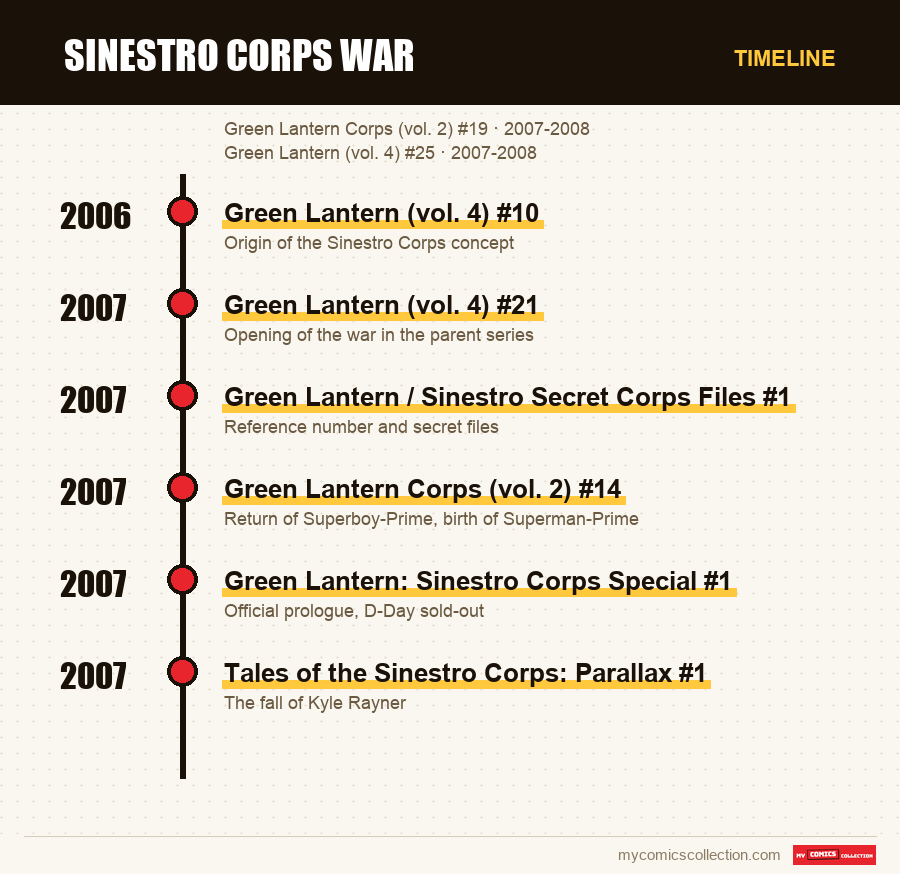
The idea of a "Sinestro Corps" was not born in 2007. It was sown almost a year and a half earlier, in Green Lantern (vol. 4) #10, in May 2006, by Geoff Johns and Ethan Van Sciver. It is in this arc, known to readers as "Wanted: Hal Jordan", that the reader first understands that Sinestro is not just on the run from galactic justice: he is planning something much bigger. This seminal issue is often overlooked by collectors who focus on the 2007 crossover itself, even though it is the true editorial starting point for the concept.
The war itself officially started with Green Lantern: Sinestro Corps Special #1, released June 27, 2007 (cover date August 2007), a 64-page event one-shot priced at $4.99, bringing together Geoff Johns and Ethan Van Sciver: the same creative duo as on the miniseries Green Lantern: Rebirth a few years earlier: with a backup origin story drawn by Dave Gibbons. The main story then ran on two parent series in parallel: Green Lantern (vol. 4) #21 to #25, with Ivan Reis drawing, and Green Lantern Corps (vol. 2) #14 to #19, carried by the duo Peter Tomasi (screenplay) and Patrick Gleason (drawing), with Dave Gibbons as co-writer on certain issues. The whole thing took place from June to December 2007, with ramifications in four “Tales of the Sinestro Corps” one-shots (Parallax, Cyborg Superman, Superman-Prime and Ion), a tie-in in Blue Beetle #20, and a closing number, Green Lantern / Sinestro Corps Secret Files #1, published December 2007.
On a commercial level, the event was a tidal wave for the time. THE Sinestro Corps Special #1 sold out in its entirety on the day of its release at distributors, prompting DC to reprint it four times with new variant covers signed by Van Sciver in each printing. By August 2007, cumulative sales exceeded 89,000 copies, 36% of which came from exceptionally high restocking orders: a strong signal that demand had been greatly underestimated at the time of the initial solicitation. Green Lantern Corps #14 also had a third draw, and the tie-in in Blue Beetle #20 saw its sales jump 75% thanks to the crossover. Critically, the Launch Special earned Ethan Van Sciver a nomination for the 2008 Eisner Awards in the best artist/inker category, while the specialized press of the time (IGN, Newsarama, Comic Book Resources) unanimously hailed the story as one of the defining events of the year in superhero comics.
On a narrative level, the stakes go far beyond the simple confrontation of Hal Jordan against Sinestro. The Guardians of the Universe Guild authorizes the use of lethal force by Green Lanterns for the first time, rewriting the Book of Oa which previously prohibited killing. Kyle Rayner, separated from the Ion entity, finds himself possessed by Parallax. Sinestro frees devastating figures from their imprisonment on Oa: the Cyborg Superman (Hank Henshaw), the Anti-Monitor, and especially Superboy-Prime, renamed Superman-Prime after joining the ranks of the Yellow Army. It was this escalation, carefully orchestrated issue after issue, that allowed Johns to set the backdrop for the prophecy of the Blackest Night: the idea that seven Corps, one for each color of the emotional spectrum, would eventually clash in a much larger war.
Green Lantern (vol. 4) #10
This issue belongs to the “Wanted: Hal Jordan” arc and precedes the official start of the war by thirteen months. It is here that the reader understands for the first time that Sinestro is preparing a project of an entirely different magnitude than his simple hunt for Hal Jordan: the editorial genesis of the concept of a yellow army based on fear. Many collectors who focus on run #21-25 miss this issue, even though it constitutes the true narrative ground zero of the event.
Green Lantern: Sinestro Corps Special #1
The one-shot that started the whole event, 64 pages priced at $4.99. Sold out of distributors the same day it was released, it was reprinted four times with new variant covers by Van Sciver-a rare sign of commercial success for an industry where restocks are generally modest. It introduces around twenty new members of the Sinestro Corps in a single delivery, including Arkillo (the Corps' drill sergeant, Kilowog's evil counterpart), Karu-Sil, Despotellis and Slushh. Van Sciver received a 2008 Eisner Award nomination for his work on this issue.
Green Lantern (vol. 4) #21
First chapter of the actual crossover in the series Green Lantern. Ivan Reis takes charge of the design of the main arc, imposing a style which will become the visual reference of the Johns era on the title for several years. The Sinestro Corps' assault on Earth and Oa begins in earnest from this issue, with the appearance of new members recruited from among the most terrifying figures in the DC universe.
Green Lantern Corps (vol. 2) #14
During the assault on Oa and Mogo, Superboy-Prime is freed from his imprisonment alongside the Cyborg Superman. He joins the Sinestro Corps and becomes Superman-Prime: a major turning point for a character whose return has been eagerly awaited by readers since the events of 52 and Infinite Crisis. The issue had a third printing, proof of the strong demand on the distribution side at the time of its release.
Tales of the Sinestro Corps: Parallax #1
One of the four “Tales of the Sinestro Corps” one-shots published alongside the main crossover, alongside the issues dedicated to Cyborg Superman, Superman-Prime and Ion. This issue, titled “Fearful Symmetry”, delves into the psyche of Kyle Rayner then possessed by the entity Parallax, separated from his previous identity as Ion. An important piece for understanding Rayner's personal arc over the entire saga, often sought after by collectors specializing in this character.
Green Lantern Corps (vol. 2) #19
In this issue, Mongul receives a yellow ring after breaking the neck of a dying Sinestro Corps member. Rare editorial feature: the version originally published differs from the one later included in the trade paperbacks Green Lantern: The Sinestro Corps War, a scene having been retouched for republication. The full original version has only been republished in the collection Green Lantern Corps: Ring Quest. This detail makes it a special number for purists who want to own the original “single issue” version.
Green Lantern (vol. 4) #25
The double-sized anniversary issue that concludes the war. Superboy-Prime attacks the Anti-Monitor, who is ultimately destroyed when a Guardian transforms into an Oanian energy bomb to annihilate him. But the most sought-after item among collectors is found in the very last pages: this issue contains the first-ever cameo appearance of Atrocitus and the Red Lantern Corps, as well as Larfleeze (future Agent Orange) and the Orange Lantern Corps: directly laying the foundation for the event Blackest Night which will follow two years later. It is this dual status, both conclusion of the Sinestro Corps War and gateway to Blackest Night, which explains why this issue remains one of the most requested of the entire Johns era on Green Lantern.
Green Lantern / Sinestro Secret Corps Files #1
Published at the end of the event, this “Secret Files” type issue brings together character sheets and complementary lore elements on the two opposing Corps. Less sought after than the narrative chapters of the saga, it remains a welcome addition to readers wanting a complete editorial collection of the event, particularly because it was also included in subsequent compilations devoted to the Sinestro Corps War.
Collecting this series?
Track what you own, what you are missing and what your collection is worth. 7 day trial.
Start my trial →The impact of adaptations on the rating
Unlike other Green Lantern arcs, Sinestro Corps War has never been adapted as is for film or series. The movie Green Lantern from 2011, starring Mark Strong as Sinestro, was mainly inspired by the miniseries Green Lantern: Rebirth for its origin, and was content with a tease at the end of the film, the famous post-credits shot where Sinestro puts on the yellow ring, without ever developing the war of the Sinestro Corps on screen. This did not prevent the paper saga from remaining the absolute reference for any screenwriter or reader wanting to understand the evolution of the character from simple sworn enemy to intergalactic warlord.
The situation is concretely changing in 2026. The series Lanterns, produced by James Gunn and Peter Safran for HBO, with Damon Lindelof, Tom King and Chris Mundy writing, is due out August 16, 2026 on HBO Max, as part of the first chapter of the new DC universe. The series, centered on Hal Jordan and John Stewart and thought of as a thriller style True Detective, has already confirmed the presence of Sinestro, played by actor Ulrich Thomsen, presented as a former friend of Hal Jordan who has become a figure as charismatic as he is formidable. If the showrunners have not publicly confirmed that the series will directly adapt the founding of the Sinestro Corps, the mere confirmation of the character in a central role in the first season is already fueling collectors' interest in the character's founding comics: starting with the very first issues where the concept of the Yellow Army appears.
Editorially, DC has also scheduled a new full compilation of the event for 2026: Green Lantern: The Sinestro Corps War Compendium, a 1,440-page volume priced at $59.99, collected in reading order Green Lantern #18-38, Green Lantern Corps #10-32, the Special, the four “Tales of the Sinestro Corps” one-shots and the Secret Files issue. This type of massive republication has historically tended to renew public interest in the original single issues among collectors who prefer the experience of the periodical comic to that of the bound collection: a phenomenon already observed on other DC compendiums in previous years.
For a collector, these two signals (TV series with Sinestro as a confirmed character, and new large format compilation) are exactly the type of context that deserves to be followed closely in the months preceding a release. Historically, media attention around a character often precedes by several weeks a renewed demand for its founding comics, without however being able to guarantee an immediate or lasting effect on the rating.
Buying guide
- Do not confuse the two parent series: the crossover runs in parallel on Green Lantern (vol. 4) #21-25 and on Green Lantern Corps (vol. 2) #14-19. A "complete" collection of Sinestro Corps War requires both runs, plus the Special and the four Tales one-shots.
- Always check whether it is a first printing or a reprint, particularly for the Sinestro Corps Special #1 (four prints with separate variant covers) and for Green Lantern Corps #14 (third printing): the printing number is usually indicated in small print near the barcode on the back of the comic.
- On Green Lantern Corps #19, keep in mind the editorial particularity: the content of the original version differs from that of the trade paperback reissues. If you're looking for the "as originally released" version, make sure the seller specifies that this is the original issue single and not a TPB-aligned reprint.
- For Green Lantern #25, particularly inspect the last pages when purchasing in scans: this is where the cameos of Atrocitus and Larfleeze are found which make all the collector's interest in the issue beyond the simple conclusion of the arc.
- On the gradation, the difference between a 9.8 and a 9.6 can represent a significant difference in value on this type of issue which is very manipulated upon its release (high sales circulation on newsstands and comic shops); if you are unsure about the level of requirements to aim for for a dimming shipment, our comparison CGC 9.8 vs 9.6 details the criteria that tip a rating.
- Issue #10 from May 2006, often overlooked, is worth seeking out alongside the 2007 crossover issues: it is the real narrative starting point of the Sinestro Corps concept, and its lesser awareness among the general public sometimes makes it a more accessible piece to complete a thematic collection.
- Before purchasing a lot or a complete collection, take a precise inventory of what you already own using a dedicated application: this avoids costly duplicates on a saga which has more than a dozen issues linked together.
To methodically organize your Green Lantern collection and track precisely which Sinestro Corps War issues you're still missing, the collection management application allows you to catalog each print, each variant and each grade in one place.