Sinestro (Thaal Sinestro) first appears in Green Lantern (vol. 2) #7 (August 1961, DC Comics), created by writer John Broome and artist Gil Kane. Former Green Lantern of sector 1417 who became tyrant of Korugar then banished to the antimatter planet Qward, he forged the first yellow ring there (Green Lantern #9, December 1961) and later founded the Sinestro Corps, an army of fear which confronted the Green Lanterns during the Sinestro Corps War (2007). The character was played by Mark Strong in the film Green Lantern (2011) and by Ulrich Thomsen in the HBO series Lanterns, expected on August 16, 2026.
Few DC villains have an editorial career as tortuous as that of Sinestro. Born as a simple recurring antagonist in a superhero comic in the early 1960s, he became, forty-six years later, the center of one of the best-selling crossovers in Green Lantern history, before briefly joining the ranks of heroes in the New 52, then carrying his own monthly series. This jagged trajectory explains why its key appearances are spread over several eras of the comic collector market: the Silver Age, the modern post-2000 era and the contemporary period of relaunches and audiovisual adaptations.
This article traces the history of the character in the comics, from the origins of John Broome and Gil Kane to Geoff Johns' Sinestro Corps War, including his time as a hero in the New 52 and his role in Injustice: Gods Among Us. We also detail what collectors are really looking for in this character, with benchmarks of rarity and rating when they are documented, and what the recent adaptations - 2011 film and Lanterns series on HBO: are changing concretely for the paper comics market.
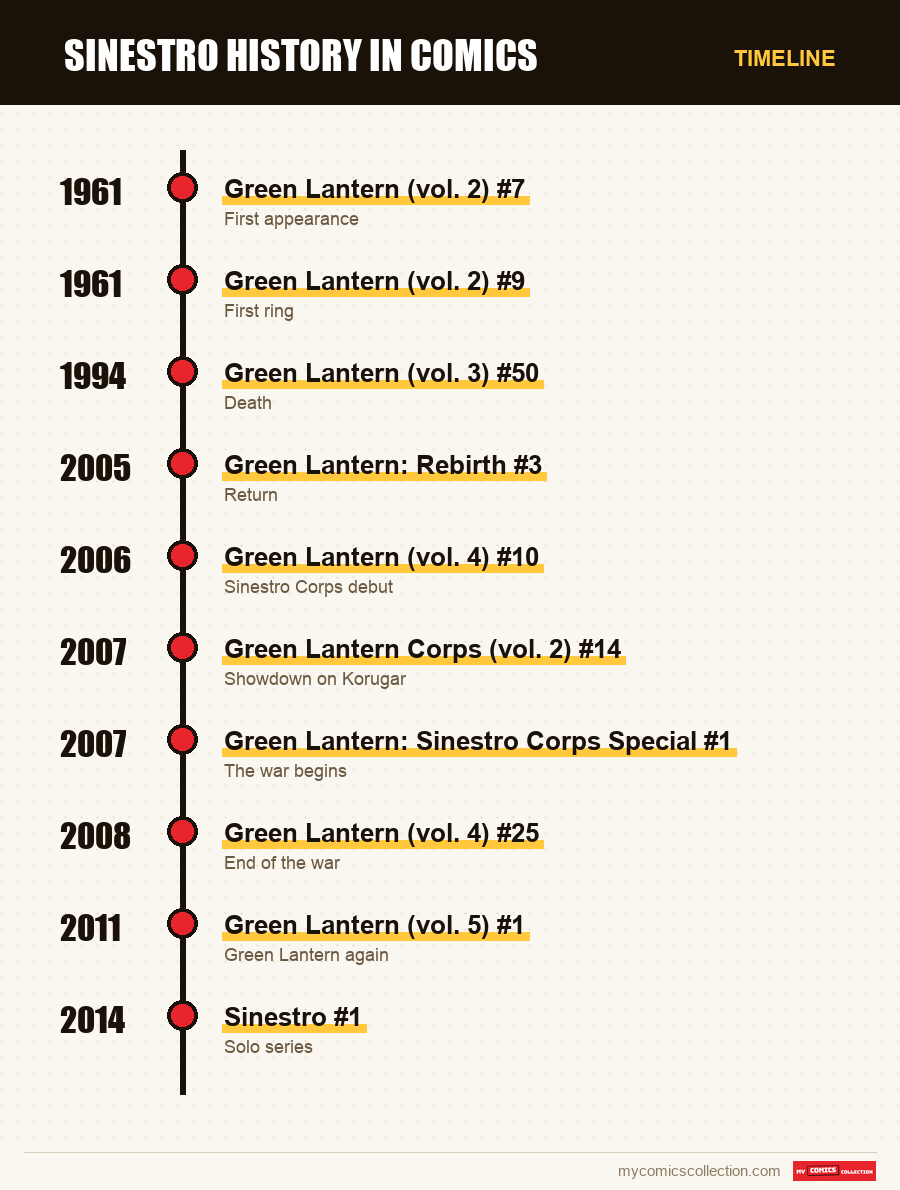
Birth of a villainous cult: Green Lantern #7 and the Silver Age
Sinestro made his debut in Green Lantern (vol. 2) #7, an issue dated August 1961 but released on sale July 10 of that year. The scenario is by John Broome, a major figure in the DC Silver Age already responsible for relaunching the character of Green Lantern with Hal Jordan two years earlier; the drawing is by Gil Kane, inked by Joe Giella. Kane later said he was inspired by the face of British actor David Niven to draw the character's fine features, mustache and aristocratic appearance: a graphic choice which immediately distinguished Sinestro from other villainous costumes of the time, which were more crude or monstrous.
In this origin story, Sinestro is not presented as a fallen antihero in the modern sense: he already appears as a former Green Lantern from sector 1417, responsible for monitoring his home planet Korugar, who misused the power of his ring to establish a regime of terror on his own people. Unmasked, he is deposed by the Guardians of the Universe and banished to the antimatter universe, on the planet Qward. The founding story thus immediately establishes the central irony of the character: a protector of the will who became a despot ruling by fear, which would become decades later the thematic driving force of the entire mythology of the emotional spectrum.
Broome's subsequent runs in the 1960s, then those of Denny O'Neil and Mike Grell in the 1970s-1980s, would make Sinestro Hal Jordan's most important recurring enemy, regularly returning to confront the Corps since his exile on Qward. It is in this period that the twin rivalry with Hal Jordan is established which will structure all the rest of the continuity, including the later reworked versions where Sinestro is presented as the direct instructor of young Jordan within the Corps: a nuance which will be especially developed and popularized by Geoff Johns' run in the 2000s and then taken up in the cinema.
Exile on Qward and the birth of the yellow ring
The most enduring element introduced by the Silver Age screenwriters is not only the character of Sinestro, but the object that will define his identity for the next six decades: the yellow ring. On Qward, Oa's antimatter twin planet ruled by the Weaponers, a caste of warrior-scientists historically hostile to the Guardians of the Universe and their Corps, Sinestro finds natural allies. He reveals to them a structural weakness of the green rings of the time: their inability to affect anything yellow, known in continuity as the "yellow impurity". The Weaponers, who have long been working on rival power ring technology, exploit this information to forge a ring capable of drawing its energy from fear rather than will.
This yellow ring made Sinestro, for more than forty years of continuity, one of the very rare adversaries capable of directly neutralizing the power of a Green Lantern rather than simply opposing it through brute force. It is this mechanism, a conceptual weakness exploited as a weapon, which will later give Geoff Johns the material to construct the entire emotional spectrum (red rage, orange greed, yellow fear, green will, blue hope, purple love, indigo compassion, black death) from the sole invention of 1961.
Sinestro Corps War (2007): the turning point that redefined the character
For more than forty years, Sinestro remains a solitary villain, formidable but isolated. This status changed radically in 2007 with Sinestro Corps War, an eleven-part crossover written by Geoff Johns and Dave Gibbons, drawn in particular by Ivan Reis, Patrick Gleason and Ethan Van Sciver, published between June and December 2007 in Green Lantern (vol. 4) #21 to #25, Green Lantern Corps #14 to #19 and the one-shot Green Lantern: Sinestro Corps Special #1.
The premise changes everything: Sinestro is no longer a simple repeat criminal, but the founder and general of a true interstellar army, the Sinestro Corps, recruiting beings capable of inspiring immense fear across the galaxy and equipping them with mass-produced yellow rings. The story pits this army against Earth's Green Lanterns (Hal Jordan, Kyle Rayner, John Stewart and Guy Gardner) as well as the entire Green Corps in a clash on a cosmic scale. Critical reception was immediately very favorable: IGN called the story a resounding success while Newsarama designated it as the most notable DC event of its year of publication.
Editorially, this saga has two lasting consequences. First, it transformed Sinestro into the central character of the entire Green Lantern franchise for the following decade, paving the way for Blackest Night (2009) then Brightest Day, which generalized the concept of the emotional spectrum to the entire DC universe. Next, it created a new generation of issues considered key by modern collectors: Green Lantern Corps #14, the second part of the war (the Sinestro Corps had first appeared in Green Lantern vol. 4 #10, May 2006), sold out of print upon its July 25, 2007 release, forcing DC to release a second and then a third printing: a rare signal of demand for a solo-collectible title in that period.
Return to the heroes: the New 52 and Cullen Bunn's solo series
The 2011 New 52 relaunch offered Sinestro the most unexpected narrative twist in its entire editorial history. In Green Lantern (vol. 5), still written by Geoff Johns, Hal Jordan starts the series without a ring or his status as Green Lantern: the Guardians expelled him from the Corps at the end of War of the Green Lanterns (Green Lantern vol. 4 #67, 2011). In that same issue, it is a green ring that, in a gesture of irony assumed by the writers, chooses Sinestro, and the Guardians let him rejoin the Corps that he had betrayed decades earlier. For several arcs, the reader therefore follows a Sinestro Green Lantern again, still as authoritarian and convinced of his own moral superiority, but officially on the side of the defenders of galactic order: a configuration which had never been attempted for so long in the previous continuity.
This heroic parenthesis ends with the arc Wrath of the First Lantern, at the end of which Sinestro regains his status as an outlaw and is entrusted, a rare occurrence, with his own monthly series: Sinestro (2014-2016), twenty-three issues plus an annual, written by Cullen Bunn and drawn by Dale Eaglesham. The title follows his attempt to regain control of the Sinestro Corps and the Yellow Lantern Corps that he founded, in a darker and more personal tone than his previous appearances as the second sword in the Green Lantern titles. It is also in this extended period that one of the character's most commented narrative threads develops: the revelation of his biological daughter, Soranik Natu.
Soranik was born from her marriage to Arin Sur: the full sister of Abin Sur, the Green Lantern who had recruited Hal Jordan and whose sector partner Sinestro was once, making her Abin Sur's niece. Entrusted from birth to adoptive parents on Korugar to protect her from her father's growing reputation, she becomes a surgeon then, without knowing it, is selected by a green ring to join the Corps. The gradual discovery of his origins, notably developed in Green Lantern Corps at the end of the 2000s then in Hal Jordan and the Green Lantern Corps (the story "The Ballad of Soranik Natu", 2018), adds a rare family dimension to a character until now defined almost exclusively by ideology and power.
Sinestro among the alternative villains: Injustice: Gods Among Us
Outside of the main continuity, Sinestro occupies a special place in Injustice: Gods Among Us, the line of digital and then printed comics launched in 2013 as a tie-in to the video game of the same name. In this alternative universe where Superman establishes a planetary dictatorship after the death of Lois Lane, Sinestro is one of the rare villains to voluntarily join Superman's regime rather than fight him. The logic is, however, perfectly consistent with the character established since 1961: his own mode of government on Korugar was already based on the order imposed by fear, so much so that he recognizes in Superman's project a version on a planetary scale of his own philosophy.
Sinestro becomes one of the military leaders of the regime, leads his Corps in the service of Superman and even recruits, in an additional twist, a broken Hal Jordan having deserted the traditional Green Corps. This status of "villain who is right in his own way" in a universe where moral benchmarks are reversed has largely contributed to broadening his popularity with a more recent audience, notably via the fighting game, without ever entering into competition with his reference continuity in classic paper comics.
The impact of adaptations on the rating
Sinestro has seen two major audiovisual adaptations to date, and their effect on collectors' interest in its original comics deserves to be nuanced rather than exaggerated.
The first is the film Green Lantern, released in theaters on June 17, 2011 by Warner Bros, with Ryan Reynolds in the role of Hal Jordan. Mark Strong, chosen to play Thaal Sinestro from January 2010, has explained on several occasions that the scenario followed the original comics quite closely: his Sinestro is a respected and devoted member of the Corps, skeptical mentor of Hal Jordan, who only switches to the dark side at the very end of the film by stealing the yellow ring resulting from the defeat of Parallax: a post-credits scene which was to open onto a sequel centered on the character. The film, however, received a disappointing critical and commercial reception, and this sequel never saw the light of day, which limited the halo effect generally observed on the comic market after a successful theatrical release. The film nevertheless remains the gateway most cited by new readers who then discover Green Lantern #7 by going back to the source of the character.
The second adaptation, in production at the time of writing this article, is much more potentially structuring for the market: the Lanterns series, produced by HBO and created by Chris Mundy, Damon Lindelof and Tom King, with Kyle Chandler in the role of Hal Jordan and Aaron Pierre in that of John Stewart. Ulrich Thomsen plays Sinestro in a recurring role described by the production as "ruthless but undeniably charismatic". The broadcast is announced for August 16, 2026 over eight episodes. A premium series of this format, backed by HBO's reputation in prestige television, is historically the type of release which triggers the most searches and impulse purchases on the first paper appearances of the character concerned: a phenomenon already observed on other DC franchises during their series adaptations. However, it is still too early, at the date of publication of this article, to measure the real effect of Lanterns on the demand for Green Lantern #7 or the issues of Sinestro Corps War: this will have to be verified once the series has been broadcast.
Collecting this series?
Track what you own, what you are missing and what your collection is worth. 7 day trial.
Start my trial →Buying guide: what you need to know before buying a Sinestro
Unlike characters whose rating is based on a single iconic number, the editorial history of Sinestro spans several distinct eras of the market, which changes the purchasing logic according to the budget and the collection objective.
- Green Lantern (vol. 2) #7 (1961) is the historical must-have. This is the first appearance and origin of the character. The book remains generally affordable in intermediate grades because more than two thousand copies are listed in the CGC census according to GoCollect, but very high grades are extremely rare: only two copies are known in 9.8, and a copy in 9.6 sold for 27,166 dollars in 2018 while a 9.0 had reached 9,560 dollars in 2008. Systematically check the presence of both staples, the condition of the corners and the absence of undeclared restoration before purchasing a high grade copy.
- Green Lantern Corps #14 (2007) deserves special attention for collectors of the modern era. This is the second part of the Sinestro Corps War, with Sinestro's duel against Soranik Natu on Korugar; the very first appearance of the Sinestro Corps dates back to Green Lantern (vol. 4) #10, in May 2006. The issue, out of print as soon as it was released and reprinted twice, illustrates strong initial demand; always compare the prints (first printing vs second or third printing, recognizable by the mention on the cover or in the index) because the difference in collectability between the printings can be significant.
- Don't neglect the Bronze Age runs (1970s-1980s). The recurring appearances of Sinestro against Hal Jordan during this period remain much less hunted than number 7, but they trace the progressive construction of the rivalry and are at very accessible entry-level prices for those who want to follow the character number by number.
- For the New 52 period, favor collection consistency rather than rarity. Green Lantern (vol. 5) #1 to approximately #13 (the arc of Sinestro's return to the Corps) and Cullen Bunn's Sinestro solo series (2014-2016) are not rare issues, but they form a complete and affordable narrative package, ideal for reconstituting the entire character without a Silver Age budget.
- Systematically go through a real sales comparator before bidding. The prices displayed on sales sites do not always reflect the real market; our estimator based on current eBay listings allows you to check in a few seconds a low, median and high range before positioning yourself on a copy of Green Lantern #7 or an issue of Sinestro Corps War.
- Catalog your acquisitions as you go. With a character whose editorial history spans so many different eras and titles (Green Lantern, Green Lantern Corps, Sinestro Corps Special, Sinestro Solo), it's easy to lose track of what you already have. Our comic collection management application allows you to precisely track each issue, its condition and its origin of purchase.
Key issues to know
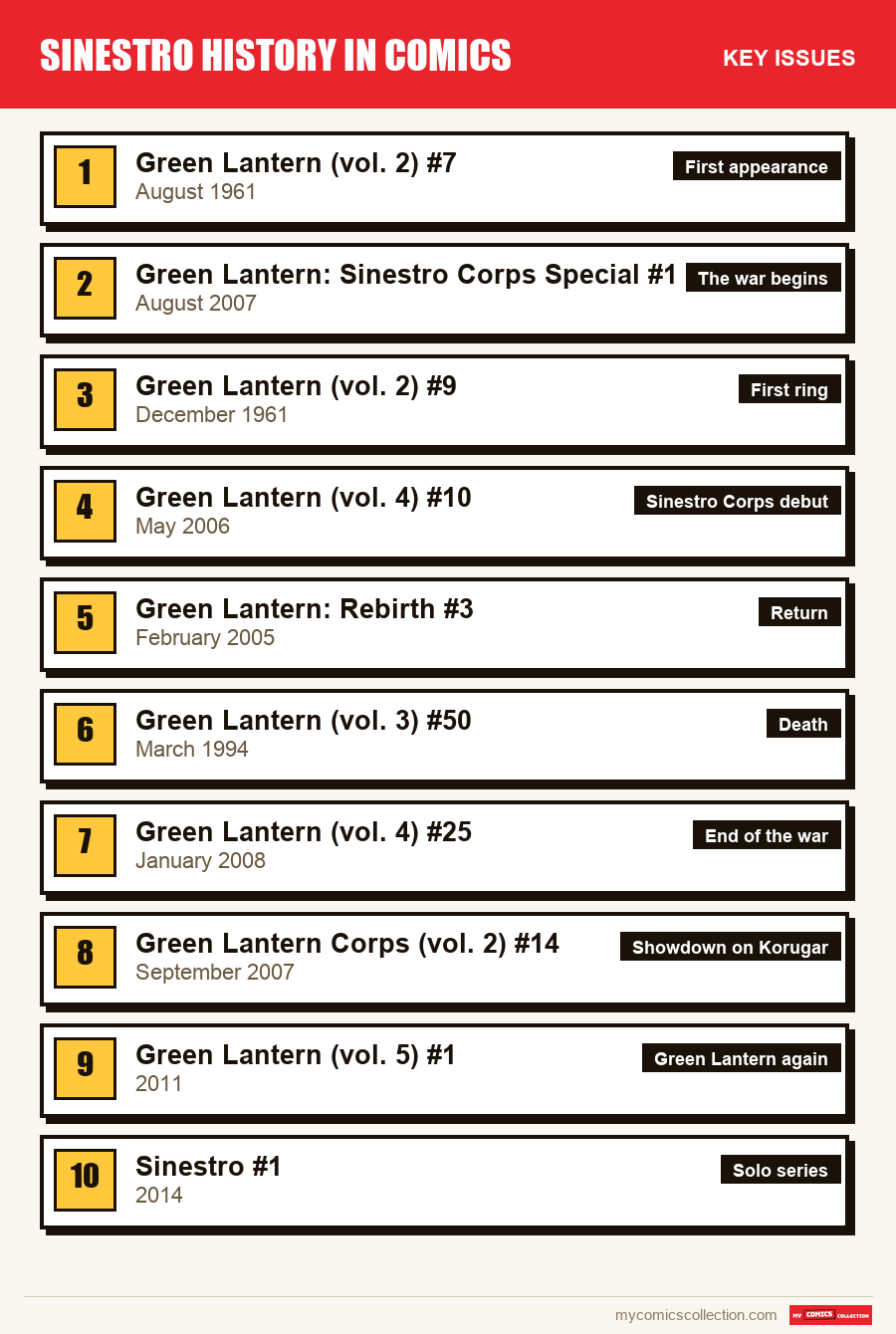
Green Lantern (vol. 2) #7
John Broome and Gil Kane introduce Sinestro, a former Green Lantern of Korugar who used his ring to enslave his planet. Stripped of his power by the Guardians of the Universe and banished to Qward in the antimatter universe, he allies with the Weaponers to trap Hal Jordan. The character's whole history starts here.
Green Lantern: Sinestro Corps Special #1
Geoff Johns and Ethan Van Sciver open the Sinestro Corps War. Sinestro unveils his army armed with yellow rings, has Oa attacked and stands alongside Parallax and the Anti-Monitor. This one-shot launches the crossover that puts him at the centre of the Green Lantern franchise.
Green Lantern (vol. 2) #9
In Battle of the Power Rings!, Sinestro returns armed with a power ring he built himself, one that drains energy from green rings. He takes on Hal Jordan's appearance to strike at the Guardians on Oa. It is the first time he wields the ring that will become his trademark.
Green Lantern (vol. 4) #10
In a short scene of this Geoff Johns issue, a yellow ring seeks out a monstrous warrior and welcomes him into an organisation called the Sinestro Corps. It is the very first appearance of Sinestro's army, a year before the war that bears its name.
Green Lantern: Rebirth #3
This issue of Geoff Johns and Ethan Van Sciver's miniseries ends with Sinestro, alive and well, revealed as the one who awakened Parallax, the entity that had corrupted Hal Jordan. The series establishes that the Sinestro killed in 1994 was only a Parallax construct.
Green Lantern (vol. 3) #50
Conclusion of Emerald Twilight, by Ron Marz and Darryl Banks. Freed by the Guardians to stop a rampaging Hal Jordan, Sinestro duels him on Oa and ends up with his neck snapped. In the same issue, Hal becomes Parallax.
Green Lantern (vol. 4) #25
Eleventh and final part of the Sinestro Corps War, by Geoff Johns and Ivan Reis. Hal Jordan defeats Sinestro in Coast City, after which he is imprisoned on Oa. The issue also heralds new corps based on the colours of the emotional spectrum and the Blackest Night prophecy.
Green Lantern Corps (vol. 2) #14
Second part of the Sinestro Corps War. Sinestro returns to Korugar to face Soranik Natu, the Green Lantern who succeeded him, and easily overpowers her. Yet he lets her believe she has beaten him, to force her to stay and protect their planet.
Green Lantern (vol. 5) #1
First issue of the New 52 relaunch, by Geoff Johns and Doug Mahnke. Chosen by a green ring at the end of War of the Green Lanterns, Sinestro recites the oath before the Guardians, who let him keep the ring as a chance at redemption. Hal Jordan, meanwhile, no longer has a ring.
Sinestro #1
Cullen Bunn and Dale Eaglesham give Sinestro his own monthly series. The book follows his efforts to regain control of the Sinestro Corps and runs for twenty-three issues and one annual until 2016.