Green Lantern (2011) Martin Campbell , with Ryan Reynolds , adapts Hal Jordan (Showcase #22, 1959), pilot chosen by a power ring to join the Green Lantern Corps. The film features Oa, the Guardians and Sinestro, but simplifies a dense cosmic mythology. Here is the detailed comparison, film versus comics.
The first film adaptation of the intergalactic guardian, Green Lantern brings to the screen Hal Jordan, the green ring and the Corps that protects the universe. It draws on a cosmic mythology built since 1959. Decryption source by source.
As in each article in this series, only verified information (creators, distribution, dates, comic numbers) is stated; the comparative analysis is ours, without reproducing dialogue or protected images.
Title : Green Lantern (2011)
Director: Martin Campbell
Actors: Ryan Reynolds (Hal Jordan), Blake Lively (Carol Ferris), Peter Sarsgaard (Hector Hammond), Mark Strong (Sinestro)
Exit : June 2011
Studio: Warner Bros.
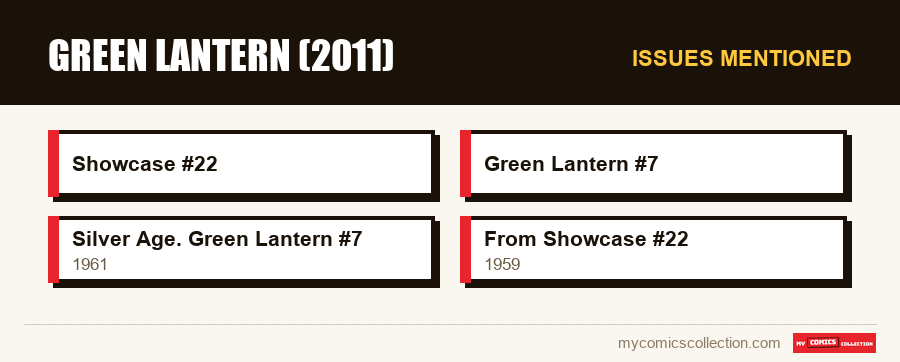
Showcase #22 (1959): Hal Jordan's first appearance
The Green Lantern Corps: the intergalactic police
Sinestro: the fallen Lantern (Green Lantern #7, 1961)
Parallax: the entity of fear
- Hal Jordan, pilot chosen by the ring of power.
- L'green ring which materializes the will into constructs.
- Le Green Lantern Corps and the planet Oa.
- THE Guardians of the Universe, immortal beings.
- Sinestro , Carol Ferris and Hector Hammond.
- Parallax becomes a cosmic cloud rather than an insect.
- Cosmic mythology is highly simplified.
- Sinestro remains an ally (his fall has only just begun).
- The original story is condensed in a single film.
- Hector Hammond has an amplified role.
Showcase #22 (1959): Hal Jordan, Guardian of the Universe
Green Lantern stars Hal Jordan, who appeared in Showcase #22 (1959), created by John Broome and Gil Kane. A brave and fearless test pilot, Hal is chosen by a dying power ring to become the Green Lantern of the space sector encompassing Earth. The ring, powered by the will of its wearer, allows the creation of “constructs”, objects of green energy materializing the imagination, and the ability to fly through space. Hal thus joins the Green Lantern Corps, an intergalactic police force founded by the Guardians of the Universe, immortal beings from the planet Oa. An emblematic character of the Silver Age, Hal Jordan embodies courage in the face of fear, a central principle of mythology.
The film faithfully follows the original story: Hal Jordan, daredevil test pilot, receives the ring from the dying Green Lantern Abin Sur and travels to Oa, where he discovers the Corps and trains. Ryan Reynolds plays this reckless hero, whose main challenge is overcoming his own fear to master the ring. The film features the ring and its constructs, the planet Oa, the Guardians and the Corps, faithful to the foundations of the comics. This adaptation respects the essence of Hal Jordan and the principle of will triumphing over fear. However, it simplifies a very dense cosmic mythology, developed over more than five decades.
The Green Lantern Corps and the emotional spectrum
At the heart of the mythology is the Green Lantern Corps, an intergalactic police force made up of thousands of members, each protecting a sector of the universe. Founded by the Guardians of the Universe from the planet Oa, the Body draws its power from the green light of will, one of the components of an “emotional spectrum” which structures modern mythology: each color corresponds to an emotion. The green light of will is particularly opposed to the yellow light of fear, embodied by Parallax, an evil entity. This rich cosmology makes the Green Lantern universe one of DC's largest and most complex.
The film exploits the Corps and Oa, introducing alien Green Lanterns like Kilowog and Tomar-Re who train Hal. It features Parallax as the main antagonist, embodying fear which opposes will. The film, however, considerably simplifies this mythology: Parallax becomes a cosmic cloud devouring fear, very far from its original form in the comics. The richness of the emotional spectrum and the scale of the Body are reduced to condense the story. This simplification, motivated by the constraints of a first introductory film, sacrifices part of the density which is the strength of comics. For the reader, the film is a gateway to a much larger cosmic mythology, to be explored in the runs which develop the Body and the emotional spectrum.
Sinestro, the ally destined to become enemy
The film features Sinestro, who appeared in Green Lantern #7 (1961), one of the most respected Green Lanterns and Hal's mentor. In the comics, however, Sinestro becomes Hal Jordan's greatest enemy: convinced that order must reign through fear rather than will, he is banished from the Corps and founds his own corps of Yellow Lanterns, fueled by fear. This trajectory, from ally to nemesis, is one of the richest in the Green Lantern mythology, embodying the philosophical opposition between will and fear, freedom and control. Sinestro is a complex antagonist, convinced that he acts for the good of the universe.
The film introduces Sinestro, played by Mark Strong, as a prominent Green Lantern and Hal's mentor, true to his initial status in the comics. His fall, however, has only just begun: in a post-credits scene, Sinestro gives in to the temptation of the yellow ring of fear, foreshadowing his transformation into an enemy. The film thus lays the foundations for its evolution without developing it, in anticipation of sequels which will never see the light of day. This approach, faithful to the trajectory of the comics, remains unfinished due to lack of follow-up. For the reader, it is an invitation to discover the complete arc of Sinestro in the comics, in particular the saga “Sinestro Corps War” (2007), where the opposition between the two characters reaches its peak in a cosmic confrontation of remarkable magnitude, a pillar of modern mythology.
Collecting this series?
Track what you own, what you are missing and what your collection is worth. 7 day trial.
Start my trial →The characters, from paper to screen
- Hal Jordan / Green Lantern: The Ring's Chosen Pilot, faithful to Showcase #22.
- Sinestro: Hal's mentor, destined to become his enemy.
- Carol Ferris: Hal's love interest, future Star Sapphire in the comics.
- Hector Hammond: Antagonist with psychic powers, with an amplified role.
- Parallax: The entity of fear, transformed into a cosmic cloud.
Will versus fear, the heart of mythology
The film brings to the screen the founding theme of Green Lantern: will triumphing over fear. The Ring of Power is powered by the will of its wearer, and Hal Jordan's main challenge is overcoming his own fear to unlock its full potential. This principle, central in the comics, opposes the green light of will to the yellow light of fear, embodied by Parallax. The film depicts this inner struggle: Hal must accept his fear and overcome it to become a true hero. This psychological dimension, faithful to the comics, gives the character a depth beyond his powers.
This exploration of courage and fear is what sets Green Lantern apart from other heroes. Hal's power does not depend on his physical strength but on his mental strength, his ability to control his emotions. The film captures this idea, making Hal's journey a quest for self-mastery. This theme, rich in comics, where the emotional spectrum structures the entire mythology, gives the character a universal resonance: everyone must face their fears. For the reader, the film is an introduction to this philosophical dimension, developed to a much greater extent in the comics, where will, fear, hope and other emotions shape a cosmic universe of remarkable richness, to be discovered issue after issue.
The Ring of Power, a weapon limited by the imagination
The Ring of Power is the most versatile weapon in the DC Universe, and its nature reveals character depth. Powered by the will of its wearer, the ring materializes everything the Green Lantern can imagine: “constructs” of green energy, whether it is a simple protective wall, a giant fist, a fighter plane or a complex mechanism. The only limit is the imagination and mental strength of the wearer. This characteristic makes each Green Lantern an artist as much as a warrior, capable of translating their creativity into pure energy. In the comics, the most inventive constructs reveal the personality of each Lantern.
The film exploits this dimension, showing Hal Jordan creating constructs reflecting his pilot's spirit: tracks, machine guns, giant springs. This staging illustrates the link between the ring and the imagination, faithful to the comics. Hal's main challenge is to unleash his creativity and will, overcoming his fear that limits the ring's potential. This idea, central to mythology, makes mastering the ring an internal journey as much as a physical one. For the reader, the power ring is an invitation to discover the visual and conceptual richness of the Green Lantern comics, where each construct becomes the expression of the hero's will and imagination, making this weapon one of the most fascinating in the entire DC universe.
Where to start reading
To extend the film, Showcase #22 (1959) features the first appearance of Hal Jordan. “Green Lantern: Secret Origin” (2008) by Geoff Johns tells his origins in a modern and accessible way, ideal after the film. “Green Lantern: Rebirth” (2004) and “Sinestro Corps War” (2007) expand on cosmic mythology. This trail covers the source material for a film centered around Hal Jordan and the Corps.
Chronology of comics to know
- 1959: Showcase #22: the first appearance of Hal Jordan (Green Lantern).
- 1961: Green Lantern #7: Sinestro's first appearance.
- 2007: “Sinestro Corps War”: the major clash of will versus fear.
Collection side: what numbers to aim for after the film
Green Lantern points to some major keys. Showcase #22 (1959, first appearance of Hal Jordan) is a highly sought after key to the Silver Age. Green Lantern #7 (1961, first appearance of Sinestro) is another important key. “Green Lantern: Secret Origin” (2008) is an accessible modern target. These numbers cover various budgets. As always, condition and gradation determine value; relying on real recent sales is strongly recommended.
Its place in the saga and for the collector
Green Lantern was the first film adaptation of the intergalactic guardian, bringing Hal Jordan, the ring and the Corps to the screen. Mixed reception aside, it maintained interest in Showcase #22 and Green Lantern #7, keys to the character. It illustrates the challenges of adapting a dense cosmic mythology. Beyond speculation, the film invites you to discover Green Lantern in the comics, from the founding story of 1959 to modern cosmic sagas. By exploring will versus fear, it serves as a reminder that Green Lantern reigns over one of DC's largest universes.
The verdict: a faithful but simplified introduction
- Loyalty: Hal Jordan, the ring and its constructs, the Corps, Oa, the Guardians, Sinestro, Carol Ferris and the will-versus-fear principle come from the comics.
- Freedoms: Parallax transformed into a cosmic cloud, the mythology simplified, the fall of Sinestro only begun, the story condensed, Hector Hammond amplified.
- Collectible numbers: Showcase #22 (Hal Jordan), Green Lantern #7 (Sinestro).
Green Lantern brings to the screen Hal Jordan, a pilot chosen by a power ring to join the Guardian Corps of the Universe. Faithful to the original story, the ring and the principle of will triumphing over fear but simplifying a dense cosmic mythology, the film introduces an immense universe. For both the reader and the collector, it is an invitation to discover Showcase #22 and “Secret Origin”.
Frequently asked questions
From Showcase #22 (1959), created by John Broome and Gil Kane. A test pilot, Hal is chosen by a power ring to become the Green Lantern of his space sector. The film faithfully repeats this original story and the principle of the ring powered by will.
An intergalactic police force of thousands of members, each protecting a sector of the universe, founded by the Guardians from the planet Oa. The film features the Corps, Oa, and Lanterns like Kilowog and Tomar-Re, while simplifying the scope of the cosmic mythology.
In the film, he is Hal's mentor, true to his initial status. But in the comics, Sinestro becomes his greatest enemy, founding a corps of Yellow Lanterns fueled by fear. The film only begins its downfall in a post-credits scene.
The film transforms Parallax, originally the entity of fear, into an all-consuming cosmic cloud. This simplification, motivated by the constraints of a first introductory film, moves away from the form and role of the character in the mythology of the comics.
Showcase #22 (1959, first appearance of Hal Jordan) is a crucial key to the Silver Age. Green Lantern #7 (1961, first appearance of Sinestro) is another key. “Green Lantern: Secret Origin” (2008) is an accessible modern target.
Does the film make you want to collect? Estimate the value for free of your issues (Showcase #22, Green Lantern #7…) with our tool based on current eBay listings.