Essential characters from the Green Lantern universe: Hal Jordan, John Stewart, Guy Gardner, Kyle Rayner, Sinestro, Star Sapphire, the Guardians of the Universe, and the seven Emotional Bodies (Green, Yellow, Red, Orange, Blue, Indigo, Violet): a cosmic universe of a unique magnitude in American comics.
The Green Lantern universe is a narrative empire that spans thousands of space sectors. From the creation of Alan Scott in 1940 to the cosmic mythology developed by Geoff Johns in the 2000s, the Lanterns offer the collector an immense territory to explore, with dozens of major first appearances spread over eight decades.
The richness of this universe lies in its structure: each color of the emotional spectrum has its own Body, its characters and its key numbers. For the strategic collector, it's a goldmine with varying entry points depending on budget and preference.
The main Green Lanterns
Hal Jordan
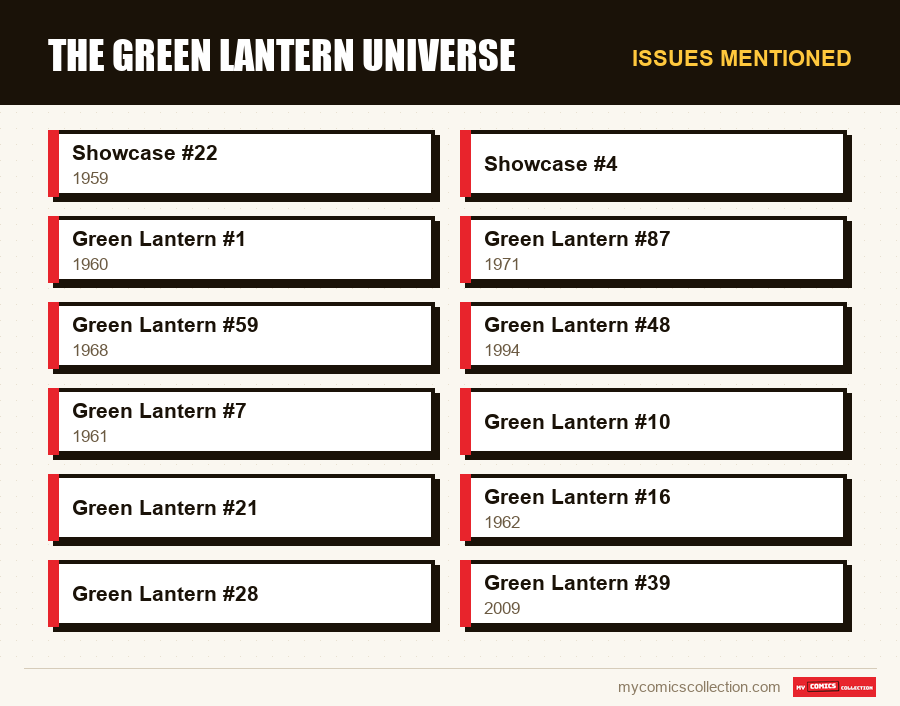
First appearing in Showcase #22 (1959), Hal Jordan is the most iconic Green Lantern. This Silver Age issue is one of DC Comics' most sought-after, alongside Showcase #4 (Flash). Green Lantern #1 (1960) is the other holy grail of the Hal Jordan collection.
John Stewart, Guy Gardner and Kyle Rayner
John Stewart appears in Green Lantern #87 (1971): a number that has risen sharply since the television series. Guy Gardner debuts in Green Lantern #59 (1968). Kyle Rayner, the Lantern of the 90s, arrives in Green Lantern #48 (1994) during the famous “Emerald Twilight” arc.
Cosmic Villains and Antagonists
Sinestro and the Sinestro Corps
Sinestro appears in Green Lantern #7 (1961). Former mentor turned nemesis, he founded the Sinestro Corps in Green Lantern #10 vol.4 (2006). The “Sinestro Corps War” (Green Lantern #21-25, 2007) is a seminal modern arc.
Star Sapphire and other threats
Carol Ferris becomes Star Sapphire in Green Lantern #16 (1962). Atrocitus (Red Lantern) appears in Green Lantern #28 vol.4 (2008), Larfleeze (Agent Orange) in Green Lantern #39 (2009). Each new Corps brings its share of collectible first appearances.
The emotional spectrum: the seven Bodies
Geoff Johns' great innovation was to associate each color with an emotion: Green (Will), Yellow (Fear), Red (Rage), Orange (Greed), Blue (Hope), Indigo (Compassion), Violet (Love). The event Blackest Night (2009-2010) adds the Black Lanterns (Death) and the White Lanterns (Life), creating an event crossover whose key numbers have become essentials.
Spin-off series and related titles
The GL universe includes: Green Lantern Corps (2006-2011, then 2011-2015), Red Lanterns (2011-2015), Larfleeze (2013-2014), Sinestro (2014-2016), Green Lanterns (2016-2018) with Jessica Cruz and Simon Baz. The essential runs remain Green Lantern vol.3 #48-81 (Ron Marz) and Green Lantern vol.4 #1-67 (Geoff Johns).
Collection strategy
Start with the Johns run (2005-2013) for modern mythology, then work your way back to the Silver Ages depending on your budget. The first appearances of the Colored Corps remain accessible. For premium parts, aim for Showcase #22 and GL #87. Consult our guides on Green Lantern key numbers and the editorial history of the title for a complete view.
Ready to organize your Green Lantern by Corps collection? Our app allows you to track every title, every color of the spectrum and every first appearance to methodically build your GL universe.
Timeline of first appearances and numbering pitfalls
The Green Lantern universe spans eight decades. The first appearances cited in this guide, put back in order, give a common thread:
- 1940: Alan Scott, the first Green Lantern.
- 1959: Hal Jordan in Showcase #22.
- 1961: Sinestro in Green Lantern #7.
- 1962: Carol Ferris becomes Star Sapphire in Green Lantern #16.
- 1968: Guy Gardner in Green Lantern #59.
- 1971: John Stewart in Green Lantern #87.
- 1994: Kyle Rayner in Green Lantern #48 ("Emerald Twilight").
- 2006 to 2009: the Sinestro Corps, then Atrocitus (2008) and Larfleeze (2009).
The main pitfall for the collector is numbering by volume. The 1961 Green Lantern #7 (Sinestro) has nothing to do with a "#7" from a later volume. The same goes for volume 4 #10 (2006, founding of the Sinestro Corps), volume 4 #28 (2008, Atrocitus), or #48 meaning Kyle Rayner in volume 3 (1994). Before any purchase, always check the volume and year, not just the issue number.
The colors of the spectrum also read as a collecting grid. Each Corps has a founding moment: Green (Willpower) with Hal Jordan, Yellow (Fear) with Sinestro, Red (Rage) with Atrocitus, Orange (Avarice) with Larfleeze, Violet (Love) with Star Sapphire. The Blue (Hope) and Indigo (Compassion) Corps complete the spectrum, and Blackest Night (2009 and 2010) adds the Black Lanterns (Death) and White Lanterns (Life). Aiming for one first appearance per color is a coherent, achievable project.
For reading, two runs structure the modern catalog: Green Lantern volume 3 #48 to #81 (Ron Marz), which follows Kyle Rayner, and Green Lantern volume 4 #1 to #67 (Geoff Johns), which founds the Corps mythology. Between them, the Sinestro Corps War (Green Lantern #21 to #25, 2007) serves as a pivot.
Finally, a budget tip: the first appearances of the colored Corps remain accessible, whereas Showcase #22 and Green Lantern #87 are premium pieces. Start with the former and save the latter for last.
Frequently asked questions
In Showcase #22 (1959), one of the most sought-after Silver Age issues of DC Comics, alongside Showcase #4 (Flash). Green Lantern #1 (1960) is the other grail of the Hal Jordan collection. Alan Scott, the first Green Lantern, dates from 1940.
John Stewart appears in Green Lantern #87 (1971), Guy Gardner in Green Lantern #59 (1968) and Kyle Rayner in Green Lantern #48 (1994), during the "Emerald Twilight" arc. These are the three entry points for the human Lanterns other than Hal Jordan.
Sinestro appears in Green Lantern #7 (1961). A former mentor turned nemesis, he founds the Sinestro Corps in Green Lantern volume 4 #10 (2006). The Sinestro Corps War (Green Lantern #21 to #25, 2007) is a fundamental modern arc.
Geoff Johns matched each color to an emotion: Green (Willpower), Yellow (Fear), Red (Rage), Orange (Avarice), Blue (Hope), Indigo (Compassion), Violet (Love). Blackest Night (2009-2010) adds the Black Lanterns (Death) and White Lanterns (Life). Each new Corps brings its share of collectible first appearances.
Start with Geoff Johns' run (2005-2013) for the modern mythology, then work back toward the Silver Age depending on your budget. The first appearances of the colored Corps remain accessible. For premium pieces, aim at Showcase #22 and Green Lantern #87.